
Israel Tortured These Activists. Now They’re Speaking Out.
Multiple Gaza flotilla activists describe severe violence and psychological torment while in Israeli detention.
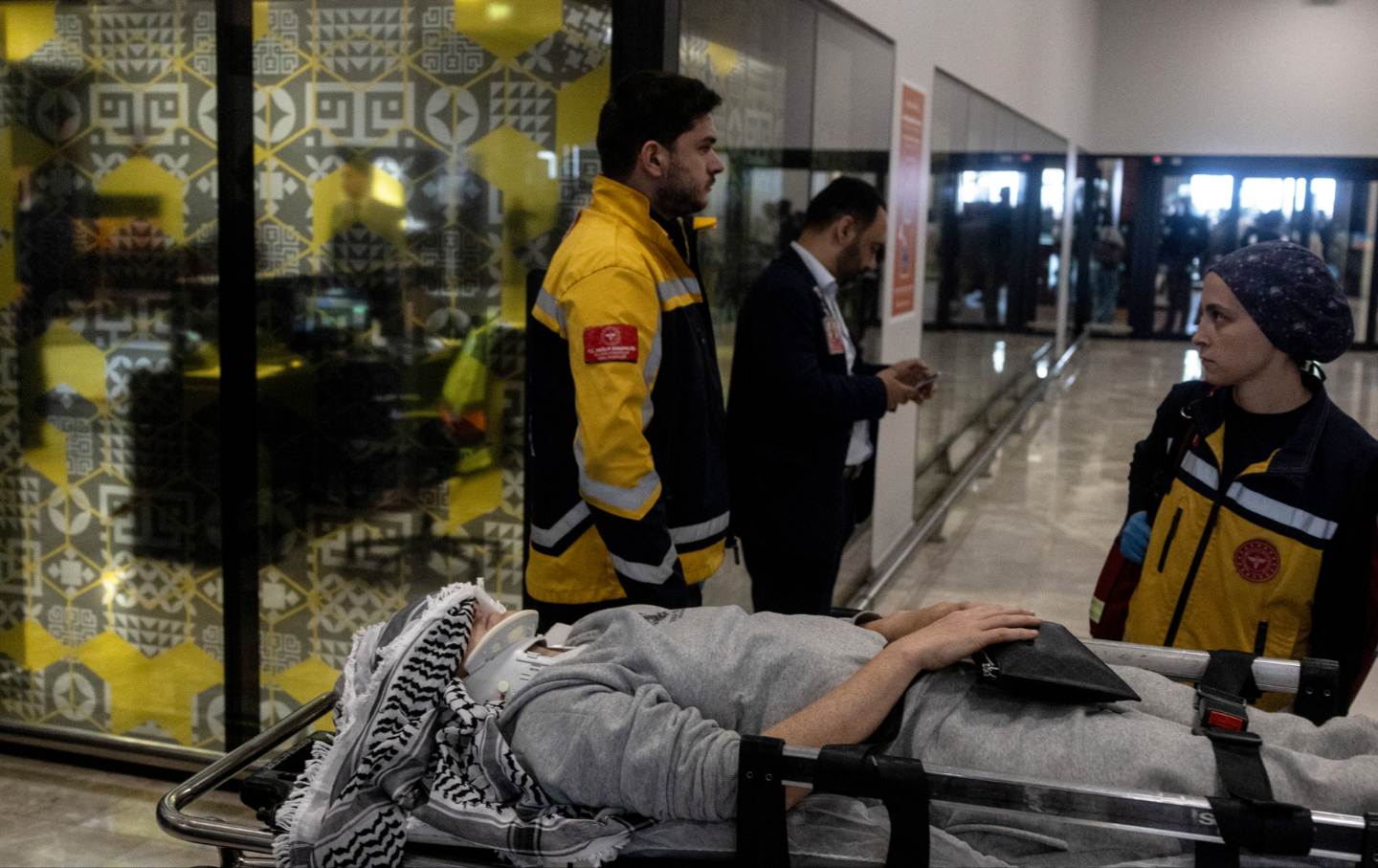
Injured activists from the Gaza-bound Global Sumud Flotilla, detained by Israeli forces after their vessels were intercepted in international waters in the Mediterranean, gather upon arrival at Istanbul Airport on May 21, 2026, in Istanbul, Turkey.
(Burak Kara / Getty Images)As hundreds of activists from the latest voyage of the Freedom Flotilla Coalition (FFC) and Global Sumud Flotilla (GSF) returned to their homes around the world, multiple participants reported that Israeli authorities physically and psychologically abused them in a systematic manner reminiscent of the mistreatment that Palestinian political prisoners are subjected to every day. I spoke with a few of these activists—who had set out to break Israel’s illegal siege on Gaza—and they all described serious injuries inflicted on them by Israeli authorities.
Starting on May 18, Israel intercepted dozens of boats and abducted about 430 activists who were carrying aid to a besieged and starving Gaza, as part of a now decades-long mission started by the FFC. The abductions occurred over two days in international waters, dozens of miles away from the coast of Palestine. Activists were then transported from their boats to Ashdod port in Israel on “prison ships” with makeshift holding areas constructed from shipping containers and barbed wire, without any information on when and where they would arrive. The excruciating journey lasted up to two days.
Cássio Pelegrini, a Brazilian pediatrician who was aboard the GSF boat Hawsha, told me that Israeli authorities beat him until they broke a rib, and then continued to beat him despite his fracture. “They started intercepting us really far from the Palestine coast, so they could have more time to perpetrate the violence, ” Pelegrini told me. “All the violence happens there, in the middle of nowhere, in the middle of the ocean, when nobody is watching.”
Read our previous Gaza flotilla coverage
-
Israel Just Attacked Another Flotilla. But the Movement Will Never Stop.
-
A Reflection on “Objective” Journalism From the Global Sumud Flotilla
-
The Freedom Flotilla Is Sailing Into Its Most Dangerous Waters Yet
-
“They Wanted to Humiliate Us”: Israel’s Abuse of Freedom Flotilla Activists
-
From the Gaza Flotilla: “I’m Here Because My Jewish Heritage Demands It”
Ariadne Telles, also from Brazil, told me that her hands were zip-tied so tight that she fractured her radius bone. Mecid Bağçivan, from Turkey, said that he was shot with a rubber bullet at close range and wound up needing reparative surgery. Amrou Ibrahim, a US citizen who was aboard the FFC boat Adalah, told me they were violently beaten up three separate times while in Israeli custody.
Pelegrini said his vessel was the second to last to be intercepted, about 90 nautical miles away from Gaza. He was then moved to a prison ship that detainees dubbed the “torture boat” (the GSF believes this is the US-built-and-funded naval ship the INS Nahshon). “After a passport check, they took me to a dark container,” Pelegrini told me. “There were five soldiers with flashlights on their heads and lasers. They asked me to sit. They started kicking me and punching me with guns. I felt my rib being broken, and I stood up instinctively. They asked me to sit again and started beating me again really hard, and then they asked me to stand up and pull my pants down, and they poured more water on me, and then they asked me to put my pants back on again, and they threw me inside.”
Pelegrini said that Israeli soldiers poured water on him multiple times to keep him cold in the damp, dark containers of the ship. Many others had their warm clothes taken from them. Everyone was subjected to some level of cruelty. “We tried to sleep to get some rest, but it was a nightmare. There were 188 people divided in three containers. There wasn’t space for everybody, and also with the fractures, we couldn’t find a comfortable position,” he said. Pelegrini and others on board started to take a tally of the incidents that happened on this military vessel alone; they counted 35 fractures, 22 taser injuries on the head and neck, and 10 cases of sexual violence.
“The harder people screamed, the more [the Israeli authorities] enjoyed it, and the harder and longer they beat you. If you didn’t react, they would eventually get bored,” Ibrahim, who was transported to Ashdod port on a second prison ship separate from Pelegrini, told me. “You could hear screams of torture all around you, and everything was meant to break you and degrade you.”
“I have a fracture in my hand, my radius bone, because they zip-tied my hands until it smashed the nerves and broke my bone,” Telles told me. She said she thinks she was treated this way because she protested the violent assault of her comrades. When she saw Itamar Ben-Gvir, Israel’s national security minister, who can be seen taunting flotilla activists in a now widely circulated video, she screamed that he was a terrorist and criminal. “They are very sadistic. They enjoy the violence they are doing to us,” she said. Telles and Pelegrini said that the Israelis were particularly violent with people of color, people from the Global South, Muslims, and anti-Zionist Jews.
After arriving at the Ashdod port, Pelegrini was violently beaten up once more, despite telling his tormentors that he had a broken rib. After being processed by Israeli immigration and transferred to Ketziot prison, where most of the flotilla participants were held, Pelegrini was beaten up again. This time, he said, the beating was not as aggressive, possibly because they were under official custody and more eyes were on the Israeli soldiers. At one point, he was taken in for a “medical evaluation,” but he did not receive care for his broken rib.
Bağçivan, who was also on the Conscience when it was attacked last May, told me he was shot in the leg with a rubber bullet as he tried to shield a friend from being detained. He said that Israeli authorities then proceeded to beat him, despite his open wound. Bağçivan was later taken to Givon prison—the only one of the flotilla activists to be held outside of Ketziot, he believes. He said that the Israelis offered to give him surgery afterwards, but that he refused, worrying what would be done to him under the effects of the general anesthesia while he was separated from everyone. He was left with a two-centimeter-deep hole in his leg, which had to be repaired with two surgeries once he returned to Turkey.
In addition to the physical abuse, Pelegrini told me that he and his comrades were subjected to psychological torment throughout their custody. He said the guards would play the Israeli national anthem over and over again—at one point, he calculated that he’d heard it 72 times. At Ketziot, he was taken into a room and forced to watch a video of an alleged militant “decapitating” someone. “These are your friends, Hamas,” he said the Israeli authorities told him. On a previous mission, abducted flotilla activist Yasemin Acar was similarly forced to watch violent Israeli propaganda videos. Participants were also subjected to sleep deprivation, another method consistent with Israel’s mistreatment of people in their custody,
In press releases, both the FFC and the GSF reported that several of their participants were sexually harassed. Pelegrini believes that people were raped. He said that, while placed in a stress position with his hands zip-tied behind his back and his head on the ground, he began noticing that people were being selected and taken into a room, at which point he then heard Israeli authorities making “moaning” sounds. Participants were also subjected to invasive searches, and Muslim women had their hijabs forcibly removed.
The activists were released and boarded a flight to Turkey by May 21. “It was a miracle that no one died [on the flight] because we had injuries that were very serious,” Telles said. As Malaysia prepares to take Israel to the International Court of Justice over the mistreatment of its citizens, Pelegrini hopes that the Brazilian government—which at the time of our conversation, had yet to reach out to the flotilla participants—will join the case.
Now back in their home countries, the activists spoke to me with a newfound resolve and commitment to the Palestinian cause. “This is something really new to me, the strength that comes out of camaraderie and solidarity. Not even for a moment we doubted that we were doing the right thing, and I didn’t see anyone regretting joining the mission,” Pelegrini told me. “We have so much moral clarity on what we are doing.”
Pelegrini reminded me that the flotilla participants are fighting for the over 1,500 medical workers killed in Gaza, and for the “9,000 Palestinians who were left behind in Israeli dungeons, 400 of them children.” He mentioned Walid Ahmed, a 17-year-old Palestinian boy with Brazilian citizenship who was the first child known to have died in Israeli custody since October 2023; an autopsy showed signs of prolonged malnutrition as the likely cause of his March 2025 death. Pelegrini also referenced Dr. Hussam Abu Safiya, the director of the Kamal Adwan Hospital in North Gaza, who has been in Israeli custody without charge for over 500 days and who, like Pelegrini, has sustained broken ribs after being tortured by Israeli authorities and denied medical care.
Popular
“swipe left below to view more authors”Swipe →“It’s important that we don’t center our experiences too much…. the abuse reflects a broader system of violence and dehumanization that Palestinians are still going through in Israeli prisons and detention centers,” Ibrahim, an Egyptian American activist from New Jersey, told me, highlighting the Palestinian political prisoners Ahmad Sa’adat and Marwan Barghouti who have been held in Israeli detention for decades. “Palestinians endure this without all the media attention, largely in isolation, without any diplomatic intervention or any kind of protection, so you could only imagine what the Israelis are getting away with.”
“Our mission was not to just deliver aid, but to confront the political reality that leaves Palestinians in need of aid, the illegal Israeli occupation and colonization of Palestinian land, and the ongoing denial of fundamental freedoms to Palestinian people,” Ibrahim continued.
Telles ties her involvement with the flotilla to her work as a human rights attorney fighting for the indigenous people of the Amazon against aggressive business interests. “I think we are in the same struggles for land and territory,” Telles told me. She said that people from the Amazon “are invisible to the world” until activists from Europe come to fight alongside them. “Only when people with strong passports face a little bit of this violence, they are noticed,” Telles told me. “It’s the same with the Palestinians…. the Palestinian people today face the most evil and cruel colonization experiment. So I need to be with them in solidarity…because I believe that the future of Gaza is the future of humanity.”
More from The Nation
An Effective Movement for Palestine Needs Allies Like Zohran Mamdani An Effective Movement for Palestine Needs Allies Like Zohran Mamdani
In order to build a broad-based coalition, we need to work together—not practice purity politics.

The First Amendment Applies to Concert Stages Too The First Amendment Applies to Concert Stages Too
Protests like that of Macklemore on Palestine should never be silenced by billionaire owners.
France’s Students Won’t Back Down France’s Students Won’t Back Down
Without full-time teachers, temperature-regulated classrooms, or school nurses, French students are turning their grievances into a national movement.

Inside Cornell’s Week of Protest Inside Cornell’s Week of Protest
“We won’t be silenced anymore. Our university needs to start protecting us, like they should’ve with Jane Doe and all other survivors on campus.”
Netanyahu Came to New York. New Yorkers Were Ready for Him. Netanyahu Came to New York. New Yorkers Were Ready for Him.
Scenes from the defiant protest against the genocidal leader’s UN speech.
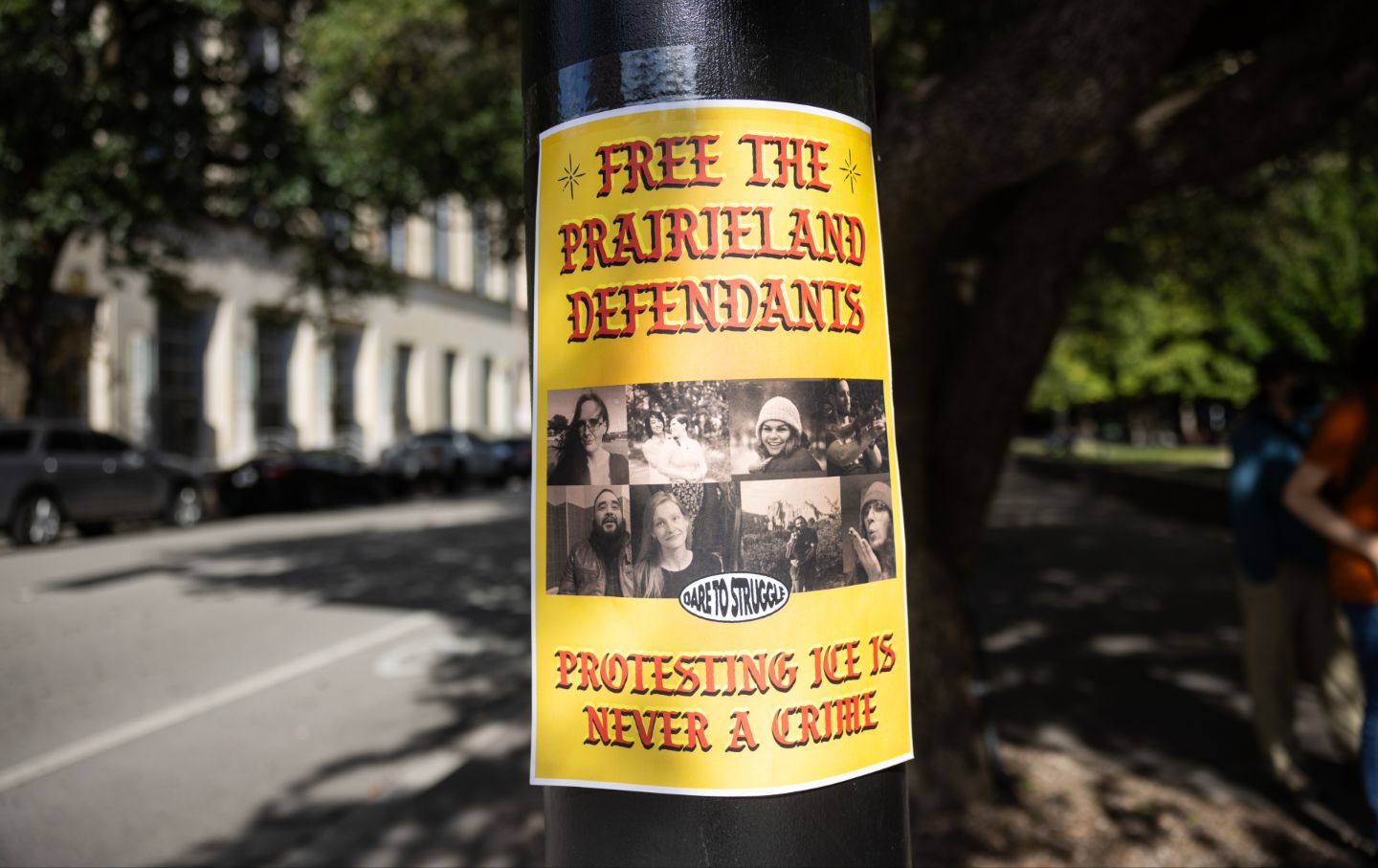
A Message From Prairieland Prisoner Autumn Hill: “Don’t Be Afraid” A Message From Prairieland Prisoner Autumn Hill: “Don’t Be Afraid”
I talked to the political prisoner about the politics of love, her case, surviving as a trans woman in a men’s prison, and how she makes it through the day.

