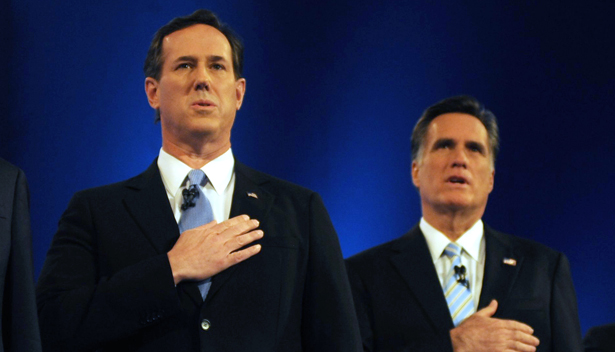
U.S. Republican presidential candidates Rick Santorum and Mitt Romney stand for the National Anthem before the start of the Republican presidential debate in Mesa, Arizona, February 22, 2012. REUTERS/Laura Segall
The appeal of any presidential candidate, argued Richard Nixon’s speechwriter Raymond Price, is based on a “gut reaction, unarticulated, non-analytical, a product of the particular chemistry between the voter and the image of the candidate…. [It’s] not what’s there that counts, it’s what’s projected.”
Every time the Republican Party checks its gut about its presidential front-runner, Mitt Romney, it has a severe intestinal response. He is projected as the former venture capitalist and future CEO of America Inc.: the man who will use the know-how he developed turning companies around to turn the country around and get it back to work.
For a party that has been railing against the encroaching socialism imposed by the current administration, you would think at least this aspect of his biography would appeal. True, Romney may have taken the shuttle to Damascus and back on issues like abortion, healthcare and climate change. His lack of conviction and consistency on social issues might turn off social conservatives. But his business experience was supposed to be an asset, not a liability.
It turns out, however, that while the GOP base loves capitalism it is not so keen on capitalists—or at least not those of Romney’s ilk. His hold on the party has been precarious, in no small part because he perches on the fault line between the party’s corporate sponsors and its white, working-class base; between the capitalism that is extolled and the capitalism that is experienced. Like a meat-eater in an abattoir, when they are confronted with the process head-on, it makes them gag.
Romney’s problem in this regard is twofold. First, there is the way he made his money, as a venture capitalist. Unlike Herman Cain, who at least produced pizzas, Romney didn’t make anything. He bought companies, restructured them and then sold them. He was not a producer but a financier. Although it’s widely recognized that free market capitalism cannot operate without financiers, their parasitical nature holds little popular appeal.
“Darling, Daddy doesn’t build roads or hospitals and he doesn’t help build them,” says Judy McCoy in Bonfire of the Vanities, explaining her husband’s bond-trading job to their daughter. “But he does handle the bonds for the people who raise the money…. Just imagine that a bond is a slice of cake, and you didn’t bake that cake, but every time you hand somebody a slice of the cake a tiny little bit comes off, like a little crumb, and you can keep that.” As a venture capitalist, Romney bought cakes cheap, sliced them up, sold off the chunks for a profit and kept a huge slice for himself. Notwithstanding party affiliation, a substantial section of the GOP electorate identifies more with the baker than the slicer.
Popular
"swipe left below to view more authors"Swipe →
Part of the populist appeal of the Tea Party was that, even as it did the corporations’ bidding, it railed against Wall Street in general and the bailouts in particular. A 2009 New York Times poll showed more than half concerned that someone in their household would be out of a job in the next year. Romney is keen to make common cause with them. In his Super Tuesday “victory” speech he described the jobless rate as an “inconvenient statistic” for the White House. “But those numbers are more than data on a spreadsheet; they are worried families and anxious faces,” he said. “And tonight, I’d like to say to each of them: You are not forgotten.”
But it was precisely by treating people as data on a spreadsheet that he made his money at Bain Capital. Little wonder that among the key Reagan Democrat demographic of white, noncollege-educated men earning less than $50,000 he trails his opponents. As Mike Huckabee observed in 2008, “People would rather elect a president who reminds them of the guy they work with, not the guy who laid them off.”
Which brings us to the second problem. Politics at the presidential level is in no small part performance, one that Romney plays very badly. He attracts hostility not because he’s wealthy—that never hurt George W. Bush—but because he acts wealthy at a moment of economic crisis and in a manner that makes people think he has no idea how ordinary people live. While Romney was talking about his wife’s Cadillacs and saying he likes “being able to fire people” for bad service, Santorum was telling a rally in Lansing during the Michigan primaries that he will stand up for the “little man.” One small business owner there explained, “I get the feeling [Romney’s] more for big business. I love NASCAR and he has friends who own NASCAR teams, and it’s difficult to relate to that.”
Santorum, conversely, comes across as “a guy that can go into a union hall and at least make eye contact with a hard-core Democrat, remind them that their father voted for Ronald Reagan,” as Ed Kasputis, a former Republican state legislator in Ohio, told the Times. Santorum has had his own stumbles on issues of class. In February he said, “There is income inequality in America. There always has been and, hopefully…there always will be.” But he still looks better than Romney.
This is what makes widespread claims of class warfare in the GOP overblown. Class confusion, certainly, and class realignment, possibly. But warfare? Hardly, given that the candidates are ultimately all on the same side and working for the same interests.
What there is, though, is a frustrated aspiration for class-based politics that has no home in America’s electoral politics and so finds its outlet in cultural grievance and social resentment. The result is as unfulfilling as the simulated steak that the character Cypher savors in the movie The Matrix. “You know, I know this steak doesn’t exist,” he says, holding a morsel to his lips. “I know that when I put it in my mouth, the Matrix is telling my brain that it is juicy and delicious. After nine years, you know what I realize? Ignorance is bliss.” It’s hard to trust your gut on an empty stomach.

