
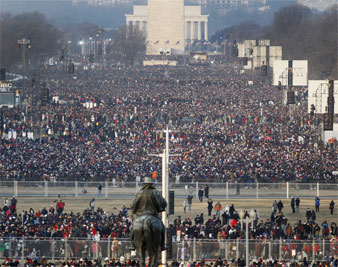
 AP ImagesWitnessing history on the Mall.
As the Obama presidency unfolds, our new weekly column will chronicle how the promise of change meets the reality of Washington, DC. –The Editors
Three hours before Barack Hussein Obama took the oath of office to become the nation’s first African-American president, the crowd already looked impossible. Gazing west from the Capitol, you could see them: an incomprehensible mass of peaceful citizens, overwhelming every monument, impediment and security banner that had been put up to contain them. The sight was so arresting that when the senators marched out onto the rostrum, Patrick Leahy and Orrin Hatch stopped to snap photos.
My first thought, as I took in the sight from the press stand, was that I wanted them all to stay.
I’d felt the same way on Sunday listening to 89-year-old Pete Seeger sing Woody Guthrie’s oft-omitted verses to “This Land Is Your Land” on the steps of the Lincoln Memorial. “In the squares of the city,” he sang to the half-million who’d assembled, “by the shadow of the steeple, by the relief office–I saw my people.”
I saw my people. It’s been a long time since a lot of people in this country felt like their government saw them. “My parents were texting me these heart-wrenching messages,” a friend, the son of Muslim immigrants, told me. “They feel like they’ve been welcomed back into the embrace of the American body politic.” Most of the time–in fact, pretty much all the time–that “embrace” is an abstraction. In a nation of 300 million, we end up outsourcing so much of our citizenship to professionals–the organizations we write checks to and the politicians we elect–that we’re left with no way to experience the simple thrill of solidarity.
Which is a large part of why I wanted the crowd to stay. But it was also because after these eight long years, Washington needs more than new blood; it needs transfusions by the pint. There are changes afoot, of course, but DC’s hierarchies of power are so embedded it will require more than a few thousand new staffers to dislodge them.
Case in point: in the weeks before the inauguration, an energetic trade in inaugural tickets arose, and the economy of power and influence through which they were distributed was a perfect microcosm of How Things Work here. The process was murky (how Don King and the Tuskegee Airmen ended up within a few yards of each other is anyone’s guess), but presumably it was based on nothing more than the routine traffic of favors and clout. This is a city characterized by a million ceaseless nonviolent battles for scarce resources: face time with senators, line items in the stimulus, tickets to a black-tie ball. And these battles reinscribe themselves, fractal-like, down to the most minute item: politicians campaign for office, their staff jockeys for jobs within the administration, staffers fight for office space closest to their bosses and, as one inaugural committee staffer relayed to me, volunteers battled fiercely for promotion from simple volunteer to the elevated status of “volunteer captain.”
Popular
"swipe left below to view more authors"Swipe →
This won’t change with Obama as president or the Democrats in power. Hierarchies will define the new Washington as surely as they did the old. But the central theme of Obama’s campaign, what provided its form and its content, was the ability of a self-governing polity to overwhelm these hierarchies, to wrest power from the people standing behind the rope line and pass it into the hands of those crowded outside.
In his speech–which was somber, subdued and, like everything about the day, dwarfed by the sheer magnitude of the crowd and the weight of the moment–Obama referred to the imperative of democratic engagement as the “price and promise of citizenship.”
Hundreds of thousands of people fulfilled that promise for the first time in their lives in this past campaign, and many of them were on the National Mall to soak it in. Tamara Stevens, a Republican for Obama volunteer from the Atlanta suburbs, had driven up in a van along with four of her fellow volunteers, people who had been strangers before the campaign. “He’s the one that brought us together,” she said to me, describing the bond they’ve formed. “It’s up to us to stay together.”
I wish Tamara and her group could have stayed–not just to watch Obama take the oath of office or to get gussied up and attend the balls but for the rest of the week, the whole first hundred days, the entire four years of the administration. Set up shop: take up residence on the Mall in tents, along with millions of others in a modern-day bonus army of citizens. That’s a fantasy, of course. But that a crowd like this could be assembled suggests it could be assembled again, and I hope every lobbyist and staffer and hack, every member of our elected government, especially President Obama, remembers that every single day for the next four years.
The problem is that it’s going to be very easy to forget. Outside of storming the city, the mechanisms by which citizens exert influence over their government are decayed. If they weren’t, there’s no way Rahm Emanuel could have spent much of his time on Charlie Rose the week before the inauguration bragging about how forcefully and seamlessly the new administration had lobbied Congress to fork over–against the will of a large majority of Americans–another $350 billion to banks with little more than a handshake and a promise.
The defining question of the Obama era is whether that crowd figures out a way to organize itself, force its way past the checkpoints and security guards and bouncers, and make its demands known. Or whether the people who enforce the boundaries of the establishment, the ones who give out the tickets and draw up the seating charts, are able to act like the whole thing never happened.

