The Ridiculous Spectacle of Trump’s Meeting With Xi and Putin
The Shenzhen “summit” was a charade intended to generate handshake-and-hug memes rather than binding international agreements.
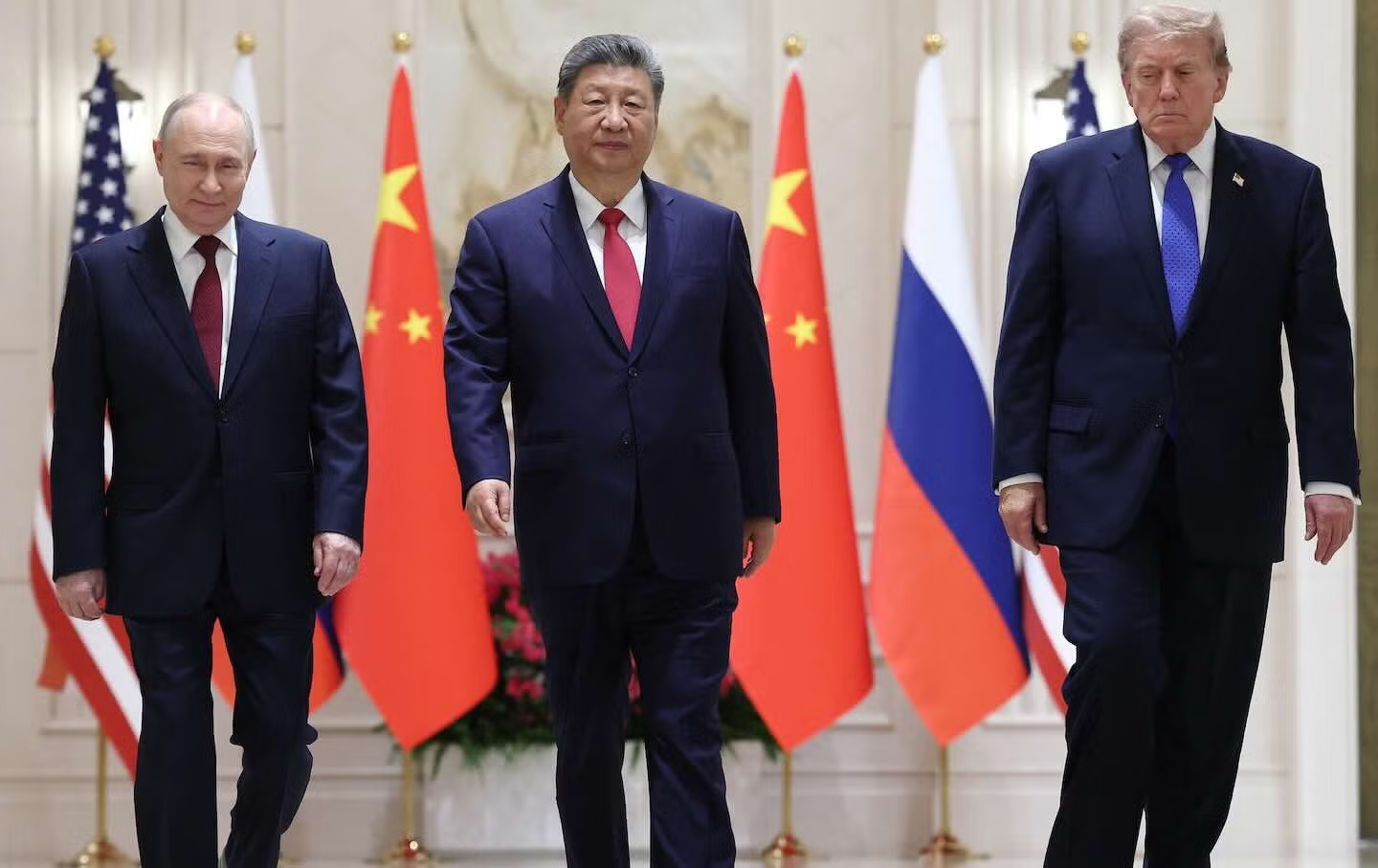
What does a would-be-autocrat who craves public adoration do when he suffers a once-in-a-century electoral revolt? Well, in the case of Donald Trump, he hightails it to Shenzhen, China, to meet with Russian President Vladimir Putin and Chinese President Xi Jinping and shower them in effusive praise, in anticipation that they will return the compliments. And he teases the possibility of a meeting with North Korea leader Kim Jung Un, which ultimately doesn’t “work out.”
There is something peculiarly repulsive about the images of Trump’s oh-so-very-important meeting with Xi and Putin. We see an increasingly senescent man-child looking to play with the big boys, with Putin smirking next to him and Xi stone-faced. We are forced to bear witness to Trump casually throwing away whatever shreds were left of America’s claim to marshal, in some way, the forces of the “free world” in defense of democratic values. Instead, we see this politically emasculated 80-year-old man bending over backward to fluff the egos of the genuine autocrats whose company he so clearly prefers to that of the leaders of the world’s great democracies.
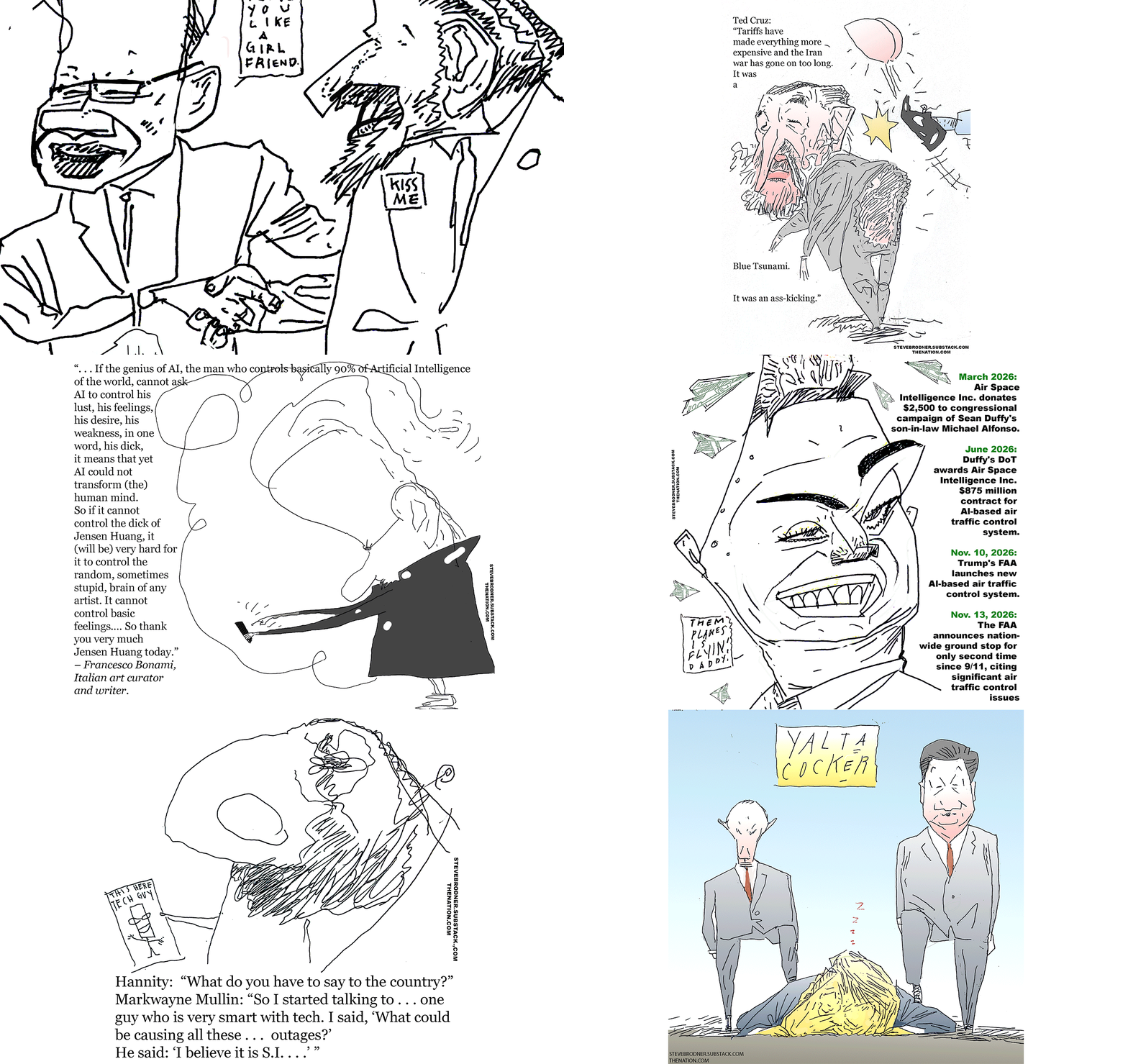
This ridiculous spectacle was marketed, however improbably, as another Yalta, when the Big Three—Franklin D. Roosevelt, Winston Churchill, and Joseph Stalin—sat down in the Crimea in early 1945 to divvy up spheres of influence in a postwar era. For Putin, whose forces were readying yet another a powerful drone and missile barrage against Ukraine, Shenzhen was a chance to explain his view of the endgame of the war. He said at the meeting, “Nobody divided up the world at Yalta. It simply codified the realities that had emerged after World War II. And when it comes to today’s conflicts, the realities on the ground will have to be accepted.” In other words, “you don’t have to like what’s going on in Ukraine, but you’re going to have to suck it up.”
For Trump, the meeting was a chance to rail, once again, against the International Criminal Court and its work on holding accountable out-of-control, violent leaders and warlords.
In reality, of course, Shenzhen in 2026 simply isn’t Yalta in 1945. Not by any stretch of the imagination. For one thing, last I looked, and Trump’s preferences notwithstanding, Russia, China, and the US aren’t brothers-in-arms, marching lockstep for years in a global fight against fascism. For another, far from 2026 being a moment of incipient triumph for the three world leaders, these days Russia is bogged down in Ukraine, and has lost a staggering number of soldiers; the US is bogged down in Iran, and the Iranians retain the ability to inflict huge economic damage on the world through sowing chaos in the Strait of Hormuz; and China, while increasingly asserting its own sphere of influence, is stumbling from one economic hit to the next as bubbles start to burst, ranging from real estate to artificial intelligence.
Yalta was about restoring an international power balance at the end of a long conflict; Shenzhen occurred as international chaos and conflict are on the upswing, in large part because of the actions of Trump and of Putin. If any historical comparison could be made, this was far more akin to the Hitler-Mussolini meetings in the run-up to war than it was to the get-together in the Crimea.
So what exactly was the point, beyond apparently giving America’s stamp of approval to Putin’s ongoing war, and providing him a tonic by having the US president publicly label him a “friend”? There were no concrete proposals on the table that could substantively benefit the world. Rather, this was simply a way for Trump to show the world—that ungrateful place that has, multiple times, rebuffed his efforts to secure a Nobel Peace Prize—that he still has influential friends in high places.
That was the long and short of it. There were no specifics, no nuclear disarmament or control treaties put on the table to replace those that have recently expired—though there were some milquetoast comments by the three that nuclear war ought to be considered an impossibility. There were no binding agreements to rein in AI, no effort to really end the wars in Ukraine and Iran. In short, this simply wasn’t a genuine reset moment. Rather, it was a simulacrum, a “summit”—with the air quotes detailing the fantasy quality of the event—intended to generate handshake-and-hug memes rather than binding international agreements.
It was a charade, and America’s historic allies recognized it as such. As Trump was sweet-talking Putin and Xi, European leaders were heading to a meeting in Berlin to chart the way forward in Ukraine. Not surprisingly, they viewed the Shenzhen “summit” with particular dismay. Jeremy Hunt, the UK’s foreign secretary under Prime Minister Theresa May in 2018–19, immediately concluded that America “is no longer leader of the free world.” French Foreign Minister Jean-Noël Barrot dismissed it, pointing out that nothing constructive would emerge. German Chancellor Friedrich Merz said it was simply a photo op.
None of this mattered to Trump. He had been swaddled in warmth and appreciation by two of the world’s Quality Autocrats, genuine OGs, and it felt damn good. It felt like relief from all the bad news stateside, from cascading technology-related crises, to a swooning stock market, to reports that the incoming Democratic congressional majority is planning an array of investigations into his corrupt administration. America’s man-child leader could fly home happy, knowing he had had a satisfying playdate with two of the most powerful dudes on the schoolyard.