
Birth Wars
How one of America’s most common labor interventions became so contentious.

Liz Lucking was 37 weeks pregnant when she arrived at her ob-gyn’s office in New Jersey for a prenatal visit in February 2025, expecting to be back home an hour or two later. But when a nurse took her blood pressure, it was high. By that afternoon, Liz had received a diagnosis of gestational hypertension, which can be life-threatening. Her doctors said the safest option would be to induce her labor.
Liz and her wife, Christine Malanga, were excited about the prospect of meeting their baby sooner than anticipated. Two of their friends had recently had successful inductions: They’d delivered vaginally and felt the process had gone smoothly. “We were completely unconcerned,” Liz recalled. “We were like, ‘Cool!’” Christine added. “‘Let’s go meet our baby.’”
More than three days later, they did: a healthy boy, just shy of seven pounds, delivered by C-section. But shortly after the surgery, Christine noticed that something was off. Liz looked ghastly; the monitor showed her blood pressure dropping. Suddenly, she started bleeding—a lot. Christine described a “wave” pouring out of her. Liz’s doctors were forced to take her back to the operating room, where they performed a lifesaving hysterectomy—a rare, last-resort response to postpartum hemorrhage, which is a leading cause of maternal morbidity and mortality in the United States. Liz, 36, woke up without her uterus.
The couple has since struggled to make sense of that devastating outcome. They hadn’t known what to expect going into the process, but it certainly wasn’t this: a days-long labor, during which nurses and doctors filtered in and out but seemed pressed for time and unavailable for questions. “I felt like a burden, not like an active participant in my own labor,” Liz said. “It was very much a case of ‘This is what’s being done to you,’ as opposed to ‘These are your options; these are the risks you should consider.’”
As they recovered, Liz and Christine couldn’t shake the sense that what had happened wasn’t just bad luck, but the result of how Liz’s labor was managed. But three law firms told them they didn’t have a case. One said the care had been “bad, but not so bad as to fall below the standard of care”—the core threshold for proving medical malpractice. It’s difficult, the lawyer explained, to isolate a single cause of a postpartum hemorrhage. Birth is unpredictable; some women will simply bleed heavily without any known risk factors, for reasons we don’t fully understand.
Liz realized she wouldn’t be able to find closure in a court settlement. But other questions lingered: Was her induction managed the way it was supposed to be? Who even sets those standards, and who ensures they are upheld?

It’s not surprising that liz and Christine arrived eagerly at the hospital, expecting a routine procedure. In the United States, more than one-third of pregnant women, and by some estimates nearly 40 percent of first-time moms, have their labors induced. That’s a more than threefold increase since 1989, when just 10 percent were induced, and a sharp rise from 2016, when the practice accounted for around 25 percent of births. The trend stems from a changing patient population—pregnant patients today are older and more likely to suffer from conditions like high blood pressure or diabetes than they were in the 1980s—and evolving obstetric practice, which has increasingly embraced induction at 39 weeks, based on evidence suggesting that it can lower the risk of needing a C-section. Additionally, limited access to obstetric care, especially in rural America, has likely made more providers and patients opt for induction, which allows them to schedule labor rather than risk being hours from a hospital when it begins; one-third of US counties lack an obstetric clinician or birthing facility.
But despite becoming a fixture of American delivery and labor wards, induction—from what justifies doing one to how it’s managed—remains a subject of debate in obstetrics. Part of this is rooted in a split that’s racked the profession since its founding: To what degree should providers intervene in labor, or should they trust the body to do its own thing?
“When you talk about induction of labor, you can’t talk about it as one thing, because all inductions are not the same,” said Dr. Emiliano Chavira, a high-risk obstetrician practicing in Los Angeles. “The outcome depends heavily on who’s doing it,” and where. One reason for this is the lack of a conclusive evidence base in the research, which leaves room for decisions to be made based on the opinion of the provider or on hospital culture; it’s notoriously challenging to conduct clinical trials on pregnant women. Sometimes, though, individual preference takes precedence even when the science is settled. This duality has pushed one of America’s most common childbirth interventions into a fraught gray area.
At the same time, more patients are turning to platforms like TikTok and Instagram for information about birth and to air grievances about their experiences. This honest dialogue is being steered by predatory algorithms that amplify extremes and capitalize on the rising anti-science sentiment that defines our political moment.
The result is that having a baby today feels simultaneously more informed and more confusing than ever. Nowhere is this clearer than in the rise of “free birth,” a radical trend to opt out of medical care entirely during childbirth and, in some cases, pregnancy. Thanks to the echo chamber of social media, the trend has become a movement, particularly adept at attracting those who have had negative encounters with the health system or who feel they underwent procedures they didn’t need, from inductions to C-sections. But there is a legitimate reckoning to be had about improving birth outcomes and experiences—one that shouldn’t force patients to choose between misinformation on the one hand, or to accept a flawed system on the other.

On the third day of Liz’s induction, a new nurse, Lisa (a pseudonym, to protect her from professional retaliation), began her shift. Looking at Liz’s chart, Lisa was immediately concerned. “So many things did not feel set up for success for Liz,” she said.
When Liz was checked into the hospital, her cervix was closed and her baby was high up. That’s not unusual; she was three weeks from her due date, and most patients who undergo an induction aren’t physiologically ready for labor—that’s kind of the point. During an induction, providers use a variety of techniques to soften and open the cervix (a process called “cervical ripening”) and instigate uterine contractions to increase the chances of a vaginal delivery.
Liz received one dose of a cervical-ripening drug a few hours before she was started on Pitocin, a synthetic version of the hormone oxytocin, which facilitates childbirth by making the uterus contract. It’s not uncommon for a patient to require several attempts to open the cervix, and the process can span a day or more. Sometimes, this alone can kick-start labor. If not, providers will then typically administer Pitocin, which is highly effective at advancing stalled labor. But doing so prior to adequate cervical ripening essentially forces contractions before the body is ready, which can make complications more likely. (Morristown Medical Center, where Liz gave birth, did not respond to multiple requests for comment about its induction protocols and Liz’s case.)
When Lisa arrived at Liz’s bedside, she found an exhausted, bed-bound patient, with contractions putting pressure on a baby that wasn’t ready to move—a situation she likened to trying to “squeeze a square through a circle.” Lisa tried to reposition the baby, but worried that it was too late.
As Liz continued to labor, her baby showed signs of distress, and the team decided that a C-section was necessary. Lisa agreed but was concerned that the conditions of Liz’s labor made it more likely that the surgery would lead to heavy bleeding. In an exchange documented in Liz’s medical records, Lisa expressed her apprehension to the doctor and asked if she should prepare antihemorrhagic medication as they prepared to move to the OR. The doctor declined.
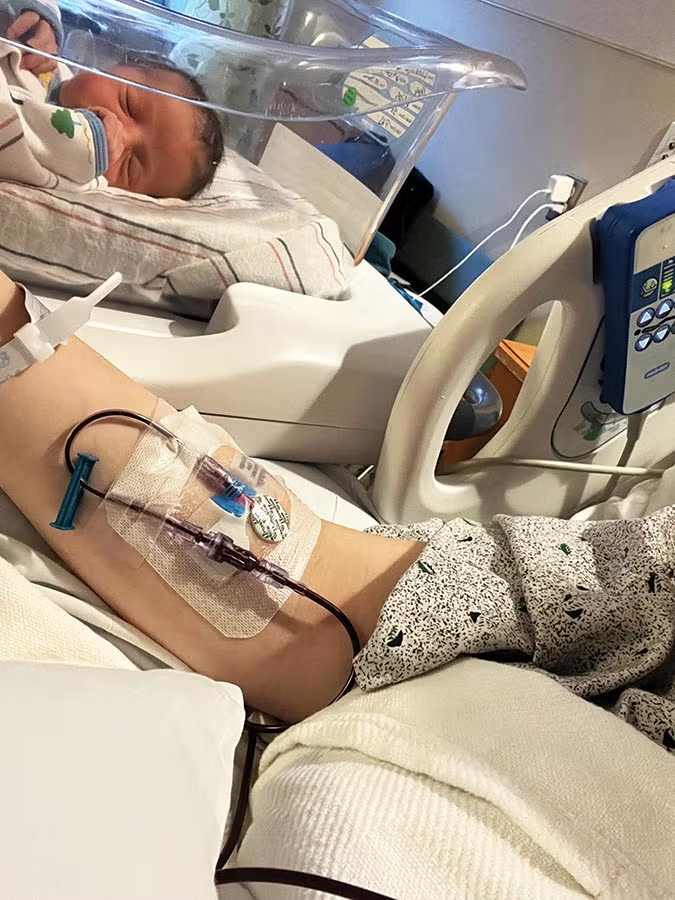
Until relatively recently, providers believed that induction tended to increase the risk that a patient would require a C-section and should be reserved for medical necessity. The prevalence of induction climbed steadily in the 1990s, but the practice spiked sharply after a 2018 study upended that assumption: the ARRIVE trial.
ARRIVE (A Randomized Trial of Induction Versus Expectant Management) found that low-risk, healthy first-time moms induced at 39 weeks were less likely to have C-sections and develop hypertensive disorders like preeclampsia. The trial was immediately embraced by the American College of Obstetricians and Gynecologists (ACOG) and the Society for Maternal-Fetal Medicine, and clinical practice followed suit. One study from the Northwest United States found that “elective” inductions jumped 42 percent soon after ARRIVE was published.
It was not surprising that ARRIVE rapidly transformed clinical practice: The study had a lot going for it. It was a multicenter randomized trial—the gold standard of scientific research—in a field where much of the evidence is observational. It also landed at a moment when the use of C-sections, especially among first-time moms, was in the spotlight as a growing public-health concern. While they are lifesaving when medically necessary, C-sections are a major, costly surgery that can expose mothers and babies to serious health risks and affect future pregnancies. In 2018, one-third of US births were C-sections, up from 22.9 percent in 2000; Black patients are far more likely to receive unnecessary C-sections than white patients.
But ARRIVE was also divisive. Unlike ACOG and the Society for Maternal-Fetal Medicine, the American College of Nurse-Midwives urged caution and continued to discourage elective induction; the Association of Women’s Health, Obstetric and Neonatal Nurses (AWHONN) characterized the trial as having found “no harm in waiting for spontaneous labor.”
Midwives in particular saw a trend: Medical interventions adopted in lieu of making systemic changes to obstetric care in the US. “There’s a sea of evidence showing that integrating midwifery into the healthcare system decreases C-section rates,” said Jessica Brumley, a certified nurse-midwife and former president of the American College of Nurse-Midwives. But investing in that workforce, she added, takes time. “Providers are looking at the short term versus the long term, and induction feels like an easier intervention. We are very ready to adopt interventions that are convenient for us.”
Indeed, critics feared that providers would seize on ARRIVE for convenience—putting birth on the calendar rather than adapting to its inherent unpredictability. And they questioned whether, in the real world, induction would actually improve the chances of vaginal delivery. Most hospitals in the study were academic centers, and the patients participating in the ARRIVE trial—including those not induced at 39 weeks—had C-sections at far lower rates than the national average.
“When you’re in a randomized controlled trial like this, run by an efficient network, the study nurses were going to make very sure that clinical guidelines were followed, that people weren’t doing unnecessary cesarean births,” explained Dr. Elizabeth Langen, a high-risk obstetrician and researcher at the University of Michigan. In 2024, she published a large study to test ARRIVE’s real-world impact and found an opposite relationship: At Michigan hospitals, low-risk induced patients had C-sections more often than those who waited for labor to begin; they were also more likely to have a postpartum hemorrhage. Additional research has echoed Langen’s findings, while other studies have shown that C-section rates fell modestly after ARRIVE.
ACOG specifies how many hours of stalled labor must pass before it is medically appropriate to move to a C-section, at which point the induction has “failed.” In her research, Dr. Langen noted systematic deviation from these guidelines. When patients are not given adequate time to progress in labor, she said, “you’re calling the cesarean too early and not really giving someone a chance to see if they could deliver vaginally.”
State-level efforts to improve birth outcomes have shown similar results. When Dr. Ann Borders, the executive director and obstetric lead of the Illinois Perinatal Quality Collaborative, began work across 68 Illinois hospitals in 2021, fewer than half had standardized protocols for induction, and only a third of the inductions that were deemed “failed” met professional guidelines (the initiative studied deliveries as of 2019). Inductions, Dr. Borders said, take more time than spontaneous births, creating “nurse staffing issues” that “really put pressure on the unit.”
There’s another factor that can make the management of labor so difficult, explained Dr. Christina Davidson, the chief medical officer of ACOG: fundamental blind spots in our knowledge of the mechanisms of birth. “We still don’t know what really contributes physiologically to a woman going into labor spontaneously,” she said. These gaps can make for an ever-shifting understanding of labor itself. Dr. Davidson gave the example of active labor (when contractions intensify to fully open the cervix), which was previously thought to begin at four centimeters of cervical dilation and was later revised to six centimeters. Even within those gray areas, she said, there’s a lack of precision: Practitioners typically use their fingers to measure “how much the cervix has opened,” and one person’s four centimeters might be another person’s six.
While professional guidelines establish a minimum amount of time before an induction “fails,” they do not set an upward limit for how long one can go. Yet there’s growing evidence that risks compound as an induction drags on.
When Liz’s doctors opened her up again after her C-section, her uterus was soft and boggy, like a plastic bag. During labor, each contraction helps push the baby down. After the birth, contractions continue, expelling the placenta and clamping down on blood vessels in the uterus. Sometimes, though—after a long labor, for example, or extended exposure to Pitocin—the uterus fails to contract effectively, and the many arteries that helped support the fetus and placenta are left to bleed. The condition, uterine atony, is responsible for 70 to 80 percent of postpartum hemorrhages, a complication that, in the United States, has increased dramatically: from 2.7 percent of delivery hospitalizations in 2000 to 4.3 percent in 2019, a rise of nearly 60 percent, according to one estimate. Researchers have yet to explain the rise at the population level.
At the start of any labor, it’s standard for a care team to assess a patient’s risk profile for postpartum hemorrhage. And while it’s best practice to update that assessment as labor evolves, another nurse I interviewed who works in maternal-fetal medicine said that doesn’t happen systematically. But Lisa, Liz’s nurse, thought it was obvious that Liz’s risk had grown, because she had been on a Pitocin drip for nearly 30 hours—in Lisa’s mind, an immediate red flag.
While it would be ethically challenging to conduct randomized trials to establish a causal link between Pitocin exposure and postpartum hemorrhage, several observational studies show a strong association between the two—some after 12 hours, and some after just seven. Other research disputes the relationship. Further complicating matters, every patient responds differently to Pitocin, for reasons scientists are still working to understand.
For its part, ACOG cites “prolonged use of oxytocin” as a risk factor for postpartum hemorrhage. “Unequivocally, the longer a patient is exposed to Pitocin, the greater their risk of a postpartum hemorrhage,” said Dr. Luke Burns, a Chicago-based high-risk obstetrician, noting that in most cases additional factors—such as a long labor, a large baby, or an amniotic sac that’s been broken for many hours—compound that risk. “Pitocin makes the uterus contract over and over and over again. The uterus is a muscle, and a muscle that gets tired cannot constrict immediately postpartum. That’s how we end up with a postpartum hemorrhage.” Somewhat counterintuitively, Pitocin is also a first-line treatment to stop a hemorrhage once it’s begun, but if a patient has been exposed for hours during labor, their body can become less responsive when they need it most, requiring providers to use secondary measures. When those don’t work, hysterectomy becomes the only way to save the patient’s life. That’s partly why cervical ripening and other strategies to limit an induction’s duration matter; they can reduce the time a patient is exposed to Pitocin.
To that end, researchers at the Obstetrics Initiative, a statewide effort through the University of Michigan to improve maternal-health outcomes, identified two strategies that have been proven to reduce the duration of an induction, beginning with thorough cervical ripening and breaking a patient’s water early in the process. Yet, the program found, fewer than 10 percent of inductions at more than 60 hospitals in the state utilized both; overall, inductions tended to run longer than those included in the published studies, especially in first-time births—more than a quarter exceeded 30 hours. I asked Dr. Michelle Moniz, the Obstetrics Initiative’s program director, about the tension between an induction that’s ended too soon and one that goes too long. “In medicine, we are often living in a gray zone where we don’t have a black-and-white answer,” she said. What’s clear, however, is that “the longer an induction lasts, we start to see a rise in risk of various complications.” And while a C-section alone can cause heavy bleeding, doing one after a multi-day induction heightens that risk.
The Obstetrics Initiative recommends that when inductions exceed 48 hours, providers engage in “shared decision-making on the risks of ongoing [Pitocin] versus cesarean,” discussing each with the patient.
Nearly two years after her son’s birth, Liz wishes she’d had that chance. Instead, she believes that her providers had a singular goal: to avoid a C-section until it was an emergency. In fact, she said, the hospital’s head obstetrician told her as much in a debriefing: that doctors were letting inductions go longer, under pressure to reduce their cesarean rate.
Liz, too, had wanted a vaginal delivery. But having a better understanding of the stakes might have changed her assessment. “If someone had floated the possibility of a C-section at an earlier time, and explained the risks of waiting longer,” she said, “it would have been an absolute no-brainer.”
Some providers even wonder whether the push to reduce unnecessary cesareans has led to longer labors and inductions, with consequences we have yet to quantify. “In the Pacific Northwest, we are definitely trending more towards giving more time,” said Dr. Jennifer Lincoln, an obstetrician in Portland, Oregon. “And then you start to wonder, ‘Are we causing more harm? Is this leading to more infection and bleeding?’”

Liz hadn’t known of Pitocin before her induction, but looking back through her medical records, the drug kept popping up. One day, she was chatting with a friend about what she’d found—how much she’d been given and for how long—when her friend’s eyes got big. “She was like, ‘Oh my God, that’s a really high dose.’”
Liz began spiraling, and what she found online didn’t allay her concerns. Pitocin has featured prominently in recent malpractice cases, typically when it’s administered incorrectly and causes excessive contractions that stress the fetus. It has also emerged as a bogeyman in online birth spaces; providers noted that they’ve increasingly encountered fearful patients who refuse the drug, sometimes interfering with medically necessary care. In obstetrics, too, it has become polarizing.
Nowhere is this battle clearer than in the gap between the guidelines issued by ACOG and those issued by AWHONN, its nursing counterpart. Both give hospitals the discretion to determine how they dose the drug, but the two don’t agree on what that discretion should look like. AWHONN recommends using the lowest possible amount to instigate contractions—and specifies an upper threshold that should rarely be exceeded. ACOG says there’s no maximum dose. Dr. Burns, the Chicago-based high-risk OB, said it is not uncommon to exceed the AWHONN ceiling by 50 percent, and some units permit even higher doses.
Different interpretations of the same evidence, or guidelines based on a selection of different evidence entirely, impact patient care. “If we’re educating nurses in one silo and educating doctors in a different silo, and then asking them to come to the bedside and collaboratively care for a patient, that is a setup for failure,” said Dr. Emily Donelan, an obstetrician at Dartmouth Hitchcock Medical Center who coauthored a paper on guideline discrepancies earlier this year.
Nurses and doctors have long clashed over how Pitocin should be administered. In 2007, it was added by the Institute for Safe Medication Practices to its list of “high-alert” drugs—medications that, when used in error, can cause serious harm. In recent years, some hospitals have implemented safety checklists to promote more standardized administration of Pitocin. But nurses in particular remain wary, said Jen Atkisson, an obstetric nurse in Portland who serves as an expert witness in birth-injury cases. Her hospital follows AWHONN guidance, and nurses increase the drip only if contractions are weak or sporadic. In reviewing legal cases, however, Atkisson has consistently seen doctors continue Pitocin even when it causes too many contractions, with consequences for mothers and babies. “There’s a sweet spot, and then you don’t keep going,” she said. “But people think, ‘Why not?’ We titrate Pitocin based on vibes, essentially. Every other medication we titrate based on clear, objective data—we titrate to effect.” With Pitocin, she said, doing so would mean using it only as necessary to move labor forward.
But Dr. Ella Damiano, a Dartmouth obstetrician who coauthored the paper with Dr. Donelan, said AWHONN’s approach reflects a “fear-based culture around oxytocin.” The organization’s contradictory guidance, she said, could encourage a “low and slow” induction process that, while perhaps “more gentle or more comfortable” for the patient, can prolong labor and increase a woman’s risk of hemorrhage.
The evidence tells a complex but inconclusive story. Some studies have shown that high-dose regimens reduce the duration of labor and the risk of hemorrhage or infection but are more likely to cause excessive uterine contractions. Others have found that the dose has no significant impact on hemorrhage risk or C-section rate.
These disagreements played out in Liz’s care. Lisa, the nurse, worried that Liz had been on too much Pitocin for too long—a concern Liz’s doctor didn’t seem to share. At a wider scale, these conflicts can affect resource priorities. Amid a national nursing shortage, hospitals often don’t staff in line with AWHONN standards, which call for a one-to-one nurse-to-patient ratio for any patient on Pitocin—necessary to administer the drug safely and to allow nurses to do the physical work, like repositioning, that can move labor along.
Atkisson agreed that helping a patient stay on track to delivery is harder and more resource-intensive than titrating a drip, and providers can sometimes use Pitocin to avoid the complexity of the former process. The calculus, then, “becomes a little bit like Maslow’s hammer,” she said. “If the only tool you have is a hammer, every problem looks like a nail.”
When the evidence is contested and its application can depend on who’s interpreting it, a patient’s own understanding of induction—the process, the risks, and whether it aligns with their expectations and values—is paramount.
While there are unequivocal medical reasons to induce labor—gestational diabetes or preeclampsia, for example, or signs that a fetus’s in-utero growth has stalled—some situations occupy a fuzzier middle ground. It’s not uncommon, for example, for a doctor to recommend induction when a baby measures large. According to ACOG, this alone is insufficient to justify induction, especially before 39 weeks, when the fetus’s lung and brain are still developing; there’s not enough evidence to support it, and ultrasound measurements are unreliable late in pregnancy.
In practice, however, it seems to happen all the time. In the most recent Listening to Mothers survey, produced in June 2026 by the National Partnership for Women & Families, nearly half of women whose babies measured large said their providers recommended induction; two-thirds of those were ultimately induced.
Nadine B., a waitress living in Florida, learned that her baby was measuring large during a third-trimester ultrasound. Her doctor recommended induction at 38 weeks, but after an elevated blood-pressure reading that the doctor attributed to anxiety, she moved it up to 37. Nadine wanted a chance to go into labor on her own, but her doctor insisted that induction was the safest option. “She scared me,” Nadine recalled, into thinking that “something would happen to my baby, and it would be my fault.” But after she had spent three hours pushing, her son’s heart rate decelerated, and Nadine was rushed into an emergency C-section, during which she suffered severe blood loss. She’s stuck replaying the birth in her head, wondering why she was induced in the first place. Her son was born at a little under seven pounds (below the average birth weight of a full-term newborn).
Professional guidelines consistently call for shared decision-making and informed consent. But that can be disregarded when prenatal visits are short or irregular—and when providers might be eager to schedule an induction for convenience.
Throughout her third trimester, Shree C., an accountant living outside of Portland, was urged to schedule an induction at 39 weeks. She was hesitant, and asked her doctor what the procedure entailed and whether there were risks. The doctor “said there were no risks at all and that, because I was already healthy, it would be very safe,” Shree told me, and so she agreed. Despite her closed cervix, she was immediately started on Pitocin, and she had a grueling three-day labor during which she developed an infection, among other complications.
In her medical records, Shree’s doctor wrote that she had been induced because her pregnancy was “post-dates.” The average pregnancy lasts 40 weeks and is not considered post-term, according to ACOG, until it reaches or exceeds 42 weeks.
Stories like these inspired Ann Peralta to create Partner to Decide’s first decision aid to facilitate discussion between patients and providers. During her own pregnancy, her providers recommended induction between 41 and 42 weeks, citing an increased risk of stillbirth. Peralta was completing her doctorate in public health at the time, and when she reviewed the data, she found that the risk was not significant enough to override her preference to wait for labor to begin on its own. A different patient, Peralta stressed, could review the same evidence and opt for the induction, which is why providers must “have a values-based conversation about what matters to that person.” Ultimately, Peralta declined the intervention, and her daughter was born healthy at 42 weeks.
“Strong opinions” about induction, she continued, can affect providers’ counseling and interfere with informed consent, “which includes a clear ability to decline.” In her exchanges with patients, Peralta said, she has never heard “that someone told them they could decline.”
While reporting this article, I spoke with other women whose stories mirrored Liz’s, Nadine’s, and Shree’s. In some cases, the experience hardened their views on doctors and made them sympathetic to anti-science voices. But more often, they simply wished they’d had more information—about pregnancy, birth, and what they were signing up for—and are angry not at the doctors but at a society that has refused to value maternal health. For them, access to better, more transparent, evidence-based care is a question of bodily autonomy. There is nothing particularly radical about having a say in how you give birth—or at least there shouldn’t be.
Today, Liz and Christine still wonder whether things could have been different. But there is no single, binding rulebook for how an induction, or any labor, should be managed. And it’s possible that Liz might have bled heavily even if her labor had gone differently. The reality is that she will never know. What is clear, though, is that the state of maternal healthcare in the United States makes closing these care gaps even less attainable. Federal cuts to health agencies and research programs, like those handling the type of data collection that helps doctors determine when and how to intervene medically, have further imperiled efforts to make pregnancy and childbirth safer.
Reflecting on her experience, Liz wishes more than anything that she could have a second chance. She had always envisioned a bigger family, but hadn’t made a concrete plan for whether she would be the one to carry a future child. Now, though, she longs for another pregnancy. “Talk about not knowing what you want until it’s gone,” she said. “Because, in a heartbeat, I would do it again.”
More from The Nation

How Did New York Become So Unequal? How Did New York Become So Unequal?
A new history of New York examines how it went from a center of social-democratic experiment to one of neoliberal devastation.

Rethinking the Early History of North America Rethinking the Early History of North America
Peter Mancall’s new book reframes the history of the American continent as a zone of encounters between Native peoples, European empires, and African societies.

Do Socialists Even Believe in Socialism Anymore? Do Socialists Even Believe in Socialism Anymore?
The American left has a growing list of victories—and an unfinished argument about the society it wants to build.
Feature / Mike Beggs, Ben Burgis, and Bhaskar Sunkara

A Rogue DA in No-Man’s Land A Rogue DA in No-Man’s Land
A strange case of prosecutorial misconduct during a murder investigation in the Oklahoma panhandle.

Letters From the December 2026 Issue Letters From the December 2026 Issue
True progress… A willful blilndness… Correction…

Chad Harbach’s Novel of Millennial Intellectuals Chad Harbach’s Novel of Millennial Intellectuals
In “The Brightness,” Harbach examines life before 2016.