Why Navi Pillay’s Receiving the Nobel Peace Prize Is So Important
She believes that human rights and international law are universal principles that must be enforced regardless of violator’s ideology, ethnicity, or geostrategic alignment.
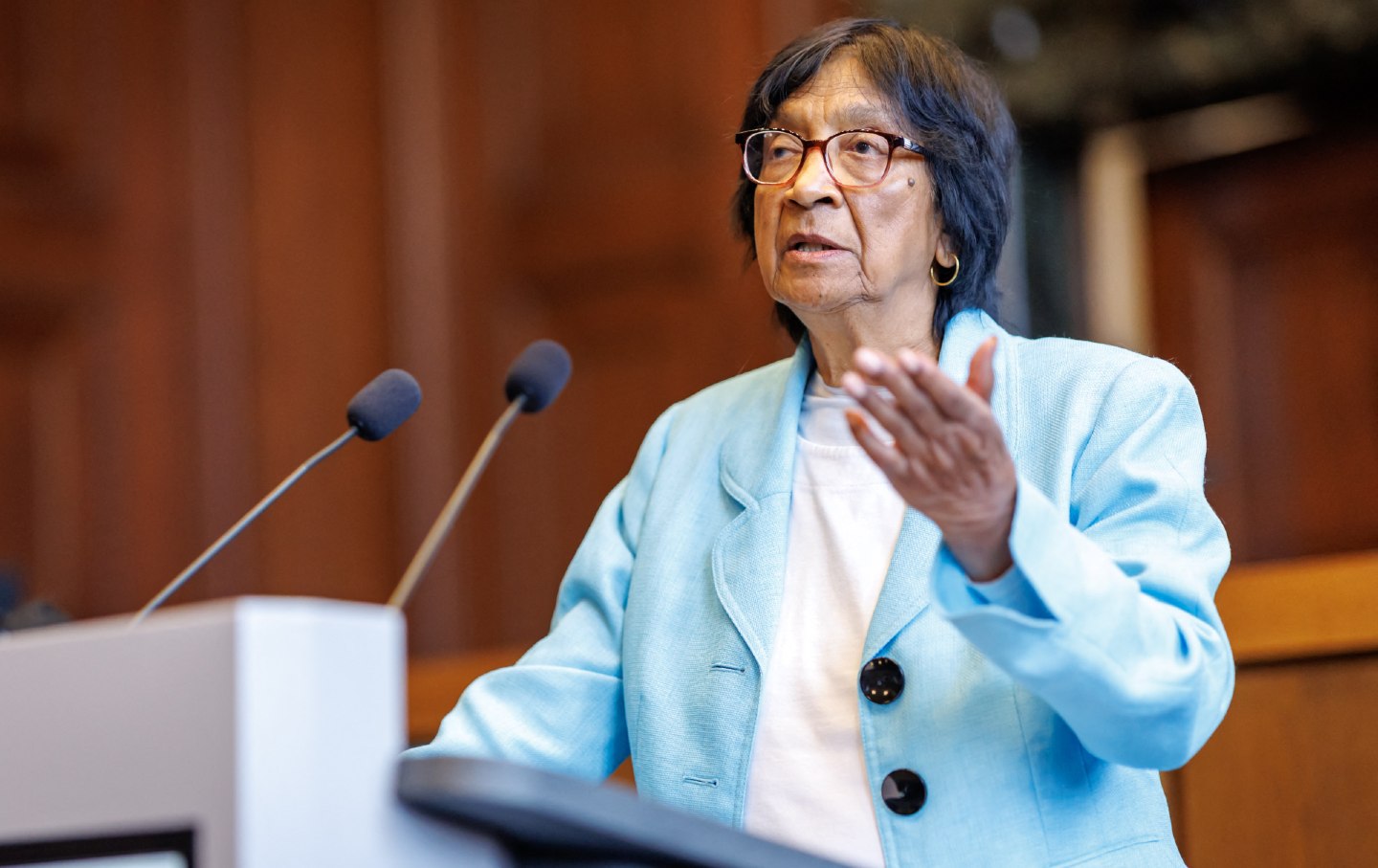
With international law and human rights under attack by such major powers as the United States and Russia and with ongoing genocidal wars in Sudan, Myanmar, and Palestine, the Norwegian Nobel Committee, in awarding the Nobel Peace Prize to the prominent South African jurist Navi Pillay, has sent a message that these foundational principles of the post–World War II era indeed do matter.
In the statement announcing its decision, the committee declared, “In awarding this year’s Nobel Peace Prize, the Norwegian Nobel Committee wants to remind the world that the rule of law—national and international—underpins the system we have set up to ensure peace and resolve conflicts non-violently. Peace requires justice.” While not specifically naming such major violators as the United States, Russia, Israel, and Morocco, the Nobel committee warned that international law is “an absolute necessity” for peace, noting how Pillay embodies these values—values that are currently being undermined by Washington.
It is hard to imagine a better representative of the efforts to defend human rights through international law. Among many prominent roles, the Harvard-educated Pillay has served as a judge of the International Criminal Court (ICC), as UN high commissioner for human rights, as president of the International Criminal Tribunal for Rwanda, and as a jurist on the International Court of Justice investigating charges of genocide in Myanmar.
The reaction from Washington was swift. President Donald Trump called the decision by the Norwegian committee “an indelible stain on the country of Norway” and said that the Nobel Peace Prize “has been forever discredited by a handful of radical ideologues who are anti-democracy, and really enemies of civilization.”
Secretary of State Marco Rubio then announced punitive sanctions against the ICC, prohibiting any Americans or US businesses from working with the court and punishing anyone in banking, technology transfers, commercial services, or other professional engagement.
Perhaps not surprisingly, in reference to Pillay, Trump initially acknowledged he had “never heard of the person,” but went on to declare that, despite her arguably being the world’s most prominent advocate of human rights and international law, “Nobody did. It’s a mystery person.”
Pillay, however, is actually well-known in Washington and has for years been the subject of bipartisan attacks, with leading Democrats joining Republicans in targeting her over her refusal to exempt US allies like Israel from investigations and accountability.
Pillay is perhaps best known for her role as the United Nations high commissioner for human rights between 2008 and 2014, the UN’s leading entity dedicated to advancing and protecting the full range of human rights and freedoms enshrined in the Universal Declaration of Human Rights.
While the UN Human Rights Council, made up of 47 states, can sometimes be politicized, the Office of the High Commissioner has traditionally been led by independent-minded professionals like Pillay who are willing to stand up for human rights regardless of the violator.
Despite this, in 2012, House Foreign Affairs Committee Chair Ileana Ros-Lehtinen (R-FL) and ranking Democrat Representative Eliot Engel (D-NY) wrote an angry letter calling on the Obama administration to “publicly and strongly oppose” Pillay’s reelection, falsely claiming that she had not condemned Syria, China, and other human rights violators and that she had “repeatedly demonstrated bias against the State of Israel,” despite her consistent law-based approach to human rights, which has led her to denounce human rights abuses in many countries.
The Obama administration agreed with the bipartisan opposition in Washington, joining Syria’s Assad regime and other authoritarian states in attempting to block Pillay’s reelection. Because she had strong support from prominent US allies, however, Obama agreed to allow her to stay on, but only for an abbreviated second term of two years instead of the customary four.
It is noteworthy that while Obama and Democratic Senate leader Chuck Schumer publicly congratulated last year’s Nobel Peace Prize winner, right-wing Venezuelan opposition leader María Corina Machado, prominent Democrats have been conspicuously silent about Pillay’s receiving the award.
Popular
“swipe left below to view more authors”Swipe →In March 2022, 68 senators signed a letter to President Biden calling on him to quash an investigative panel chaired by Pillay into war crimes by both Israel and Hamas. The United States was one of only eight members of the 193-member General Assembly to vote against funding the UN Independent International Commission of Inquiry on the Occupied Palestinian Territory led by Pillay and two other highly respected international jurists. In its report issued last year, it confirmed findings by international human rights organizations, genocide scholars, and others that Israel had violated the 1948 Genocide Convention and called on both Israel and Hamas to fully comply with international humanitarian and human rights law and to hold those accountable for violations.
Also in 2022, a bipartisan group of 42 House members condemned Pillay for having “repeatedly and unjustly accused Israel of committing war crimes” and for her acknowledging the Israeli government’s disdain for international legal principles, claiming that Israel actually “respects and complies with international law.” They similarly falsely accused her of saying “nothing at all about egregious human rights abuses” in other countries.
While there are certainly some who do unfairly single out Israel for ideological or even antisemitic reasons, Pillay is not among them.
As with similar criticisms out of Washington of international judicial bodies, human rights organizations, and international jurists, the problem is not that Pillay singles out Israel or other US allies but that she fails to exempt them from the same rigorous standards she applies to all nations.
And this is why Navi Pillay’s receiving the Nobel Peace Prize is so important and US opposition is so dangerous. Pillay has worked to build up institutions and principles the United States wants to tear down. She believes that human rights and international law are universal principles that must be enforced regardless of the violator’s ideology, ethnicity, or geostrategic alignment.
And that is what Washington finds so objectionable.
More from The Nation

How Golf in the Philippines Became a Symbol of American Imperialism How Golf in the Philippines Became a Symbol of American Imperialism
Rafael Manuel’s debut film, “Filipiñana,” demonstrates how the American sport’s export to the Philippines helped shape the colony in our country’s mirror image.
Scotland’s Wealthiest University Is in Crisis Scotland’s Wealthiest University Is in Crisis
The University of Edinburgh’s £140 million cuts threaten the institution’s intellectual life and Scottish identity. Students and staff are fighting back.
Trump Wants to Quiet Quit the Iran War—but the War Won’t Let Him Trump Wants to Quiet Quit the Iran War—but the War Won’t Let Him
The president’s senseless war of choice has left him without any good choices.
Does Spain’s Leftist Government Stand a Chance? Does Spain’s Leftist Government Stand a Chance?
Pedro Sánchez’s coalition has been an exception to Europe’s reactionary turn. What went wrong?
Has Pedro Sánchez’s Luck Finally Run Out? Has Pedro Sánchez’s Luck Finally Run Out?
Spain’s progressive prime minister has defied political gravity over and over again. But this Sunday’s election might be his last act.

The Deportation Influencers The Deportation Influencers
A growing group of US deportees is documenting their new, post-deportation lives on social media, revealing the human cost of our Kafkaesque immigration system.