We Can’t Let the Kaepernick Era Be Erased From History
Critics say the Black Lives Matter movement in sports went too far. In reality, it didn’t go far enough, and the backlash to it has been brutal.
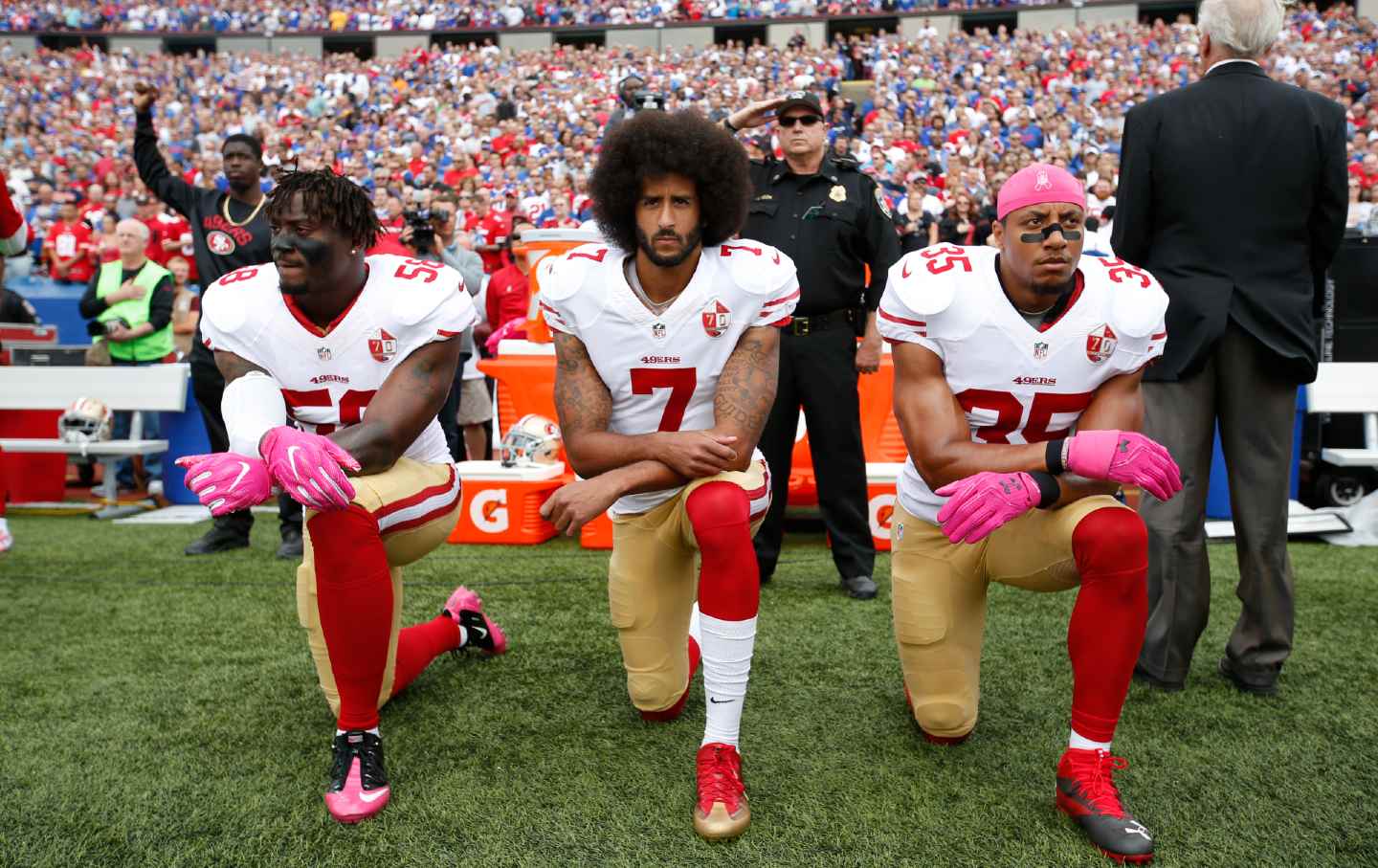
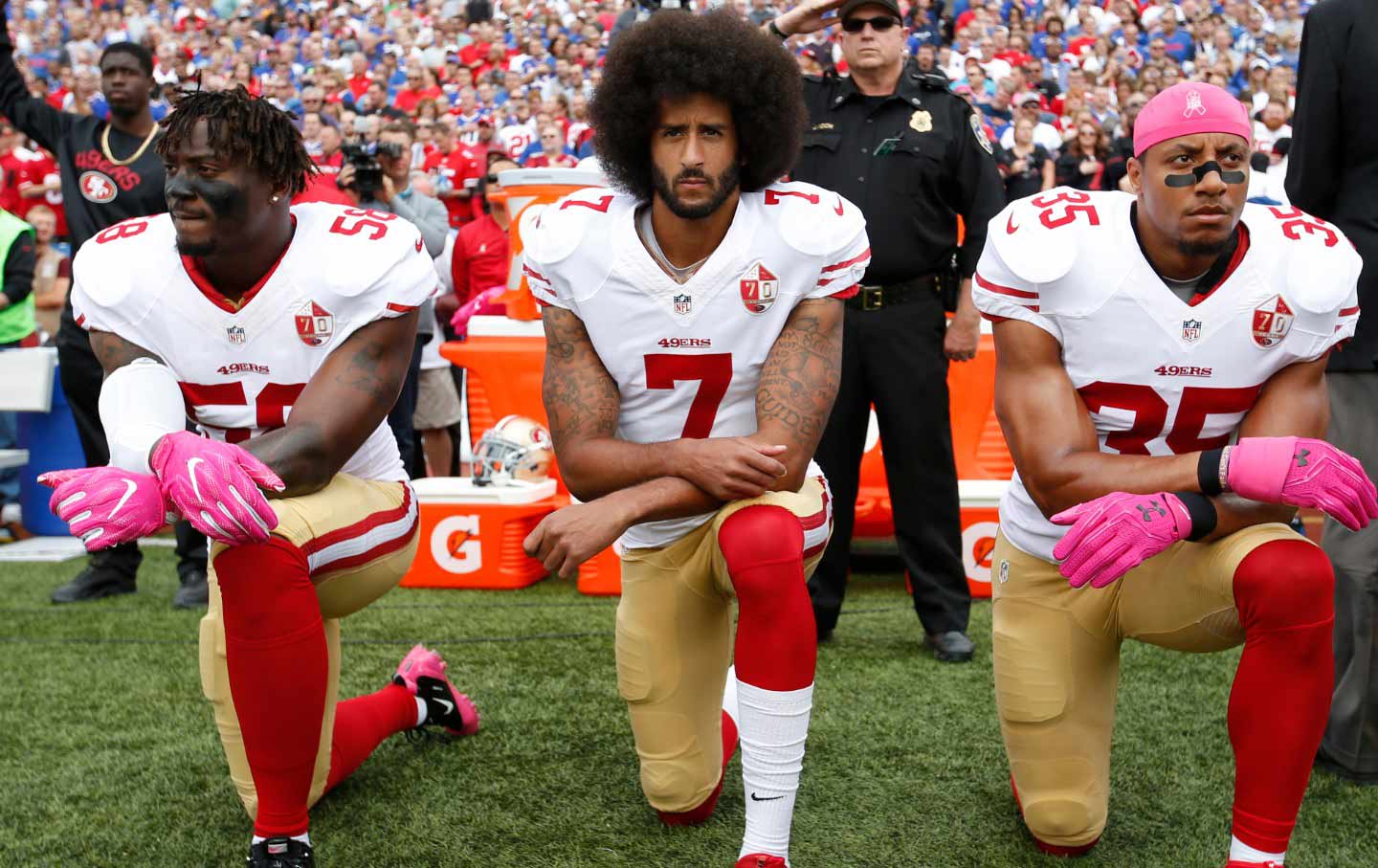
Eli Harold #58, Colin Kaepernick #7, and Eric Reid #35 of the San Francisco 49ers kneel in protest during the anthem, prior to the game against the Buffalo Bills on October 16, 2016 in Orchard Park, New York.
(Michael Zagaris / San Francisco 49ers / Getty Images)
Ten years ago, Colin Kaepernick took a knee during the national anthem in protest of racist police violence. Four years later, following the police murder of George Floyd, the United States experienced the largest protests in its history, and athletes—overwhelmingly but not exclusively Black athletes—took to the streets in unprecedented numbers. For an eyeblink, this activism provoked a “racial reckoning” that challenged white supremacy and its attendant state violence. And Kaepernick became a symbol of so much more than his own demand that the police stop “getting away with murder.”
Kaepernick immediately became an avatar for an era of struggle: an era that began when George Zimmerman killed 17-year-old Trayvon Martin in 2012, intensified when police officer Darren Wilson killed Michael Brown in Ferguson, Missouri in 2014, and burst into the world of sports when members of the (then) St. Louis Rams came onto the field arms raised in a “hands-up-don’t shoot” gesture. Soon after, members of the WNBA wore black T-shirts over their uniforms and linked arms during the anthem and then, following the 2016 summer of viral videos of the police murders of Philando Castile and Alton Sterling, Kaepernick—the San Francisco 49ers quarterback, the highest profile position for the most popular league in the country—took that fateful knee.
During four years of steady protest, Kaepernick was more than an icon. He was an inspiration—and this has been left out of every retrospective I have read—for hundreds of high school athletes who also took a knee during the anthem, sparking (depending on the community) violent backlashes but also positive changes in school policies. It was young athletes as much as any other force who kept the connective tissue of Black Lives Matter alive, contacting each other over social media and taking action. While the memory of Kaepernick’s knee cannot be erased—only slandered or coopted—the actions of these young people have been largely forgotten, their bravery invisible to the discussions and assessments taking place on this 10th anniversary..
This is why I am so frustrated when the question is asked in 2026, “Was Kaepernick’s knee a moment or a movement?” Of course it was a movement—one that stretched before and after him: It started in 2012 and continued on and off the field culminating with the Black Lives Matter protests of summer 2020 after police officer Derek Chauvin murdered George Floyd.
We also know that it was “a movement” because “moments” don’t provoke the unholy right-wing backlash that has occurred since 2020. Take your pick when choosing the low points of the racist revanchism that followed the heights of Black Lives Matter: the white riot that sacked the Capitol building on January 6, Joe Biden’s thundering repetition at his first State of the Union that we “FUND the police,” the openly fascistic Project 2025 that has defined President Donald Trump’s second term, and Trump’s war on US history itself—attacking both what is on display at the Smithsonian and what is taught in our schools. Trump has made clear that the BLM movement is a central motivation for him trying to scrub this country’s past. As he said, “The left-wing rioting and mayhem are the direct result of decades of left-wing indoctrination in our schools. Our children are instructed from propaganda tracts, like those of Howard Zinn, that try to make students ashamed of their own history.” (There is zero chance that Trump knows who Zinn is.)
And most pointedly, we have seen the rise of a new kind of domestic security state even more rooted in counter-insurgency aimed at brown and Black communities. We have seen a dramatically expanded ICE become a violent, untethered paramilitary force; we have seen the National Guard shoot people in the back in Memphis; we have seen Washington, DC, turn into an armed encampment of gilded Trump monuments, National Guard troops, and military bunkers. Even the repressive tech used by ICE—which will surely be coming to your local police department soon—like those new electro-shock gloves is part of this. And with Israel training police chiefs in the brutal art of “pacification,” the chant “We are all Palestinian” is now far more than a slogan.
More from Dave Zirin on Colin Kaepernick:
All of this flows from the oligarchs and their minions being scared shitless by the numbers in the streets in 2020 and the way anti-racist discourse, books, and analysis gained ground. Even ESPN has had a McCarthyite political cleansing. It’s gone from the home of incisive, award-winning journalists like Howard Bryant, Bomani Jones, Jemele Hill, and Pablo Torre to a MAGA cesspool. It’s never “shut up and dribble” when it’s time for Pat McAfee or Stephen A. Smith to make clear that any kind of progressive or investigative analysis at the network is dead.
So yes, Kaepernick’s protest was a movement. But we have surrendered ownership of the memory of that movement. We owned the streets just six years ago, and it feels like it might as well have been 60. The authoritarian right has not forgotten. But now many on the social-democratic left are also engaged in the political art of forgetting, or at least doing the right’s job by rewriting the history of this era. To hear politicians like AOC talk with a sideways smirk about “Woke 1.0” (the period of struggle between 2012-2020) is to see them caricature the movement as immature—worthy more of mockery than appreciation. Too many on the ostensible left are saying that the people in the streets were asking for too much when their demands weren’t nearly enough. It was a mass movement, but they—and it’s a bipartisan “they”—have engaged in a hostile takeover of its memory, and we are weaker for it.
But what about Kaepernick’s own legacy? One of my arguments is that to remove him from the larger movement and erase the young people who took inspiration from him is to not talk about the actual history at all. It is an act of political deletion. As for Kaepernick, I met and interviewed him on more than one occasion, one of the few to do so during his years of stoic silence.
My assessment of him and his actions following the taking of that knee—after the 2016 season—are foremost that he was both brave as hell and at the same time deserves a great deal of grace from his critics who wish he had done more. Kaepernick never wanted to be a symbol of a movement. His first act was not kneeling before the world but sitting behind his team next to a water cooler during the anthem out of disgust, and if one reporter, Steve Wyche, hadn’t noticed, we may never have known what was ricocheting around his brain. Instead, to his own shock, he became the greatest athletic amplifier of a movement of his generation. As Shakespeare wrote, “Some are born great, some achieve greatness, and some have greatness thrust upon them.” Kaepernick’s greatness was thrust upon him.
Yes, there are tactical actions that I wish he had taken immediately when the NFL’s Trumpist ownership class blackballed (whiteballed) him following the 2016 season. I wish he had toured a dozen cities, where he would undoubtedly have had thousands of people in attendance looking for leadership or even just the opportunity to celebrate what he had done. I wish he had partnered with the NFL Players Association—who wanted to join with him—and turned his protest also into a labor and free-speech battle that would have confronted the team owners. I wish when dozens of players were on a group text with Kaepernick and asked what they should do, he had encouraged them to act as a collective. But I deeply respect that he put on his Know Your Rights camps in different cities to educate young brown and Black youth about history, politics, and how to navigate a racist system. I deeply respect that he put his money where his mouth was, giving a fortune to grassroots anti-racist organizations. I also—especially in today’s sports culture where there is so much noise emitting from athletes who have nothing to say—that Kaepernick chose silence, chose to let his gesture speak for itself. By doing this, he gifted a language of protest to thousands of people: Through the simple act of taking a knee during the anthem, they could be a part of the struggle. According to my own reporting, it wasn’t just high school athletes taking a knee. It was kids during the pledge of allegiance. It was school marching bands. It was people in the streets as part of the practice of protest. Again, he gave the struggle a new language and for that he deserves a place in history. But if we decontextualize that history, then we are not really learning it at all.
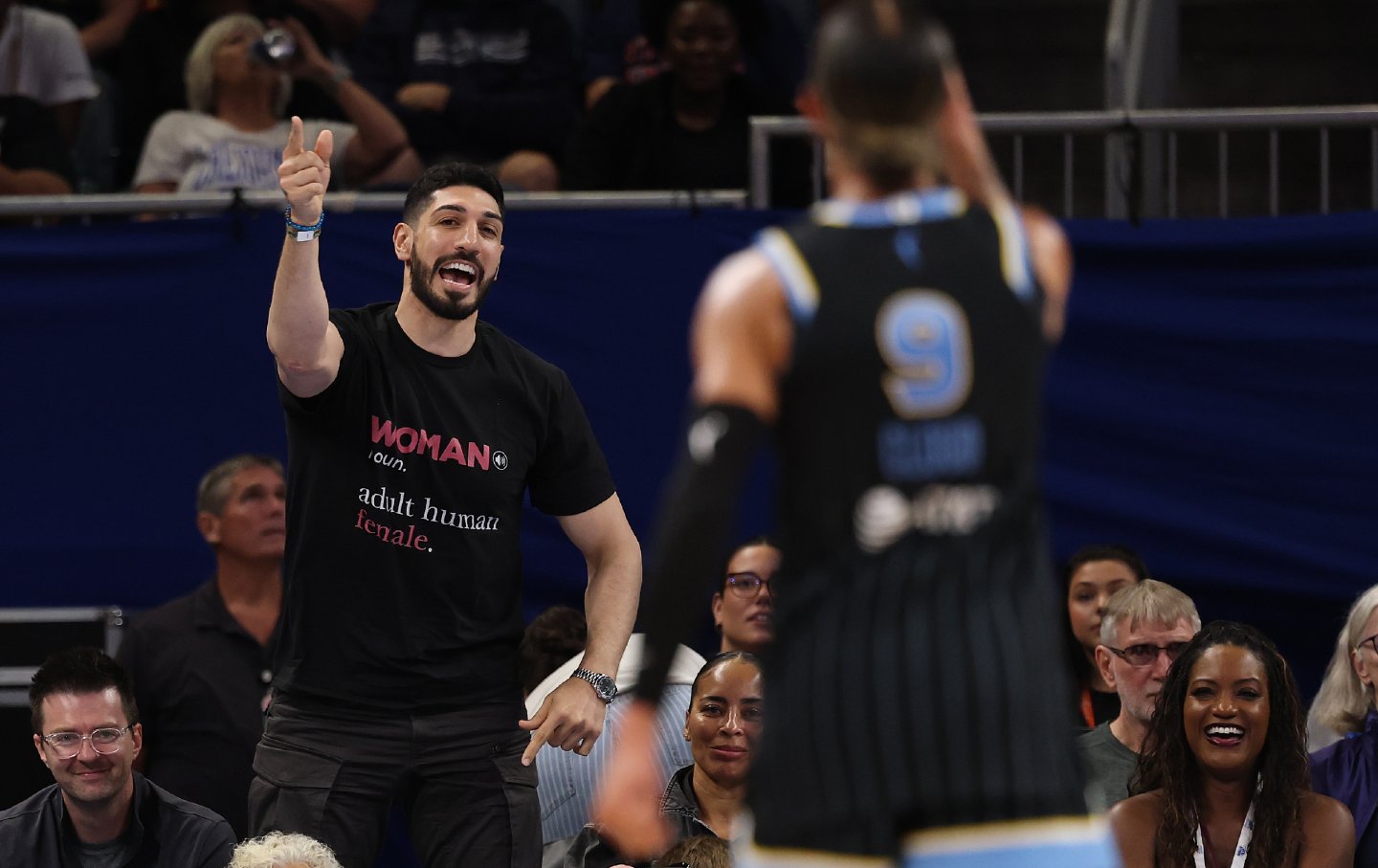
There is no doubt in my mind that protest will return to the athletic arena as long as there are movements off the field and outside the lines. What that looks like won’t resemble 2016 any more than 2016 looked like 1968. I personally think it will look a lot more like hooper Natasha Cloud’s recent on-court eruption aimed at anti-trans thug Enes Kanter who was mocking the WNBA from the stands in the name of “protecting women.” Cloud’s anger was raw, expressive, and real. These are more desperate times and that kind of rage will make itself heard. Kaepernick offered a peaceful direct action in the name of justice. The fight for justice will make its return. But it will be far less peaceful. Kaepernick wanted peace, and NFL owners destroyed his career. Next time “peace” won’t be on the menu.