Cuba enters the second half of 2026 under its tightest siege in years. In January, the Trump administration issued an executive order aimed at cutting off the island’s fuel supply, and the effects were felt immediately: a series of nationwide blackouts, including one on July 6 that left the country without power. Yet, even under this pressure, Havana has pressed ahead with its most significant economic opening in a decade. Measures announced on June 18 widened space for private business and foreign investment, with the government insisting that the changes are being able to secure, not abandon, the social guarantees of the revolution.
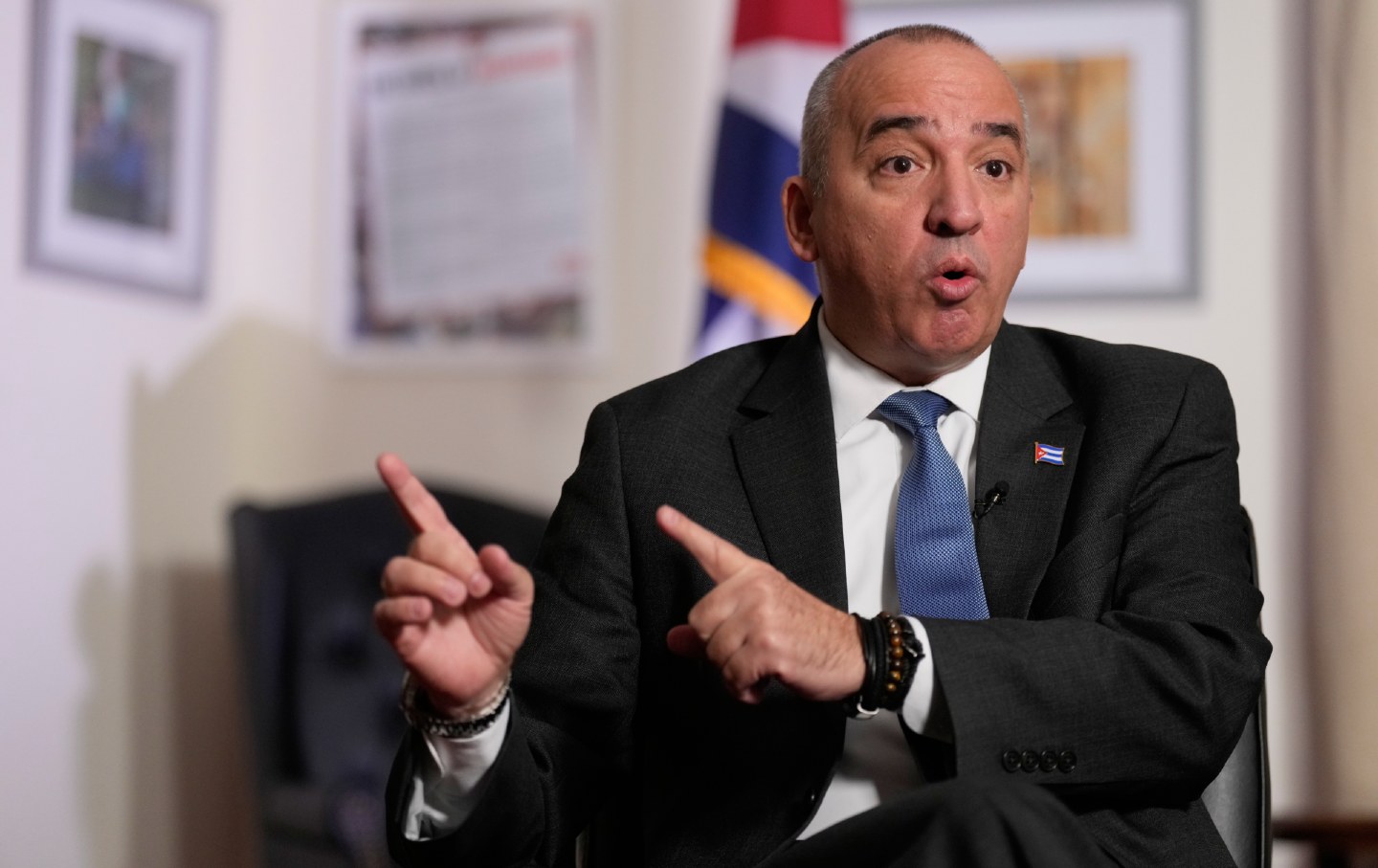
Ernesto Soberón Guzmán, Cuba’s permanent representative to the United Nations, spends his days navigating a difficult diplomatic environment. In this conversation with The Nation, he lays out how Havana reads the escalating US blockade, what the new reforms are meant to accomplish, and where his government draws the lines it says it will not cross.
—Bhaskar Sunkara
Bhaskar Sunkara: Can you tell us a little about your own background, what your life in Cuba was like, and what first drew you toward diplomatic work?
Ernesto Soberón Guzmán: I was born in San Antonio de los Baños, Cuba, and was educated entirely in my country. I originally trained as an industrial engineer before pursuing diplomatic studies. Like all Cubans, I grew up benefiting from universal access to education and healthcare. Those opportunities shaped my understanding of public service.
From an early age, I developed a strong interest in international affairs because, in Cuba, foreign policy is never something distant from people’s everyday lives. The relationship between international developments and our national reality has always been very direct, particularly given the economic blockade that Cuba has faced for more than six decades. That naturally drew me toward diplomacy.
I joined the Ministry of Foreign Affairs in 2002, initially working on North Africa and the Middle East. Later, I served at the Cuban Embassy in Qatar, was ambassador to the Bahamas, and subsequently held responsibilities in Havana as director and later director general of consular affairs and Cuban residents abroad before assuming my current responsibilities as permanent representative to the United Nations.
Throughout those different assignments, one principle has remained constant. Diplomacy, for us, is not simply about representing national interests. It is about defending the principles that have consistently guided Cuban foreign policy: respect for international law, sovereign equality among states, noninterference, multilateralism, and solidarity.
BS: Cuba just went through another nationwide blackout on July 6. How does Havana understand the aims of the escalating US blockade?
ESG: From our perspective, these events cannot be analyzed in isolation from the policy that successive US administrations have pursued against Cuba for more than six decades.
The blockade is not simply a bilateral disagreement or a collection of sanctions. It is a comprehensive system of economic coercion explicitly designed to deprive Cuba of resources, create shortages, undermine economic activity, generate social hardship, and ultimately provoke political change. That objective has been openly acknowledged in official US documents dating back to the 1960 Lester Mallory memorandum, which advocated denying Cuba financial resources and supplies in order to produce hunger, desperation, and the overthrow of the government.
What we are witnessing today is an intensified version of that same strategy.
In January 2026, President Trump signed an executive order aimed specifically at cutting off Cuba’s access to energy supplies. This marked a dangerous escalation of the blockade. The objective has been to intimidate suppliers, shipping companies, insurers, financial institutions, and third countries into refusing any transaction involving fuel destined for Cuba.
The consequences have been profound. Fuel deliveries have been severely disrupted. Ships have been deterred from transporting oil to Cuba because of the threat of secondary sanctions. Banks have refused to process payments. Companies have withdrawn from legitimate commercial contracts out of fear of US penalties. This has severely affected electricity generation, transportation, industry, agriculture, hospitals, water pumping systems, telecommunications, tourism, and virtually every sector of the Cuban economy.
The nationwide blackout this month should therefore not be viewed as an isolated event. It occurred within the context of what we have described as an energy blockade deliberately designed to collapse Cuba’s electrical system.
The arbitrary inclusion of Cuba on the US list of State Sponsors of Terrorism has compounded these effects by paralyzing normal banking operations.
Our government continues to prioritize the recovery and modernization of the National Electric System through investments in renewable energy, distributed generation, and cooperation with international partners. But no country can develop normally while being subjected to the most comprehensive system of unilateral coercive measures in the world.
BS: The June 18 package of liberalization measures has often been described abroad as a sharp turn. From the leadership’s point of view, is this just an acceleration of changes that were already underway rather than something more profound?
ESG: I would not characterize these measures as a rupture with previous policy. Rather, they represent another stage in a process of updating our economic model that has been underway for many years.
Since the guidelines adopted by the Communist Party and subsequent policy documents, Cuba has been implementing reforms aimed at increasing efficiency, broadening the participation of the private sector, expanding productive capacities, attracting investment, and creating greater flexibility within our socialist economy.
Economic policy is not static. It evolves in response to changing domestic realities and an increasingly hostile international environment.
The measures announced recently seek to unlock productive potential, facilitate economic activity, improve the business environment, and attract additional investment and capital while preserving the strategic role of the state in sectors that are fundamental to national development. They are intended to strengthen the country’s capacity to withstand external aggression while preserving the social achievements of the revolution.
These measures also open up a wide range of opportunities in business and investment for US companies and businesses led by Cuban American citizens.
It is important to understand that these decisions are taken based on Cuba’s own realities and priorities, not as an imitation of any external model or in response to external pressure.
BS: There has long been debate in Cuba over how to widen room for private initiative without eroding the socialist gains of the revolution. As more space opens for private business, deeper economic engagement with the diaspora, and more direct foreign trade, what are some of the contours of that discussion like within Cuba?
ESG: This is indeed an active discussion within Cuban society. Our objective is to make socialism more productive, more efficient, and better able to satisfy the needs of our population.
The emergence of private businesses, cooperatives, and other non-state economic actors is viewed as a valuable and important complement in our economic model. The state continues to retain responsibility for strategic sectors, macroeconomic planning, and the protection of social equity.
Naturally, there are legitimate debates regarding regulation, taxation, market concentration, inequality, and how to ensure that economic dynamism contributes to collective welfare rather than creating disparities.
Regarding Cubans living abroad, our government has repeatedly expressed its willingness to deepen ties with those who wish to contribute to Cuba’s development while respecting our sovereignty and legal framework.
The guiding principle is that economic modernization must strengthen, not weaken, the social achievements that define the Cuban project.
BS: The revolution’s social support has always rested in part on those universal social achievements: healthcare, education, basic provisioning…. In conditions of deep scarcity, what does the state still believe it must guarantee to everyone in order to preserve that social compact?
ESG: The answer is straightforward. Universal access to healthcare and education remains absolutely nonnegotiable. The state also maintains responsibility for protecting the most vulnerable sectors of society through social assistance, pensions, and essential public services.
Of course, scarcity creates enormous challenges. No government wishes to ask its people to endure the difficulties that Cubans have experienced in recent years.
But even under these circumstances, Cuba has not privatized healthcare, has not introduced tuition fees in public education, and continues to prioritize social expenditure despite severe fiscal constraints.
The principle that no one should be abandoned remains central to our public policy. Economic reforms are designed precisely to preserve those guarantees over the long term, not to dismantle them.
BS: When Cuban leaders point to reforms in China and Vietnam, what parts of those trajectories are seen as incompatible with Cuba’s own social compact and economic starting point, and what are instructive?
ESG: Every country follows its own path. Cuba maintains close and excellent relations with both China and Vietnam, and we value their achievements. There are certainly lessons regarding productivity, investment promotion, technological development, export capacity, and economic management.
At the same time, Cuba’s circumstances are unique. No other country has been subjected for decades to a comprehensive economic blockade with such extensive extraterritorial effects. Our geography, demographics, natural resource base, and economic structure are also very different. Therefore, while we study international experiences carefully, no model can simply be copied.
The reforms adopted in Cuba must always correspond to our national realities and preserve the social principles that have characterized the revolution.
BS: After Venezuela and the Iran War, what forms of escalation against Cuba seem most plausible right now, as your government continues to withstand the US blockade?
ESG: We do not speculate about hypothetical scenarios. But what we can observe is a continuing pattern of escalating economic pressure.
Additional financial sanctions, efforts to discourage foreign investment, restrictions on banking operations, measures against maritime transportation, and obstacles to fuel supplies remain the most likely forms of escalation because they are already being implemented.
The energy blockade imposed this year demonstrates that Washington continues to look for new ways to maximize economic suffering by targeting sectors that are essential to the daily life of the Cuban people.
We also continue to witness extensive campaigns of misinformation designed to portray Cuba in ways that seek to justify coercive policies.
Our position remains unchanged. We will continue to advocate for dialogue based on mutual respect, reciprocity, sovereign equality, political independence, self-determination, and strict adherence to international law.
BS: Talks with Washington now appear to be stalled. Is there still any real channel for de-escalation that your government sees?
ESG: Cuba has repeatedly stated that it is prepared to maintain a respectful and civilized relationship with the United States despite our profound differences.
We have never conditioned dialogue on ideological agreement. What we insist upon is sovereign equality, mutual respect, and strict adherence to international law and the principles and purposes of the Charter of the United Nations.
Experience has demonstrated that bilateral cooperation is possible in areas of mutual interest, including migration, maritime safety, environmental protection, law enforcement, public health, disaster response, and business and investment opportunities.
Cuba has consistently expressed its readiness for constructive engagement without interference in our internal affairs or attempts to impose conditions on our sovereign decisions.
BS: What do you say to administrations in Latin America and the Caribbean that do not want a war or a strangulation campaign against Cuba, but are still aligning with Washington under pressure and the need to retain good relations with a superpower?
ESG: Every government makes its own sovereign foreign policy decisions.
Many governments maintain productive relations with both Cuba and the United States. Cuba does not ask countries to choose between relations with Havana and relations with Washington. Our expectation is much simpler. We hope all countries defend the principles that underpin international law: nonintervention, sovereign equality, peaceful coexistence, and the rejection of unilateral coercive measures.
The overwhelming and consistent votes in the United Nations General Assembly demonstrate that these principles continue to enjoy overwhelming support.
What should never become acceptable is the normalization of unilateral measures that seek to coerce the sovereign choices of another nation.
BS: Under all this pressure, what are the nonnegotiable elements of Cuban socialism in 2026? What cannot be given up?
ESG: The answer has been consistent throughout the years.
Cuba’s sovereignty, independence, and the Cuban people’s right to determine their own political, economic, and social system without external interference are not subject to negotiation.
Neither are the principles that have defined our social project: universal access to healthcare and education, social justice, solidarity.
Economic policies may evolve. Institutions may adapt. Reforms will continue, because every society must respond to changing realities. But those reforms are intended to strengthen the Cuban social project, not to dismantle it.
Ultimately, the future of Cuba belongs exclusively to the Cuban people. No foreign government has the right to dictate our political system or our development model. That principle is not only embedded in our Constitution; it is also one of the fundamental principles of the Charter of the United Nations.