
Pedro Sánchez Is Living on Borrowed Time
Spain’s prime minister has become a global progressive icon. But at home, his government is hanging by a thread.
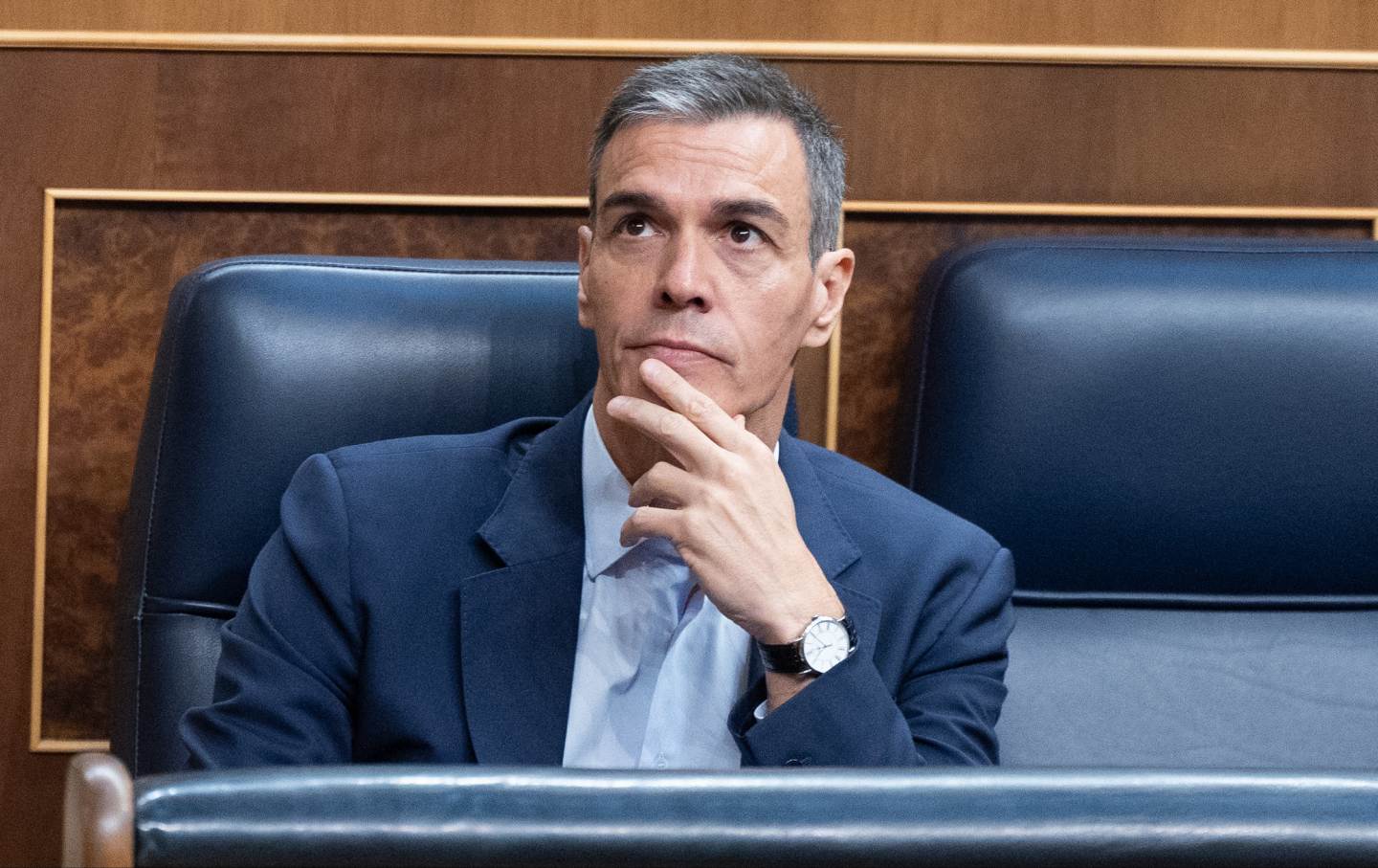
Pedro Sánchez at the Congress of Deputies in Madrid on June 25, 2026.
(Jesus Hellin / Europa Press via Getty Images)On April 17, as Europe’s 1986 hit song “The Final Countdown” boomed through the PA system, José Luis Rodríguez Zapatero, Spain’s former Socialist prime minister, entered the room at the two-day Global Progressive Mobilization in Barcelona to massive applause. The summit featured Latin American leaders like Brazilian President Lula da Silva, outgoing Colombian President Gustavo Petro, and Mexican President Claudia Sheinbaum, alongside Minnesota Governor Tim Walz and other left-of-center luminaries. (Bernie Sanders and Zohran Mamdani sent video messages.)
The mood was as combative as it was optimistic. “This is the most important progressive summit of the century,” Zapatero, who spoke on both days, said. “We are about to enter a cycle in which we’ll see the collapse of the denialist, anti-scientific discourse that doesn’t value peace and instead gets off on Tomahawk missiles.… Right-wing governments everywhere are in free fall.”
Spain’s current prime minister, social democrat Pedro Sánchez, was also there, basking in Zapatero’s glow. In his opening statement, Sánchez, who has emerged as Europe’s most outspoken critic of both the Trump administration and Israel, spoke plainly. “Resisting is not enough,” he said. “We must work to strengthen and perfect democracy every day.” His closing speech, the next day, turned up the volume. “They’ve tried to shame us for our ideas and our history,” he said. “But that ends today!… From now on, it’s them who will feel ashamed! Ashamed for being silent in the face of injustice. For exploiting workers, turning rights into commodities, or protecting the privileges of the elite.”
Yet today Zapatero’s “Final Countdown” rings ironic. On June 17, the 65-year-old statesman testified before Spain’s national criminal court after being indicted on multiple counts of corruption. Zapatero, who led his country’s government from 2004 to 2011, has claimed that he has broken no laws. But the scandal has irreparably damaged his reputation among Spain’s progressive electorate and dealt yet another blow to Sánchez, who for the past year has faced a steady stream of scandals and attacks and whose government is hanging by a thread.
In the span of two months, Zapatero’s support for Sánchez has gone from being one of the government’s most powerful assets to its fastest growing—and possibly fatal—liability. While Sánchez’s relationship to other old-guard Socialists, including former prime minister Felipe González, has long been testy, he has grown closer to Zapatero in recent years—to their mutual benefit.
For Zapatero, assuming a prominent role as an outspoken progressive stalwart and international ally of embattled left-wing regimes, especially in Latin America, has been a way to repair his reputation: In 2011, shortly before resigning, he buckled to international pressure in the wake of the Great Recession and helped push through a constitutional reform that privileged public debt reduction over social spending.
Progressives in Spain are conflicted. It was to protest Zapatero’s policies that many frustrated citizens took to the plazas on May 15, 2011, in what would become the indignados protests, one of the largest in the country’s history. That Zapatero has been indicted on corruption charges that may bear fruit thus comes as no surprise to those who came to political consciousness during the early 2010s. The same might be true of Sánchez, who came into politics as a centrist apparatchick.
Over the past year, a series of police investigations have linked some of Sánchez’s closest collaborators with alleged kickback schemes. On June 24, one of Sánchez’s right-hand men, a former minister of government and organizational head of the party, was sentenced to 24 years in prison; his successor is awaiting trial.
The latest corruption saga, which exploded in May, involves Leire Díaz, a zany, middle-aged party member who reportedly conspired with high-ranking officials to stymie the barrage of legal cases against Sánchez and the Socialists by digging up dirt on prosecutors and police commanders—an effort that, if real, failed spectacularly, given that those legal cases have gone full speed ahead. These cases hint that an indictment of Sánchez himself, which would be a first for a sitting prime minister in the history of Spain’s young democracy, may only be a matter of time.
Yet many on the left see this swirling set of legal crises as part of a concerted right-wing effort to torpedo one of the last progressive governments in Europe. They have witnessed how, over the past couple of years, the conservative Spanish judiciary, spurred by far-right activist groups, has gone after Sánchez’s wife and brother on charges that, according to judicial experts, are clearly spurious and guided by ideological animus. (In late June, the judge investigating the prime minister’s wife suggested, absurdly, that she might run off with her bodyguards and ordered her to hand in her passport.)
The central role in these cases played by zealous police investigators and judges who are quick to reach speculative conclusions has further undermined Spaniards’ faith in a judicial system whose legitimacy was already on shaky grounds. Although the courts have plenty of cases involving conservative politicians on their docket—the trial recently began for the so-called “Kitchen case,” in which officials from the center-right Partido Popular have been accused of obstruction of justice—the speed at which they’ve investigated and prosecuted those involving progressive politicians has been staggering. They have also been quick to break their own rules, regularly leaking embarrassing evidence to the media. “More and more people are convinced that this is lawfare,” Ignacio Sánchez-Cuenca, a political scientist, wrote in La Vanguardia, “or at least that there is a double standard in legal cases involving politicians.” “To be honest, I think the courts are not particularly concerned about their legitimacy,” María Eugenia Rodríguez Palop, a professor of philosophy of law at the Carlos III University in Madrid and former member of the European Parliament, told us. “What primarily drives the judges,” she continued, “is their corporatist desire to protect the current structures, which benefit them.”
Judges are not the only ones who have undermined the separation of powers. The conservative opposition is also to blame for the growing public mistrust of the Spanish judiciary. Over the past year, Alberto Núñez Feijóo, leader of the PP, the main opposition party, has prematurely issued sentence after sentence against the Sánchez government, finding it guilty-in-advance of everything from the abuse of power by the attorney general—who was convicted by the Supreme Court in November for purportedly leaking secret information to journalists, despite numerous reporters’ testifying to the contrary—and corruption regarding the Catalan amnesty law to leading an organized crime ring of bribery and influence-peddling.
All the while, Feijóo and Isabel Díaz Ayuso, the regional PP leader in Madrid, have claimed that Sánchez has turned Spain into “a dictatorial state.” Yet by abrogating their political responsibility to the legal system instead of presenting a viable alternative, they have been tripped up by their own arguments. After all, what kind of dictatorship would allow its own sitting attorney general to stand trial, let alone be found guilty?
In its ongoing effort to topple Sánchez, the Spanish right has not only received help from Spain’s conservative judiciary but also, quite unexpectedly, from the Trump administration. Zapatero and his daughters have been charged with receiving close to $800,000 from a $61-million Covid rescue package that the Spanish government had granted to a small airline partially owned by Venezuelans who have been the target of an international money-laundering investigation. (Zapatero denies any wrongdoing.)
A key piece of evidence in the case against Zapatero is the contents of a Venezuelan cell phone obtained in 2021 by Homeland Security Investigations, a division of ICE, which the US administration voluntarily sent to Spanish law enforcement in March 2026. (Reportedly, the cell phone contains text messages about the Covid rescue package that refer to Zapatero’s help.) The unsolicited handover occurred shortly after Pedro Sánchez spoke out publicly against the US-Israeli attacks on Iran.
Zapatero, for his part, still has a target on his back among US Republicans, who see him as a champion of Spanish anti-Americanism. They haven’t forgiven him for his 2004 decision, announced on his first day in office, to withdraw Spain’s troops from Iraq and his close ties, after his 2011 resignation, with the Latin American left, particularly in Venezuela. (The Washington Examiner recently called him “Maduro’s fixer.”) If the timing of the information sharing isn’t suspicious enough, more serious questions surround the legality and chain of custody of the cell-phone evidence, which was obtained without a warrant and would therefore normally be inadmissible under Spanish law.
How Sánchez will overcome these mounting scandals is anyone’s guess. Yet Spain’s prime minister, a six-foot-three former basketball player, is also Europe’s ultimate political comeback kid. In a running gag on Polònia, the Catalan version of Saturday Night Live, an elusive Sánchez drives the Grim Reaper to despair: The scythe-wielding skeleton keeps coming for him, only to be outfoxed into taking his political rivals instead.
Indeed, since he first rose to prominence in the PSOE, Spain’s social democratic party, the 54-year-old economist has survived at least half a dozen seemingly certain defeats, including within his own party. He became the country’s prime minister in 2018, after winning a no-confidence vote against then–Prime Minister Mariano Rajoy. Since seeking out reelection in 2023, he has governed in a minority coalition with the progressive group Sumar, led by Yolanda Díaz. Pressed to the left by his coalition partner, which has pushed for increases in the minimum wage and job security, mass legalization of immigrants, curbing energy prices, and other progressive measures, Sánchez has overseen the EU’s most successful economy. Over the past five years, Spain’s GDP growth has roughly tripled the EU average, while unemployment is at the lowest rate since the 2008 crisis.
Since Trump’s return to power, Sánchez has also emerged as one of the few European leaders willing to stand up to him, to Israel, and to NATO’s demands that member states drastically increase defense spending. In fact, he has become the de facto leader of a global anti-Trump resistance movement. But it’s not clear that Sánchez’s international stature will do him much good at home during the next parliamentary elections, which must, at the latest, occur sometime before fall 2027.
“His reputation abroad won’t help compensate for the political weakness of his party and government,” says Noelia Adánez, the opinion editor of Público, one of the country’s largest progressive dailies. A much greater relative advantage for Sánchez, she points out, is the fact that the leadership of the conservative opposition is weak and divided. Its nominal head, Feijóo, “is not a real leader and behaves rather erratically,” Adánez told us, “making constant bad choices on his timing, discourse, and allies.”
One of Sánchez’s most powerful weapons, meanwhile, is his ability to project calm and confidence despite everything coming down around him. A superior orator, he regularly leaves the opposition in the dust in parliament. But his coalition government is fragile. While he was voted in with the parliamentary support of conservatives from Catalonia and the Basque Country, those parties are increasingly hesitant to link their fate to his. As a result, Sánchez has not been able to present, let alone pass, a budget since his reelection in 2023. (Unlike other countries, Spain rolls over its most recently approved budget and continues to function with the help of executive decrees and tax revenue.)
This has made it doubly challenging for him to address Spain’s housing crisis, which has reached unsustainable levels. On the one hand, without a budget, Sánchez isn’t able to dedicate new state resources to, for instance, intervening in a housing market in which US private equity firms are the biggest landlords; on the other, it’s doubtful that he, a political centrist at heart, would ever be willing to fundamentally challenge elite economic interests in the first place. He has also yet to keep certain promises, such as the repeal of Spain’s notorious Gag Law, which limits freedom of the press and imposes outsize sanctions on forms of public protest.
Spanish politics thus finds itself at an impasse. The conservative PP leads in the polls. But the party’s closeness to its far-right ally, Vox, with which it has formed coalition governments across Spain’s regions and municipalities, has alienated many centrist critics of Sánchez. These anti-Sánchez, anti-Vox voters are Spain’s version of never-Trump Republicans. This group has found increasing support among traditional Catholics, whose hospitable approach to immigration—affirmed by Pope Leo XIV’s visit to the country in early June—has clashed with the xenophobic drift of the PP.
Popular
“swipe left below to view more authors”Swipe →Ironically, the PP’s relationship with Vox has put the center-right party in a double bind. For one, Vox is not a reliable partner. In July 2024, a year after striking coalition agreements to govern five of Spain’s regions, Vox broke with the PP and left these regional governments. But a more serious challenge is that Vox’s extreme Spanish nationalism has alienated the PP’s former and, for some, more natural allies in the Basque Country and Catalonia, where regional nationalisms prevail, even among conservatives. Because center-right parties in those regions cannot countenance having anything to do with Vox, the country’s national politics remains in a holding pattern, likely until next summer, when parliamentary elections are expected to take place.
The threat of Vox is also keeping Sánchez’s junior partner Sumar from punishing the prime minister for his party’s corruption scandals—for example, by leaving the coalition. Weakened by infighting and clinging to the little power it currently has in government, Sumar has framed its decision to continue to support Sánchez in terms of responsibility. “It’s still useful to be part of a coalition,” said Eduardo Rubiño, a Sumar spokesperson, before listing a series of pending measures that ranged from increasing the budget for public healthcare to preventing vulture funds from buying up housing. Staying on is necessary “to prevent Trump’s allies from governing,” he said, “because if Fejóo is given the chance, we could see [Vox leader Santiago] Abascal become deputy prime minister.”
Left-wing leaders also point to the cutbacks in public services, social spending, and political rights in the regions where the PP has governed with Vox. In late 2023, for example, the Valencia region eliminated its emergency unit; when the city was hit by major floods less than a year later, nearly 250 people were killed.
Pope Leo’s plea to Spanish politicians to tone down their divisive rhetoric and address polarization fell on deaf ears. Both Sánchez’s PSOE and the PP have reason to believe that dialing up the tension will help bring their voters to the polls.
Sánchez, in particular, may be able to turn his legal troubles to his advantage. The more overtly the PP, Vox, conservative judges, and the Trump government appear to be conspiring to bring him down—by indicting him, for example—the easier it will be for Sánchez to portray himself as the only thing standing between democracy and fascism. Still, campaigning on fear is a risky electoral bet for the left. Sánchez pulled it off in 2023—but just barely. Even though the threat today is objectively more grave than it was three years ago, it’s unlikely that the tactic will work again.
More from The Nation

This Is Not an Anniversary This Is Not an Anniversary
Does remembering the date of October 7 make it easier to name?
Are Europe and Russia Slow-Walking to World War III? Are Europe and Russia Slow-Walking to World War III?
Dangerous rhetoric has been escalating on both sides for some time now.
This Village Has Been Fighting Israel’s Demolition Orders for Years. It May Be on Its Last Stand. This Village Has Been Fighting Israel’s Demolition Orders for Years. It May Be on Its Last Stand.
A new order for Khan al-Ahmar’s destruction failed to attract the international attention that had protected it in the past, and residents fear they can no longer stop the bulldoz...
The Year I Taught in a Former Coal Mining Town The Year I Taught in a Former Coal Mining Town
Teaching in the South of France, I learned that equality was just a story teachers told about themselves.
Why French Students Are Revolting Why French Students Are Revolting
France’s education system is stretched to its limits, as student anger kicks off a hot fall protest season.
Revolution or No Revolution Revolution or No Revolution
Eight years after Armenia’s “Velvet Revolution,” Nikol Pashinyan’s government has deepened the country’s neoliberal trajectory while reorienting Armenia toward the West.

