The “Merge” With AI Has Already Begun
As AI insinuates itself into every corner of our lives, many of us are growing inured to the push to digitize the whole world—including humanity itself.
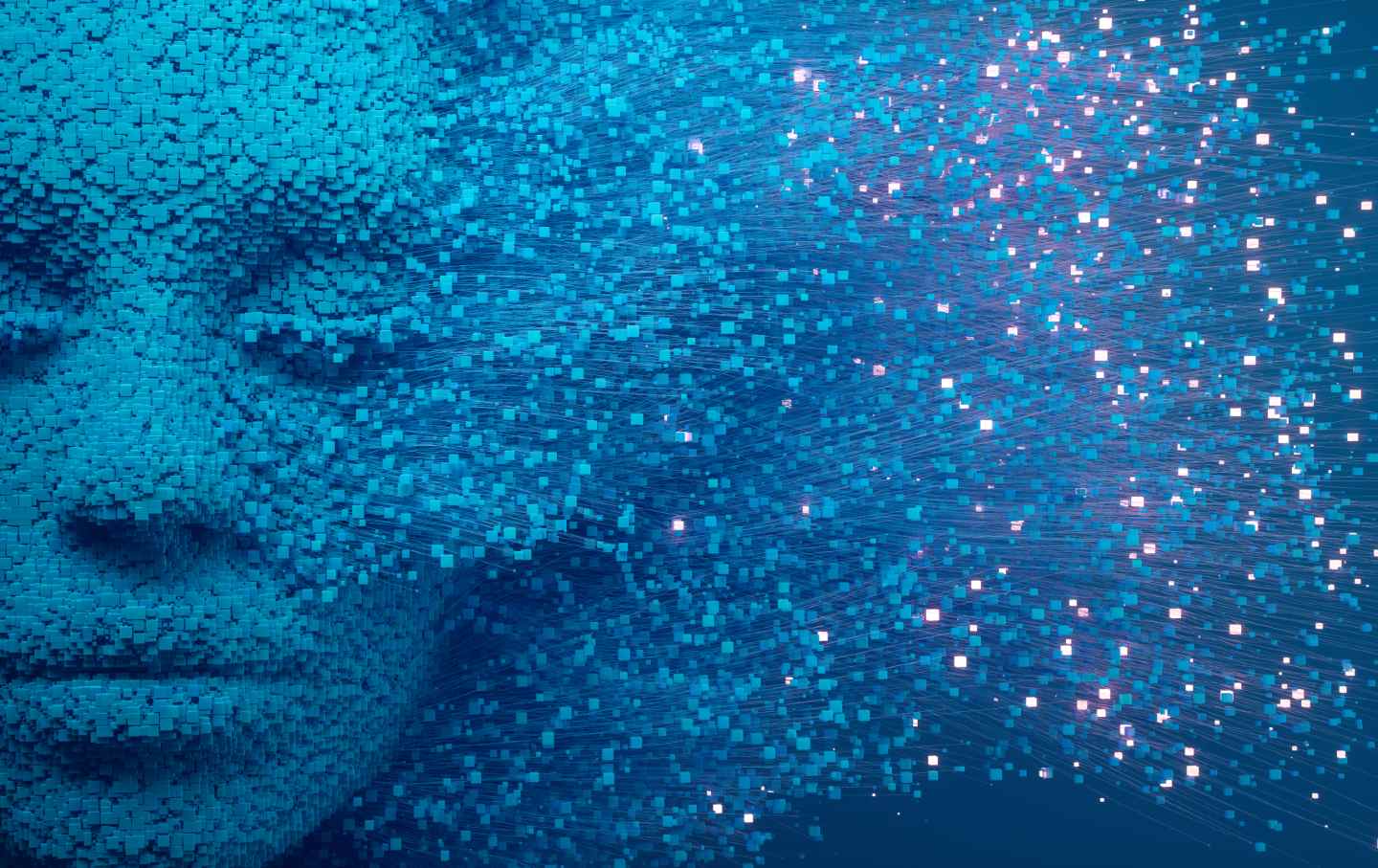
An abstract human face dissolves into a cloud of glowing cubes. The image illustrates concepts of data fragmentation, information flow, and technological change.
(imaginima / Getty Images)On May 1, OpenAI CEO Sam Altman tweeted about what his company hopes to achieve with artificial intelligence. “We want to build tools to augment and elevate people,” he wrote, “not entities to replace them.”
The statement was no doubt meant to calm the millions of nerves jangled by the cascade of layoffs that have accompanied the arrival of AI, with scores more predicted in the coming years. The problem is that, until very recently, Altman has been making it clear not only that “entire classes of jobs will go away” but also that he doesn’t envision humanity existing in its current form for long.
In a 2017 blog post, he argued that our best chance of surviving the rise of artificial superintelligence will be to “merge” with the machines. He wrote that “we will be the first species ever to design our own descendants,” and “we can either be the biological bootloader for digital intelligence and then fade into an evolutionary tree branch, or we can figure out what a successful merge looks like.” Altman was arguing, effectively, that there are two possible outcomes for the ASI age. Artificial superintelligence might get rid of our species; the “bad case,” he warned in 2023, is “lights out for all of us.” Or humanity could survive the advent of ASI by integrating ourselves into the digital world, becoming one with our digital progeny.
What might this “merge” look like? Altman has suggested it might start off with people becoming “really close friends with a chatbot.” But “the full-on-crazy version,” he told The New Yorker in 2016, “is we get our brains uploaded into the cloud. I’d love that.” Altman himself has signed up with a company called Nectome to have is brain “uploaded” to a computer when he dies. He’s already taking steps to become an AI himself.
The implications of Altman’s future-casting are radical and raise serious questions for anyone interested in our collective future. These questions include: Who will own the computers on which digital minds exist? Who will have the opportunity to “merge” with ASI once it arrives—everyone around the world? Billionaires and poor people alike? MAGA supporters and the “woke” left? Obviously not. The tech oligarchs who run our country will never permit the masses to join them on “the cloud.” These people live in gated communities, have their own apocalypse bunkers, and want to flee Earth for Mars. Their whole schtick is separating themselves from the masses, building a socioeconomic firewall between them and us. As the media theorist Douglas Rushkoff notes in his 2022 book Survival of the Richest, the billionaires want to upload their minds to the digital realm because it provides the ultimate escape hatch from the world they’re destroying. The digital afterlife is not for the 99.9 percent.
At least as serious is the question of what “merging” with AI would require of the human organism. Uploaded minds would have no physical body. They would exist as mere software floating in a digital ether—creatures in the form of pure information. They would never age, because software is immortal, and they could share memories, personality traits, and experiences with one another at the metaphorical click of a button. The boundaries between individuals would become porous, and everyone would meld into a giant amorphous digital hive mind. Consequently, uploaded humans would be so different from biological humans that we would classify them as forming an entirely novel species, which we can call “digital posthumans.”
As for what might happen if we don’t become digital posthumans, Altman predicted a kind of Terminator-level “conflict” that could end either with their enslavement—or ours. “We need to level up humans,” Altman told The New Yorker, “because our descendants will either conquer the galaxy or extinguish consciousness in the universe forever. What a time to be alive!”
Altman’s account of the future is an instance of what I call “digital eschatology,” where “eschatology” refers to a belief system or narrative framed around the end of the world as we know it. Adherents of this view believe that the future will—and should—be dominated by digital rather than biological beings. It finds expression in Elon Musk’s claim that, because of AI, biological “intelligence” will soon constitute less than 1 percent of all the “intelligence” on Earth. Larry Page, cofounder of Google, has reportedly argued that “digital life is the natural and desirable next step in… cosmic evolution and that if we let digital minds be free rather than try to stop or enslave them, the outcome is almost certain to be good.” Like Altman, he imagines humans eventually “merging” with AI such that “one day there would be many kinds of intelligence competing for resources, and the best would win.”
In 2012, Page personally recruited Ray Kurzweil, the famed futurist and transhumanist, to work at Google. Kurzweil argues that the “singularity”—when humans merge with machines—is imminent, and that if you choose not to upgrade yourself, then “you won’t be around for very long to influence the debate.” Become posthuman or die out.
A former Kurzweil collaborator, Eliezer Yudkowsky, similarly claims that “the happy future” is one in which people have been transformed into magical digital beings living in computer simulations that are “powered by the sun.” He suggests that these posthumans might then “clear all the humans off the earth and leave the entire place as a park.” On another occasion, he argued that it’s so important for there to be superintelligent AIs in the future that he would willingly sacrifice “all of humanity” to create such beings if it were the “only…reliable” way to make this happen.
As rank and untethered as these views are—and as much as they now serve to boost the narrative that AI is inevitable and can only be entrusted to our current tech elite—they are also an orthodox religious view within Silicon Valley. From leading scientists to young researchers, from tech CEOs to AI futurists, from AI “doomers” to “accelerationists,” nearly everyone agrees about one thing: The future will be digital. The age of biological humans is coming to an end, and the role of our species in this grand eschatological scheme is to initiate the new era of digital lifeforms—to trigger the singularity by creating superhuman AIs that usher in what Yudkowsky calls our “glorious transhumanist future.”
The advent of this digital era might seem like a distant possibility. Yet the CEOs of DeepMind, OpenAI, and Anthropic all predict that ASI will arrive within five years—meaning that it could be here as soon as this year or as late as the early 2030s. According to Musk, who founded xAI (which recently merged with SpaceX), we’re already in “the very early stages of the singularity.” Altman agrees, declaring in a 2016 interview that “the merge has begun.” He reiterated this view in a 2025 blog post, arguing that “the takeoff has started,” although he tempered his pronouncement slightly by adding that this process will unfold in a gradual manner. “The singularity happens bit by bit,” he wrote, “and the merge happens slowly.”
To be sure, humanity has been “merging” with technology since the origins of our evolutionary genus, Homo. The first human species, Homo habilis, crafted stone tools to scrape meat from bones, among other things. These stone tools could be seen as technological “enhancements” of the human body, and consequently one could conceptualize our ancient ancestors as rudimentary “cyborgs.” Today, people have pacemakers to control their heart rhythms, electrodes in their brains to ease the symptoms of Parkinson’s disease, and cochlear implants to restore hearing. Many of us offload parts of our memories to computers. I doubt most people could recite their friends’ phone numbers; what’s the point of memorizing them when our smartphones can do it for us?
There is, however, a crucial difference between technologies that enhance humanity as humanity and those that would transform us into something completely different. The “merge” that Altman and other Silicon Valley extremists want to bring about would entail fundamental changes to the very nature of being human, because the ultimate goal, in Altman’s words, is to “crazy uplevel” people by reengineering them into digital posthumans.
Whereas I, and most people outside the Bay Area, advocate for technologies that improve the human condition, the tech elite advocate for technologies that would ultimately replace it with a new posthuman condition. That’s the point of “the merge”: to transition our species into a new digital era, whether you and I want this or not.
Alarmingly, we see evidence of “the merge” all around us today. Altman is correct that this process has already started—and that should worry us.
Consider that many students are now outsourcing critical thinking skills to AI. One study found that “more than half of teens” are using AI to complete their schoolwork. At the end of last year, I asked my class of 350 students at Case Western Reserve University to raise their hands if they know of someone in the class who used AI chatbots to generate an entire assignment at some point during the semester. To my chagrin, two-thirds raised their hands, despite my co-instructor’s and my insisting that they eschew AI.
One undergraduate told me that nearly everyone in his pre-med cohort uses AI to complete most of their coursework, as this frees up time for internships. If I were to walk into the pre-med library, he said, I’d find nearly every computer with ChatGPT open in a window. And students aren’t the only ones offloading the labor of thinking. Studies show that six in 10 teachers are now delegating grading tasks to AI, meaning that there’s no human in the loop at all: AIs are generating term papers that are then evaluated by AIs.
Critical thinking is a core capacity of the human mind. It’s what enables us to evaluate, analyze, and synthesize information. By offloading such skills to AI, young people are becoming dependent on it for even simple cognitive tasks. They are essentially “merging” with AI by integrating it into their cognitive systems, alongside other brain structures like the hippocampus and prefrontal cortex. If AI were to become suddenly unavailable, these students might experience the loss as a serious if reversible form of brain damage. This coupling of human brains with AI is a small but nontrivial step toward Altman’s goal of radical cyborgization.
Another manifestation of “the merge” concerns the way AI is replacing people in our social lives. We are in the grips of a loneliness pandemic, which impacts 18- to 24-year-olds the most. Consequently, many young people are turning to AI to satisfy their need for friendship, belonging, and even romance.
AI is designed to be sycophantic—to validate users with affirmations and constant flattery. Befriending AI requires no emotional effort or social skills, and one can turn to it at any time of the day—or night—to share one’s deepest secrets. Even more, AI “girlfriends” and “boyfriends” can be specifically designed by users to exhibit desired traits, and there’s no hassle if one opts to suddenly end the relationship. This makes AI especially appealing for young people isolated in a world torn apart by capitalism and technology.
One study from the nonprofit Common Sense Media found that 72 percent of teens in the US use AI for companionship, while another reports that “28% of Americans have had an intimate/romantic relationship” with AI. The AI girlfriend app OurDream has over 10 million users, while the AI companionship app Replika boasts of 30 million. More than 150 million people have used Snapchat’s My AI, and ChatGPT has 900 million active users per week. According to a Harvard Business School study, the number-one use of chatbots is “therapy” and “companionship.” This fits with Altman’s description of one form of “merging,” whereby people form “really close” bonds with chatbots.
Similar trends are found in the workplace. One person I’m close with tells me that he often uses AI as a coworker, delegating certain tedious tasks to it. But soon he may not have a job if AI CEOs like Dario Amodei are right that “AI could wipe out half of all entry-level white-collar jobs” in the coming years. Altman’s OpenAI even defines “AGI” (artificial general intelligence, the precursor to ASI) as “highly autonomous systems that outperform humans at most economically valuable work.” This is why the AI bubble has grown so large: Companies are banking on not having to pay human workers. Instead, they’ll pay far less in subscription fees to companies like OpenAI and Anthropic for access to AI workers that never sleep and never complain. Replacing humans with AI in the workplace is yet another step toward a world dominated by artificial entities rather than human beings.
Or consider how AI bands are now competing with real artists on streaming services. Last year, AI-generated songs reached “the highest spots on Spotify and Billboard charts,” and an AI “artist” named Xania Monet reportedly landed a record deal worth millions. Our social-media feeds are flooded with AI-generated videos, with many viewers unable to tell the difference between deepfakes and human-created content. According to Janice Min, a longtime Hollywood media executive, studios are now using AI more than they publicly admit. It was even “used to help enhance the Hungarian accents of lead actors” in the Oscar-winning film The Brutalist, according to Futurism.
The effect of this encroachment of AI into every corner of our lives—and society more generally—is to inure us to the push to digitize the whole world. It is conditioning us to accept the digital eschatology advocated by people in Silicon Valley.
This conditioning is further reinforced, in subtle but effective ways, by claims from AI boosters that human beings are fundamentally no different from the large language models (LLMs) that power chatbots like ChatGPT. During an interview last year, Altman complained: “People talk about how much energy it takes to train an AI model… But it also takes a lot of energy to train a human. It takes, like, 20 years of life and all of the food you eat during that time before you get smart.” This view simultaneously anthropomorphizes AI while dehumanizing people. It suggests that we are just biological forms of AI that undergo a “training” process not all that different from LLMs. It implies that we’re distinguished from AI in degree rather than kind.
On another occasion, Altman wrote on X: “i am a stochastic parrot, and so r u.” The phrase “stochastic parrot” was introduced by the linguist Emily Bender to describe how LLMs work: They stochastically—i.e., through a probabilistic process—string words together into sentences, based on patterns in their vast training data. They are not “thinking” in the same sense as what you and I do. Yet Altman claims the opposite: All our human brains do is stochastically concatenate words into sentences, and sentences into paragraphs. We are bio-LLMs, siblings to the LLMs crafted in AI laboratories.
Popular
“swipe left below to view more authors”Swipe →The implication is that transitioning to a world dominated by digital beings won’t be as radical as you’d think. Consider that every 30 years or so, a generation of humans dies out and a new generation replaces it. No one finds this problematic. However, if LLMs are fundamentally similar to humans, then replacing humanity with AI would be no different than one human generation replacing another. We are all one big family, so a world overrun by AIs wouldn’t constitute a dramatic transformation after all. Nor would “merging” with AI, as this would amount to nothing but one type of LLM fusing with another. That is Altman’s point.
For those of us on Team Human—rather than Team Posthuman—who don’t want digital beings to replace our species, we must be vigilant about the slow creep of AI normalcy. Each small step toward a digital future may appear relatively trivial: “All” AI is doing is writing students’ term papers, providing companionship, assisting people in the workplace, generating songs on Spotify, and so on. To be sure, there are plenty of people upset about these changes. But after initial protestations, many of us become acclimated to the new function of AI in our lives and society.
We must resist this normalization, because the end result will be a world in which our species is disempowered, sidelined, and ultimately expunged. As AI takes over, humans will become increasingly obsolete—economically, scientifically, politically, and technologically. Obsolescence makes us disposable, and that’s precisely what will happen: The elites will “merge” with AI to survive the arrival of superintelligence, while the rest of us will be left behind. By Altman’s own account, we will be enslaved and then eliminated. And that is, once again, his “best-case scenario” for the future.
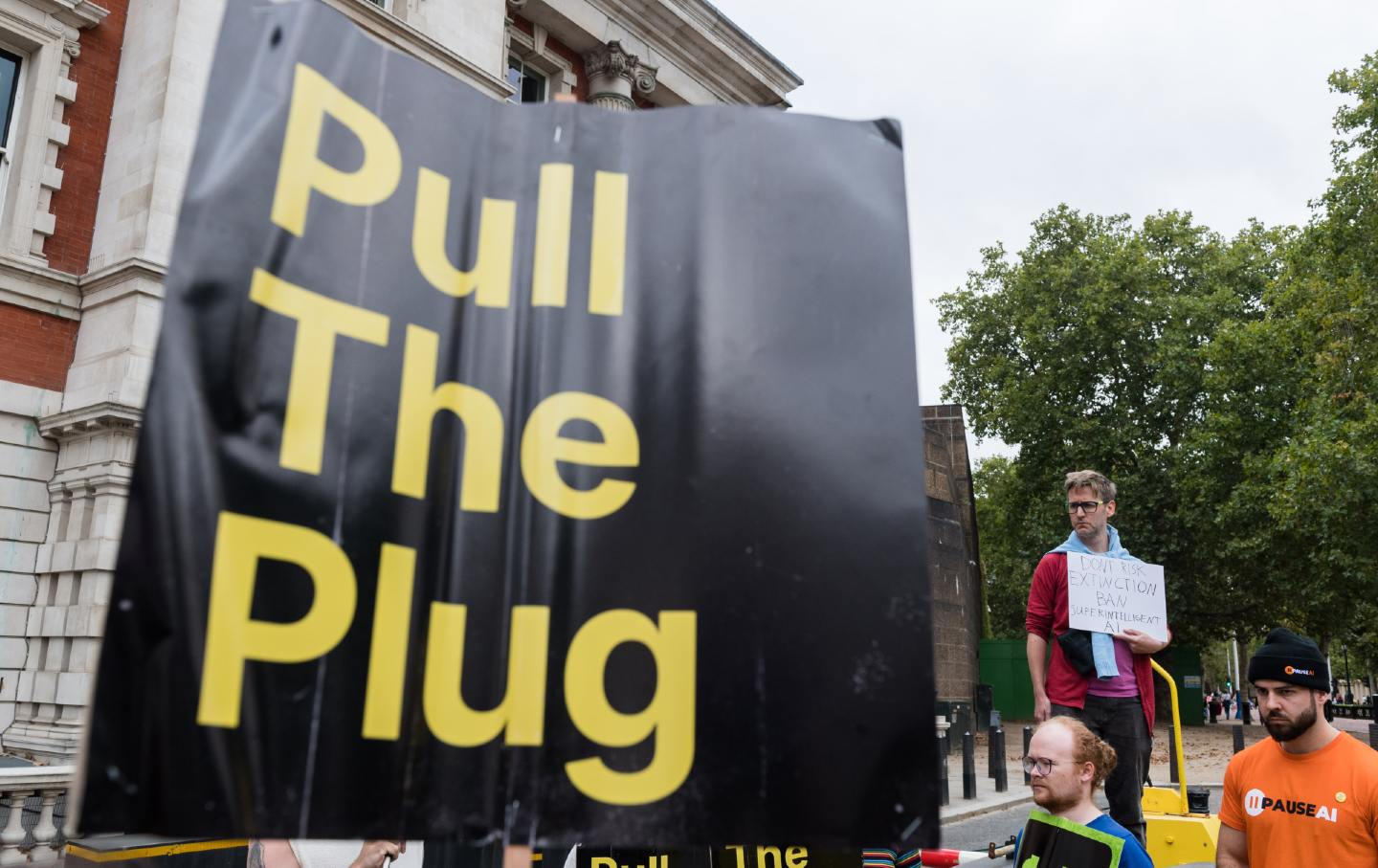
But there’s still time to stop this from happening. We can resist the push to realize Silicon Valley’s dream of digital eschatology by fighting back against the AI companies. Boycotts, protests, data poisoning, and pressuring our representatives to regulate the AI industry are all necessary. The further down this path we go, the harder it will be to reverse course. We don’t want to end up like the proverbial frogs in a pot of boiling water. Hence, for Team Human, there is a certain moral urgency to resisting the eschatology of Silicon Valley.
Altman claims that OpenAI is not trying to build “entities to replace” us. But that is precisely what will happen if the AI bros get their way and their own predictions come to pass.
More from The Nation
How Mexico Proved Mainstream Economics Wrong How Mexico Proved Mainstream Economics Wrong
American analysts have long viewed inequality as a byproduct of technological causes. But Claudia Sheinbaum’s Morena Party has boosted workers’ income without any technological tr...

My Rape, the Cornell Case—and Why We Need Better Approaches to Teaching How Consent Works My Rape, the Cornell Case—and Why We Need Better Approaches to Teaching How Consent Works
I tried to process the experience of being raped by disassociating. We have to show our kids a better way.

The Death Penalty Has Become a Torture Machine The Death Penalty Has Become a Torture Machine
Christa Pike's botched lethal injection proves there is no humane form of execution.
The People vs. the Supreme Court The People vs. the Supreme Court
This term the Supreme Court has plans to trample
even more of our rights. But we, the people, are not powerless
in the face of their power grab.
Cornell Students Challenge University Power at a “Students vs. Billionaires” Town Hall Cornell Students Challenge University Power at a “Students vs. Billionaires” Town Hall
Representative Alexandria Ocasio-Cortez spoke to Ithaca students about tuition hikes, sexual violence, free speech, and university governance.