Attacks on Black Citizenship Are Attacks on Democracy
Too often, Democrats reinforce Republicans’ lie that the language of racial justice is the problem—instead of the injustices the language is trying to name.
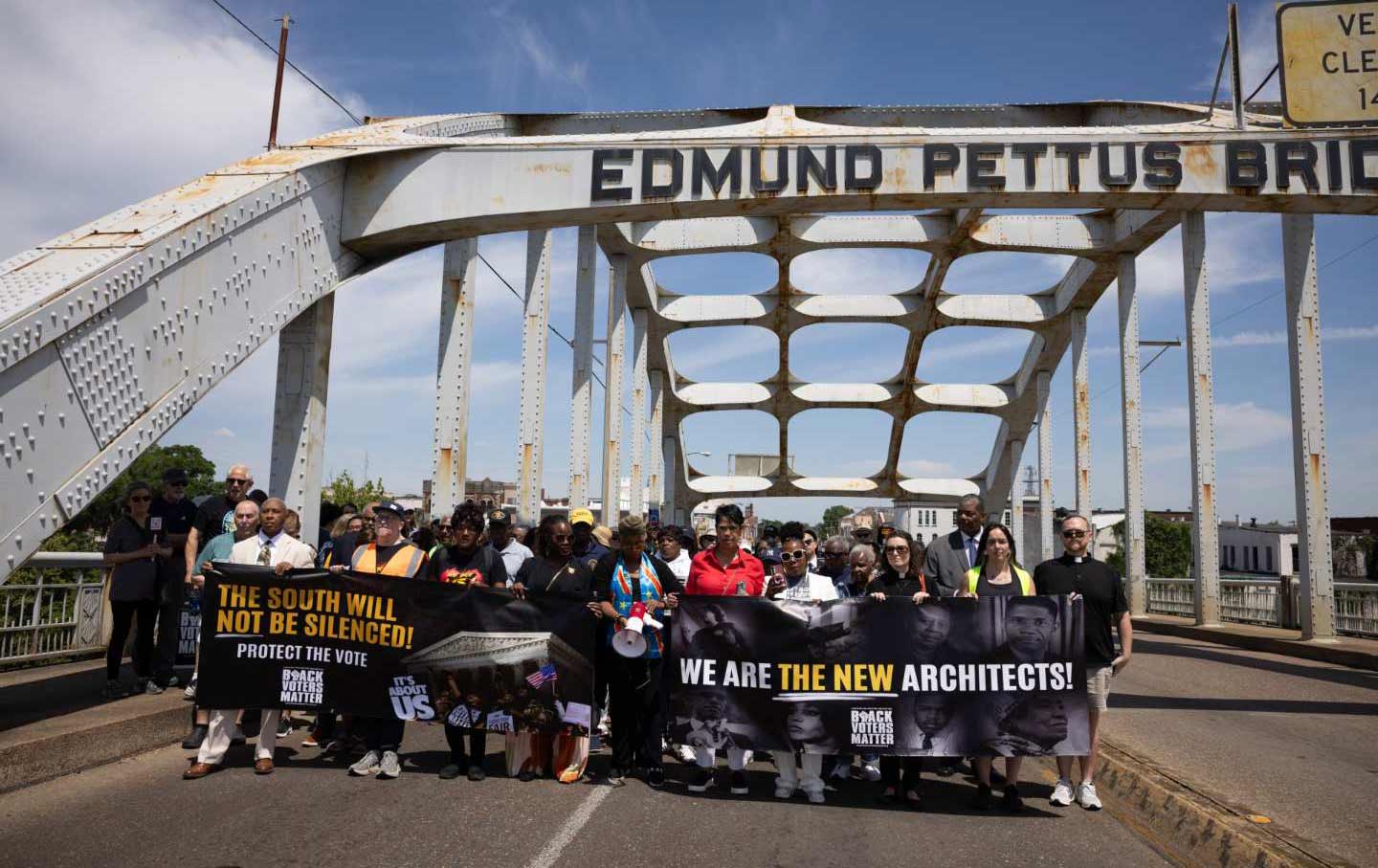
Voting is a defining right of citizenship in a democracy. That’s why the United States can only be described as one after the Voting Rights Act of 1965 overturned the Jim Crow–era laws that systematically robbed Black Americans of the right to vote. But in April, the Supreme Court voted to gut what little remains of that legislation. The court’s conservative supermajority ruled in Louisiana v. Callais that race-conscious congressional maps violate the Constitution but partisan ones do not. In a country where race so often predicts party, racist mapmakers can plead partisan intentions, and the court has put the burden of proof on their critics. The effect is that racist gerrymandering is nearly impossible to challenge. This outcome seems to have finally forced Democrats to recognize that attacks on Black citizenship are attacks on democracy itself.
Too bad that recognition comes so terribly, tragically late. Louisiana v. Callais was an utterly predictable milestone in the right’s ongoing legal and cultural counterrevolution against Black civil rights and Black citizenship itself. And it was Democrats’ passivity and even deference in the face of that counterrevolution that helped enable its success.
Since public outrage over the killing of George Floyd briefly forced Americans to reckon with our legacy of racial injustice, the right has been overt in its frontal attack on the struggle for Black equality. Most often, we heard about the right’s attacks on speech—on slogans like “Black Lives Matter,” which the right derided as racially exclusionary, or on crucial concepts, often developed by scholars, like critical race theory, intersectionality, and diversity, equity, and inclusion (DEI). But the backlash quickly turned from the rhetorical to the material: Within one year of 2020’s Black Lives Matter protests, more than 100 bills to limit the rights of protesters were introduced nationwide, and at least three states passed “hit and kill” laws to shield people who struck protesters with their vehicles from criminal or civil liability. Nearly 900 proposals to limit how educators teach race and sex were filed at the local, state, and federal level, with 21 states codifying restrictions on classroom instruction about slavery and racism. The right’s attacks on DEI programs would help justify everything from 600,000 Black women losing their jobs within Trump’s first year back in office, to purges of Black historical artifacts from museums, to the cancellation of long-overdue sanitation improvements in the Black Belt. Eventually, Republicans reduced this entire assault to a war on wokeness, a word they redefined and weaponized to mean anything related to race.
Each attack further normalized the idea that Black claims to equal citizenship are illegitimate. “They start out by demonizing our language,” Stacey Abrams, the voting-rights activist, attorney, and former Georgia lawmaker, said recently on her podcast, Assembly Required. “It then moves to litigation to dismantle the rights we have. And then, eventually, to legislation to ensure we can never build them back.”
Instead of rebutting these attacks, Democrats blamed the very language that the right was demeaning—and rushed to disavow it themselves. Vermont Senator Bernie Sanders argued that the Democrats lost the 2024 presidential election because they presented themselves as “a party of identity politics.” Virginia Senator Mark Warner claimed that the party’s “over-the-top wokeism” resulted in “a valid attack.” Washington Representative Adam Smith sought counsel not from the scholars and community organizers whose ideas had been openly—and proudly—distorted by the conservative activist Christopher Rufo, but from Rufo himself. In early 2025, the center-left think tank Third Way convened a group of moderate Democrats in order to, as Third Way’s summary of the gathering described it, “chart the Democratic comeback.” The bulk of their grievances, Politico reported, “centered on the kind of identity politics that they believed lost them races up and down the ballot.” The group’s top recommendation was for the party to “move away from identity politics.” A follow-up list of over 40 terms to avoid included intersectionality and critical theory, lest Democrats be seen as “enforcers of wokeness.”
This was tantamount to cosigning the moral panic spread by Republicans. It reinforced the lie that the problem was the language of racial justice instead of the injustices the language was trying to name. “This is perhaps a reflection of one thing that the right did understand about us,” Kimberlé Crenshaw, the legal scholar who coined the term intersectionality and worked with other scholars to develop critical race theory, suggested to me: “that our commitments to these so-called values, and our literacy with the ideas that are an expression of those values, was tepid at best.”
Then conservatives used what Crenshaw calls the “Trojan horse of wokeness” to mainstream ideas that had previously been considered extreme. The right increasingly called for circumscribed citizenship, from propagating the idea of “heritage Americans” to attempting to overturn birthright citizenship. “I would often say, ‘If you think [that conservatives are] moving into this space only to eliminate the things you don’t really know or feel ambivalent about—structural racism, critical race theory, the 1619 Project—you are so sadly mistaken,’” Crenshaw told me. “‘Because it is going to transcend, it’s going to metastasize, and it’s eventually going to take out a bigger chunk of what you may value as part of our collective history.’”
Someday, historians will retrace the steps leading to this authoritarian moment, and they will undoubtedly point to Republicans’ steady march toward extremism. But I hope they will also note that Democrats helped clear the path by treating each right-wing attack on Black citizenship as a fight too politically risky to wage, until we ended up with this frontal assault—first on the words, then on the laws, and now on democracy itself.
Become a Sustaining Donor This September
Between the reemergence of right-wing red-baiting and Donald Trump’s use of the chilling National Security Presidential Memorandum–7 to criminalize left political organizing, we’re seeing McCarthyism reborn before our eyes.
This assault on democracy cannot be ignored or wished away. Resisting it requires bravery in the face of threats and repression, a steadfast commitment to the truth, and the unwavering belief that we can—and will—overcome this darkness.
We must have an independent media that sets the record straight, unearths corruption and abuses of power, and advances a politics of justice and dignity for all if we’re to win this fight.
That’s why I’m writing to you today. This September, The Nation needs to add 100 monthly donors to sustain our progressive journalism. Your contribution makes the next investigative report, the next truth-speaking column, and the next pathbreaking essay all possible.
I hope you’ll support our work with a recurring donation today. If you donate $10 or more a month, we’ll send you a brand new “Hands Off the Free Press!” sticker to recognise your commitment to our cause. Please, donate today.
Onward,
Katrina vanden Heuvel
Editor and Publisher, The Nation