
Trapped in “el Pozo”: As Overcrowding in ICE Detention Increases, So Does Solitary Confinement
Trapped in “el Pozo”: As Overcrowding in ICE Detention Increases, So Does Solitary Confinement
The spike in solitary confinement epitomizes the abuses of a migrant detention system that seems to be spinning out of control.
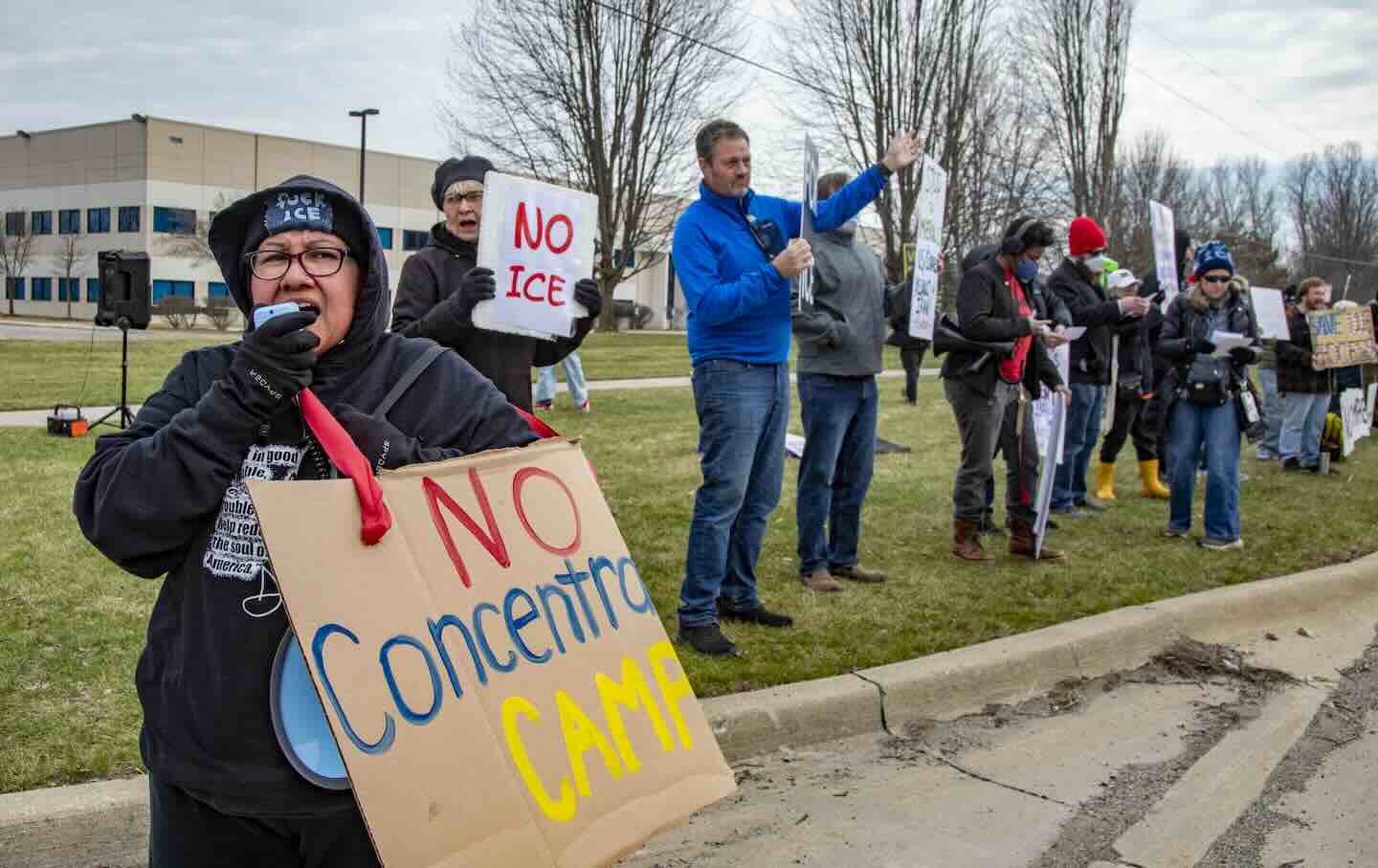
The practice of solitary confinement has soared during the Trump administration’s nationwide crackdown on illegal immigration.
(Jim West / UCG / Universal Images Group via Getty Images)This article received support from the independent nonprofit newsroom Solitary Watch.
Angel Lemus-Linares, a 32-year-old migrant from El Salvador seeking political asylum, recalls ICE officers shoving him into a filthy, cramped solitary confinement cell and beating him after another detained individual attacked him while in ICE custody. He remained for seven consecutive days in what’s known as “el pozo”—the hole—at the T. Don Hutto Detention Center, a notorious, privately run facility in Taylor, Texas.
“They beat me a lot,” Lemus-Linares said in a phone interview from inside Hutto. “They had left my ribs and sides all bruised.”
On three occasions from October 2023 to December 2025, he said, officers at the facility locked him in the solitary unit without giving a satisfactory reason other than that they don’t like him. He spent 24 hours a day isolated in the cell with virtually no access to medical care or even a bathroom until officers decided his punishment was over.
Lemus-Linares is one of thousands of individuals that US Immigration and Customs Enforcement has locked in solitary confinement in its custody—a practice that has soared during the Trump administration’s nationwide crackdown on illegal immigration. More than 10,500 detained migrants were thrown into solitary confinement in the 14 months ending in May 2025, according to a recent report by Physicians for Human Rights (PHR).
In the first four months of Trump’s second term, the monthly increase in the harsh punishment was twice the rate documented between 2018 and 2023. Trump has built on increases during the Biden administration, when it grew by 56 percent each quarter in FY 2025 compared to 2022.
The spike in solitary confinement epitomizes the abuses of a migrant detention system that seems to be spinning out of control. After 15 months, the Trump administration is already locking up a record high number of people—at one point holding over 70,000 individuals in its custody in January 2025—in the over 160 facilities that ICE acknowledges; roughly 200 other “staging facilities” have been used by the agency, though they are not counted in its public figures. And the administration plans to spend billions of dollars to add more than 41,000 detention beds to its facilities by January of next year, giving ICE the capacity to hold more than 107,000 people, according to The Washington Post.
In the meantime, conditions are deteriorating, and mortality rates within ICE facilities are skyrocketing. Earlier this month, the agency reported the 18th death and the fifth suicide of an individual in its custody so far in 2026—the most on record in over 20 years and on track to be the highest in the agency’s history, according to a recent release from PHR. Denny Adan Gonzalez, the individual who took his own life, was reportedly isolated in solitary confinement while in custody.
Amid a partial government shutdown that closed the Department of Homeland Security, ranking Judiciary Committee member Senator Dick Durbin (D-IL) noted the appalling conditions and rising mortality rates within ICE facilities in a speech on the Senate floor, calling for reforms within ICE and CBP and stating that Democrats “will not fund cruelty without accountability.” Though the House has since passed legislation to reopen DHS without direct funding for ICE and parts of CBP, House and Senate Republicans are looking to enact legislation that would directly provide the agencies with over $70 billion through the end of Trump’s second term, without any reforms. Furthermore, the administration has moved to close a watchdog agency, which Trump had signed into law in 2020, citing its lack of funding in the spending bill that reopened DHS.
“Conditions inside of ICE detention have always been egregious and deplorable,” said Setareh Ghandehari, the advocacy director at Detention Watch Network, an immigrant-advocacy organization. “All of these things are just being exacerbated, and part of that is because the number of people in detention has risen so rapidly over the last few months.”
It’s difficult to determine precisely how many detained people ICE has segregated since Trump took over. ICE itself has reported that between April 2024 and August 2025, it placed 13,866 detainees in solitary confinement, with almost 54 percent oof them occurring following Trump’s second inauguration. But despite these numbers, ICE has a long history of underreporting solitary confinement placements and a lack of transparency more broadly.
In January of 2025, the ACLU filed a FOIA lawsuit against ICE after the agency updated its solitary confinement policy in December 2024, but did not publicly release the updated guidelines or respond to the civil rights group’s request for a copy. “ICE has largely hidden its use of solitary confinement to abuse people held in immigration detention, and our FOIA findings provide much needed disclosure regarding the standards and requirements for using solitary confinement units,” the ACLU’s Cho said in a press release.
ICE policy has mandated that solitary confinement, or “segregation” as it calls it, should never be a form of retaliation and that officers should only briefly use it after an individualized assessment and the consideration of less restrictive alternatives. However, those who represent “an immediate, significant threat to safety, security or good order” may be placed into solitary confinement if cause exists, following approval from a supervisor.
Popular
“swipe left below to view more authors”Swipe →But a 2024 report by PHR found that ICE didn’t appear to be following its own policy. The report, “Endless Nightmare,” revealed that of the more than 14,000 solitary confinement cases within ICE facilities between 2018 and 2023, detained people were isolated for 27 days on average, with more than 680 segregation cases lasting at least three months, well over the 15-day limit established by the United Nations.
The updated policy, obtained by the ACLU, requires individualized assessments and a review of a detainee’s medical history to be completed when deciding to place the individual in solitary confinement, in addition to communicating a reason for the detainee’s placement in a manner they can understand. It also directs ICE to use the practice only as a last resort for pregnant individuals and to place individuals with serious physical or mental health issues in an environment, within or outside of the facility, in which they can receive treatment.
Despite the updated policy, the neglect and abuse of these populations persists. A letter from the ACLU released last October detailed the frequency at which pregnant individuals in custody were barred from medical attention and prenatal care, with one pregnant woman testifying that she’d been isolated in solitary confinement and blocked from receiving medical treatment until other detained individuals advocated for her.
ICE did not respond to a request for comment.
It’s also important to note that migrants face fewer legal protections after the Trump administration gutted civil rights enforcement. In March of 2025, the Department of Homeland Security (DHS) announced that it would reduce staffing of its Office for Civil Rights and Civil Liberties, which investigates civil rights complaints. The office had multiple ongoing investigations among the over 160 detention facilities nationwide before reportedly losing four-fifths of its staff.
Solitary confinement is not the only way that people in ICE detention experience extended periods of isolation. Overcrowded facilities and staff shortages contribute to prolonged lockdowns, when detained people are confined to their cells with limited access to resources and recreational time—a form of solitary confinement.
During FY 2025, a report by the Transactional Records Access Clearinghouse at Syracuse University found that the vast majority of ICE facilities repeatedly exceeded their contractually allocated capacities—a likely indication of overcrowding. In one case, the report found that the Krome North Service Processing Center in Florida held, on average, around 158 people over capacity, exceeding its limit threefold for at least one night.
A recent report by Human Rights Watch (HRW) highlighted Krome’s harmful overcrowding issues, with detained individuals reporting that they lacked access to bedding, clothes, hygiene, and medical resources. The lack of access to medications and healthcare potentially contributed to the deaths of two detained people.
According to Cho, ICE facilities often go into lockdown due to staffing shortages, which in turn creates distress for those detained.
“Being put into lockdown for lengthy periods of time is very challenging for people,” Cho said “The number of hours a day that you have to do basic things, such as take showers, make phone calls to your counsel, talk to your family, use law library resources—things that might be vital to your case—all those things may be squeezed into a few hours a day.”
Lemus-Lenares has undergone lockdowns, lasting from around eight days to more than two weeks, multiple times while at Hutto. He said the staff put the facility under lockdown in retaliation after the detained population demanded better living conditions. Oftentimes, he said, the facility serves the detained population rotten or moldy fruit and meat, and provides expired medicine.
“They always tell us that we don’t have the right to demand anything because we’re not in our countries,” he said.
Lemus-Linares had turned himself in at the US border in Piedras Negras, Mexico, in October 2023, seeking asylum due to alleged discrimination and abuse from the Salvadoran government. He has been fighting his deportation through the immigration courts ever since.
During a 17-day lockdown period, Lemus-Linares recalls, the detained population was given only one meal a day for three of those days. “After a week, they started giving us no more than an hour outside of the cells, just so we could bathe ourselves,” he said.
Like lockdowns, solitary confinement is often used as a punishment or retaliation, according to Jessica Sandoval, the national director of the Unlock the Box Campaign, which aims to end solitary confinement. She said ICE officers use the practice against detained individuals who won’t or can’t comply with demands, even if the individual doesn’t speak the officer’s language.
“If somebody isn’t willing to sign papers, is having trouble understanding certain directives not in their own language, or they simply say no to a strip search, they’re oftentimes put in solitary for punishment,” Sandoval said. “Oftentimes it’s for coercion, like, ‘You don’t wanna do this? Then we’ll put you in solitary and make you do it.’”
Reports from ICE facilities across the country consistently corroborate this point. In one case, ICE officers at Stewart Detention Center in Georgia placed a Liberian-born man in segregation for three days after he refused to enter a flooded cell that could have damaged his electronic prosthetic legs, according to The Guardian.
HRW’s report, “You Feel Like Your Life Is Over,” found that ICE officers at the Broward Transitional Center in Florida routinely segregated migrants for weeks for expressing distress or seeking mental health support. In one instance, an individual recalled that the facility’s ICE officers denied mental health support to another detainee. After he had self-harmed, they isolated him for a week without providing psychological support.
In Lemus-Linares’s experience, ICE officers at Hutto target migrants who don’t speak or understand English with threats, physical abuse, and solitary confinement. He said they often tell him that, by law, he must speak English in the United States.
“They’ve beaten me and told me that if I ever say anything, I’m going to face the consequences,” Lemus-Linares said. “[They tell us] that we are nothing more than rats that have come to invade their country.”
In December, after winning a Board of Immigration Appeals case, Lemus-Linares had a new hearing on his asylum claim where an immigration judge denied him relief and ordered his removal. Denise Gilman, Lemus-Linares’s attorney, and codirector of the Immigration Clinic at the University of Texas School of Law, said that if Lemus-Linares returned to El Salvador, he might be imprisoned and tortured, but Lemus-Linares chose not to file another appeal. Solitary “led him to become even more isolated within the facility, which…led to even greater harsh impacts on his mental health.”
Gilman said Lemus-Linares has since been deported to Mexico and is applying for refugee status.
Become a Sustaining Donor This September
Between the reemergence of right-wing red-baiting and Donald Trump’s use of the chilling National Security Presidential Memorandum–7 to criminalize left political organizing, we’re seeing McCarthyism reborn before our eyes.
This assault on democracy cannot be ignored or wished away. Resisting it requires bravery in the face of threats and repression, a steadfast commitment to the truth, and the unwavering belief that we can—and will—overcome this darkness.
We must have an independent media that sets the record straight, unearths corruption and abuses of power, and advances a politics of justice and dignity for all if we’re to win this fight.
That’s why I’m writing to you today. This September, The Nation needs to add 100 monthly donors to sustain our progressive journalism. Your contribution makes the next investigative report, the next truth-speaking column, and the next pathbreaking essay all possible.
I hope you’ll support our work with a recurring donation today. If you donate $10 or more a month, we’ll send you a brand new “Hands Off the Free Press!” sticker to recognise your commitment to our cause. Please, donate today.
Onward,
Katrina vanden Heuvel
Editor and Publisher, The Nation
More from The Nation


Trump Has Made it Legal to Destroy Endangered Species’ Habitats Trump Has Made it Legal to Destroy Endangered Species’ Habitats
By redefining the meaning of “harm” in the Endangered Species Act, the administration is giving big corporations a gift they have long demanded.

Journalist Meaghan Beatley on Latin America’s Feminist Resistance Journalist Meaghan Beatley on Latin America’s Feminist Resistance
A conversation with the author of Sex and Dissent about what American feminists can learn from the Green Wave movement.

As Cornell’s Rape Case Draws National Attention, Students Want Accountability. As Cornell’s Rape Case Draws National Attention, Students Want Accountability.
A new lawsuit alleging that a former student was drugged and gang-raped by Chi Phi fraternity members is sparking outrage in the Cornell community.

Irish Goalkeeper Gavin Bazunu’s Refusal to Play Against Israel Puts Him on the Right Side of History Irish Goalkeeper Gavin Bazunu’s Refusal to Play Against Israel Puts Him on the Right Side of History
Bazunu’s decision raises the perennial question: Why is a country that is currently committing a genocide allowed to compete in the first place?

The Promises and Compromises of the University of California The Promises and Compromises of the University of California
I grew up in a neighborhood manufactured by the University of California, Irvine. It felt like a utopia for academics—until the university forsook its mission of serving the publi...

