May Day Films to Inspire You With Solidarity
From Modern Times to Harlan County, USA.
As we celebrate May Day, the International Workers’ Holiday, we might want to watch a movie that inspires us in our own struggles. But there aren’t that many great movies about the workers’ struggle. The reason is obvious—capitalists control Hollywood. Their class interest is in promoting the status quo, not radical change. Still, a century of movie history has led to some great films about the class struggle, anti-colonialism, and other leftist causes. Here are 20 of my favorites, in order of their release date. May watching them inspire you with solidarity!
The Battleship Potemkin (1925). From the moment of film’s invention, both capitalists and socialists understood the power of the moving image to influence people. The Soviet government made many powerful propaganda films to solidify their revolution in the 1920s. Sergei Eisenstein was the best of all the early Soviet directors. His film dramatizing the 1905 Russian ship rebellion, part of that year’s great revolutionary struggle, makes you want to overthrow the corrupt tsarist state a century later. If you like this, try Earth, The Extraordinary Adventures of Mr. West in the Land of the Bolsheviks, Strike, or some of the other astonishing early Soviet films.
Modern Times (1936). Charlie Chaplin was a committed socialist and, as his fame grew, he included more politics in his films. Modern Times is a fantastic comedy about working-class life that any viewer could relate to. He plays his famous Tramp character once again, but this time finds himself the subject of a corporate experiment to feed workers through automation so they work harder, gets spied on in the bathroom by the boss, and accidentally leads a strike. It’s a fantastic look at life under capitalism while also being funny and sweet.
The Grapes of Wrath (1940). John Steinbeck’s famous novel about Oklahoma migrants to California was not explicitly leftist. Neither was John Ford’s 1940 film adaptation starring Henry Fonda in an iconic role as Tom Joad. But the Great Depression opened Hollywood up to a little more lefty politics in the movies. Ford turned the novel into a powerful vision of how an entire class of farmworkers were chewed up and spat out by an America lying to its working class.
Salt of the Earth (1954). In 1950, Mexican mine workers organized with the International Union of Mine, Mill and Smelter Workers went on strike in New Mexico. They worked and lived in horrible conditions. They won that strike when women took over on the picket lines after a court banned the union members from striking. At the same time, Mine Mill leadership was under attack for their communist leadership. A group of blacklisted filmmakers came to New Mexico and used the workers and the organizers themselves to dramatize the strike. The filmmakers underwent police harassment and the female star was deported to Mexico during the shooting. It disappeared for decades before a rediscovery. When I show it to my students, I ask them how this film is communist, the justification for its blacklisting. They don’t get it—the film is about decent living conditions, indoor plumbing, and basic respect on the job. If that’s communism, sign me up.
A Generation (1955). Andrzej Wajda was the great filmmaker of Polish freedom. Later in his career, he got in trouble with the authorities for making films critical of the communist government, such as Man of Marble, which uses the story of an exceptional worker in the 1950s to discuss the corruption of the communist ideal. But in 1955, Wajda’s film about the role of socialism in the Polish resistance to the Nazis still makes me want to take up arms against the fascists today. A powerful, brilliant film.
The Organizer (1963). Mario Monicelli’s film is probably the best film ever made about a labor strike. Starring Marcello Mastroianni as an anarchist organizer fleeing the police who leads Italian textile workers in a strike, The Organizer does a wonderful job of showing the ups and downs of an early 20th-century strike that is doomed to fail but that builds the class struggle that viewers believe will eventually lead to victory.
I Am Cuba (1964). The Cuban Revolution of 1959 soon had the support of the Soviet Union. Mikhail Kalatozov, the greatest Soviet director of the era, worked with Cubans to create a film dramatizing four stages before the revolution—the sex work Cuban women do to survive, the exploitation by United Fruit, the failed student movements, and the successful peasant revolution that will propel Castro to power. It’s technically brilliant, simply a beautiful film to watch. It also teaches ideology while being super entertaining.
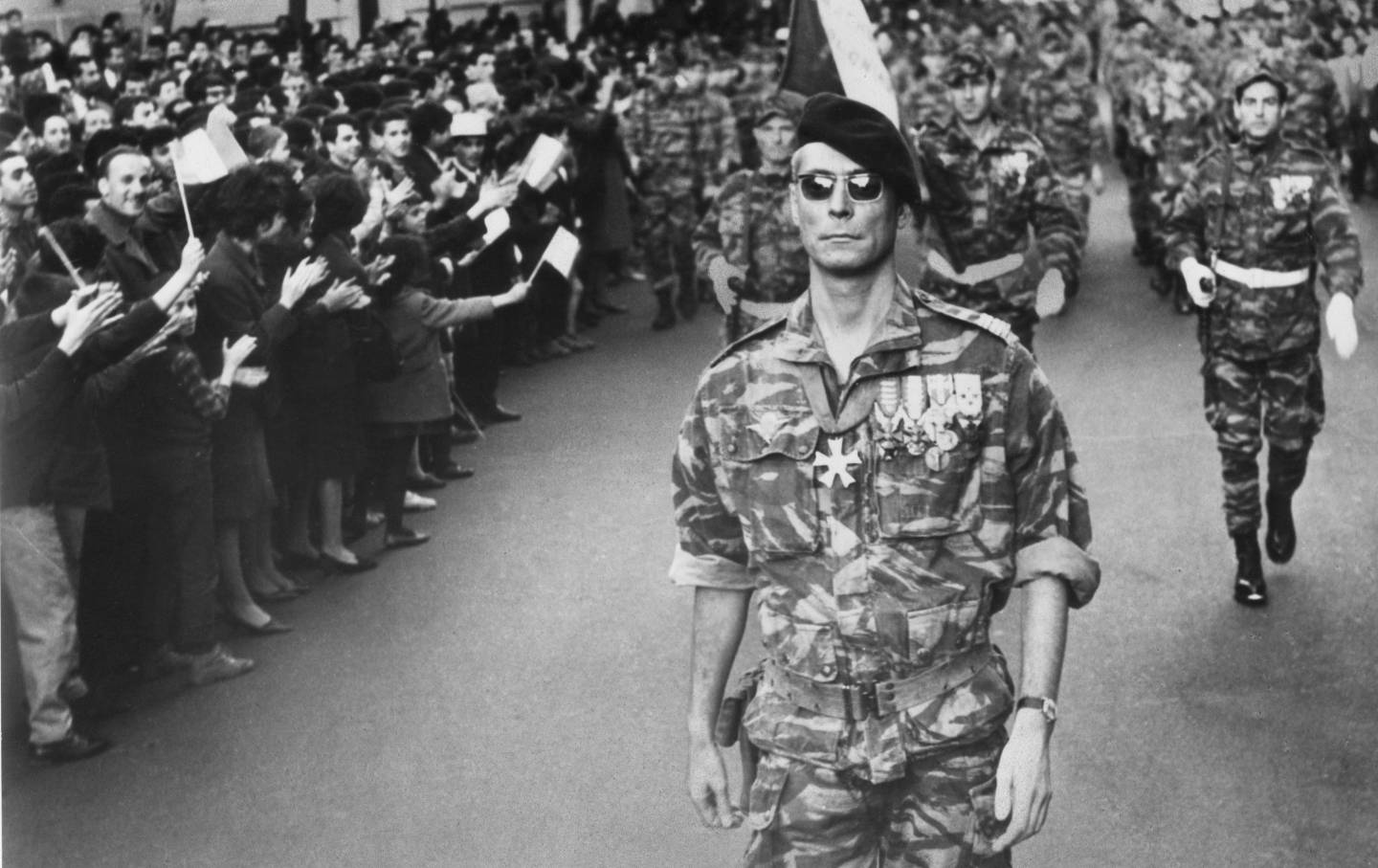
The Battle of Algiers (1966). In my opinion, Gillo Pontecorvo’s film about the Algerian Revolution against the French is the best film ever made. Period. Working with Algerians who had just won their independence, it tells the story of the revolution that lays out both revolutionary and counterrevolutionary ideology with tremendous sophistication. Most powerfully, it centers the real power and costs of violence, which can bring independence, but at the price of dead babies. Pontecorvo lets no one romanticize that violence, but he forces us all to understand how it leads to the historical inevitability of freedom.
Investigation of a Citizen Above Suspicion (1970). Just how much can a leading fascist get away with? That’s the subject of Elio Petri’s film. It follows a top police inspector who kills his mistress and leaves clues everywhere, just to see if he gets caught. Of course, all the powerful people know he did it. They don’t care. They intervene just before he destroys himself and make sure he stays in his position. You think this has any relevance for today?
The Battle of Chile (1975–79). Released in three parts in the late 1970s, this smuggled-out film is the document of a revolution and its failure. Directed by Patricio Guzmán, it is footage of the workers supporting the democratic socialist government of Salvador Allende and the rise of the right-wing counterrevolution that overthrew the government with CIA help in 1973, placing the neofascist military leader Augusto Pinochet in power as a dictator. You will never watch a better or more complete document of revolution. Guzmán himself had to flee Pinochet’s torturers and smuggle out the footage. The whole thing is a miracle.
Harlan County, USA (1976). Barbara Kopple’s documentary of a 1973 Kentucky coal strike shows some of this nation’s poorest workers struggling for basic decency on the job against one of the most exploitative industries in the nation. The United Mine Workers of America represented these workers, and it’s a story of the rise of democratic unionism as well as the story of a struggle told from the perspective of the workers themselves. A true masterpiece of documentary filmmaking.
Norma Rae (1979). Martin Ritt’s film fictionalized the story of Crystal Lee Sutton, a woman fired for organizing her North Carolina textile factory. Starring Sally Field, the film was a blockbuster, capped with Field holding up a sign reading “UNION” as she is escorted from the factory. Sutton herself was unhappy with the movie because it downplayed the organizing and the Black workers in the mill and created sexual tension between her and the organizer. Simplified it might be, but it’s a hell of a great film and places women at the center of the labor movement, as they should be.
Born in Flames (1983). Lizzie Borden’s film about men in a democratic socialist revolution kept women subordinated was hard to make. Who would fund it? No one. It took her years, filming one scene a month if she was lucky. It’s not any kind of technical masterpiece. It’s absolutely a political masterpiece that takes on racism, homophobia, and of course sexism in a supposedly democratically socialist utopia.
Matewan (1987). Even at the peak of his powers as an early giant of indie film, John Sayles could never raise much money. When he took on the story of the Matewan Massacre, part of the West Virginia Coal Wars of the 1910s and early ’20s, he attempted to tell a complex story of race, class, and violence on a shoestring budget. Somehow, he made it work and created one of the best films ever made on work in America. Starring James Earl Jones as the representative of the Black miners brought in as strikebreakers, a very young Will Oldham (better known as the singer Bonnie “Prince” Billy) as the young preacher and striker, and Chris Cooper as the organizer, this is the best feature film ever made about an American strike.
Popular
“swipe left below to view more authors”Swipe →The Wind That Shakes the Barley (2006). Ken Loach spent his whole career making socially conscious cinema, some about the British working class, some about specific incidents of the past, including the Sandinista Revolution (Carla’s Song), the Spanish Civil War (Land and Freedom), and the Los Angeles Justice for Janitors campaign (Bread and Roses). The Wind That Shakes the Barley, about Irish independence and the civil war that followed in the 1920s, is in my view his masterpiece. The story of two brothers who find themselves on opposite sides of the civil war, the film is ultimately about the tragedy of concluding the revolution and deciding when you’ve won enough. Every revolution has struggled with this question.
The Baader Meinhof Complex (2008). Uli Edel’s dramatization of West Germany’s Red Army Faction is the best of a series of films released around this time that told the story of the left-terror movements of the 1960s and ’70s. The commitment of these German leftists—to the point of death—is riveting, and yet the film does not let them off the hook either, showing their unseriousness when training with the Palestine Liberation Organization or the sloppiness by which they engaged in their political activism. It’s always better for the present to learn complex stories about past leftists and not strictly heroic stories. Edel does a great job of helping viewers understand a now largely forgotten moment in time when leftist terrorism seemed to make a lot of sense.
The Black Power Mixtape (2011). Swedish state television was fascinated with the Black Panthers and repeatedly sent crews to the United States to interview various members. Göran Hugo Olsson put together this compilation of footage as a documentary, providing both firsthand accounts of these iconic American radicals and trenchant analysis about America’s racial problems from a very different nation.
Parasite (2019). Inequality is a theme of many contemporary political films. Few have done it better or to more gory shock than Bong Joon Ho’s Academy Award–winning film about an impoverished but scamming Korean family who infiltrate the household of some rich people to take advantage of them. It provides one core lesson—the rich are stupid because they have the money to be. The poor are smart because they must be in order to survive.
Bacurau (2019). Like Parasite, Kleber Mendonça Filho and Juliano Dornelles’ film exposes the violence at the heart of contemporary global life. A village in rural Brazil suddenly disappears from the map. Cell phones stop working. People start dying from gunshot wounds. A local politician—clearly a follower of Jair Bolsonaro’s far-right Brazilian movement—is hostile to the town. It turns out that someone (played by the great Udo Kier) is running a ranch where foreigners can come to hunt down locals. When the town starts fighting back, well, let’s just say that there’s no shortage of gloriously deserved payback, with buckets of blood to boot.
Do Not Expect Too Much from the End of the World (2023). The Romanian director Radu Jude takes a flamethrower to his nation’s problems in all his movies. Here, he tells the story of a young woman who works herself to the bone—for a company that puts out workplace safety videos. This irony, and the fact that their client is seeking to avoid payouts for all their workers who have gotten hurt, is just a piece of this skewering of the corruption, inequality, sexism, and fear of minorities that Jude sees as defining modern Romania. In her spare time, our heroine makes videos of herself pretending to be the misogynist sexual criminal Andrew Tate—who saw Romania as his personal sexual fiefdom. And this is just the beginning of this film’s glorious anarchy.
Taken as a trio, these last three films show that there are brilliant films coming out about our contemporary inequality. Unfortunately, none of them are made in a United States whose film industry remains allergic to talking about class.
More from The Nation

The Carnival of Venice Biennale The Carnival of Venice Biennale
That so much of the art of “In Minor Keys” is muted in effect is ironic, because so much of it is overproduced, aspirationally eye-catching, and so big.

America Without the NFL America Without the NFL
Chuck Klosterman’s Football is a eulogy for the sport on the eve of its decline.

Edward Said: Between Worlds Edward Said: Between Worlds
A new film biography depicts the Palestinian writer as still out of place—and ahead of his time.

Imani Thompson’s Grad-School Thriller Imani Thompson’s Grad-School Thriller
In Honey, the novelist offers a different take on the campus satire.