
Israel Is Also Committing Genocide In the West Bank
It’s not just Gaza—Israel wants to exterminate all Palestinians, everywhere. We are one people being destroyed as one people.
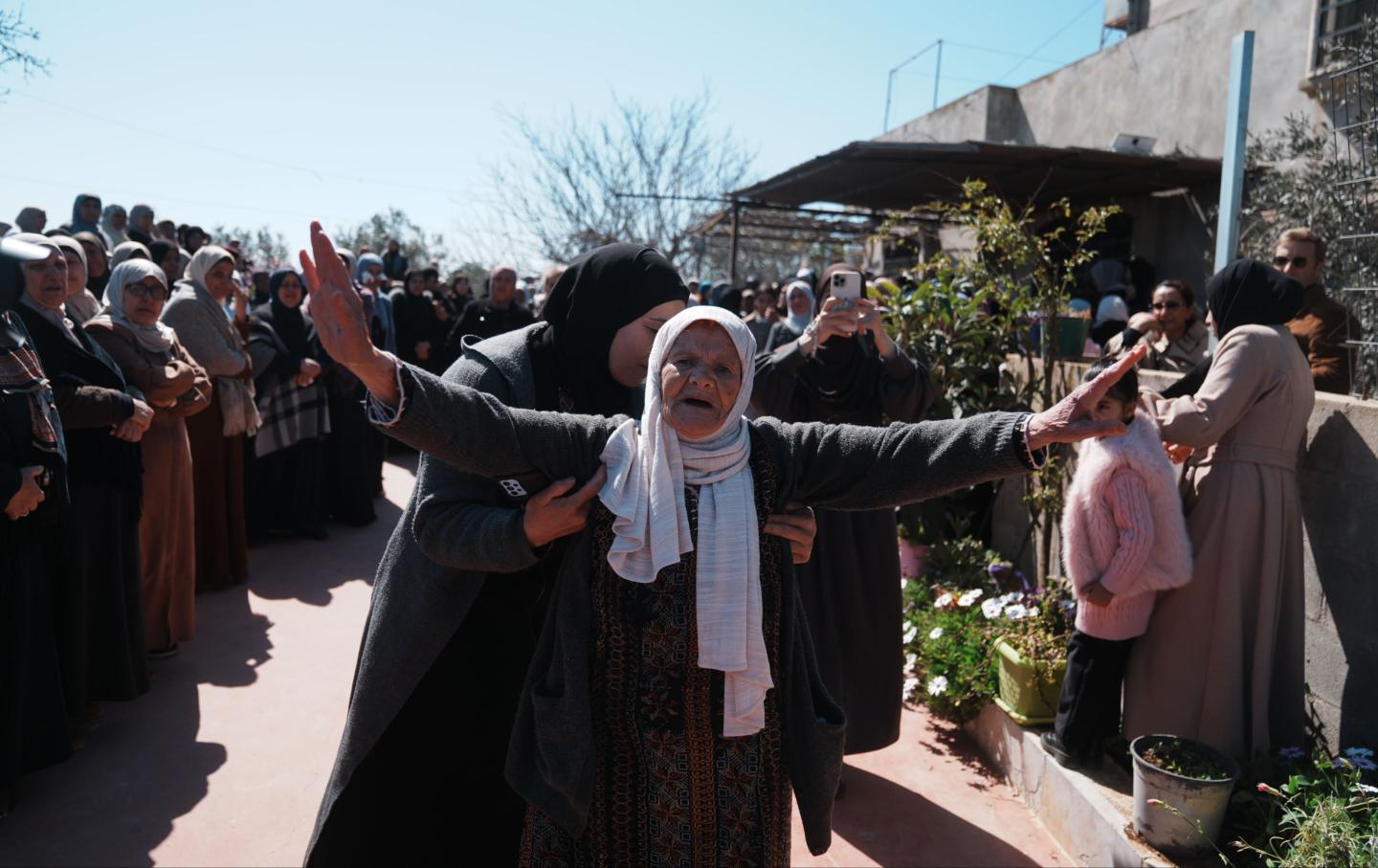
Family members and relatives mourn the loss of two brothers who were killed by Israeli settlers during a raid on the town of Qaryut in the southern West Bank, on March 3, 2026.
(Issam Rimawi / Anadolu via Getty Images)Watching Israel spread its genocidal violence to southern Lebanon and Iran, it is hard not to be reminded of the ongoing campaign to exterminate my people, the Palestinians. Even as Israel widens the scope of its brutality, the core of its national project—the genocide of Palestinians—continues, and we must never forget it.
What’s more, it’s time that we understood that Israel’s genocide is not limited to Gaza. It is also taking place in the West Bank. It might not be from bombs or the mass murders we see in the news from Gaza, although both have happened before. But it is genocide nonetheless.
Article II of the Genocide Convention defines genocide as acts committed with “intent to destroy, in whole or in part, a national, ethnical, racial or religious group.” The acts include killing, causing serious bodily or mental harm, deliberately inflicting conditions calculated to bring about physical destruction, imposing measures to prevent births, and forcibly transferring children.
The Genocide Convention does not require gas chambers. Nor does it require a minimum body count. In 2004, the International Criminal Tribunal for the Former Yugoslavia established that the destruction of a “substantial part” of a group could constitute genocide even when the group is geographically limited or numerically small. The Bosnian Muslims of Srebrenica were 2.9 percent of all Bosnian Muslims, but the court ruled that they qualified as a “substantial part” because of their symbolic significance and the intent that the community would never reconstitute itself. The ICT for Rwanda (ICTR) Akayesu judgment ruled that genocidal intent can be inferred from “the general context” and “the perpetration of other culpable acts systematically directed against that same group.” The September 2025 UN Commission of Inquiry into Israel’s conduct in Gaza applied this standard and concluded that genocidal intent was “the only reasonable inference” from the totality of evidence.
Crucially, the Commission also raised “serious concern that the specific intent to destroy the Palestinians as a whole has extended to the rest of the occupied Palestinian territory…and to the period before October 7, 2023.”
In other words, Israel’s genocidal intent covers not just Gaza but the West Bank as well.
The intent was clear before Israel was established—as in 1937, when David Ben-Gurion wrote that “We [Zionists] must expel Arabs and take their places.” It continued long after—as in 1969, when Golda Meir infamously declared, “There is no such thing as a Palestinian people.” And it persists to this day. Israel spent decades denying that the Nakba happened, even passing a law in 2011 making it illegal to commemorate it. Then, in 2023, Agriculture Minister Avi Dichter bragged, “We are now rolling out the Gaza Nakba.”
That same logic is being applied to the West Bank.
Article II(a) of the Genocide Convention refers to “killing members of the group” as part of a campaign of extermination. Israel’s conduct in the West Bank meets this standard.
Since October 7, 2023, Israeli forces and settlers have killed over 1,000 Palestinians in the West Bank, a quarter of them children. That’s a rate of over one killing per day.
The names of the victims go on and on: 10-year-old Saddam Hussein Rajab, 19-year-old Palestinian American Nasrallah Abu Siyam, 14-year-old Palestinian American Amer Rabee, 55-year-old Mohammed Murra… to name just a tiny number of the people killed in the last few years alone. Earlier this month, Israeli forces slaughtered the Bani Odeh family—a mother, father, and two sons—while they were shopping for Eid. A surviving son recounted that the Israelis bragged about the murders, saying, “We killed dogs.”
In March 2025, the Israeli human rights group B’Tselem reported that air strikes on the West Bank had become “routine.” The group said that Israel had carried out 69 air strikes between October 2023 and March 2025, killing 261 people. B’Tselem called this the “Gazafication” of the West Bank, a term that captures how the same elimination drive is now adapted to a different terrain but animated by the same intent.
Article II(b) of the Genocide Convention prohibits “causing serious bodily or mental harm to members of the group” as part of a campaign of extermination. Israel’s conduct in the West Bank meets this standard too.
As of late 2025, about 10,000 Palestinians were imprisoned by Israel, most of them in the West Bank. That number included 4,000 people considered “administrative” detainees, held without charge, and 350 children. (Israel remains the only country in the world that automatically prosecutes children in military courts. Between 2000 and 2023, approximately 13,000 children were detained, interrogated, and imprisoned, with a conviction rate exceeding 99 percent. UNICEF has found the mistreatment of detained children by Israel to be widespread, systematic, and institutionalized.) But to call the places where they are held “prisons” is a misnomer. What Israel has built is purposefully a network of torture camps.
Between October 2023 and January 2026, at least 84 prisoners died from torture, starvation, and deliberate medical neglect while in Israeli detention; 31 of these were in the West Bank. Detainees have described unimaginable horrors inflicted upon them: cigarettes extinguished against their skin, hydrochloric acid poured on their backs, eyes lost to burns. This past Monday, Francesca Albanese, the United Nations special rapporteur on the occupied Palestinian territories, declared that Israel’s systematic use of torture was “a foundational pillar of a genocidal project aimed at the complete erasure—physical and psychological destruction, displacement and replacement—of the Palestinian people.”
That’s not all. In March 2025, a UN commission concluded that sexual and gender-based violence, including rape, is used by Israel as a deliberate method of war across Palestine, against men, women, and children. To use just one example, in December, Sami al-Saei, a journalist from the West Bank held for 16 months without charge, described being raped with multiple objects by prison guards at Megiddo Prison, an assault other prisoners told him was called the “reception party” inflicted upon arrival.
Israel does not merely condone these acts—it celebrates them; earlier this month, Israeli Prime Minister Benjamin Netanyahu hailed the end of a criminal case against a group of Israeli soldiers who were filmed gang-raping a Palestinian man in the notorious Sde Teiman prison, calling the soldiers “heroic fighters.”
In its 2025 report, the UN commission wrote that this pattern of violence “was intended not only to humiliate, punish, and intimidate the individual Palestinians but the civilian population as a whole, with the objective to subordinate, destroy and expel the Palestinian community.”
The physical harm is compounded by the mental anguish from generations of apartheid and occupation. During this year’s Ramadan, Israel prohibited all Palestinians from praying at Al-Aqsa mosque; to many, this is torture.
When a state detains so many people, tortures them as policy, rapes them as a method of war, and returns the ones who survive to their communities permanently broken, that is part of the deliberate destruction of a people through their own bodies and minds. In other words, it is an act of genocide.
Article II(c) prohibits “deliberately inflicting on the group conditions of life calculated to bring about its physical destruction in whole or in part.” Again, this can be applied to Israel’s actions in the West Bank.
Since 1967, Israel has seized all West Bank water resources under Military Order No. 158, which classifies rainwater itself as Israeli state property. Since October 2023, over 100 water facilities have been demolished and 81 wells destroyed or sealed. Israel has simultaneously dismantled the agricultural base that allowed Palestinians to feed themselves. Since October 2023, settlers tripled their attacks on West Bank olive farmers, destroying over 52,300 trees, many of them centuries old.
Israeli settlements discharge untreated wastewater and sewage onto Palestinian agricultural land, contaminating fields and knocking entire crops permanently out of use. Permits to farm one’s own land are denied or conditioned on Israeli approval. Israel destroys the wells, burns the crops, contaminates the soil, denies the permits, and watches a people become entirely dependent on their occupier for the water they drink and the food they eat. This is a condition engineered to make indigenous life on indigenous land impossible.
This is compounded by Israel’s assaults on the physical territory that Palestinians call home. On January 21, 2025, two days after the first Gaza ceasefire was announced, Israel launched Operation Iron Wall, the largest military operation in the West Bank since the Second Intifada. Over 40,000 Palestinians were displaced from their homes. 32,000 still cannot return.
Beyond that, Israel continues to demolish Palestinian homes while approving new settlements. In 2025, settlers drove out 13 rural Palestinian communities completely. In January 2026, the entire community of Ras Ein al-Auja was expelled after settlers cut the villagers’ water, stole and poisoned their livestock, and seized their land.
When you destroy social infrastructure, prevent cultural, economic, and political reproduction on the land, shatter the family as the basic unit of a people’s continuity, you destroy the group itself.
The violence in the West Bank is often described as gradual, but the word concedes too much, as though there were pauses, as though there were time. What is unfolding is autonomic: a continuous system of killing, displacement, legal disenfranchisement, agricultural destruction, sexual terror, and cultural erasure operating simultaneously and across generations.
This is not “the Gaza genocide” but the genocide of the Palestinian people.
Popular
“swipe left below to view more authors”Swipe →Treating Gaza as an isolated genocide allows the grinding destruction in the West Bank to continue below the level of international alarm. The legal and historical record shows one process targeting one people across one homeland for nearly eight decades. The Nakba did not end in 1948. It continues through near-daily murders, expulsions, poisoned wells, demolished homes, settler pogroms, and the bureaucratic machinery that makes Palestinian life on Palestinian land impossible.
Today, less than 10 percent of historic Palestine remains under complete Palestinian control. I do not know what to do with that number except to say that I have watched it shrink during my entire life, and my parents watched it shrink before me, and their parents before them.
I wrote at the beginning of this piece that watching Lebanon and Iran burn reminded me of my people being maimed and hunted and evaporated. What I did not say is that the retraumatization is not only from the violence but also from watching the same impunity: the same world finding new excuses to avoid using the word it has already defined and enshrined and promised would never again go unanswered.
Genocide has a legal definition. Palestinians meet every element of it—not since 2023, not since the siege of Gaza in 2007, but since 1948, across every inch of the land, in the West Bank as in Gaza, in the prisoner as in the displaced, in the poisoned well as in the demolished home. The world has always found it easier to mourn Palestinians in pieces than to reckon with what is being done to us as a whole. We are one people being destroyed as one people.
Become a Sustaining Donor This September
Between the reemergence of right-wing red-baiting and Donald Trump’s use of the chilling National Security Presidential Memorandum–7 to criminalize left political organizing, we’re seeing McCarthyism reborn before our eyes.
This assault on democracy cannot be ignored or wished away. Resisting it requires bravery in the face of threats and repression, a steadfast commitment to the truth, and the unwavering belief that we can—and will—overcome this darkness.
We must have an independent media that sets the record straight, unearths corruption and abuses of power, and advances a politics of justice and dignity for all if we’re to win this fight.
That’s why I’m writing to you today. This September, The Nation needs to add 100 monthly donors to sustain our progressive journalism. Your contribution makes the next investigative report, the next truth-speaking column, and the next pathbreaking essay all possible.
I hope you’ll support our work with a recurring donation today. If you donate $10 or more a month, we’ll send you a brand new “Hands Off the Free Press!” sticker to recognise your commitment to our cause. Please, donate today.
Onward,
Katrina vanden Heuvel
Editor and Publisher, The Nation
More from The Nation
The Decades-Old Roots of Trump’s War on Iran The Decades-Old Roots of Trump’s War on Iran
An interview with historian Behrooz Ghamari-Tabrizi about the generations of US presidents who have tried to destroy the Iranian regime.
Emmanuel Macron’s Turbulent Exit Emmanuel Macron’s Turbulent Exit
Between a budget crisis and a cost-of-living squeeze, Macron is leaving a country feeling more insecure than ever—and ready to take to the streets.
Israel’s Election Can’t Fix What Netanyahu Broke Israel’s Election Can’t Fix What Netanyahu Broke
The fundamental problem is not the name of the prime minister, but rather the actions of the Israeli government and the urgent issues that need to be addressed.
The AfD’s Rise Isn’t Just About East Germany The AfD’s Rise Isn’t Just About East Germany
The Alternative für Deutschland has a stable national poll lead, including in the former West Germany. Its rise owes to much more than Eastern grievances.
Chinese Development Is the Betrayal Washington Cannot Forgive Chinese Development Is the Betrayal Washington Cannot Forgive
The prospects for Xi Jinping’s visit are dim because American leaders are blaming China for the failures of globalization.
Pinochet: The Verdict of History in the Letelier-Moffitt Case Pinochet: The Verdict of History in the Letelier-Moffitt Case
An act of international terrorism on the streets of Washington, DC, still reverberates 50 years later.

