
Can the Dictionary Keep Up?
In Stefan Fatsis’s capacious, and at times score-settling, personal history of the reference book, he reveals what the dictionary can still tell us about language in modern life
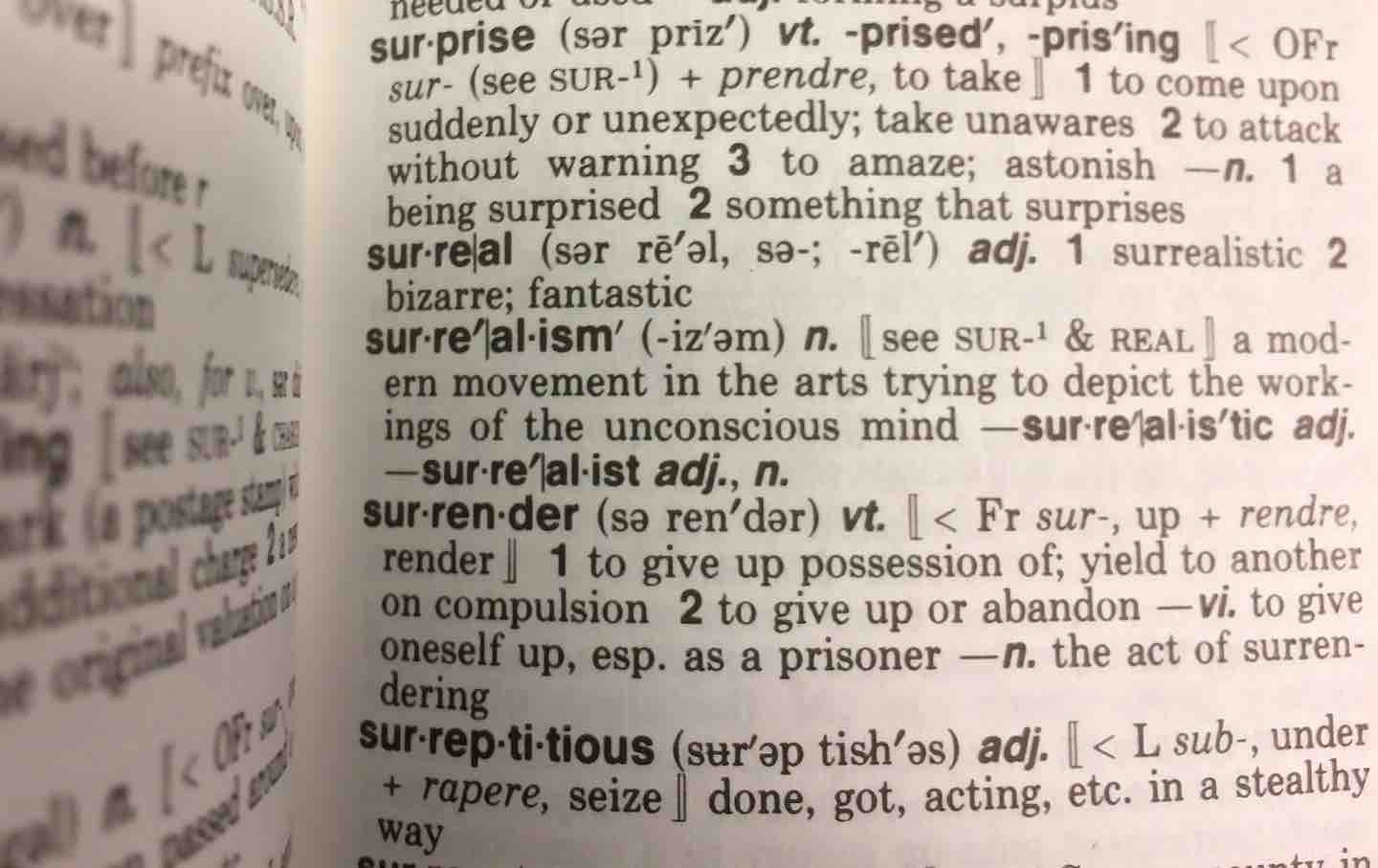
A page taken from the Merriam-Webster’s Desktop Dictionary, 2016.
(AFP / Karen BLEIER via Getty Images)
In 2014, at a small Stanford University lecture hall, the Merriam-Webster editor Peter Sokolowski introduced the crowd of assembled nerds to the idea that a dictionary is not a static document but a living object, constantly updated and remade in response to how people write and speak. In a talk titled “The Dictionary as Data,” Sokolowski emphasized that the editors at Merriam-Webster look to how the general public uses language to guide their work. He shared enticing tidbits, including that xi and za, classic Scrabble words, were popular late-night searches in the online dictionary, and that people regularly look up love ahead of Valentine’s Day. Awed, I wrote in a campus magazine a few days later that “we forget that the dictionary, a seeming bastion of objective reality, is compiled by people who use language, too.”
Books in review
Unabridged: The Thrill of (and Threat To) the Modern Dictionary
Buy this bookI had not, until that evening, thought much about how the dictionary came to be the way it is. I had always seen it as one of those things that was just kind of there, like a textbook or a museum wall text or the other ambient bits of language that seemed to arrive in front of me for my education and consumption.
But the totemic reference book that we know as the Merriam-Webster Dictionary, Sokolowski argued, is a dynamic text. The book is formal and highly structured; it seems like something from another, vaguely bygone time. Still, dictionary editors have long paid close attention to how language is used and perused—in signs, in novels, in articles and pronouncements, and lately on the Web. Sokolowski told us about how he could trace the emotional ripples of tragedies by looking at the data on the words that people look up in the online dictionary. In the immediate aftermath of an event like 9/11, he stated, people might first look up the unfamiliar matter-of-fact words (rubble, triage), then the technical or conceptual ones (terrorism, jingoism). Soon, though, people turn to the psychological ones (succumb, surreal). We don’t just go to the dictionary to learn new words; sometimes, in moments of flux, it’s an attempt to latch on to a source of vetted truth, and to confirm what we thought we understood.
In January of 2020, for example, the word pandemic started trending on the dictionary’s website; on March 11, searches for that word exploded. Eight days later, coronavirus spiked. At different points that year, searches for mamba, malarkey, and defund also skyrocketed. On election night 2024, the top searches on Merriam-Webster.com included fascism, LOL, bellwether, and gaslighting. Through it all, irregardless remained a very popular search (Merriam-Webster says it is a word and a synonym for regardless, though it suggests using the latter “if you wish to avoid criticism” because the former is “widely disliked”).
The Internet has sired and popularized a huge range of new terms. Twerking and trolling, Karens and -core, dumpster fire and microaggression and post-truth and safe spaces, Covid and rawdog and OK Boomer have floated into the mainstream vocabulary. As absurd or obscene as these words may be, dictionary editors track them, keeping an eye on their usage and circulation. And if the words meet a set of rigorous standards, the editors allow them into the book itself, or at least the online version. That’s because the role of the contemporary dictionary is not to prescribe how we talk but to describe how language is used.
It wasn’t always this way. In the dictionary’s early days, which Stefan Fatsis enthusiastically recounts in his roving new book, Unabridged: The Thrill of (and Threat to) the Modern Dictionary, gatekeepers pronounced from on high. The 1604 Table Alphabeticall aimed to “helpe” the “ignorant” learn about words and ideas in the English language.
A couple of centuries later, some ambitious Yalies dreamed of imposing their linguistic views on the public, too. In the 1780s, a young Noah Webster, styling himself as “the prophet of language to the American people,” became fixated on shaping and capturing American English. After decades bogged down in various other pursuits (including feuding with Alexander Hamilton, editing a newspaper, publishing a book that advocated for phonetic spelling, and supporting Benjamin Franklin’s efforts to replace the letters C, J, Q, W, X, and Y with new ones), Webster published an American Dictionary of the English Language in 1828, at the age of 70. His dictionary was an achievement, Fatsis notes, but “far from perfect,” rife with suspect etymologies and quirky phonetic spellings. In 1844, shortly after Webster’s death, the Merriam brothers, a pair of eager publishing upstarts, nabbed the rights. Along with some scholarly associates, they set about editing and improving the sloppy original, predicting—rightly—that the dictionary could be a major commercial endeavor.
Fatsis’s most compelling writing involves his work digging into this history, deciphering the “swooping penmanship” in the G. & C. Merriam Company Archive at Yale’s Beinecke Library. He gushes about the drama between the Webster and Merriam families and shares his admiration for the enterprising Merriam brothers. Their 1864 edition, he writes, nabbed “rave reviews and boffo sales.” As John Morse, the retired president and publisher of Merriam-Webster, told Fatsis, “Webster invents American lexicography, and the Merriams invent dictionary publishing.” The Second Edition of the unabridged Merriam-Webster dictionary, published in 1934, was marketed as the product of America’s intellectual elite, a rulebook produced, as Fatsis notes in a typically cheeky summation, by “stuffy, privileged white dudes.”
But a new editor, Philip Gove, brought in a new, somewhat radical vision when he took over as editor in 1950: that dictionaries should not dictate but rather reflect language. His team cast a wide net into the sea of colloquy and took seriously what it dragged in. The result was a fiasco. The Third Edition, published in 1961, was pilloried for its informality, especially for its inclusion of ain’t. The New York Times editorial board called the edition “disastrous” because it reinforced “the notion that good English is whatever is popular,” and Wilson Follett, writing in The Atlantic, deemed it “a very great calamity.” So dramatic was the blowback that David Foster Wallace, in his 2001 Harper’s Magazine essay “Tense Present,” referred to it as “the Fort Sumter of the contemporary usage wars.” It is quaint to think back to a time when so many people cared about a dictionary. But for all the pearl-clutching, the Third Edition reset the role of the American dictionary: With its publication, a new era of the reference book began.
Fatsis embraces Govian informality. He writes of faves and haters, says things like “I mean, omg,” and “wut,” and responds to the news that alt-right has been added to the dictionary with “Yas!” But he also doesn’t shy away from imposing his own views on the English language onto dictionary readers, attempting as he does to squirrel his own favorite words into the reference book.
The thrust of Fatsis’s memoir—broken up with history lessons and charming, if slightly disjointed, profiles and dispatches from dictionary-related events—is a recounting of his time embedded in the Merriam-Webster offices during a stretch of great linguistic and economic change. During his apprenticeship as a professional lexicographer, which spanned the late Obama and early Trump years, Fatsis harbored many pet projects and words that he wanted to add or update, which included gender pronouns, sports terms, trending political words, and adolescent humor. Fatsis demonstrates how words get added to the dictionary through his own confident but oft-foiled efforts to get his definitions in. Sometimes, his climactic encounters with language reflect words in “the current cultural stew”—for example, the then-emerging terms safe space and microaggression. (His pride at getting these words into the dictionary curdles into contrition when, a few years later, after the killings of George Floyd and Breonna Taylor, he muses that “a microaggression is whatever its recipient says it is.”) But just as often, his submissions merely reflect his own interests: He spends time on the slang terms Dutch oven (as when someone farts under the sheets) and fluffer (the person who keeps porn actors hard on set). He fixates on getting sportocrat into the dictionary, grasping for usage examples; he lavishes attention on slurs, taboos, and the obscene.
Fatsis is open about both his ambitions and his skepticism of the dictionary’s fusty ways. As he works on his definitions, he bristles against edits and faces negative feedback, suggesting more than once that the dictionary might consider shaking things up a bit. “While I respected the Merriam process,” Fatsis notes as he heads to the company’s offices in drab Springfield, Massachusetts, “I also copped to a selfish, subjective quest to scribble my initials on the language.” His failure to get ze past the gatekeepers “pushed [him] to the belief that there are times when The Dictionary benefits from flexibility, when it’s okay to welcome a word that might just fall short of its ingrained standards—or might change those standards.” After causing a PR headache for Merriam-Webster, he writes, “I wasn’t predisposed to the inoffensive, the way a seasoned definer would be. I thought a funny, cutting, sexy, or culturally relevant quotation could say more about how we use language than a vanilla sentence devoid of context.” Stephen Perrault, a staid, stalwart editor who keeps Fatsis at bay, counters: “We’re not looking to be provocative.”
Popular
“swipe left below to view more authors”Swipe →Fatsis is, though. Throughout this book (and in subsequent writing), he flirts with the narrative that Merriam-Webster is in big trouble, as “another early twenty-first-century digital media outfit battling to survive an increasingly bookless world,” goosing traffic with games and spinning toward obsolescence. He writes, concerning the dictionary’s years of struggle, that “I was never rooting for that story, just chronicling it,” adding that he was glad to see the clicks and revenue recover. Still, it’s hard to shake the sense that Fatsis is skeptical about its future and keen to sniff out doom. A catastrophe would make for a zestier book. That things eventually bounce back means that he seems uncertain, in the end, what to say about the dictionary. Over the decade-plus he spent thinking about it, it had some ups and some downs. Its future is unclear, but so is the future in general.
Fatsis doesn’t, in the end, hack the dictionary. He doesn’t uncover a wild story or form a cohesive narrative or argument about his beloved reference book. He observes its constructors in action for a few years, then roves around and learns some more; his work culminates in an oddball appreciation of their work more than an exposé.
For all his waxing on its problems, Fatsis delights in the dictionary, and his prose teems with enthusiasm. And the dictionary, for all its flux in recent years, is now on pretty solid ground. Merriam-Webster still sells about 1.5 million print dictionaries a year, a modest but respectable sum. And its website has seen well over a billion visitors in the last 12 months. After some years of contraction and cringe—the brief stretch of viral Twitter clapbacks from the dictionary’s account in 2016 and 2017 was a low point—Merriam-Webster is still here. Its team, by and large, still tries to engage with the world as it changes. Lately, that’s meant Greg Barlow, the president of Merriam-Webster, going on the radio to talk about what human editors do that artificial intelligence cannot. “AI tries to figure out what the definition is,” he told Kai Ryssdal on Marketplace in October. “At Merriam-Webster, we actually write the definition. We create it, invent it, so it can’t be wrong.”
That’s a lofty claim. But Fatsis, in a way, bolsters it. After spending hundreds of pages bouncing around with him—watching his thinking on language evolve in accordance with political trends and personal hang-ups, seeing him get the proverbial bee in one’s bonnet or take a stand or get carried away—I have to say: The editors’ resistance to Fatsis’s interventions serves as a convincing testament to their process. The good book is going strong. It maintains its standards yet.
More from The Nation
The Genius of Charli XCX The Genius of Charli XCX
On her new album, Music, Fashion, Film, the musician embraces rock.

The Architectural Follies of Trump’s Washington, DC The Architectural Follies of Trump’s Washington, DC
The president plans to remake the capital in his own image, but is all he is doing destroying what’s already there?

The Carnival of Venice Biennale The Carnival of Venice Biennale
That so much of the art of “In Minor Keys” is muted in effect is ironic, because so much of it is overproduced, aspirationally eye-catching, and so big.

