
The Strange Afterlife of Confederate Monuments
“Monuments” an exhibition in Los Angeles, interrogates the changing meanings of Civil War-era statues and their ability to shape historical narrative.
Once Confederate monuments are removed from their plinths, they do not simply lose their power. At the “Monuments” exhibition, they metamorphose. Brought indoors, stripped of their granite base, paint-bombed, broken, dented or cut open, they cease to function as public commands and begin to solicit scrutiny again: strangely seductive artifacts that can look ridiculous, brutal, theatrical, even beautiful. The achievement of the exhibition is that it largely refuses to deploy their damaged surfaces into the reassuring clarity of a morality play. Instead, we encounter the shapeshifting life of monuments, revealing how they persist, mutate, and acquire new power precisely when they are undone, stripped of their original meaning.
Curated by Bennett Simpson, Hamza Walker, and Kara Walker, the show is split between MoCA Geffen and The Brick. The former holds the bulk of the exhibition and the latter functions almost like a chamber piece. At the Geffen are nine largely “intact” decommissioned monuments, one monument rendered into bronze ingots, and fragments from the bases of the Robert E. Lee and Jefferson Davis monuments in Richmond, Virginia. Produced between 1887 and 1985, these objects are confronted by works from 18 artists and collectives made between 1990 and 2025. The Brick, by contrast, revolves around Kara Walker’s sculptural reworking of a Stonewall Jackson statue paired with archival imagery that recounts the monument’s history from its unveiling in 1921 to its removal a century later.
Rather than narrating American history as linear, the exhibition stages the life cycle of the Confederate monument itself. It begins with the monument’s original function in the Lost Cause era: to turn defeat into dignity, grievance into stone and bronze. But it also shows what happened after that meaning hardened and then began to crack through the civil rights era, through decades of uneasy civic coexistence, and finally through the recent wave of protest, defacement, removal, and decommissioning. The decommissioned monument emerges here as a time-thick object, one that has accumulated layer upon layer of political meaning without ever fully shedding the old one.
The contemporary artworks in “Monuments” serve several functions at once: They investigate the history of antebellum Confederate imagery beyond the pedestal, test the continued force of monumental form, and at times explore counter models of memory. The exhibition’s best moments resist the temptation to turn history into a diagram and cleanly separate these functions into binaries.
Fraser’s Robert E. Lee and Stonewall Jackson (1948) and Thomas’s A Suspension of Hostilities (2019) is one of the exhibition’s most striking and disquieting juxtapositions. On paper, the contrast seems easy enough: A bronze equestrian monument to Confederate heroism faces a verticalized replica of the “General Lee,” the muscle car from The Dukes of Hazzard, another vehicle through which Confederate iconography was naturalized in American popular culture. But the pairing is more unsettling because of how they operate with a surprising formal kinship. Both are upright, frontal, weighty, and imposing; both address the viewer through mass, scale, and a kind of declarative stillness. The question, then, is not only what the Lost Cause taught but also how it ciruclated—through which forms, which postures, which repetitions of authority, seduction, and spectacle.
If Thomas’s sculpture exposes the migration of Confederate myth from civic monument to entertainment commodity, it also recognizes that the inherent meaning, or grammar, of the monument survives the shift. This is where the exhibition is at its strongest, when juxtaposition produces not a tidy correction. Instead, seeming difference gives way to formal resemblance, creating an uncanny parallel that the viewer has to grapple with.
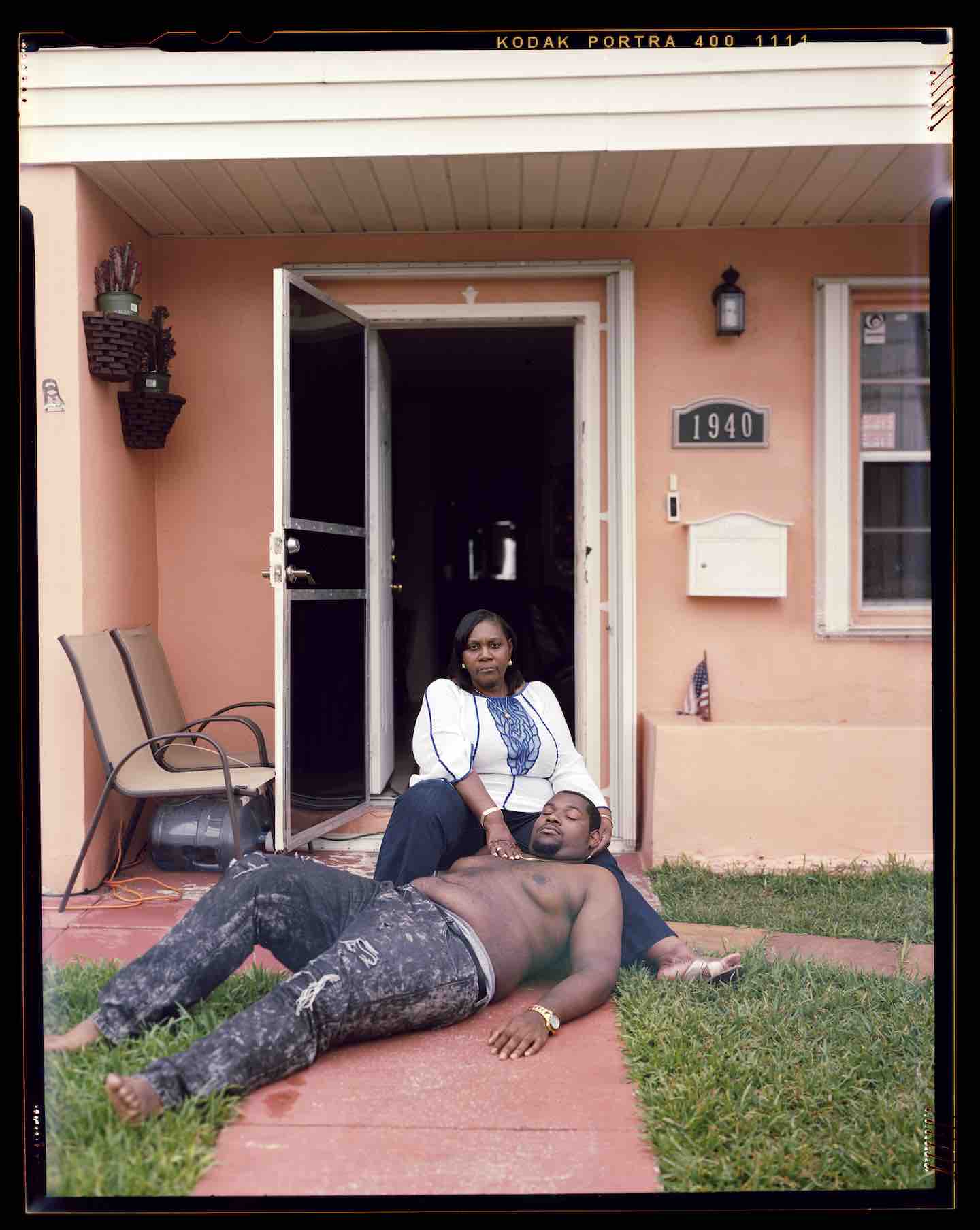
“Monuments” is at its most searching when it asks how political myth is made to feel like mourning. One of the most charged examples is the pairing of J. Maxwell Miller’s Confederate Women of Maryland (1917) with Jon Henry’s Strange Fruit photographs (2014–21). Both stage the mourning mother, the broken son, the downward weight of grief held in the body; both rely on a Christian image tradition of maternal lament, most immediately the Pietà. That echo is productive precisely because it is not equalizing. Miller’s monument mobilizes maternal grief in the service of Lost Cause redemption, turning Confederate defeat into a sanctified image of suffering; Henry’s photographs, by contrast, return the maternal lament to the history of racial violence from which such monuments sought to avert their gaze. The pairing presses on a harder question: not whether mourning is universal but how it gets politicized. What made the Lost Cause so seductive to its adherents? Was it because the movement could present itself through the language of care, tenderness, and bereavement? And how does religious imagery help monuments convert ideology into feeling? How does commemoration depend less on the ability to claim injury, sacrifice, and the promise of redemption?
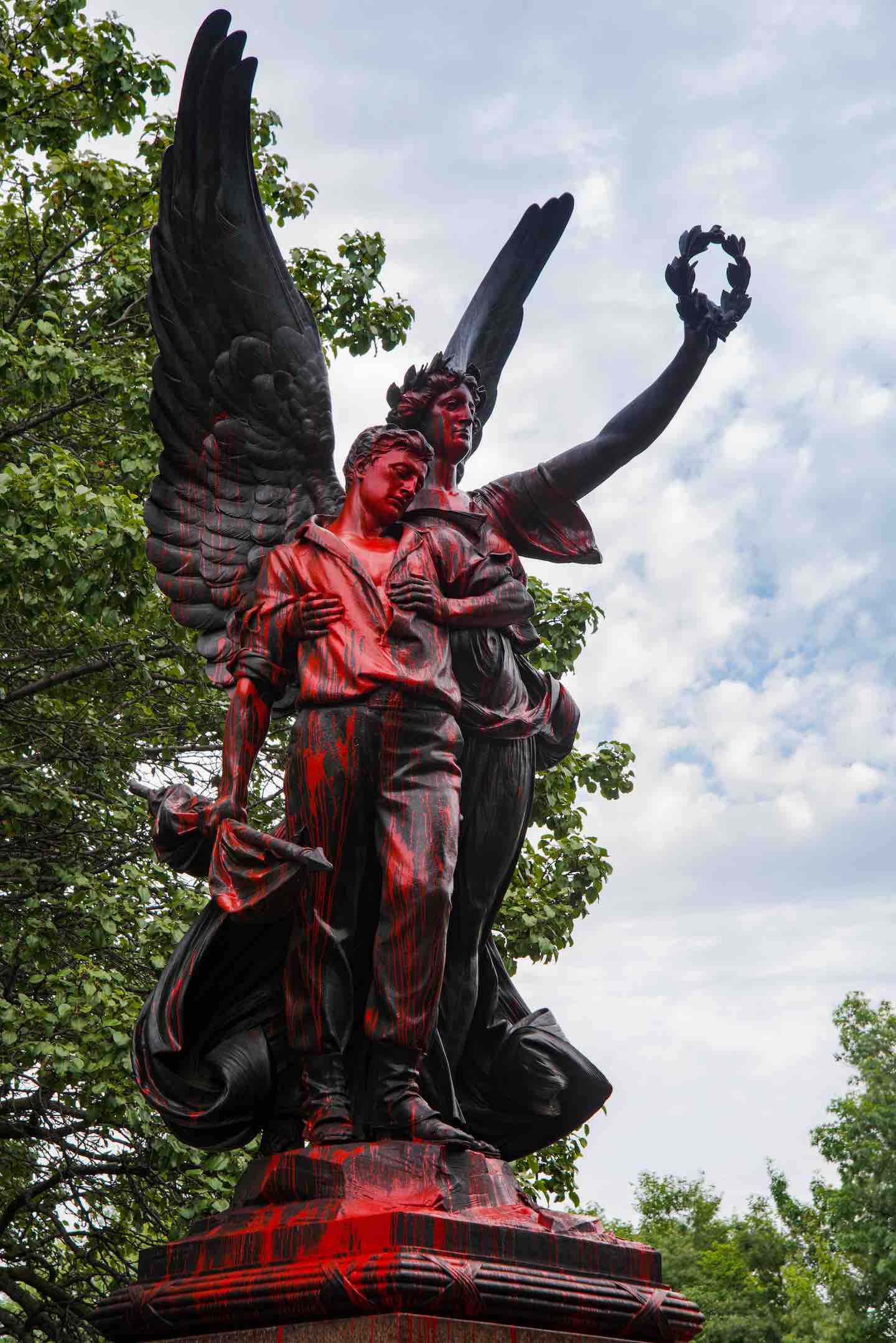
For the most part, the exhibition’s two modes—contemporary art and historical monument—feed off each other: Their meanings are intensified, as if each work were refracting the other into sharper visibility. The exhibition’s logic of refraction extends to the question of redemption. In Lost Cause monuments, the redemptive arc is built in. A case in point is Frederick Wellington Ruckstuhl’s Confederate Soldiers and Sailors (1903), with its angel bearing a fallen man heavenward, turns Confederate defeat into sacred vindication; even the red paint splattered across its dark bronze now intensifies the sculpture’s injured, martyred pathos.
Davóne Tines and Julie Dash’s HOMEGOING (2025) is one of the only contemporary works willing to meet that redemptive logic head-on. Commissioned by the curators for the 10th anniversary of the 2015 massacre at Mother Emanuel AME Church in Charleston, and carried by Tines’s immense rendition of “This Little Light of Mine,” the video stages an ascent of another kind: not mythic absolution but the difficult, collective labor of mourning through song. Tines’s voice rises, but not with the easy upward arc of allegory. It carries grief, witness, and endurance without pretending that history can be washed clean. It is one of the exhibition’s most moving and beautiful works.
If the Lost Cause monuments teach through pathos and redemption, they do so without usually depicting the enemy they require. This is one of the exhibition’s more revealing fault lines. Compared to the contemporary art on display, the Confederate sculptures are notably absent in their depiction of explicit antagonists: No Union soldier appears, no freed slave, no Lincoln. Perhaps that absence is itself telling. Their enemy must remain implicit. The placement of Edward Valentine’s dented and paint-splattered Jefferson Davis (1907) vis-à-vis Andres Serrano’s extraordinary photographic series The Klan (1990) makes that submerged antagonism explicit. Serrano’s isolated, frontal, sharply lit Klansmen are stranger and more disturbing than straightforward illustrations of evil. Deploying the cool conventions of fashion and studio portraiture, the photographs turn the exhibition upside down, asking not how a culture sanctifies its heroes but how it imagines its enemy. Turns out, monuments can also help produce the figures we learn to fear, hate, and oppose.
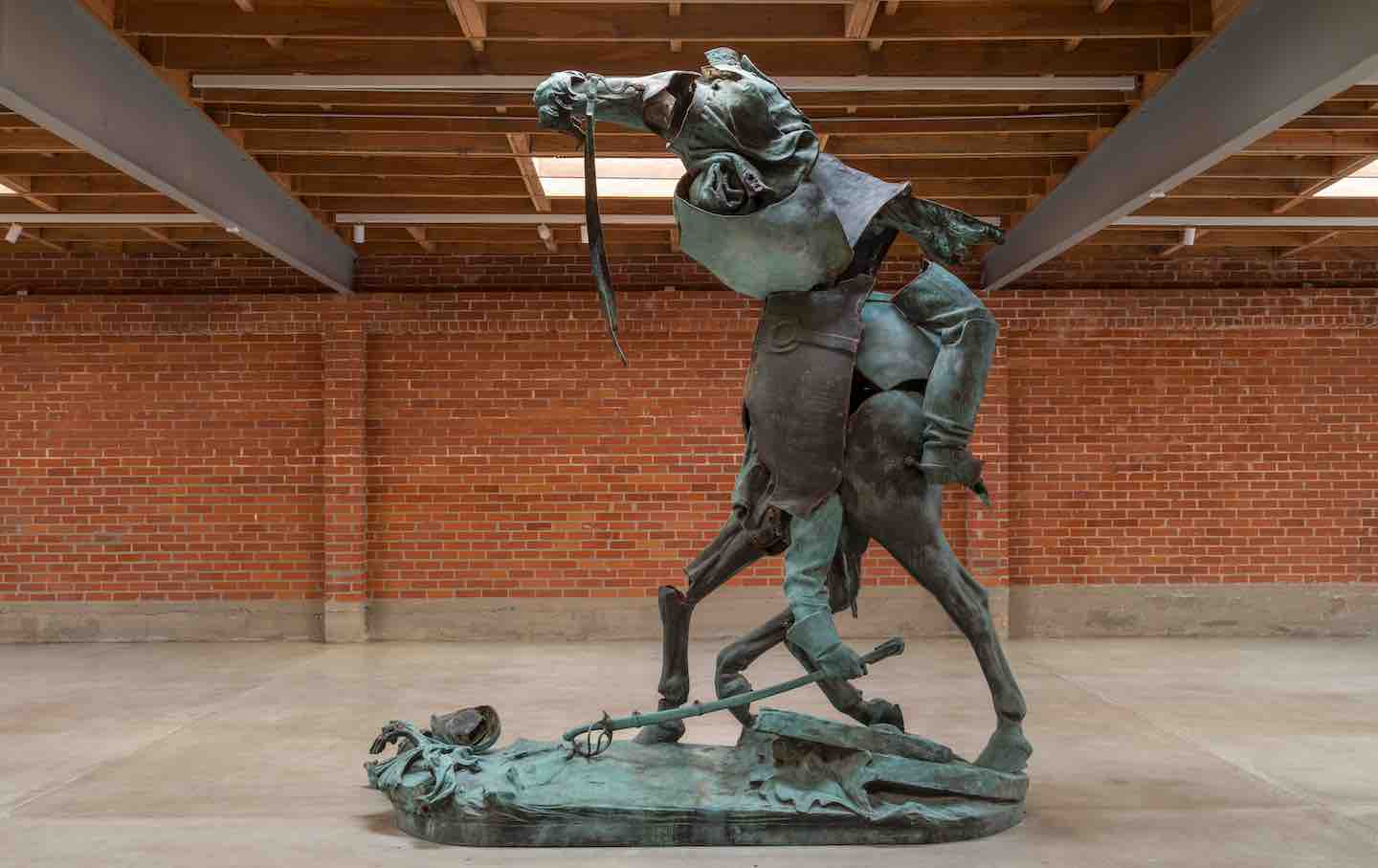
At The Brick, Kara Walker’s installation transforms the problem of representing the enemy into a problem of sculptural afterlife: What remains when a Confederate monument is broken open and remade? Here the exhibition leaves behind the logic of juxtaposition and enters a more concentrated, almost forensic mode. Centered on Walker’s newly commissioned sculpture Unmanned Drone (2023) and surrounded by preparatory drawings, archival images, and reworked granite fragments from a Stonewall Jackson monument that was originally displayed in Charlottesville, Virginia, the installation unfolds as a chamber of afterlife, in which a single Confederate statue passes through a variety of states: from public idol, to political rallying point, decommissioned object, artistic raw material, and reanimated form.
Crucially, the work does not destroy monumentality; it metabolizes it, forcing it into mutation. The old lateral thrust of the charging general has been broken and rerouted into a compacted, vertical torque: The horse rears and staggers at once; the rider is displaced and partially shed; reins hang loose; the sword drags, and the severed fragments on the base refuse to settle into ruin. While violently disassembled with its seams exposed, the new form retains the original motion, pressure, and force forward. Recomposed into a centaur, what emerges is a new sculptural body whose compressed dynamism recalls the charged angularity of Vorticism. The surviving points of contact with the base, retained in part for structural reasons, preserve a ghost of the monument’s original equilibrium even as they make that equilibrium look strained, contingent, and painfully achieved.
Serrano’s photos ask what it means to imagine the enemy, giving us an “other” to project onto; Walker asks what remains when the enemy’s monument is broken open. In her Unmanned Drone, evil is no longer secured in a covered face, a uniform, or even a fixed body. It becomes structural, ambient, half-visible, something that persists after the heroic shell has been cut open. This is where hollowness becomes crucial. The opened monument reveals the desires that needed such figures to exist: desires for purity, repressed grievance, injured nobility, redemptive violence. Walker turns that fantasy into a sculpture that reflects its logic back onto us. What comes into view is the uncomfortable fact that these monuments embody not just what we oppose. They are also pictures of what we fear, disavow, and secretly require to narrate ourselves.
Popular
“swipe left below to view more authors”Swipe →“Monuments” is about watching monumentality itself change state. These sculptures do not simply preserve Lost Cause ideology; they show how antagonisms morph over time, carrying grief, grievance, sanctity, and authority into new shapes. Their meanings migrate, crack, and recombine. The exhibition’s deepest argument is thus not merely that Confederate monuments were false or violent but that monumentality itself remains an active and unstable medium of public art. Monuments help people narrate who they are, and they do so not only by elevating heroes but by conjuring the enemies against whom identity hardens—until the monuments themselves become the enemy. After all, bronze and granite can just as easily be converted into canvases for rebellion.
Become a Sustaining Donor This September
Between the reemergence of right-wing red-baiting and Donald Trump’s use of the chilling National Security Presidential Memorandum–7 to criminalize left political organizing, we’re seeing McCarthyism reborn before our eyes.
This assault on democracy cannot be ignored or wished away. Resisting it requires bravery in the face of threats and repression, a steadfast commitment to the truth, and the unwavering belief that we can—and will—overcome this darkness.
We must have an independent media that sets the record straight, unearths corruption and abuses of power, and advances a politics of justice and dignity for all if we’re to win this fight.
That’s why I’m writing to you today. This September, The Nation needs to add 100 monthly donors to sustain our progressive journalism. Your contribution makes the next investigative report, the next truth-speaking column, and the next pathbreaking essay all possible.
I hope you’ll support our work with a recurring donation today. If you donate $10 or more a month, we’ll send you a brand new “Hands Off the Free Press!” sticker to recognise your commitment to our cause. Please, donate today.
Onward,
Katrina vanden Heuvel
Editor and Publisher, The Nation
More from The Nation
America Without the NFL America Without the NFL
Chuck Klosterman’s Football is a eulogy for the sport on the eve of its decline.
Edward Said: Between Worlds Edward Said: Between Worlds
A new film biography depicts the Palestinian writer as still out of place—and ahead of his time.

Imani Thompson’s Grad-School Thriller Imani Thompson’s Grad-School Thriller
In Honey, the novelist offers a different take on the campus satire.
Love and Literature in Leslie Fiedler’s America Love and Literature in Leslie Fiedler’s America
When will the American novel grow up?

