
Cuba Is Next
Havana is in Trump’s imperial crosshairs, but dialogue is still an option.
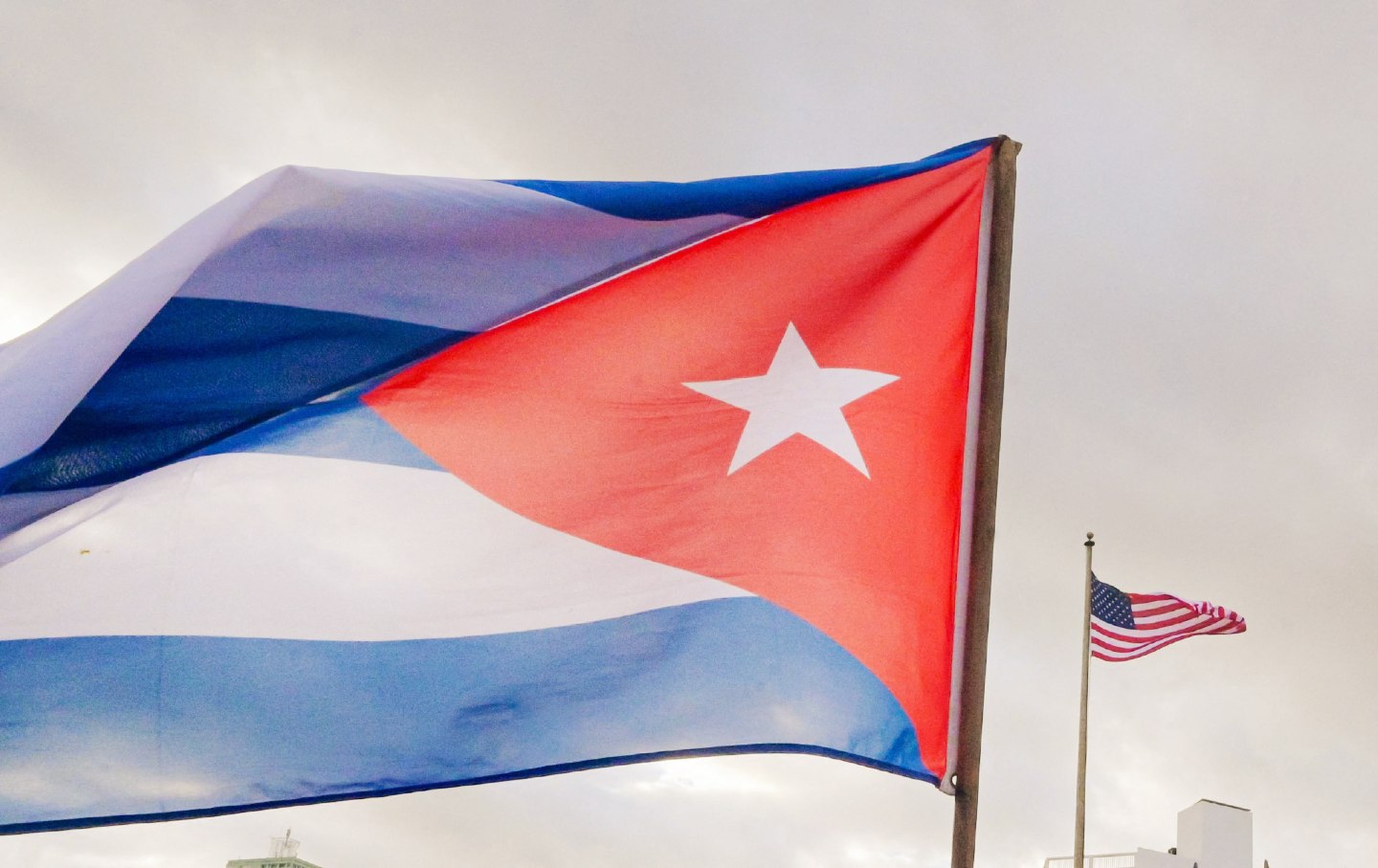
On Sunday, January 11, Donald Trump awoke with Cuba on his mind. Before most of the country had even had their morning coffee, at 7:23 am he began tweeting threats against the Cuban government. “THERE WILL BE NO MORE OIL OR MONEY GOING TO CUBA, ZERO” Trump posted on his Truth Social account with trademark emphasis. “I strongly suggest they make a deal, BEFORE IT IS TOO LATE,” he continued. “Thank you for your attention to this matter.”
To make it official, last week Trump signed an executive order titled “Addressing Threats to the United States by the Government of Cuba.” Declaring a “national emergency” where none exists, the president ordered punishing tariffs against any nation that sends petroleum to Cuba and claimed that the island nation represents “an unusual and extraordinary threat” to the national security of the United States.
Empowered, emboldened, and clearly feeling entitled after the brazen success of “Operation Absolute Resolve” in Caracas, Trump’s focus on Cuba is completely predictable. All along, regime change in Venezuela has appeared to be a stepping stone toward regime change in Cuba. There is no doubt that the president, and his hard-line Cuban American secretary of state, Marco Rubio, view Cuba as the ultimate post–Cold War trophy; the perfect target for a dramatic, symbolic, demonstration of the new “Donroe Doctrine.” “The Cuban regime has survived every president since Eisenhower,” as Trump’s conservative ally Marc Theissen tweeted, catching the president’s attention. “Wouldn’t it be something if that streak ended with Donald Trump?”
Cuba has indeed survived the last 13 presidents, and all the acts of aggression they have unleashed—paramilitary invasions, assassination attempts, an enduring economic blockade among other forms of punitive measures. Like David against Goliath, the island nation has stood up to the colossus of the north for over 67 years. “Cuba is a free, independent, and sovereign nation,” Communist Party leader Miguel Diez Canel defiantly responded to Trump’s threats. “No one dictates what we do.”
But with the brazen attack on Venezuela, the United States is attempting to reassert its imperial hegemony across the hemisphere, and Havana is clearly in its crosshairs. Amid the worst economic crisis Cuba has ever experienced, the regime is now more vulnerable than at any time since the 1959 revolution. And, for all its dramatic history of defiance and survival, Cuba has never faced a US president as dangerous as Donald Trump. Nor, for that matter, has the rest of the world.
The Costs to Cuba
More than any other nation, Cuba has suffered the most losses from the US takedown of the Maduro regime in Caracas. The success of Operation Absolute Resolve has cost Havana its closest global ally, as well as the resources that flowed from that long and close alliance. Most poignantly, however, the US attack has cost the lives of 32 Cuban security personnel and left dozens of others wounded from US bombs and bullets.
Most, if not all of Cuba’s casualties were security and intelligence agents assigned to protect Venezuela’s head of state; they were mowed down as elite Delta Force troops infiltrated the fortified compound where Maduro and his wife were living. Their deaths mark the first time since the 1983 US invasion of Grenada that Cubans have been killed in direct combat with the US military. As their remains were returned to their homeland, Cuban officials reminded the world that their fallen comrades were “a father, a son, a husband, a brother.” In a rare public statement, Cuban Interior Minister Gen. Lázaro Álvarez Casas stated that Cuba had a “profound pride” in the sacrifice of its soldiers in defense of “a sister nation’s” sovereignty.
The loss of Venezuela’s sovereignty, now effectively in the hostile hands of Donald Trump—“the acting president of Venezuela,” as he has declared himself—is already reverberating through Cuba’s moribund economy. Until January 3, Venezuela supplied Cuba with about 30,000–35,000 barrels per day of oil; approximately a quarter of Cuba’s overall energy needs. Cuba paid for this oil in human services—security guards, medical brigades, technicians—rather than cash that it does not have. Indeed, despite its widespread electrical shortages, Cuba has routinely resold some of its Venezuelan oil imports to China, in a desperate effort to raise capital for the import of other basic needs, including food and medicine.
But now that the Trump administration has commandeered Venezuela’s entire oil industry, Cuba has suffered the loss of its main, if minimal, supply of petroleum—with no clear alternative. Since the US attack, according to the shipping intelligence agency Kpler, not a single oil tanker has left Venezuela heading in Cuba’s direction.
“Experts estimate that Cuba’s current oil demand is slightly over 100,000 barrels per day,” explains Ricardo Torres, one of Cuba’s leading economists, now living abroad, in an essay titled “Only Cubans Can Build a New Cuba” in Time magazine. “If a quarter to a third of that depends on Venezuela, a major interruption could push the country toward a subsistence zone, especially because Cuba cannot readily replace that volume through cash purchases.” “The situation is very dangerous, to put it bluntly,” Torres said in an interview with The Nation. “Cuba is vulnerable.”
Like sharks in the water, the hard-line Cuban-American exile community and their Florida politicians smell blood and are pressing the White House to apply the Donroe Doctrine against Cuba. “Make no mistake, after our work in Venezuela, Cuba is next!” Cuban-American Representative Carlos Gimenez declared last week. “It’s going to be the end of the Díaz-Canel regime, the Castro regime, it’s going to happen,” Florida Senator Rick Scott who is close to Secretary Rubio, proclaimed. “We’re in the process of it happening now.”
Marco Rubio, of course, needs no convincing; besides aspiring to be president, claiming the scalp of the Cuban revolution has been Rubio’s top priority for his entire political career. Doubling as secretary of state and national security adviser to the president, he holds the main levers of foreign policy power—and has Trump’s ear. “I think it’s Secretary Rubio’s once-in-a-lifetime opportunity to try to finally bring about the end of Cuba’s Communist government,” Tim Rieser, who worked tirelessly as a foreign policy aide to former Senator Patrick Leahy to normalize US-Cuba relations, told The Nation. Matthew Kroenig, a former Senate aide to Rubio and political adviser when he ran for president, shares that assessment. “Cuba may be next,” he stated on FP Live, the podcast of Foreign Policy. “I do think there’s a focus on bringing the Venezuela model to Havana.”
The Venezuela Model: Remote Control Imperialism
How would the “Venezuela model” be applied to Cuba? It would be hard (but certainly not impossible) for the Delta Force to swoop into Havana and kidnap the entire Politburo of the Cuban Communist Party. Nor does the country have vast natural resources, like Venezuelan oil, that the US can simply appropriate to seize control of Cuba’s economic future. And on what basis would they do so?
If Trump has proven anything, it is that he can shamelessly fabricate justifications for his capricious imperial impulses. Exactly one year ago, on the first day of his return to the White House, Trump falsely designated Cuba as a “sponsor” of international terrorism, without a shred of evidence to support that claim. Putting Cuba on the official State Department list of “State Sponsors of Terrorism”—in the current company of North Korea, Iran, and Syria—has enabled the administration to impose debilitating financial sanctions on the island. But it also offers a ready-made public relations justification for escalating regime change operations against Cuba’s Communist Party–led government.
Moreover, the United States has a long, pre-revolution, history of treating Cuba as a protectorate rather than a sovereign state. In the aftermath of Cuba’s war of independence at the turn of the 20th century, Cubans were forced to trade one colonial power—Spain—for an emerging neocolonial power much closer. US marines occupied the country, and under military duress, Cuban authorities were coerced to sign the “Platt Amendment” treaty giving the United States “the right to intervene for the preservation of Cuban independence [and] the maintenance of a government adequate for the protection of life, property, and individual liberty.” For decades, US domination of virtually every aspect of Cuban society fostered the widespread resentment and nationalist fervor that would eventually make the Castro-led revolution possible.
So far in Caracas, the “Venezuela model” has been a mixture of quick-strike military action, naval quarantines, and open threats and demands for capitulation—a form of remote-control intervention that Trump and Rubio are using to manipulate what is left of the Maduro regime to do Washington’s bidding from afar. This long-distance “coercion diplomacy” reflects the painful, costly lessons learned from the US experience in Iraq—the Pottery Barn rule of “If you break it you own it.” As a real estate mogul, Trump wants to own properties—or at least be able to brand them with his name and pretend that he owns them. But as the leader of an “America First” MAGA movement, he doesn’t want to destroy them and then pay a premium price of wasted US lives and resources to rebuild them—particularly if bombast, blockades, and a few targeted bombs can obtain his goals.
Trump has repeatedly inferred that Cuba will collapse on its own, particularly now that the US is cutting its main supply of petroleum. “Cuba is going to fall of its own volition,” he told reporters who asked him if Cuba was next. “Cuba is ready to fall,” he has stated more than once.
But even Trump’s team of regime-changers seem to understand that the “failed state” scenario in Cuba, and what the CIA has called “regime-threatening instability,” constitute the real national security threats to the United States. During Cuba’s previous dire economic crisis after the collapse of the Soviet Union, the CIA drafted a secret National Intelligence Estimate (NIE) that could easily have been written today. “The impact on the population already has been devastating,” the NIE reported in August 1993, citing the scarcity of basic goods and the electricity blackouts of 10 to 16 hours a day across the country. “Food shortages and distribution problems have caused malnutrition and disease, and the difficulties of subsisting will intensify.” The advent of “serious instability in Cuba [would] have an immediate impact on the United States,” the intelligence community concluded, citing a massive influx of uncontrolled migration, the agitation of the Miami exile community, and increased “pressures for US or international military intervention”—all critical likelihoods in the current situation.
There are clear hints that the Trump administrations would like to avoid this worst nightmare scenario. “We don’t have an interest in a destabilized Cuba,” Secretary Rubio told the oil executives Trump assembled at the White House on January 9. Trump’s January 29 executive order threatening tariff penalties on any country shipping oil to Cuba has what policy makers call “an offramp” that suggests dialogue—and a deal—might be possible. According to the new executive order: “Should the Government of Cuba or another foreign country affected by this order take significant steps to address the national emergency declared in this order and align sufficiently with the United States on national security and foreign policy matters, I may modify this order.”
Most importantly, Trump himself announced on February 1 that “we’re talking to the people from Cuba, the highest people in Cuba, to see what happens.” As the president told reporters at his Mar-a-Lago estate in Palm Beach, Florida, “I think we’re going to make a deal with Cuba.”
A US-Cuba Deal?
Since the 1959 revolution, US-Cuban relations have been dominated by infamous acts of aggression—the Bay of Pigs, Operation Mongoose, the CIA assassination plots, the trade embargo. But the history is similarly replete with lesser-known episodes of back-channel dialogue to resolve crises, address mutual interests, and even attempt to normalize relations. As William LeoGrande and I wrote in our book, Back Channel to Cuba: The Hidden History of Negotiations between Washington and Havana, “the history of dialogue between Cuba and the United States since 1959 demonstrates that it is not only possible to replace sterile hostility with reconciliation but preferable for the national and international interests of both nations.” That fact is especially relevant today.
Popular
“swipe left below to view more authors”Swipe →In the past, sensitive talks between Washington and Havana have counted on support from international interlocutors. The successful Obama–Raul Castro negotiations, for example, were assisted by Canada, Mexico, and the Vatican. Over the last few months, the Vatican played a substantive role in an ongoing dialogue between Trump and Maduro—before the Delta Force special-ops team conducted its “snatch and grab” extraction in Caracas. And Mexican President Claudia Sheinbaum, who talks to Trump directly, has recently offered her good offices as an intermediary between Havana and Washington. Trump has demanded that Cuba “make a deal,” so somehow, somewhere he is presenting his coercive terms for an agreement.
Trump’s imperial demands for that deal will be onerous for Cuba’s leadership: Capitulate to US control or we will bomb your headquarters, quarantine your ports, cut off all your oil, and starve your people. But given that democracy does not seem to be a Trumpian priority, and that the administration would like to avoid the dangers of “regime-threatening instability,” Cuba’s leaders may be able to find space for negotiation around Washington’s central objective: removing Communist Party and military control over Cuba’s nonfunctioning economy and lifting restrictions on private-sector development and foreign investment.
During the very first secret talks between Washington and Havana after the failed Bay of Pigs invasion, Che Guevara told Kennedy White House aide Richard Goodwin that Cuba “could discuss no formula that would mean giving up the type of society to which they were dedicated.” But Cuba was willing to discuss virtually every other US concern, including indemnification for expropriated property and its foreign policies in Latin America.
And Cuba still appears willing to address those concerns—if a formula for diplomatic talks can be found where Trump does not simply command the Cuban government to “bend the knee” and swear allegiance to the mad King of the Continent. “Cuba does not have to make any political concessions, and that will never be on the table for negotiations,” Díaz-Canel told thousands of Cubans gathered in front of the US Embassy to protest US intervention in Venezuela last week. “We will always be open to dialogue and improving relations between our two countries, but only on equal terms and based on mutual respect.”
In the megalomaniacal mind of Donald Trump, the concepts of equality and “mutual respect” don’t exist. But other Latin American nations have been able to finesse the insults emanating from Washington and negotiate, so far, a co-existence with the Colossus of the North. A diplomatic dialogue between Washington and Havana remains possible—and preferable—to advance the best interests of both countries.
More from The Nation
Israel’s Extremist Election Israel’s Extremist Election
The run-up to the vote on Tuesday is exposing the façade of Israeli democracy—and the fealty of the country's so-called opposition when it comes to matters of Jewish supremacy.
“NAZA” and Israel’s History of Automated Warfare “NAZA” and Israel’s History of Automated Warfare
As violent technologies like spyware, predictive targeting algorithms, and 2,000-pound warheads become ordinary instruments of military rule, once-abhorred practices become routin...
Brazil’s Workers’ Party Is Not Stopping Brazil’s Workers’ Party Is Not Stopping
With just a few days remaining before the runoff election, supporters of Lula’s party are doing everything possible to rally support behind the president.
Brazil’s Decision Brazil’s Decision
The moral compass and basic humanity of political leaders really does matter.
Albanian Student Strikes Spur a Political Crisis Albanian Student Strikes Spur a Political Crisis
A new round of protests against the ruling party’s corruption has Prime Minister Edi Rama giving cops bonuses to crack down on dissent.

