
Democrats Really Can Compete in Rural America
The results for the 2025 election cycle send a powerful message regarding strategies that connect outside of urban centers.
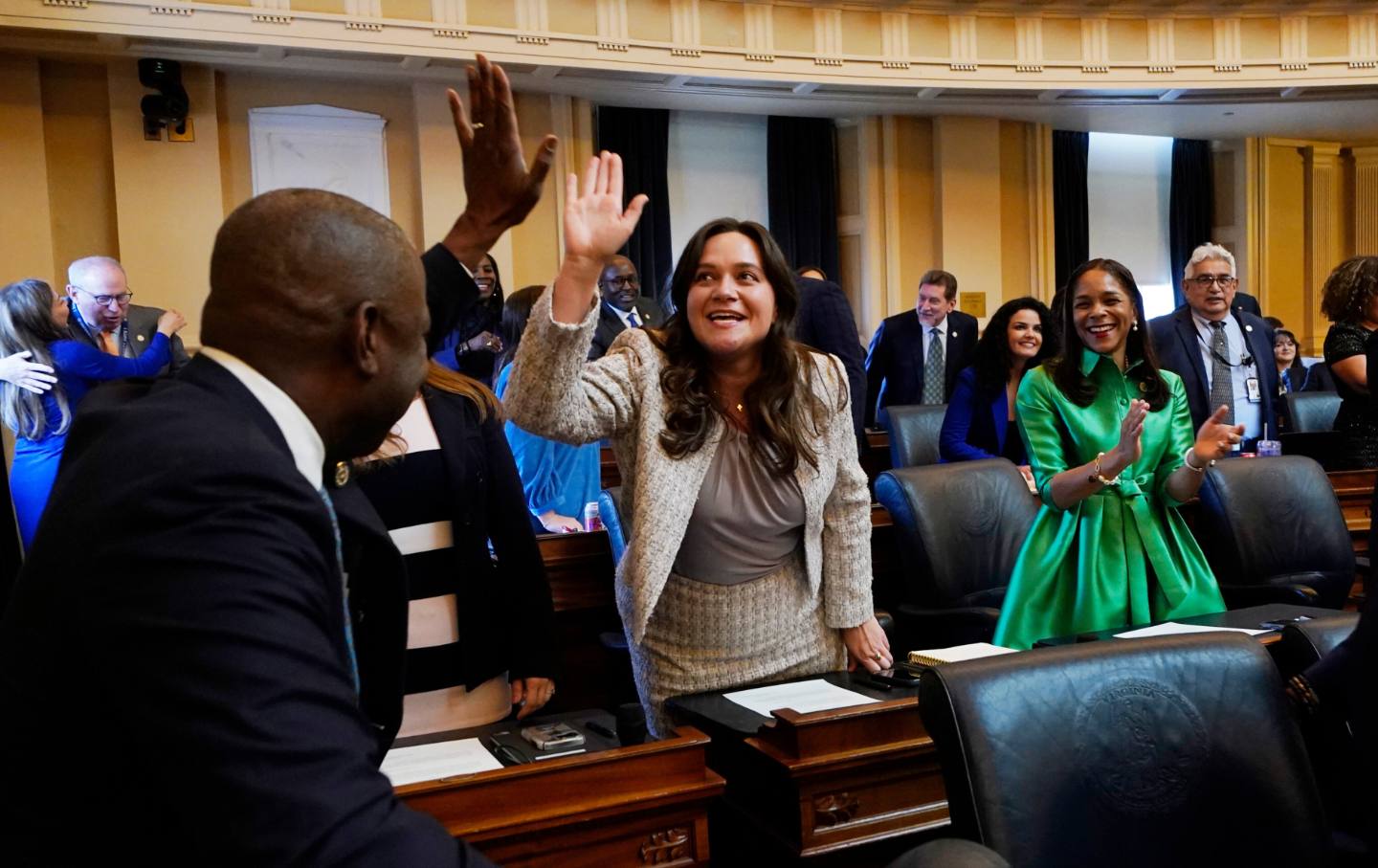
House Speaker Don Scott, D-Portsmouth, left, high-fives Delegate Lily Franklin, D-Montgomery, center, after taking the oath of office during the opening of the 2026 session of the Virginia General Assembly.
(Steve Helber / AP)
From Montana Trump country to the Appalachian foothills, rural Democrats scored a heartening number of local and statewide victories in recent off-year and special elections.
The spate of wins produced tangible results for Democrats: flipping the governorship in Virginia; expanding the party’s legislative caucuses in blue, purple, and red states; and, with a December 30 Iowa Democratic special election win, blocking Republican efforts to restore a state Senate supermajority. These sorts of victories should inspire Democrats to replicate the grassroots bench-building strategy Republicans executed with great success in the 1990s: Start local, rack up school board, town council, and mayoral wins, and run those office holders in statewide elections. By 2008, the GOP controlled the majority of governorships and statehouses, a state of affairs that persists to this day. Flipping that script sounds awful nice.
In a number of states, the shift has already begun. Consider the November results from Beaver County, Pennsylvania, where voters elected a Democratic local magistrate and dozens of school board directors, town councillors, and mayors. In one ironic twist, voters ousted a Moms for Liberty–endorsed school board that racked up heavy legal fees litigating its trans bathroom and sports policies. When local taxes were hiked to cover the costs of litigation, Republican board members found themselves on the losing side of a tax revolt.
Beaver County Democratic Committee chair Erin Gabriel said the party is thriving, with a network of supportive union locals and a strong base of volunteers who not only door-knock and phone bank but are active year-round in the community. “It’s good for our neighbors to see that we’re involved in the community because we live here too. We’re not scary,” said Gabriel.
Beaver County Democrats are mindful of the importance of being civil, friendly, and community-minded in their purple but red-leaning county. While online progressives called for Black Friday boycotts and decolonizing Thanksgiving, Beaver County Democrats’ Facebook page promoted local businesses and encouraged shoppers to buy union-made products for their Thanksgiving tables. When SNAP was paused during the shutdown, party volunteers restocked local food pantries.
Another Pennsylvania Rust Belt area hit by the blue wave was Luzerne County, where Democrats flipped four seats on the County Council to gain the majority. (In 2024, Trump won 59 percent of the vote in both Luzerne and Beaver counties.)
Pennsylvania’s Rust Belt wasn’t the only site of rebellion. The new mayor of Havre, Montana, is Wade Bitz, a family farmer who trounced his GOP-endorsed opponent. Bitz ran a sober campaign that emphasized responsive government, infrastructure, and climate resilience. His campaign benefited from the activities of a rejuvenated Hill County Democratic Committee that has a presence at every community event and regularly engages in community service projects.
In the resort community of Polson, Montana, Laura Dever, chair of the Lake County Democrats, handily beat her Republican-endorsed opponent in the race for mayor. (Local elections are often technically nonpartisan, but most voters know where a candidate’s bread is buttered). Well known in Polson for her involvement in Rotary and on the city council, Dever’s agenda was boldly unsexy: good government, affordable housing, and civic cohesion.
The list goes on: Georgetown, South Carolina’s city council flipped. Swainsboro, Georgia, voted itself a new Democrat-endorsed mayor. In Otsego County, New York, voters who went with Obama twice, then Trump twice, elected a slew of Democrats to local offices. On December 2, Democratic candidate Aftyn Behn lost but substantially outperformed the partisan lean of Tennessee’s Seventh Congressional District. Behn made inroads with Republicans in every county in the district, including the very rural ones. And in rural Virgina, with backing from the Run for Something PAC, two sprightly candidates in their early 30s, Lily Franklin and John McCauliff, flipped state legislative seats.
Building a bench of local officeholders who earn voters’ trust by addressing the things that matter most to them—and leaving the culture wars behind—is a strategy that will pay reverse coattail dividends in years to come.
Run for Something has kicked off a five-year, $50 million initiative to recruit and train millennial and Gen Z candidates to run in far-flung local and state races historically neglected by the Democratic Party. By 2030, Run for Something aspires to turn states like Ohio, Nebraska, Utah, and Iowa into battlegrounds and lay the groundwork for states like Mississippi and Louisiana to become more competitive over the long term.
Democrats made gains with rural voters in November’s statewide elections as well. New Jersey and Virginia gubernatorial elections saw unexpectedly large blue swings in rural counties. New Jersey has three counties with substantial rural populations (Salem, Sussex, Warren). In all of them, Democratic candidate Mikie Sherrill did between six and eight points better than the Democratic gubernatorial candidate did in 2021 and two to seven points better than Kamala Harris. In our era of razor-thin margins, movements of this size are minor earthquakes, especially when it comes to rural voters, who have swung hard to the GOP for the past 20 years.
According to CNN’s exit poll, Sherrill won by a 33 percent margin with voters who named the economy as the most important issue facing New Jersey. New Jersey voters are reeling from soaring electricity prices, an issue Sherrill capitalized on by declaring a day-one “state of emergency on utility costs” and promising a rate freeze. For farmers, food processors, and small businesses with unavoidably high electricity usage, Sherrill’s pledge to take on the utilities’ price gouging was just the thing.
Popular
“swipe left below to view more authors”Swipe →In Virginia, Abigail Spanberger did 12 points better in rural areas than the 2021 Democratic nominee, Terry McAuliffe. She campaigned heavily in rural counties, visiting towns Democratic candidates haven’t set foot in since 2013 and floating the idea of establishing a secretary of rural affairs. Spanberger barely mentioned Trump on the campaign trail, focusing instead on tariffs, the cost of living, Medicaid cuts, and health clinic and hospital closures.
Sherrill’s and Spanberger’s kitchen table-focus was apt. According to the American Communities Project 2025 survey, inflation and health care are top concerns for all Americans but weigh even more heavily on the minds of residents of rural areas where prosperity is a distant memory. As Politico noted, the victories of Spanberger, Sherrill, and Mamdani “suggest a recalibration of Democratic politics—from moral crusades to kitchen-table math.” Daniel Kimicata, elected in November to the school board member in rural Central Bucks County, Pennsylvania, echoed Leopold: “National politics is very performative, but local politics is very personal. One of the messages that really resonated with voters was that there is no national political agenda that we’re bringing to the school board.”
Building a bench of local officeholders who earn voters’ trust by addressing the things that matter most to them—and leaving the culture wars behind—is a strategy that will pay reverse coattail dividends in years to come.
More from The Nation

Donald Trump Is Bad at Politics Donald Trump Is Bad at Politics
The president’s flailing midterms campaign underscores a truth we should be acknowledging more often: He kind of sucks at this.

Obama Delivers a Scorching Rebuke to Trump—and Centrist Dems Obama Delivers a Scorching Rebuke to Trump—and Centrist Dems
Unlike other establishment figures, the former president isn’t scared to associate with the party’s left flank.
Elon Musk’s Mortal Threat to Democracy Elon Musk’s Mortal Threat to Democracy
The world’s richest man—saying he’s “wised up” to the fiction of self-government—is leveraging his wealth to sway elections, threaten Congress, and alter the global balance of pow...
Michigan Students Are All In for Abdul El-Sayed Michigan Students Are All In for Abdul El-Sayed
The progressive Senate candidate has won over students with his politics—and, in at least one case, his protein intake.

What Are Democrats Prepared to Do if Trump Rigs the Election? What Are Democrats Prepared to Do if Trump Rigs the Election?
In this week’s Elie v. U.S, our justice correspondent challenges Democrats' lack of a plan if Trump steals the midterms. Plus: the most racist, and honest, AI add ever.

