
European Cowardice Is Empowering Trump’s New Imperialism
NATO allies don’t want to confront Trump’s aggression. But they may ultimately not have a choice.
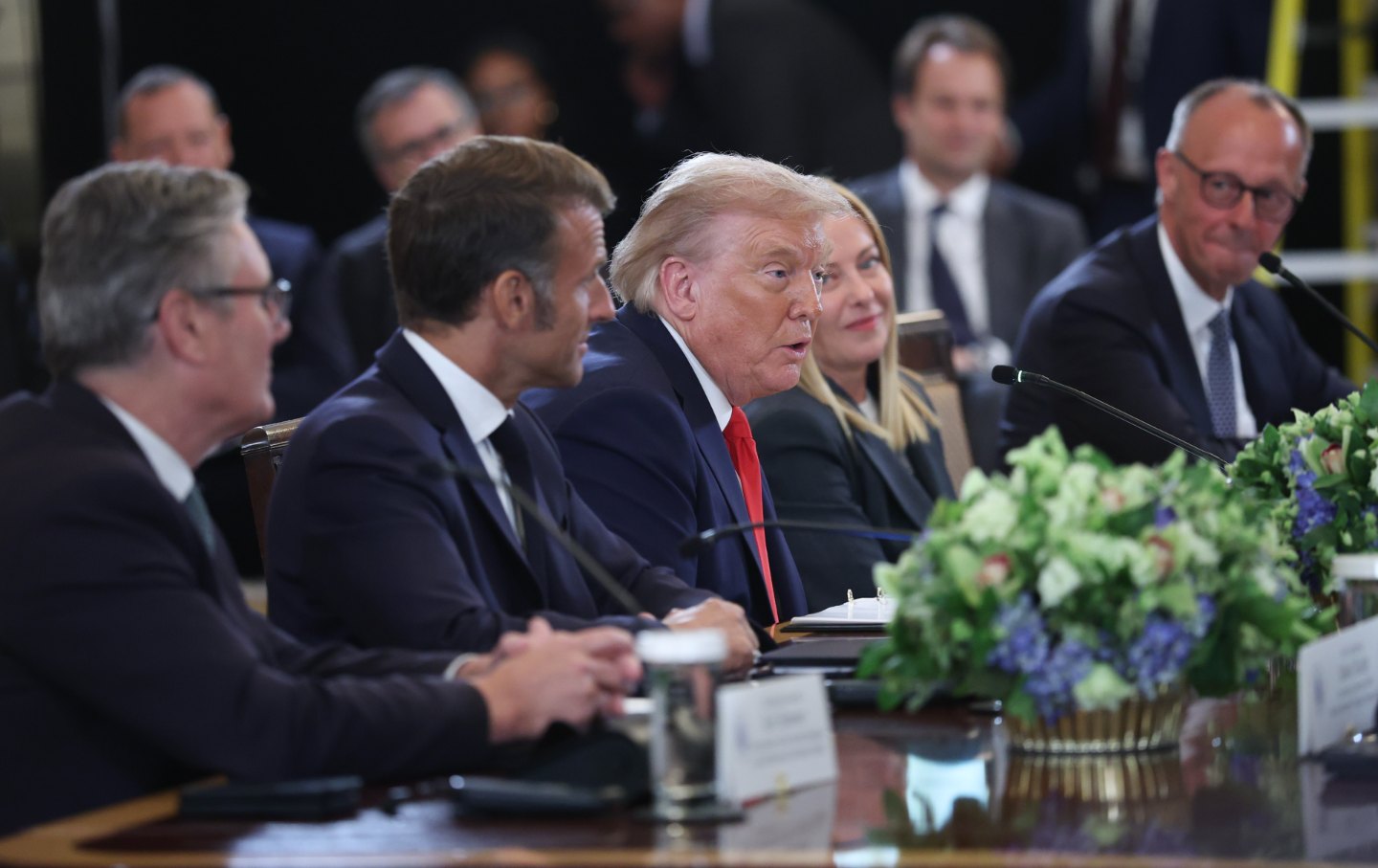
President Donald Trump hosts a meeting with Ukrainian President Volodymyr Zelensky and European leaders at the White House on August 18, 2025.
(Win McNamee / Getty Images)On Tuesday, European leaders met in Paris to try and solve their two biggest foreign-policy challenges. They were happy to talk openly about one of them: ways to strengthen Ukraine as it fends off a Russian invasion. But there was also another problem—one they are not nearly as eager to tackle in public:the fact that their ostensible ally, the United States, is now a major threat to world peace.
Donald Trump just carried out an external coup in Venezuela and kidnapped the president of that country—and he’s only getting started. In the wake of this violent assertion of American dominance over the Western Hemisphere, Trump has started threatening other neighboring countries, promising interventions in Mexico, Cuba, and Colombia. And, most pertinently for Europe, he’s renewing his vows to annex Greenland.
Trump’s efforts to create more Lebensraum for the United States are creating special problems for European countries that rely on NATO as their security guarantees. The alliance is turning out to be not just a shield but also a trap. Dependence on NATO means European countries aren’t in a position to challenge the United States when it threatens their national security
Speaking to The New York Times, Mark Leonard, director of the European Council on Foreign Relations, said,
There is a massive gap between public and private reactions from European leaders.
Privately, they are panicking about what happens next, especially in Greenland and what they might do about it. But publicly on Venezuela, they are desperate not to say anything critical or invoke international law on Trump at a time of maximum peril for Ukraine. They want to use the influence they have for Ukraine.
Nathalie Tocci, director of the Institute of International Affairs in Italy, described Trump as pursuing a policy that is “consistently imperial” which will allow other empires, such as Russia and China, to flourish. Tocci added, “Certainly it’s more comfortable for Putin and Xi Jinping to be their imperial selves where that’s the new norm.”
In Trump’s back-to-the-imperial-future world, where large powers once again unabashedly dominate their supposed spheres of influence, the United States and Russia aren’t so much competitors as fellow gangsters who reinforce each other. NATO, in this worldview, is a protection racket that the US profits from because it can sell weapons to its putative allies. The Russian threat to Europe makes the premium for that protection higher.
The danger of dependence on the United States has long been articulated by leaders such as Charles de Gaulle, who dominated French politics in the middle of the last century. De Gaulle’s warnings, little heeded in their time, seem prescient now.
The question for the Europeans is, how long do they want to stay in such a protection racket? The New York Times reports,
Bruno Maçães, a Portuguese former secretary of state for European affairs, have been outspoken in urging the European Union to come up with a possible counteroffensive should Mr. Trump move on Greenland, including sanctions on American companies, the expulsion of American military personnel and restrictions on American travel to Europe. Raphaël Glucksmann, a French member of the European Parliament, has suggested establishing a European military base on Greenland, as a signal to Washington and a commitment to the island’s security.
Writing in Purpose, Dalibor Rohac, a senior fellow at the American Enterprise Institute, advocates a similar set of harsh punishments that would make the United States respect the sovereignty of European countries, including curtailment of weapons sales, refusal to allow the US to use European military bases for missions in the Middle East, and reduction of trade ties. Rohac also suggests, “A further step would be the sanctions lists. Travel bans and asset freezes would have to be imposed on key administration figures as well as on its financial backers.”
Popular
“swipe left below to view more authors”Swipe →These proposals are certainly commensurate with the threat US imperialism poses not just to Europe but to the safety of the world. But it is unlikely that European leaders have the boldness to execute them. So far, their response to Trump’s transgressions has been meek tut-tutting. In a mewling interview last weekend, UK Prime Minister Keir Starmer refused to even say that the US violated international law by invading Venezuela. Asked about Trump’s threats against Greenland, French President Emmanuel Macron said, “I cannot imagine a scenario in which the United States of America would be placed in a position to violate Danish sovereignty.” These are not leaders who seem prepared to take radical actions to challenge Trump’s lawlessness.
But this timidity may not be able to withstand Trump’s ruthless power politics. European leaders, not for the first time, are trying to fend off an aggressive and expansionist authoritarian power by appeasement. There is little reason to think such appeasement will work. Trump will keep pushing for more and more. Given this dynamic, Europeans face a stark choice: resistance or surrender. The open question is whether the spirit of resistance is strong enough for them to take the radical steps necessary, which involve not just standing up to Trump but also remaking their national security policies so they are no longer dependent on US power.
More from The Nation

Israel’s Extremist Election Israel’s Extremist Election
The run-up to the vote on Tuesday is exposing the façade of Israeli democracy—and the fealty of the country's so-called opposition when it comes to matters of Jewish supremacy.
“NAZA” and Israel’s History of Automated Warfare “NAZA” and Israel’s History of Automated Warfare
As violent technologies like spyware, predictive targeting algorithms, and 2,000-pound warheads become ordinary instruments of military rule, once-abhorred practices become routin...
Brazil’s Workers’ Party Is Not Stopping Brazil’s Workers’ Party Is Not Stopping
With just a few days remaining before the runoff election, supporters of Lula’s party are doing everything possible to rally support behind the president.
Brazil’s Decision Brazil’s Decision
The moral compass and basic humanity of political leaders really does matter.
Albanian Student Strikes Spur a Political Crisis Albanian Student Strikes Spur a Political Crisis
A new round of protests against the ruling party’s corruption has Prime Minister Edi Rama giving cops bonuses to crack down on dissent.

