How a Community Rallied to Save My Abortion Film
When a New Hampshire venue canceled a screening of my documentary, citing safety concerns, local volunteers built a theater overnight.
Nearly two years into screening my documentary No One Asked You—a six-year road trip following Abortion Access Front, a team of activists and comics, and the communities supporting abortion providers and fighting to keep clinics alive—I thought I had seen every form of resistance. The film has traveled through red states where abortion pills are treated like controlled substances, rural towns where protesters record license plates, and cities where protesters stand shoulder-to-shoulder with police.
But I never expected the first place to censor my film would be in New Hampshire—the state whose license plates read “Live Free or Die.”
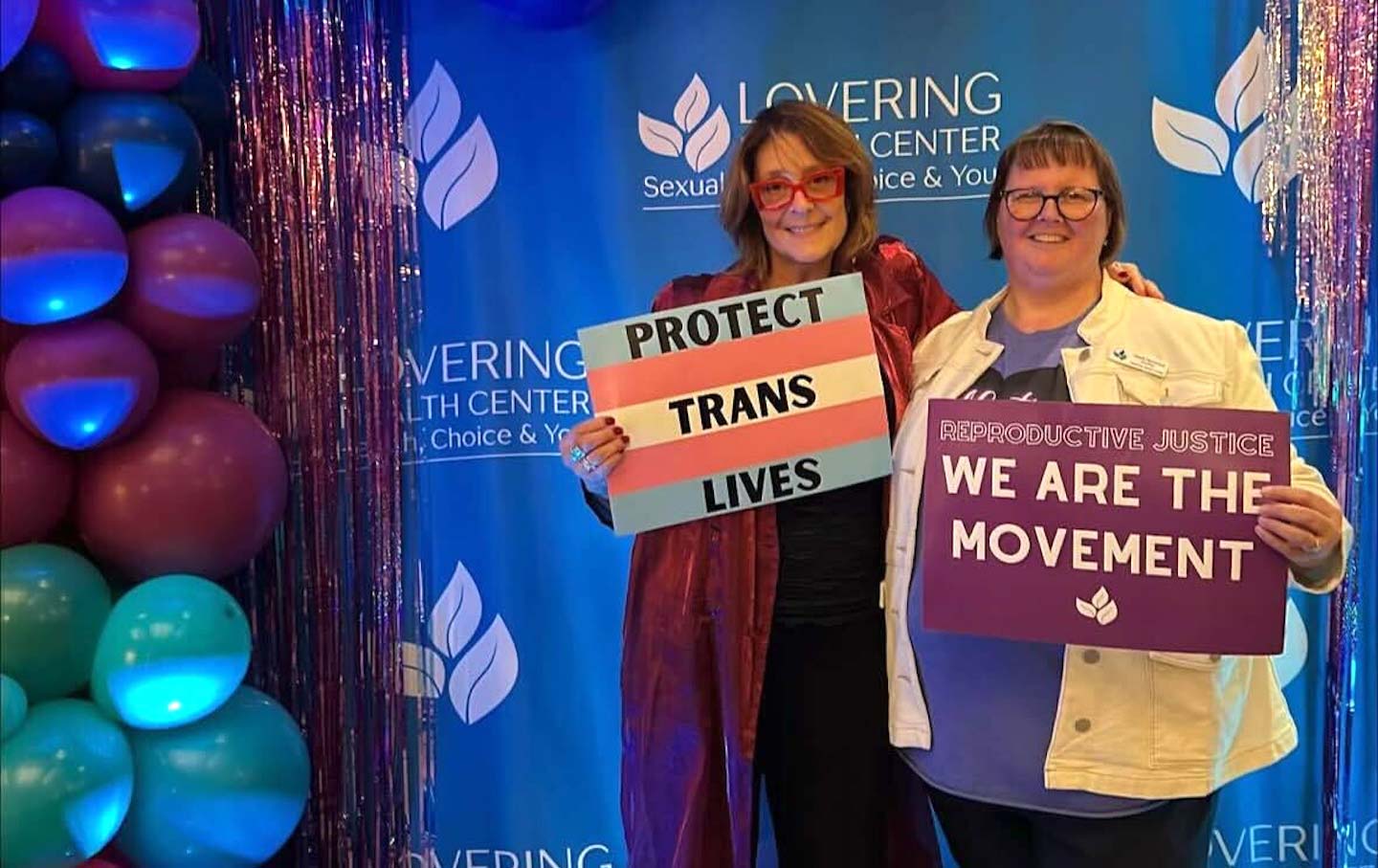
In October, three days before our long-planned fundraiser for Lovering Health Center, New Hampshire’s oldest independent reproductive health clinic, the Music Hall in Portsmouth abruptly canceled our screening. The event had been organized by clinic staff and board of directors to bring people together around the film while raising money for the clinic’s annual gala.
The Music Hall cited safety concerns after a single person said they might “chalk the sidewalk.” But Lovering’s executive director argued that the theater did not give them the opportunity for proper consultation over the decision or an opportunity to address the Music Hall’s concerns with local law enforcement or the clinic’s own security team to determine whether the threat was of real concern.
The cancellation wasn’t just a local controversy. It exposed a national shift: as post-Dobbs abortion restrictions spread across the country, the pressure to silence abortion advocates was growing, too. Institutions that once claimed neutrality were now unwilling to risk blowback, whether on abortion or a host of other issues that have been made “controversial” by those seeking to maintain or expand their political power.
But when I arrived in Portsmouth, the event had been relocated to a brand new event space called The Hawthorn. Volunteers were turning an empty room into a functional theater—rows of chairs unfolding into place, screens rising, balloon bouquets bobbing in the air.
The atmosphere was familiar: the same improvisational, determined energy I’ve seen for years inside clinics under pressure. People building what they need because the institutions meant to support them wouldn’t—or couldn’t without political consequence.
That evening, attendees walked past two young protesters—a far cry from the “threat” the theater claimed—holding mass-produced signs of fetuses that were supposed to turn them away. Inside, the Leftist Marching Band—a scrappy, intersectional community marching band—opened the night with “You’re a Grand Old Flag,” a song that reclaimed the notion of patriotism as loving and radically inclusive. The audience joined in, rousing to their feet while waving rainbow flags.
The room responded to the film in equal measure, laughing and applauding in the way one might experience The Rocky Horror Picture Show or a sing-along screening of Sound of Music. Viewers called out in recognition of providers and clinic escorts, honoring those who show up daily to protect care and access—true rock stars and heroes in their own world.
For me, the energy in the room signaled a collective refusal to be intimidated. It felt like a living demonstration of what solidarity looks like when censorship presses in on public life. And the solidarity didn’t end there.
Earlier that day, the New Hampshire Women’s Foundation had issued a letter to the Music Hall with the declaration: “Abortion is Healthcare. Censorship is Stigma.” By nightfall, the letter was circulating across social media, being shared by clinic workers and local residents, as well as civic and political leaders, including state Senator Debra Altschiller and Portsmouth city councilor Kate Cook.
Ten days later, after mounting criticism, the Music Hall held two “listening sessions..” The theater’s CEO justified the decision by using language that only deepened the mistrust within the community, by describing abortion as a “hot-button issue” and a “lightning rod” while insisting on their own neutrality. The CEO argued that hosting the film could escalate security risks, pointing to the recent Charlie Kirk assassination as evidence that controversial programming might invite disruption or violence.
But treating “abortion” as something to fear over “safety” issues is far from a neutral position. In fact, it allows fear to spread—fear that restricts access to care, silences people in need of support, and emboldens extremists—rather than protects public well-being.
The community’s frustration was unmistakable on recordings of the sessions. (When the theater asked attendees not to film the sessions, activists livestreamed them anyway, insisting that accountability not happen behind closed doors.)
In the wake of those listening sessions, locals canceled their memberships to the Music Hall and performers pulled upcoming shows. The mayor of Portsmouth demanded the theater repair the harm. Weeks later, the CEO stepped down.
People weren’t responding to one cancellation, but to what it symbolized: a cultural environment where events centering reproductive health care, and even the stories that illuminate it, can be shutdown in spite of widespread public support.
That support has been evident across screenings of No One Asked You. At just three screenings, local audiences raised over $250,000 for abortion access and practical support—including $112,000 in one night in West Virginia, a state with no clinics left. Although these donations cannot directly match what has been lost, they prove that support for abortion doesn’t end when clinics close. It shines a light on the fact that it is our citizens and communities that are demanding to keep healthcare accessible when institutions, and elected officials, have failed them.
The contrast sharpens beyond US borders—in both reception and law. Just one month earlier, when the film premiered in Colombia, a Catholic country marked by state violence, the response was strikingly different. The reception was overwhelmingly positive, shaped by a culture of collective responsibility, with men present not as bystanders but as allies—engaging the film and one another around why protecting abortion access matters. Colombia decriminalized abortion in 2022—the same year protections fell in the US—through the relentless efforts of hundreds of organizations, a victory born of sustained civic pressure and a shared imagination for what health care should be.
Years of documenting these stories have shown me how access—or its absence—reshapes entire futures. That vantage point made the contrast between Colombia and Portsmouth impossible to ignore.
Popular
“swipe left below to view more authors”Swipe →People often ask what they can do. The film, and the people within it, offer one answer: support clinics and abortion funds, host screenings, show up for providers, and speak the words others fear to say: abortion is health care.
But there is a larger answer too: we must rebuild civil society. Communities are becoming the last reliable infrastructure for care—and increasingly, for truth.
I’ve taken this film from state to state, into rooms where people are exhausted, frightened, and stretched thin. But inside The Hawthorn that night, I saw a glimpse of what a different future could look like: people refusing to wait for permission to care for one another, and how, without coalition, we will continue to fail.
If we fail to understand what Portsmouth revealed, we risk normalizing a future where institutions retreat from controversy and communities are left to shoulder the entire burden of safety and care. But if we pay attention, and commit to authentic coalition building, we might yet construct something stronger than what was lost.