Forrest Gander’s Desert Phenomenology
His poems bridge the gap between nature’s wild expanse and the private space of one’s imagination.
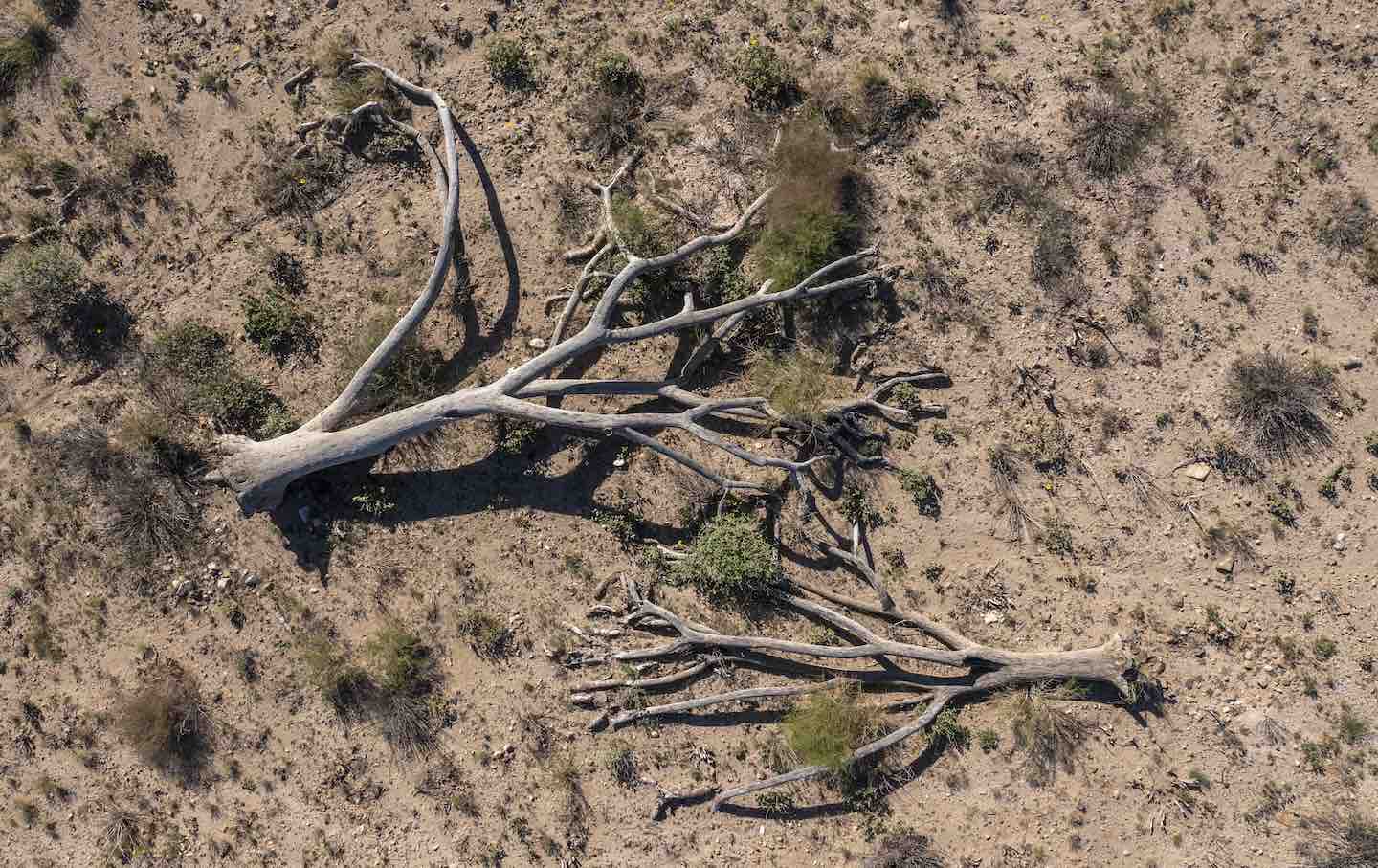
Dead Joshua trees in the Mojave Desert east of Baker, CA, 2022.
(Photo by David McNew/Getty Images)
Forrest Gander is on good terms with the mineral world, and he’s made a habit in his poetry of displaying a deep familiarity with the layers of sediment below our feet. His expertise—Gander is a geologist by training—has allowed him to convert technical terms (such as rift zone, ilmenite, and olivine) into lyrical tools that capture rarefied emotional states and complex systems of relation. So it’s natural that his latest collection, Mojave Ghost, opens with an act of geophagy. “The first dirt I tasted was a fistful of siltstone dust outside the house where I was born in the Mojave Desert,” Gander writes in a brief preface. The dirt, the rocks, the minerals that make up the earth around him are an index of intimacy, of a time and place that shaped his fluid sensibility. Melding the human and nonhuman realms becomes an act of self-recognition for Gander, granting a deeper understanding of himself and the setting of his birth.
Books in review
Mojave Ghost
Buy this bookBut Mojave Ghost is an elegy, too, and the grief Gander expresses here is another form of intimacy we might develop with the earth. His mother, who passed away in 2020, is the titular ghost:
Back here, he imagines her
everywhere he looks. As the spring hills boing green.All awake are the crows.
Flayed by the paper cut of her scent in his memory.
For her, it was home. This town
where various stirps of Christian
fundamentalism intersect
with unchecked retail sprawl.
The landscape of home isn’t necessarily charmed, then. Often, as Mojave Ghost investigates grief, the way it is inscribed in one’s soul but also in one’s surroundings, it assumes the form of a map of sorrow. “From the rain-blurred window of the notions shop / where you liked to go, a kneeling Elamite bull-god, / carved from alabaster, holds out a ritual vessel / to the torrential oncoming, a world forever in motion. // He must have watched you too pass by.” The observation is lovely in its obliquity, the embeddedness and particularity of its central supposition, which is really little more than a whim: You, too, must have passed by this place, must have seen and been seen. Throughout Mojave Ghost, Gander manages a delicate balancing act, bridging a gap between the wideness of the natural world and the smaller, personal space of memoiristic verse.
Over the course of nearly four decades and 13 collections, Gander has evolved a poetics defined, first and foremost, by its thematic and formal hybridity: It’s a poetry of transfusion, obsessed with the crossing of borders between mediums, between the animate and inanimate. A proponent and sometimes practitioner of ecopoetry, Gander is committed to describing the natural world while simultaneously frustrating an anthropocentric reading of it. As he writes in Redstart: An Ecological Poetics (2012), a truly ecological poetry would be one that “display[s] or [is] invested with values that acknowledge the economy of interrelationship between human and nonhuman realms.”
On a thematic level, it’s easy to envision how this could be done—decenter the speaker, tone down any hymning to the splendors of the natural world—but on a formal level, it raises more interesting questions. How to evoke the being of an insect? How to limn the weave of life on a forest floor? How to sing the alterity of moss growing on a stone? Gander has conducted a series of verse experiments in recent collections—including 2021’s Twice Alive, in which he splays his lines across the page, forcing them into new relations that aim at a nonlinear reading—to capture something of the synchronicity and interconnectedness of experience we tend to associate with mushrooms and other rhizomatic life-forms.
In matters of form, Mojave Ghost is less radical in comparison, but it still feels well-suited to its particular task: mounting a diffuse vigil, mourning in a weightless way. A long, continuous poem in blank verse and with no set stanza structure, Mojave Ghost moves at a meditative crawl. Its quivering rhythms mimic those of a slow desert wind, picking up dust, chaff, and the bones of small mammals—a sort of primordial accumulation:
In molecular sand at the base of the cliff,
pale fossils appear after the rain, mostly
ammonites and bryozoa. Speaking to me.
Which is when the raft of dabbling wigeons explodes.
Walking sections of the San Andreas Fault after a series of personal tragedies allowed Gander to think critically about “the fractures and folds that underlie not only my country,” as he writes in the book’s preface, “but any self in its relationship with others.” The desert, naturally, can be read as a poem, but one that is constantly being rewritten. “And though / the rocks buzz / with energy, pulsating in tune // with the earth’s vibrations, their drone // is beyond what we hear. So / the ground truth is a constant / revision,” Gander writes. “Who can read / across the vertiginous stanza / breaks?”
What we might call the linguistic meaning of the natural world will always be beyond us. When we seek to grasp it, Gander suggests, we miss out on the natural world’s symbolic meaning—how its relation to the human self is one of constant revision.
Gander’s wife, the poet C.D. Wright, passed away suddenly in 2016, and his 2018 collection Be With is largely an oblique cycle of elegies for her. As Gander sees it, grief is an embedded thing. “Your impact marks / throng the resin / of my mind,” one of the final poems in Be With asserts. Gander is interested in exploring grief as a mode of relating to the world, one that might heighten rather than deaden experience. Grieving, managed the right way, is a form of observance and, as a consequence, is contiguous with love and the reverencing of those we’ve lost.
Mourning is only half the story of Mojave Ghost, and of Gander’s recent works. The book is also a celebration—more specifically, an epithalamium. Gander is now married to the artist Ashwini Bhat, and a good portion of Mojave Ghost is addressed to her. To the extent that the book dwells on this new romance, it is also a story of regeneration, a reawakening of the senses:
Like the magnet beneath a glass table of iron shavings, you orient me.
Your warm, conductive flesh. Your scent
pooling into the hollows above your clavicles
It was your imperative that launched me forward. After I had stopped.
After the currents of possibility
coursing through my arteries were choked off
with windrows of memory, doubt, and reassessment.Arm in arm, coming down the stepwell.
I, the revenant, the forgotten unapostle of adoration.
We aren’t accustomed to thinking of dryness and sensuality as companionate phenomena, but in Gander’s poetry they’re wedded fluidly; it feels nearly alchemical, for instance, the way he imbues those iron shavings—brittle, sharp—with tender mobility, a certain desultory edge. The desert is expressively empty; on a walking tour with Bhat, Gander writes, “We pass miles of nothing but desert grass / dotted with palmilla. Heat shimmer.” And yet there’s something about the arid vacancy of the terrain that allows for transcendence. In the Mojave, “whatever he is / debouches from its sluice,” the fluid self moving outward along a natural gradient. “What / is more sacred than the gratuitous / opulence of this emptiness?” It’s a cockeyed sublimity—an oceanic feeling sans ocean, revelation without weight.
The very purpose of this method is to slip the bonds of human subjectivity and merge with the different modes of being that abound in the natural world. The emphasis is placed instead on recognizing the vital force beyond the shapes: “Isn’t the / materiality of this Joshua tree, its living / presence, more than what it means?” the book asks. The poetry wants to tear away the veil that habit has drawn over the natural world. And yet, having done this, it urges us to pull back and abide, to resist the urge to apply a fresh coat of meaning to what we’ve experienced.
Gander is probably American poetry’s foremost living exponent of what Helen Vendler, in an essay on the poet A.R. Ammons, called “the metaphysics of multiple connection.” In the past he’s written of his admiration for the “phenomenological poetics” of George Oppen. “Instead of the traditional Western account of a consciousness that digests the external world,” Gander observes in his essay collection A Faithful Existence (2005), “Oppen honors a consciousness interwoven with the world of objects, a consciousness that is nothing if not a collaboration with the world.” If there is a central lesson in Gander’s poetry, it might be precisely this: that consciousness, identity, and being itself are collaborations.
Over the past decade or so, he’s returned again and again to the image of lichen, an emblem of fusion and an allegory, of sorts, for the combinatory nature of identity as it reveals itself in the act and experience of intimacy. “With lichen,” as he points out in the prefatory note to Twice Alive, “the original organisms are utterly changed in their compact. They can’t return to what they were.” In Knot (2022), the speaker of one poem echoes this observation. “Like the component species of a lichen, I gave something up to become something else,” we read. “And I am impenetrable, inviolable, without the dimension necessary for anything to breach me.”
Lichen occurs twice in Mojave Ghost, first as plain description—an orange blotch on the “broken-tile roof” of a church—and later in an evocation of Bhat’s voice, which sounds to Gander “as low and sure / and fragile as lichens.” These are subtle references, and in general Mojave Ghost is a whispery book, spare as its two namesakes. Images rarely recur, save for a small refrain: “What bird wove those sprigs of lavender, mint, yarrow, / and citronella into a nest below our rusted porch light?” It’s a fitting moment of fusion and entanglement. Though composite, these plants have made a new whole—a nest and a home. We are back in the realm of the human, of a warmth that is often playful. Nature is “an endless memoir of / ravelment,” as Gander writes in Twice Alive. Marriage, which he calls “a divination of resonant relations” in Mojave Ghost, could just as well be added to this list.
Become a Sustaining Donor This September
Between the reemergence of right-wing red-baiting and Donald Trump’s use of the chilling National Security Presidential Memorandum–7 to criminalize left political organizing, we’re seeing McCarthyism reborn before our eyes.
This assault on democracy cannot be ignored or wished away. Resisting it requires bravery in the face of threats and repression, a steadfast commitment to the truth, and the unwavering belief that we can—and will—overcome this darkness.
We must have an independent media that sets the record straight, unearths corruption and abuses of power, and advances a politics of justice and dignity for all if we’re to win this fight.
That’s why I’m writing to you today. This September, The Nation needs to add 100 monthly donors to sustain our progressive journalism. Your contribution makes the next investigative report, the next truth-speaking column, and the next pathbreaking essay all possible.
I hope you’ll support our work with a recurring donation today. If you donate $10 or more a month, we’ll send you a brand new “Hands Off the Free Press!” sticker to recognise your commitment to our cause. Please, donate today.
Onward,
Katrina vanden Heuvel
Editor and Publisher, The Nation