
“I Think I’m Very Intimidating to AIPAC”
An interview with Illinois congressional candidate Daniel Biss.
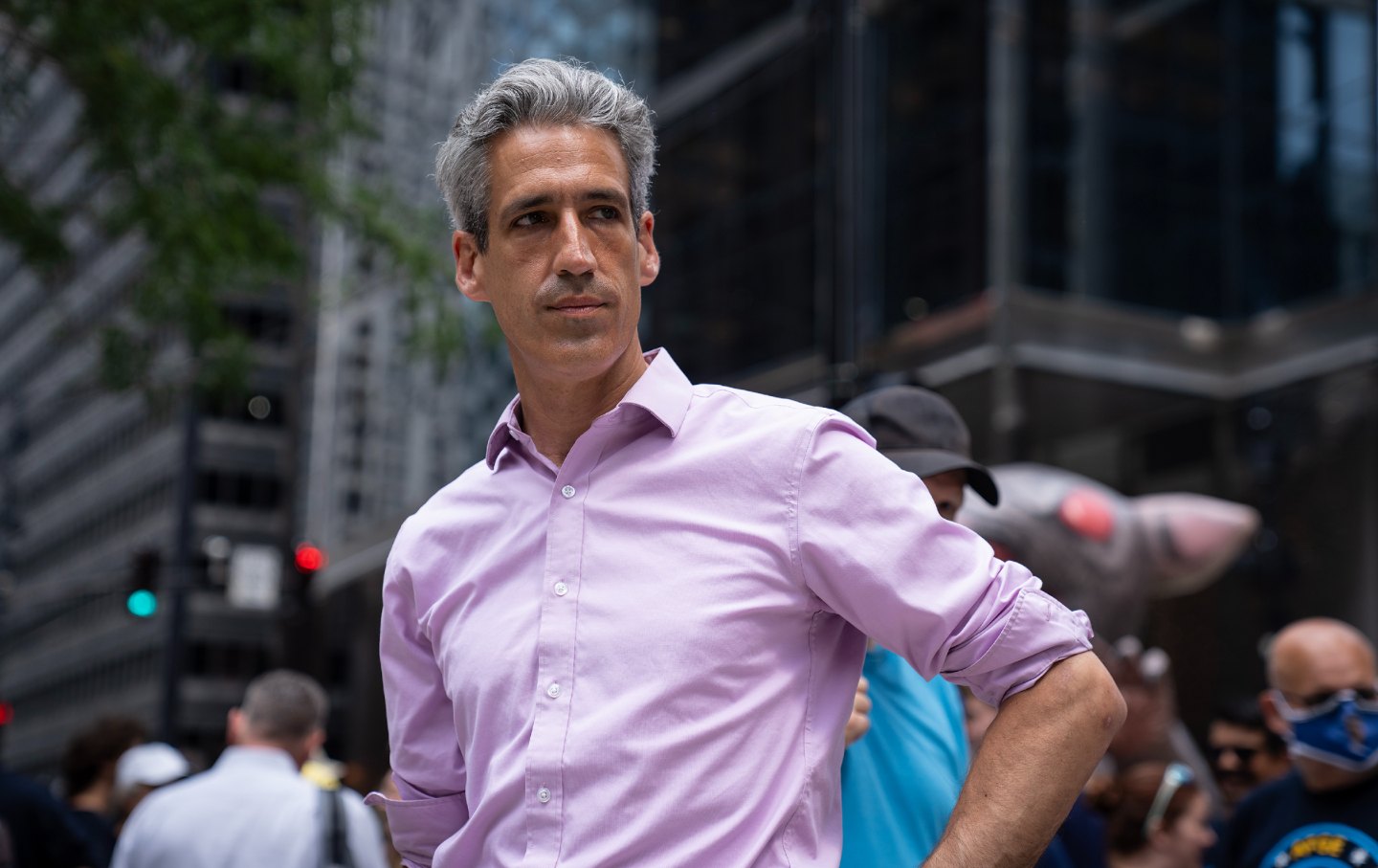
Daniel Biss in Chicago on August 12, 2025.
(E. Jason Wambsgans / Chicago Tribune / Tribune News Service via Getty Images)Outside spending, the widening war in the Middle East, generational politics, and the future of the Democratic Party’s progressive wing have all converged in the race for Illinois’s Ninth Congressional District.
The crowded primary to succeed the district’s outgoing representative has drawn national attention in part because of the millions of dollars flowing into the race from groups aligned with the American Israel Public Affairs Committee (AIPAC). Though 15 candidates are on the ballot, the contest has largely narrowed to a three-way race between Evanston Mayor Daniel Biss, journalist Kat Abughazaleh, and Illinois state Senator Laura Fine.
Biss first entered politics in the early 2000s while working as a mathematics professor at the University of Chicago, organizing against the Iraq War. He later served in the Illinois House and Senate, ran for governor in 2018, and has been mayor of Evanston since 2021.
On the eve of the primary, Biss talked with The Nation about the race, AIPAC-linked spending, the strikes against Iran, and the Trump administration’s immigration crackdown. This interview has been edited for clarity.
—Matthew Vickers
Matthew Vickers: How did you initially get involved in progressive politics?
Daniel Biss: I was a math professor at the University of Chicago. I started there in 2002 and certainly never envisioned getting into politics. But if you think about what [was] happening then, it’s the year after 9/11, six months before the war in Iraq, we’re watching as the country has been lied into a war by George W Bush. And frankly, too many Democrats were too scared to say what was obvious. I just couldn’t believe it. It seemed really dangerous. And so I wound up doing a bunch of political organizing. One thing led to another, and I ran for office in 2008.
MV: Considering you got started in politics with the lead-up and the eventual invasion of Iraq, what do you make of the war between the United States and Israel on one side and Iran on the other?
DB: It’s horrible. Let’s start with the easy stuff. It’s illegal. You don’t have to erase the Constitution as president. The idea that anybody of any point of view or any political party voted against the War Powers resolutions in the House and Senate is disappointing. I don’t think we should end the conversation by discussing the technicalities and the procedural aspects of legality. It’s also a terrible idea.
It’s dangerous and reckless, and it’s very reminiscent of where we were just 23 years ago, with the argument that the Saddam Hussein government was oppressive and terrible being correct. And, you know, Saddam’s regime in Iraq was oppressive, brutal, and dangerous—there’s no question about it. That doesn’t mean that an invasion like this makes things better.
Already, American service members have been killed. Untold numbers of civilians have been killed in Iran and elsewhere. And there’s a very real risk of a broader regional conflict that would be violent, brutal, politically destabilizing, and dangerous. So this is a horrendous idea that I think everyone ought to stand up against and just say great feeling, no war on Iran.
MV: Stepping back to the primary, what would you say are the pillars of your campaign?
DB: We’re living in an emergency. The core values, protections, and liberties that this country claims to be built on are under attack, and we need someone [in Congress] who has demonstrated the ability to do two things. One is to fight and win inside a government against tough opposition with backbone and courage when it is politically risky to do so. The other is the ability to fight and win on the streets with activists, because we’re not going to overcome this moment [otherwise]. This threat requires a resistance movement of people standing up in the street, putting their bodies on the line, and demanding change through mass mobilization.
I’ve done both. I passed our healthy-buildings ordinance here in Evanston. It’s the strongest climate ordinance of its type in the Midwest, by far, [and I passed it] against the strong opposition of the wealthiest, most powerful institutions in this town. I was able to build a coalition with activists, organizers, and policy experts and make it happen, which they couldn’t get done in Chicago or anywhere else. And I’ve been an activist and organizer since those first days organizing against the Iraq War. Unfortunately, recent circumstances have required me to demonstrate that again—being tear-gassed on the front lines by ICE, standing face-to-face with Greg Bovino in my town, and confronting him. He’s not welcome here because of the racism, brutality, and violence that his agents were involved in. There’s no one else in this race who’s consistently demonstrated both of those capabilities, and that’s why there’s something very important at stake in the primary, right?
You should not have a military-style interior border enforcement entity; it’s wrong. We also need real accountability through impeachments and prosecutions of these monsters who have terrorized our communities, violated people’s rights, and, yes, clearly, in my opinion, committed crimes. I think accountability will be critical, both for the message it sends and for the lessons we’ve learned that will help us establish guardrails to ensure this doesn’t happen again.
MV: This race has attracted significant media attention from outlets like Politico, Zeteo, The New York Times, and Jewish Currents, for the sheer amount of money dumped into it, mostly from AIPAC-linked organizations. As first reported by WBEZ Chicago, pro-Israel groups in Illinois have spent nearly $14 million attacking progressive and pro-Palestinian candidates. One of your opponents, Illinois state senator Laura Fine, has received financial support from them, despite the fact that AIPAC hasn’t directly endorsed her.
DB: There are two different things that have happened here. The first is that AIPAC has raised a ton of money for Laura. Let’s be very clear about this. There’s no gray area here. There’s no hiding the ball. There’s no pretending to wait. AIPAC raised tons of money for Laura. They sent lots of fundraising e-mails on her behalf. They set up in-person events across the country that she attended, including one with AIPAC’s board president. I think we’re now well past a million and a half that they directly raised for her campaign.
But that’s actually a drop in the bucket compared to what happened next. There’s a shady new super PAC called Elect Chicago Women that came into existence so late in the game that it won’t disclose a single donor until after the votes are counted. Everybody has acknowledged that the super PAC, which has now spent over $5 million on this race, a big chunk of it supporting Laura Fine, a big chunk of it attacking me, is entirely AIPAC-funded. So they’ve basically laundered their super PAC money through a brand new super PAC with a pretty name to hide the fact that they are spending millions and millions in this race.
Why are they hiding it? They’re hiding it because they’re toxic. They’re hiding it because their agenda, which is no-strings-attached military aid to the current Israeli government, no matter what they do in Gaza or the West Bank, is also toxically unpopular. So they’re hiding where the money is coming from, and they’re using the money to talk about anything but their policy agenda. The good news is, I think that the Democratic voters in this district are seeing through, and they’re not going to let out-of-state right-wing interests and Trump donors get away with it by this election.
MV: Why do you think AIPAC is trying to affect the outcome of this particular race?
Popular
“swipe left below to view more authors”Swipe →DB: I think I’m very intimidating to them. I think that having someone like me who’s Jewish, who’s the son of an Israeli, grandson of Holocaust survivors who can’t be dismissed, speak clearly about the horror that the Netanyahu government has perpetrated, about the need for US actions to match US and international law, the need to stop the blank check, the need to recognize a Palestinian state. I think it’s very threatening to them to have someone like me. The good news is, I think it’s going to backfire on them, because the Democrats in the district don’t want, obviously, Republicans and Trump donors to buy the seat, right?
MV: What’s your final pitch to readers deciding between you and a fellow progressive, Kat Abughazaleh, for this district?
DB: I think the views of trusted progressives are really important here. Not only is Congresswoman Jan Schakowsky supporting me, but so are Elizabeth Warren, the Congressional Progressive Caucus, Pac Premier, Pramila Jayapal, Jamie Raskin, the Illinois AFL-CIO, SEIU, many labor unions, and the Sierra Club. These are all groups and individuals who consider several candidates. They will readily acknowledge that multiple of us are progressive. Still, they say, “Hey, listen, Daniel has been in the fight, won, and made things happen with capital and courage, even at real political cost to himself, and that’s the person we want fighting with us in Washington.”
And you know, I think that record of having fought and won, not just having taken the right positions, not just having done the right things, but having put my own career on the line to fight and win, whether it’s on climate as we discussed, or affordable housing or standing up the first municipal reparations program in the country, or other racial justice, public safety work as mayor—that record of making it happen even when it’s tough is really important, particularly right now and government’s so stuck where people in this country are losing hope, the government can even be an instrument to make change in their lives. That hopelessness is such a critical part of what brought us to this dark moment in American history.
More from The Nation
Obama Delivers a Scorching Rebuke to Trump—and Centrist Dems Obama Delivers a Scorching Rebuke to Trump—and Centrist Dems
Unlike other establishment figures, the former president isn't scared to associate with the party's left flank.
Elon Musk’s Mortal Threat to Democracy Elon Musk’s Mortal Threat to Democracy
The world’s richest man—saying he’s “wised up” to the fiction of self-government—is leveraging his wealth to sway elections, threaten Congress, and alter the global balance of pow...
Michigan Students Are All In for Abdul El-Sayed Michigan Students Are All In for Abdul El-Sayed
The progressive Senate candidate has won over students with his politics—and, in at least one case, his protein intake.
What Are Democrats Prepared to Do if Trump Rigs the Election? What Are Democrats Prepared to Do if Trump Rigs the Election?
In this week’s Elie v. U.S, our justice correspondent challenges Democrats' lack of a plan if Trump steals the midterms. Plus: the most racist, and honest, AI add ever.
Ramaswamy’s Guide to a Better Vocabulary Ramaswamy’s Guide to a Better Vocabulary
Quotes of the Week.
Why Trump Is Embracing Vivek Ramaswamy’s Vile Ad Why Trump Is Embracing Vivek Ramaswamy’s Vile Ad
The president is leaning into the politics of toxic parenting.

