
Why Palestine Matters So Much to Queer People
Palestinian identity can “upend the whole world order, if done right, if spun right, if we activate it enough. And I think queerness is a very similar kind of identity.”
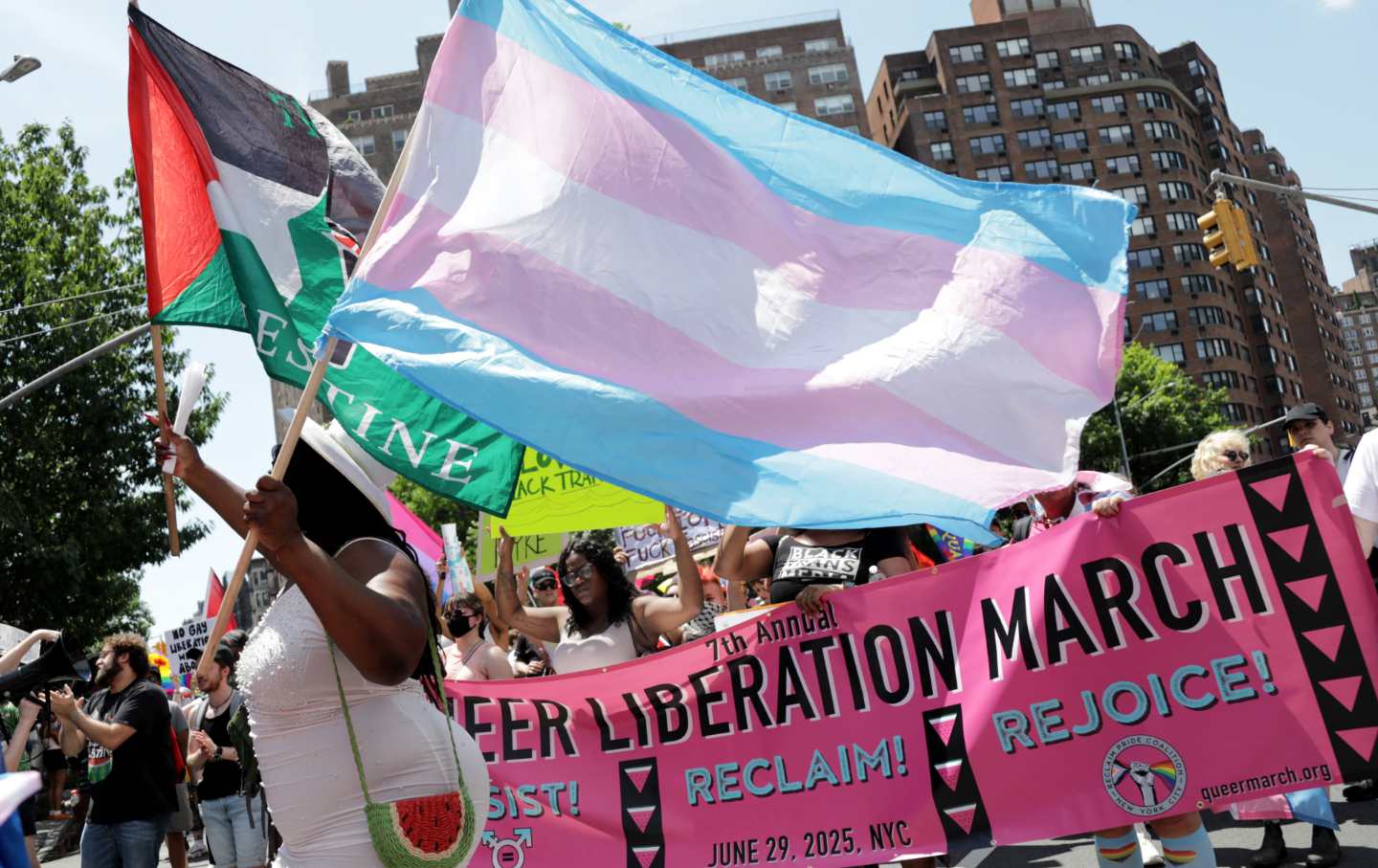
People participate in the Queer Liberation March in New York City on June 29, 2025.
(Leonardo Munoz / AFP via Getty Images)When Randa Jarrar finally dared to say it publicly—that she was both queer and Palestinian—she said it felt “beautiful to be my authentic self.” But not everyone seemed to agree.
Jarrar, a writer, novelist, and performer, was raising her son in Texas in the early 2000s when she began giving public readings from what would eventually become her debut novel, Map of Home. It wasn’t the easiest time to be a queer Arab American. The Iraq War was raging, and Islamophobia was rampant—even in supposedly liberal hot spots like Austin. During a Q&A after a reading at the Texas Book Festival, the room grew tense when a few audience members began heckling Jarrar—a reaction she says was, until recently, quite common. Her book’s heroine is an underage Arab girl fleeing an abusive father, yet attendees insisted that the queer Palestinian characters in her story needed rescuing—especially if they were queer girls. “They generalized from one character’s experience,” Jarrar told me in November from Los Angeles.
No, she countered, how can a “Christian nationalist country that hates queer people and is murdering Arabs daily” save anyone?
The moment revealed a carefully rationed, transactional empathy that has become the hallmark of Western liberalism. Enough performed compassion to reaffirm the liberals’ own righteousness, but a compassion rooted in paternalism and racism, and one that never risks unsettling the very power structures that enable oppression and suffering.
Two decades later, these contradictions have again come to the fore in many queer spaces. Now, though, Palestine itself—and the genocide in Gaza—is the defining issue.
“Palestine isn’t just another cause for queer movements—it’s a litmus test,” says Alexander Stoffel, a queer historian and author of Eros and Empire. “It reveals two competing visions of queerness. One is white, Western and assimilationist, seeking validation from the very powers that once criminalized it.” The other, he argues, is liberationist and intersectional, grounded in solidarity and “the belief that freedom must include the right of all people to shape their own lives.”
While Stoffel frames the split as ideological, queer Palestinian poet and writer George Abraham pushes it further, seeing queerness and Palestinian identity in practical terms, as twin forces capable of remaking the world. Palestinian identity, Abraham says, has the potential to “upend the whole world order, if done right, if spun right, if we activate it enough. And I think queerness is a very similar kind of identity.”
They describe attending a Pride event in Montreal, where Palestinian and trans flags could be seen everywhere, fluttering side-by-side as attendees chanted “Pride is a riot.” It was moving, they said, to see advocates of the two communities standing together, even if they felt a pointed skepticism towards the idea of flags—or, more broadly, nation-states and the ideals that come with them. “Palestinian identity is insurgent and resistive. This is not a commodifiable identity. It can’t be reduced by capital or by representational wins,” they said, adding, “who are our identities legible to and for? How do we negotiate that? How do we reclaim our own illegibility to these systems that just want us dead?” But if queerness and Palestine have the potential to reshape the world both ideologically and practically, the main obstacle to both is a global order that prioritizes the dominance of one group at the expense of another’s existence.
Scrolling through queer dating apps like Grindr over the past two years, I noticed an increase in symbols of solidarity with Palestinians, such as the watermelon emoji. But it’s not only unfolding online; it has spilled into the streets, where Palestine has become a flash point at Pride events across North America and Europe. It increasingly takes center stage—exposing the contradictions within spaces that celebrate inclusion while excluding the Palestinian struggle.
In Ottawa this past August, the city’s annual Ottawa Capital Pride parade was canceled abruptly, after a dispute over Palestine. Activist Emily Quaile of Queers4Palestine said her group had been invited by the ceremonial leader (known as the grand marshal) to march at the head of the parade, alongside indigenous floats such as the First Nations, Métis, and Inuits—a gesture meant to center communities too often pushed to the margins. But after Capital Pride retracted a statement in solidarity with Palestinians, Queers4Palestine retaliated, staging a protest against the Pride march itself. “We stopped the parade to expose how Capital Pride was talking out of two sides of its mouth,” she said.
The plan, she explained, was “to expose the role of Ottawa’s mayor and others in pressuring Prides to be silent about Palestine.” Quaile pointed to the overlap between Canada’s anti-trans movement and anti-Muslim networks—groups behind campaigns against abortion, women’s rights, and Muslim communities. “They’re all the same people,” she said. “And they’re the same people who are also anti-Indigenous, who believe violently in the white man’s right to property.”
This entanglement of oppression is hardly new; from the early days of gay liberation to the AIDS crisis, queer movements have wrestled with their relationship to empire. Some queer people have supported Palestinian resistance; others have embraced Zionism as a response to Jewish persecution or been compelled by pinkwashing campaigns that promote Tel Aviv (built on the ethnically cleansed Palestinian villages of Sheikh Muwannis, Salama, Summayl, Al-Mas’udiyya, and Jarisha) as a gay utopia.
Stoffel noted that there has long been a substantial contingent of prominent LGBTQ+ people who voiced support for the Israeli state—“Figures as different as…Audre Lorde and Barbara Smith, during the Black lesbian feminist movement, and Larry Kramer of the AIDS activist movement.”
But many queer figures also aligned themselves with anti-Zionism or anticolonial movements. James Baldwin, for instance, was fiercely critical of the state of Israel. The first time I read his 1979 article for The Nation, “Open Letter to the Born Again,” I came to understand, as so many before me had, that my existence was never a matter of ideology. Referring to the Israeli state, he reasoned that “it was not created for the salvation of the Jews; it was created for the salvation of the Western interests.”
American poet and essayist June Jordan, meanwhile, wrote about Palestine through her identity as a Black woman viewing the struggles of Palestinians as interconnected with the struggles against American imperialism and racism. In her 1982 poem “Moving towards Home,” she wrote “I was born a Black woman / and now / I am become a Palestinian.”
The connection runs in both directions. Pro-Palestine protests in New York drew inspiration from ACT UP (AIDS Coalition to Unleash Power), the advocacy group that in the 1980s demanded urgent action on the AIDS crisis. “When ACT UP occupied Grand Central Station in opposition to the first Gulf War, their slogan was: ‘Fight AIDS, not Arabs,’” writer and playwright Sarah Schulman recalls.
In her recent book, The Fantasy and Necessity of Solidarity, Schulman looks at how the pro-Palestine movement even borrowed from ACT UP’s mock-up of The New York Times, echoing ACT UP’s earlier parody, The New York Crimes, with their version, The New York War Crimes.
Schulman points to ACT UP as one of the most effective grassroots campaigns of the late 20th century, “because that was a winning structure, and also because there’s a queer trajectory between the two as well.” ACT UP and other AIDS activists even used the concept of “genocide” to frame the AIDS crisis as a form of systematic failure, negligence, and at times, deliberate harm, particularly in the early years of the epidemic.
While tactics being used by early AIDS activists and today’s growing Free Palestine movement share techniques, Palestinian queer activists point out an unsettling contradiction: that Western ideas of progress on LGBTQ+ rights lose their moral force when entire Palestinian communities are being bombed and denied essential food and medicine, in what the world’s leading scholars have said meets the criteria of genocide.
“In genocide, everything is flattened: buildings, bodies, our gender, our feelings. When a bomb falls, it doesn’t ask if you’re queer or straight. Palestinians die beside their families, with neighbors, with lovers — it doesn’t matter. In this context, what does queerness even mean?” said alQaws director Angelique Abboud. The organization—whose name means ‘the rainbow’ in Arabic— has been providing support, education, and advocacy for LGBTQ+ Palestinians for over two decades. alQaws spoke out in 2014 after a spate of stories revealed that the Israeli army was extorting and blackmailing LGBTQ+ Palestinians to become informants after digitally spying on them—a tactic that continues to this day.
Abboud describes alQaws as “a grassroots anti-colonial organization that works for sexual and gender diversity in Palestinian society.” The only place it cannot physically reach is Gaza, where Israel’s long-standing blockade tightly controls entry, allowing outsiders in only with official permission.
“It’s not that our communities don’t face social or cultural challenges—but [the Western media] highlights them without acknowledging the occupation, apartheid, and the ways colonial realities shape how we navigate religion, patriarchy, class, and gender strips the context from our experiences,” said Izat El Amoor, a Palestinian sociologist who focuses on queer studies.
He pointed to a throughline from colonial-era laws in the 1920s that criminalized homosexuality in British-mandate Palestine to the present day, where Western LGBTQ+ norms are now used to shame and police Palestinians. “Historically, colonizers pointed to same-sex practices in Eastern societies to mark themselves as ‘different’ and justify colonization. Now, the supposed lack of acceptance of queerness in non-Western societies is used to justify continued colonial attitudes,” El Amoor explained.
Even amid what Abboud describes as “patriarchal and colonial violence,” alQaws has worked to shift the conversation within Palestinian society—efforts that have begun to bear fruit over the past two decades. Since its founding, the organization has also played an important role in forging links with LGBTQ+ activists abroad, reaching those in the West who might not once have seen Palestine as an obvious point of solidarity.
But solidarity isn’t always simple. The group must also navigate Israel’s pinkwashing strategy of painting itself as a safe haven for LGBTQ+ people in order to deflect from or to justify its oppression of Palestinians. Many queer Palestinians point out that this narrative erases their lived realities under occupation, surveillance, and genocide; images of Israeli soldiers brandishing Pride flags amid the rubble of Gaza have driven home these contradictions.
In October, Louna Sbou sent me voice notes from aboard the Global Sumud Flotilla, a multinational convoy of some 40 vessels intent on breaking Israel’s blockade of Gaza. In the recordings, the German-born Moroccan-Amazigh culture worker could be heard speaking over the steady trickle of saltwater slipping off the boat’s edges and back into the Mediterranean. I asked them if Palestine was a queer issue. “It’s our shared jihad [Arabic for struggle] against systems of oppression that continue to control our bodies, our lives, and our very existence,” they replied. Their messages arrived four days before they were expected to reach Gaza.
Popular
“swipe left below to view more authors”Swipe →A few days earlier, media reports had noted tensions over the participation of LGBTQ+ activists, with some participants criticizing their involvement as unrelated to the flotilla’s stated mission and as an attempt to advance a “culturally progressive agenda.” Despite pushback, Sbou was adamant: “Solidarity with Palestine reflects the very realities that queerness is not just about sexuality or identity but about dismantling oppressive structures globally, and that is a common understanding within queer liberation and Palestine liberation movement.”
As the writer and performer Jarrar put it, “We’ve always built community in the cracks of systems that were never made for us.” For poet Yaffa As, that same principle links struggles “from Palestine to Sudan, the Congo, Kashmir, and Turtle Island [a term some use for North America].” Queerness, they said, “is inseparable from marginalization. It’s built into the identity itself. In a liberated world, queerness no longer exists because marginalization no longer exists.”
Become a Sustaining Donor This September
Between the reemergence of right-wing red-baiting and Donald Trump’s use of the chilling National Security Presidential Memorandum–7 to criminalize left political organizing, we’re seeing McCarthyism reborn before our eyes.
This assault on democracy cannot be ignored or wished away. Resisting it requires bravery in the face of threats and repression, a steadfast commitment to the truth, and the unwavering belief that we can—and will—overcome this darkness.
We must have an independent media that sets the record straight, unearths corruption and abuses of power, and advances a politics of justice and dignity for all if we’re to win this fight.
That’s why I’m writing to you today. This September, The Nation needs to add 100 monthly donors to sustain our progressive journalism. Your contribution makes the next investigative report, the next truth-speaking column, and the next pathbreaking essay all possible.
I hope you’ll support our work with a recurring donation today. If you donate $10 or more a month, we’ll send you a brand new “Hands Off the Free Press!” sticker to recognise your commitment to our cause. Please, donate today.
Onward,
Katrina vanden Heuvel
Editor and Publisher, The Nation
More from The Nation
How Trump’s Crackdown on Speech Has Damaged the Student Press How Trump’s Crackdown on Speech Has Damaged the Student Press
I serve as editor in chief and president of The Stanford Daily. Our newsroom has keenly felt the effects of Trump’s campus crackdown, which is why we sued the federal government.

Nationalize Spotify Nationalize Spotify
Music streaming platforms have way too much control over musicians and music lovers. It’s time to rein them in.
What’s the Matter With Effective Altruism? What’s the Matter With Effective Altruism?
President Trump has decried the techbro creed for indulging in AI doomerism, but its excesses are far worse than that.
As Morale Sags, More Military Service Members Are Having a Crisis of Conscience As Morale Sags, More Military Service Members Are Having a Crisis of Conscience
According to multiple GI rights organizations, service members are inquiring in unprecedented numbers about seeking conscientious objector status.
What Remains of Riis? What Remains of Riis?
A new members’ club has revived Riis Park’s long-vacant bathhouse, reopening old questions about whom the People’s Beach is really for.

When Texas Sex Ed Falls Short, Gen Z Women Turn to Social Media When Texas Sex Ed Falls Short, Gen Z Women Turn to Social Media
A 2025 study found that 70 percent of adolescents sought reproductive health information through social media platforms.

