Backsliding in Belém
Petrostates at COP30 quash fossil fuel and deforestation phaseouts.

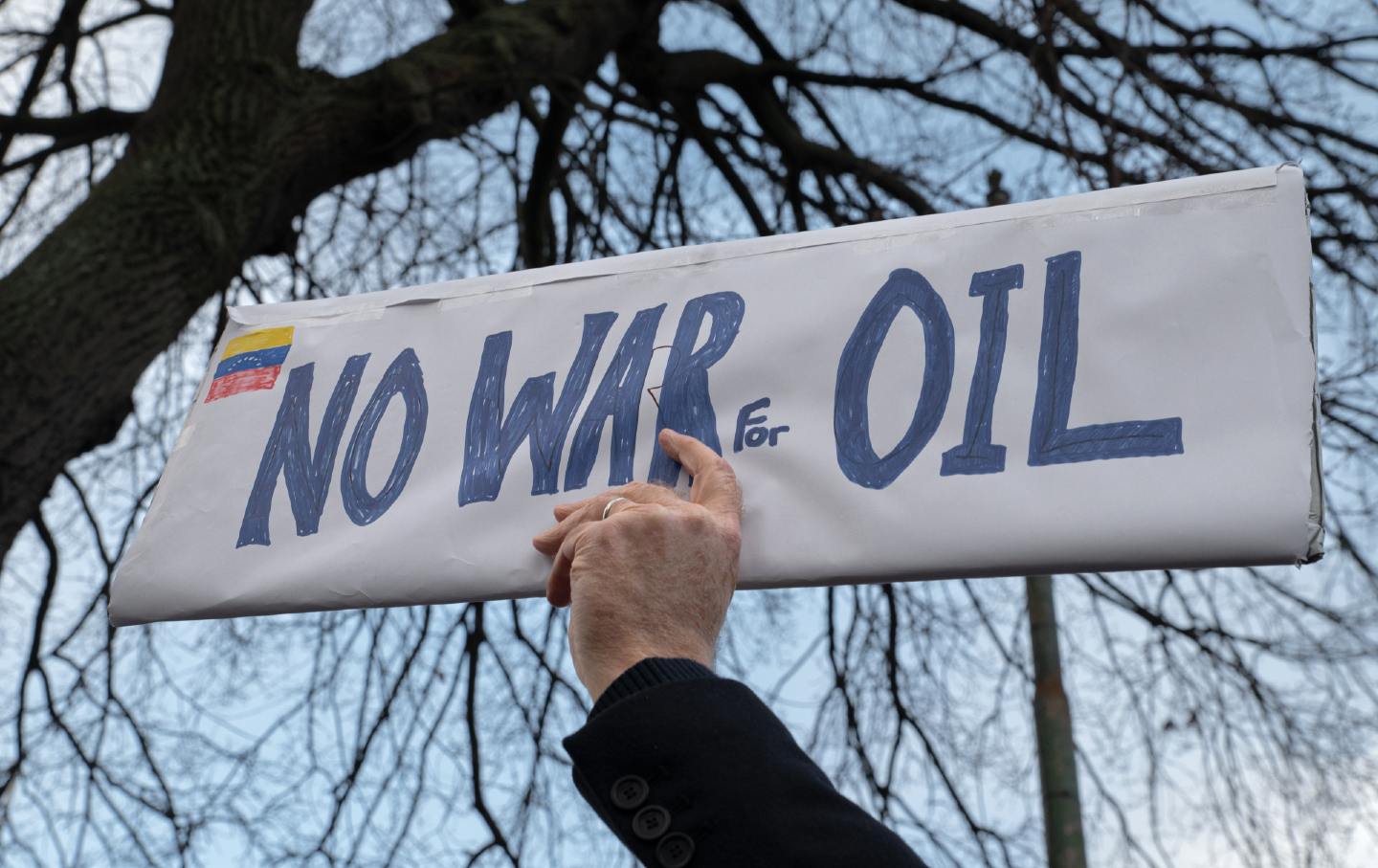
People participate in a demonstration in front of the main entrance of COP30 in Belém, Brazil on November 10, 2025.
(Ivan Pisarenko / AFP via Getty Images)
Belém, Brazil—The COP30 climate summit concluded on Saturday with a disappointing—even infuriating—agreement. In a diplomatic black eye for host country Brazil, what had been promoted as a summit of “truth” and “implementation” delivered little of either. When climate change is already imposing terrible suffering, when emissions are still increasing, and when 80 to 89 percent of the world’s people want governments to take stronger action, COP30 left the climate fight at a standstill, if not backsliding.
Money—who has it and who needs it—has been the sticking point at virtually every UN climate summit since such negotiations began here in Brazil with the 1992 Earth Summit, and it remained so at COP30. Divisions between haves and have-nots were as stark as ever, as was the power of fossil fuel interests. The result was an agreement that does not remotely align with science and leaves millions of people in frontline communities “exposed to the worst impacts and with few options for their survival,” said Oxfam Brasil executive director Viviana Santiago.
Two years ago in Dubai, the world’s governments endorsed “a transition away from fossil fuels”—the first time in 28 COP negotiations that fossil fuels, the primary driver of global warming, were explicitly named in the final text. But the words “fossil fuels” were missing from the agreement COP30 president Andre Correa do Lago gaveled through on November 22. Much less did the agreement endorse a “road map” for phasing out fossil fuels, as more than 80 countries, including Colombia, Germany, France, and the United Kingdom, demanded. Saudi Arabia, perhaps emboldened by US President Donald Trump’s contempt for climate action (shown by his not sending a US delegation to this COP), led a group of petrostates that refused to sign any agreement that targeted fossil fuels. And since COP negotiations are governed by UN rules that require consensus, this petrostate resistance prevailed. Instead, countries can voluntarily join an effort outside the COP process to devise a road map, starting at a conference Colombia will host next April.
Also not in the final text was a road map for halting deforestation, the second most potent driver of global warming. Brazil held these talks in Belém, a gateway to the Amazon, precisely to underscore the urgency of protecting forests, which absorb some of the carbon dioxide that fuels global warming. Brazil also urged respecting the knowledge and rights of Indigenous peoples, which is the most effective means of preserving forests. But in what The Guardian called “either an awful diplomatic blunder or sabotage by the Brazilian foreign ministry, which has long had a focus on selling the country’s oil abroad,” the deforestation road map was placed in the same part of the text as the fossil fuel phaseout, and the petrostate opposition killed both provisions at once.
The COP30 agreement’s one partial bright spot is a call for tripling the amount of money rich countries provide to help poor countries adapt to increasingly frequent and deadly heat waves, storms, droughts, and other impacts of rising temperatures. Adaptation funding is set to increase to $120 billion a year, but there’s a catch—two, actually. First, the delivery of such funds was delayed to 2035, rather than 2030 as poor countries proposed. Second, given that rich countries have repeatedly failed to deliver the funds previous pledges stipulated, it’s questionable whether they will do better now.
Civil society representatives condemned the COP30 agreement as a failure on scientific, legal, and moral grounds.
“Rich countries cannot make a genuine call for a road map if they continue to drive in the opposite direction themselves,” said Mohamed Adow of Power Shift Africa, referencing how some countries that in Belém urged phasing out fossil fuels are nevertheless increasing production at home. “COP30 gave us some baby steps in the right direction, but considering the scale of the climate crisis, it has failed to rise to the occasion.”
The upbeat rhetoric voiced by some countries and businesses—their talk of boosting innovation, planting trees, finding win-win outcomes—can give the appearance that they’re genuinely changing course, said Santiago of Oxfam Brasil. But they aren’t willing to change the underlying structures and practices that keep emissions climbing, she added—the preference for industrial farming over regenerative agriculture, for example, or the $7 trillion in annual global subsidies to fossil fuels. “They want to change things, without changing things.”
An International Court of Justice ruling last July legally requires all countries to honor the Paris Agreement goal of limiting temperature rise to 1.5C, said Erika Lennon at the Center for International Environmental Law. But the lack of “decisive action” at COP30 leaves the earth heading for at least 1.7C of temperature rise, said Johan Rockstrom, director of the Potsdam Institute for Climate Impacts Research. That will push structures like the polar ice caps toward catastrophic, irreversible tipping points that can unleash yet more warming. Humanity can avoid this nightmarish future only by “phasing out fossil fuels in an accelerated, orderly and just way,” said Rockstrom. After COP30, that task is more urgent than ever—but it still awaits the heroes who can make it happen.