November 24, 2025

Boris Kagarlitsky on the Trump Administration’s 28-Point Plan to End the Ukraine War


From prison, the eminent critic of Putin and the war calls for the conflict to end.
Boris Kagarlitsky
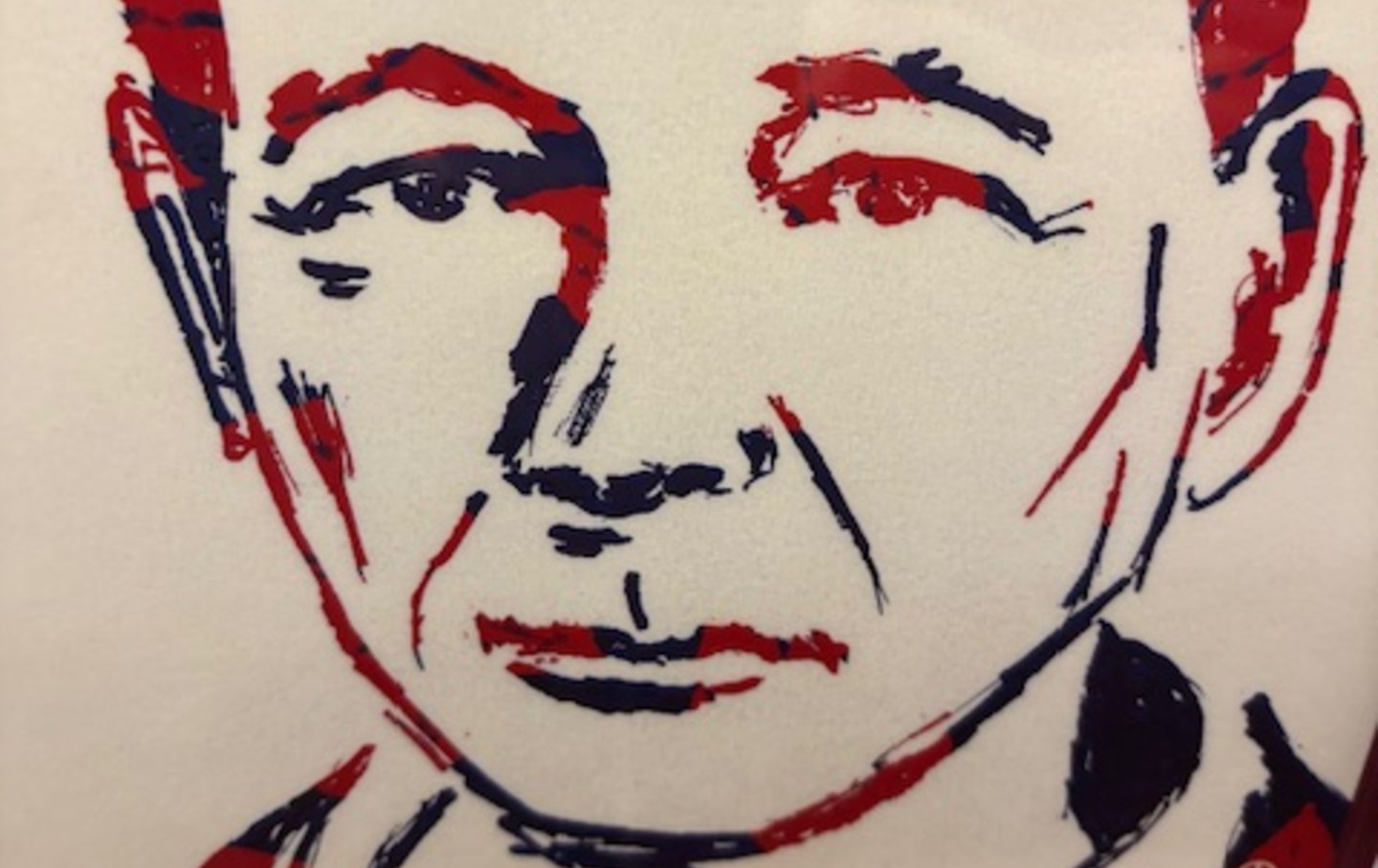
An illustration of Boris Kagarlitsky, part of a traveling political prisoner exhibit organized by the Zone of Freedom organization.

Boris Kagarlitsky was first arrested in July 2023 in connection with a since-deleted YouTube video about the 2022 Crimea Bridge explosion. His case reveals the cruelty and absurdity at work.

Kagarlitsky is perhaps Russia’s most prominent leftist intellectual, a Marxist critic of both Western imperialism and Putin’s domestic authoritarianism.

After spending nearly 5 months in pretrial detention 1,000 kilometers from Moscow, Kagarlitsky was convicted, but released with a fine of 609,000 rubles.

Supporters raised the money in less than an hour. Paying the fine, however, was complicated by the matter of Kagarlitsky having already been designated as both a “foreign agent” and a “terrorist or extremist” (common terms leveled against anti-war advocates remaining in Russia) and was therefore prohibited by law from conducting financial transactions.

The state then appealed his December release due to the fine not having been paid. Eight weeks later, the military court reversed the December verdict and imposed the harsher prison sentence of 5 years.

Kagarlitsky is now serving his sentence at Penal Colony No. 4 in Torzhok, 155 kilometers from Moscow. On November 8, he was sent to solitary confinement for three days; no reasons have been given. On November 20, lawyer Yulia Kuznetsova appealed to the head of the penal colony with a request to hospitalize Kagarlitsky: according to Kuznetsova, the 66-year-old prisoner’s health had deteriorated.

Kagarlitsky is one of Russia’s best-known political prisoners. There are others, much less visible, including quite a few labor rights advocates, environmentalists, ethnic and racial minority defenders about whom nobody writes or speaks. According to the UN Human Rights Committee in Russia, there are still more than 2000 political prisoners incarcerated in Russia, at least 120 of them “in imminent danger due to their critical health, age or disability.”

Kagarlitsky has demanded that he not be included on any exchanges. “I have stated several times and I repeat again,” Kagarlitsky insisted, “that I do not wish to participate in such exchanges… I see no point or benefit for myself in emigrating. If I had wanted to leave the country, I would have done so myself.”

Just this past weekend, Kagarlitsky released these comments on the Trump administration’s 28-point plan to end the war in Ukraine:

The twenty-eight points Trump offered, as they are currently published, look quite strange. Many aspects are written unclearly, vaguely, ambiguously, and rather contradictorily. The only thing that is described very thoroughly and in detail is the financial part. It is quite clear that Donald Trump has remained true to himself here: everything concerning money is the only important and significant thing in this situation.

It is clear that all these documents will be processed and settled in the near future; there will be further negotiations where something will be clarified and explained. The document that results in the end will most likely differ significantly from what we read today.

But if we take today’s document, the main conclusion that somehow comes to me is this: Ukraine looks like the losing side, and Russia in this situation does not look like the winning side. The only winner in this war, according to Trump, is the United States of America.

And yet the most important thing is that the conflict must end. However it happens, if people stop being killed, if cities stop being destroyed, if the sides stop exchanging blows, that will already be good news. Therefore, we still have to hope that this, even if very raw, very strange, and sometimes even unpleasant document, will nevertheless become a milestone on the path to peace.

Boris Kagarlitsky, from Penal Colony No. 4
Time is running out to have your gift matched 

In this time of unrelenting, often unprecedented cruelty and lawlessness, I’m grateful for Nation readers like you. 

So many of you have taken to the streets, organized in your neighborhood and with your union, and showed up at the ballot box to vote for progressive candidates. You’re proving that it is possible—to paraphrase the legendary Patti Smith—to redeem the work of the fools running our government.

And as we head into 2026, I promise that The Nation will fight like never before for justice, humanity, and dignity in these United States. 

At a time when most news organizations are either cutting budgets or cozying up to Trump by bringing in right-wing propagandists, The Nation’s writers, editors, copy editors, fact-checkers, and illustrators confront head-on the administration’s deadly abuses of power, blatant corruption, and deconstruction of both government and civil society. 

We couldn’t do this crucial work without you.

Through the end of the year, a generous donor is matching all donations to The Nation’s independent journalism up to $75,000. But the end of the year is now only days away. 

Time is running out to have your gift doubled. Don’t wait—donate now to ensure that our newsroom has the full $150,000 to start the new year. 

Another world really is possible. Together, we can and will win it!

Love and Solidarity,

John Nichols 

Executive Editor, The Nation

Boris Kagarlitsky

Boris Kagarlitsky, born in Moscow in 1958, was a dissident and political prisoner in the USSR under Brezhnev, then a deputy to Moscow city council (arrested again in 1993 under Yeltsin). Since 2007, he has run Institute for Globalization Studies and Social Movements in Moscow, a leading Russian leftist think tank. He is the editor of the online magazine Rabkor and an author of numerous books, of which the two most recent to appear in English are Empire of the Periphery (Pluto) and From Empires to Imperialism (Routledge).

More from The Nation

A close-up of Donald Trump against a dark background looking skeptical.

Brace Yourselves for Trump’s New Monroe Doctrine Brace Yourselves for Trump’s New Monroe Doctrine

Trump's latest exploits in Latin America are just the latest expression of a bloody ideological project to entrench US power and protect the profits of Western multinationals.

Eric Ross

Jose Antonio Kast delivers a speech in front of his supporters after being elected.

Chile at the Crossroads Chile at the Crossroads

A dramatic shift to the extreme right threatens the future—and past—for human rights and accountability.

Peter Kornbluh

Trump speaks at a NATO Summit

The New Europeans, Trump-Style The New Europeans, Trump-Style

Donald Trump is sowing division in the European Union, even as he calls on it to spend more on defense.

David Broder

Two US Marine Corps MV-22 Ospreys depart at Mercedita International Airport on December 16, 2025, in Ponce, Puerto Rico. The Trump administration is conducting a military campaign in the Caribbean and eastern Pacific, deploying naval and air forces for what it calls an anti-drugs offensive.

The United States’ Hidden History of Regime Change—Revisited The United States’ Hidden History of Regime Change—Revisited

The truculent trio—Trump, Hegseth, and Rubio—do Venezuela.

Barbara Koeppel

Idi Amin in Kampala, 1975.

Mahmood Mamdani’s Uganda Mahmood Mamdani’s Uganda

In his new book Slow Poison, the accomplished anthropologist revisits the Idi Amin and Yoweri Museveni years.

Books & the Arts / Howard W. French

Trump and Putin walk side-by-side silhouetted

The US Is Looking More Like Putin’s Russia Every Day The US Is Looking More Like Putin’s Russia Every Day

We may already be on a superhighway to the sort of class- and race-stratified autocracy that it took Russia so many years to become after the Soviet Union collapsed.

Andrea Mazzarino