
Sharm El-Sheikh Shows That the US Has Learned Nothing From Gaza
Palestinans are expected to accept the same deal that led to October 7: permanent subjugation under the guise of “prosperity.”
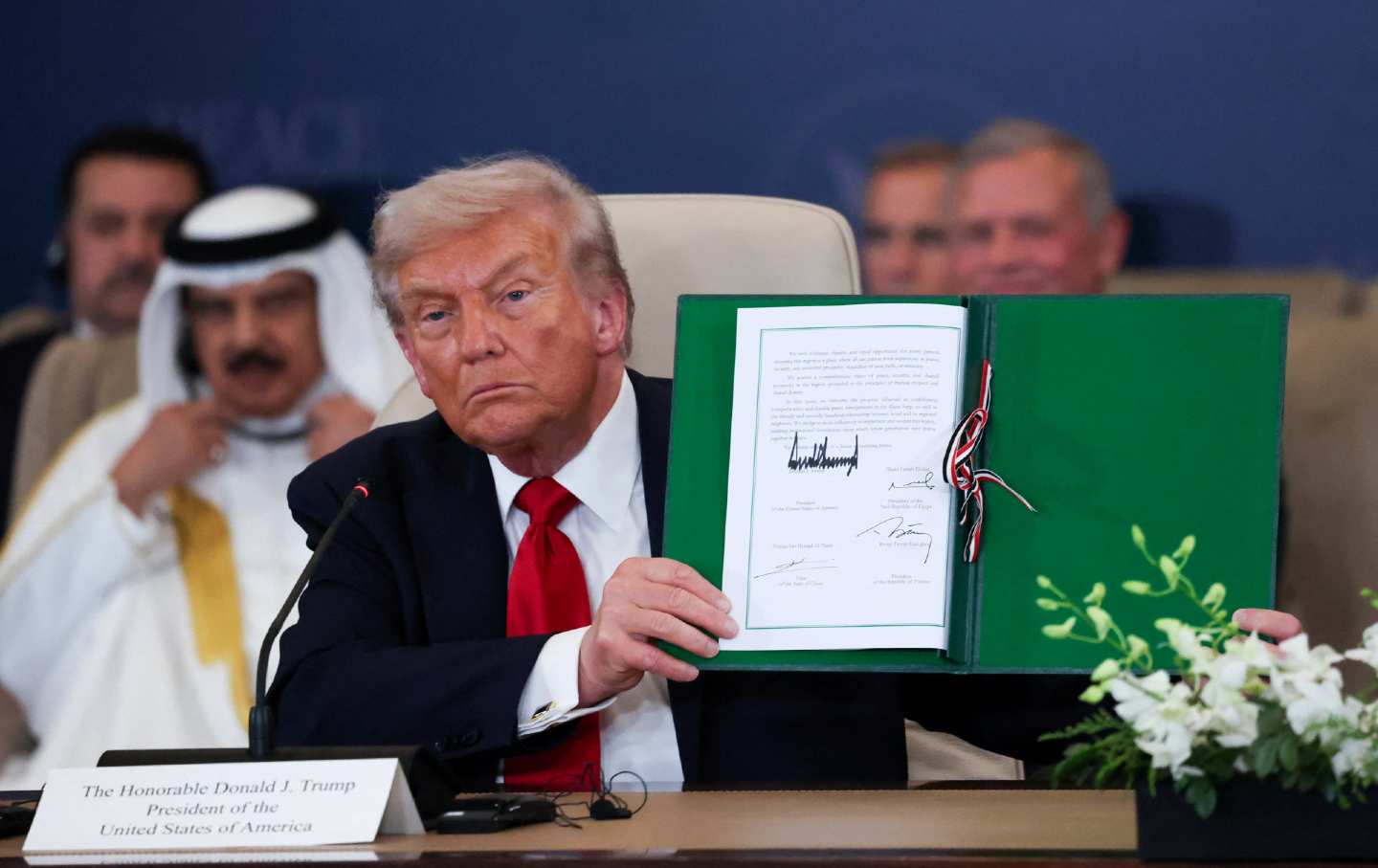
President Donald Trump displays the Gaza agreement endorsed by regional leaders at Sharm El-Sheikh, Egypt.
(Suzanne Plunkett – Pool / Getty Images)
The guns are quiet; the Palestinian ones, that is. Israel did not wait 24 hours after President Donald Trump declared the Gaza genocide “over” before killing at least six Palestinians in the Occupied Territories in aerial assaults; including five in Shujawiya and one east of Khan Younis.
Israeli’s overnight violations of the third post–October 7 ceasefire bring an undeniable sense of déjà vu. In addition to breaking the first two, it’s broken its ceasefire with Lebanon hundreds, if not thousands, of times. But they also reflect the reality beneath the pageantry of Monday’s Sharm El-Sheikh conference. Two years of nonstrop atrocities in Gaza are not yielding Palestinians the “historic dawn of a new Middle East” that Trump promised but the recrudescence of the same one that US hegemony has always offered: a permanent oppression they are expected to quietly accept.
Much of the regional diplomacy after the Israeli strike on Qatar last month had been devoted to securing a ceasefire and hostage exchange. Now that those provisional goals have been achieved, no one can answer the harder question of what comes next. The Sharm El-Sheikh summit sidestepped the Trump plan for a “Board of Peace,” chaired by the US president and run by Tony Blair, in an echo of the British Mandate a century ago. But the communiqué out of the summit, signed by most of the diplomatic intermediaries of the past two years of Israeli-Palestinian negotiation, is deafeningly silent about the central issue of Palestinian freedom.
Released by the White House on Monday under the typically self-aggrandizing title “Trump Declaration for Enduring Peace and Prosperity,” the communiqué locates the key to “lasting peace” in combating “extremism” and “promoting education, opportunity, and mutual respect.” It defines lasting peace as “one in which both Palestinians and Israelis can prosper with their fundamental human rights protected, their security guaranteed, and their dignity upheld.” It solemnly intones that a “comprehensive vision of peace, security and shared prosperity in the region” will be grounded in “the principles of mutual respect and shared destiny.”
Nowhere does the document so much as hint at Palestinian statehood. Nowhere does it even suggest accountability for the innumerable war crimes committed by the Israeli government, still led by a man facing an arrest warrant issued by the International Criminal Court. And it never comes anywhere close to establishing a diplomatic mechanism to address the Palestinians’ legitimate demands for freedom from Israel. Somehow, Palestinians are expected to consider their “dignity upheld” through continued subjugation by an Israeli military that remains inside Gaza. The communiqué was little more than a rehash of the endless post–Second Intifada assurances from the administrations of George W. Bush and Barack Obama that Palestinian material prosperity can functionally substitute for independence.
The other signatories at Sharm El Sheikh toed the same evasive line. The regional leaders endorsing the communiqué were Abdel Fattah El-Sisi, the dictator of Egypt; Tamim bin Hammad al-Thani, the emir of Qatar; and Recep Tayyip Erdogan, the autocrat of Türkiye. Sisi at least acknowledged the need for a Palestinian state, but only outside the confines of the communiqué. He gave Trump an award instead.
Sisi’s actions encapsulated the cowardice at Sharm El-Sheikh. The conference did not build a pathway to peace; it showcased a desire for quiet. And while the ostentatious treatment of Trump as a man of history is a spectacle not typically necessary for American presidents, it reflects the decades-old bargain between the United States and recipients of its largesse like Egypt. Under this compact, tyrants disconnected from their people receive advanced military technology in exchange for satisfying US political and economic prerogatives. Even as Israel engaged in its US-backed genocide, military ties between it and ostensible critics like Egypt and Qatar actually expanded, as The Washington Post recently revealed.
The Gaza genocide exposed this arrangement—usually understood as American hegemony and more recently “the rules-based international order”—as bankrupt and predatory in a manner exceeding even the US occupation of Iraq. The genocide also opened the US-backed order to unprecedented challenges, such as the ICC’s indicting a US client instead of a US adversary and the recognition, however superficial, of a Palestinian state by European powers firmly in the US ambit. That was what Trump referred to in his speech before the Israeli Knesset warning Netanyahu that Israel cannot fight the entire world.
Yet Trump is not about to let the overdue recognition of the truth stand in the way of a convenient and lucrative delusion. That delusion is known as the Abraham Accords, a massive US arms deal that Trump’s first administration brokered in 2020, cementing normalization between Israel and the Arab powers over the heads of Palestinians. When the Sharm El Shaikh statement heralded “strengthening bonds among nations” and the “friendly and mutually beneficial relationship between Israel and its regional neighbors,” it was signaling a desire to return to the momentum of those accords.
But if the Hamas attacks on October 7 proved anything, it was that substituting regional normalization with Israel for Palestinian freedom is a path into a nightmare, not out of one. A people who has survived 75 years of expulsion, massacre, apartheid and now genocide will not accept consignment to the margins of a regional order. The US coalition claims the loyalty of many of the governments of the region, but the past two years proved once again that the Palestinian cause commands the loyalty of the region’s people.
In pursuing the Abraham Accords, both Trump and Joe Biden confused the quiet of the Palestinians with their quiescence. When Israel’s supporters claimed there was peace on October 6, they succumbed to the same delusion. It led only to October 7 and genocide. The horrors of the past two years should have taught Israel and its declining-superpower patron that the only path to peace runs through a free Palestine. Instead, it chose the image of an illusory stability over the lives of at least 67,869 Palestinians, and likely tens if not hundreds of thousands more buried in the ruins of Gaza. Unless they learn the real lessons of the genocide and what preceded it, another October 7 is an inevitability.
Your support makes stories like this possible
From illegal war on Iran to an inhumane fuel blockade of Cuba, from AI weapons to crypto corruption, this is a time of staggering chaos, cruelty, and violence.
Unlike other publications that parrot the views of authoritarians, billionaires, and corporations, The Nation publishes stories that hold the powerful to account and center the communities too often denied a voice in the national media—stories like the one you’ve just read.
Each day, our journalism cuts through lies and distortions, contextualizes the developments reshaping politics around the globe, and advances progressive ideas that oxygenate our movements and instigate change in the halls of power.
This independent journalism is only possible with the support of our readers. If you want to see more urgent coverage like this, please donate to The Nation today.
More from The Nation

Drones? Europe’s Automakers Are Taking Orders. Drones? Europe’s Automakers Are Taking Orders.
French car company Renault seeks a foothold in rearmament.
Trump’s Abraham Accords Fantasy Will Only Cause More Suffering Trump’s Abraham Accords Fantasy Will Only Cause More Suffering
Any expansion of the alleged peace agreement would lock the Middle East into endless apartheid, despotism, and militarism.
An Alternative View of What’s Next After the Trump-Xi Summit An Alternative View of What’s Next After the Trump-Xi Summit
Hawkish rhetoric from the national security establishment isn’t grappling with the complex challenges posed by China’s rise.
Trump’s Killing Spree in Somalia Is Just One Assault in His Global War-Making Trump’s Killing Spree in Somalia Is Just One Assault in His Global War-Making
No American president has ever attacked Somalis with the persistence and at the rate of President Donald Trump.
“Why Did So Many People Think This War Was a Good Idea?” “Why Did So Many People Think This War Was a Good Idea?”
The story of how millions of Iranians fell for the regime-change fantasy.

