Clarence Thomas Admits That He’s Coming for Our Rights
In a little-covered speech, the Supreme Court justice explained how he thinks the court should reverse rulings conservatives don’t like.
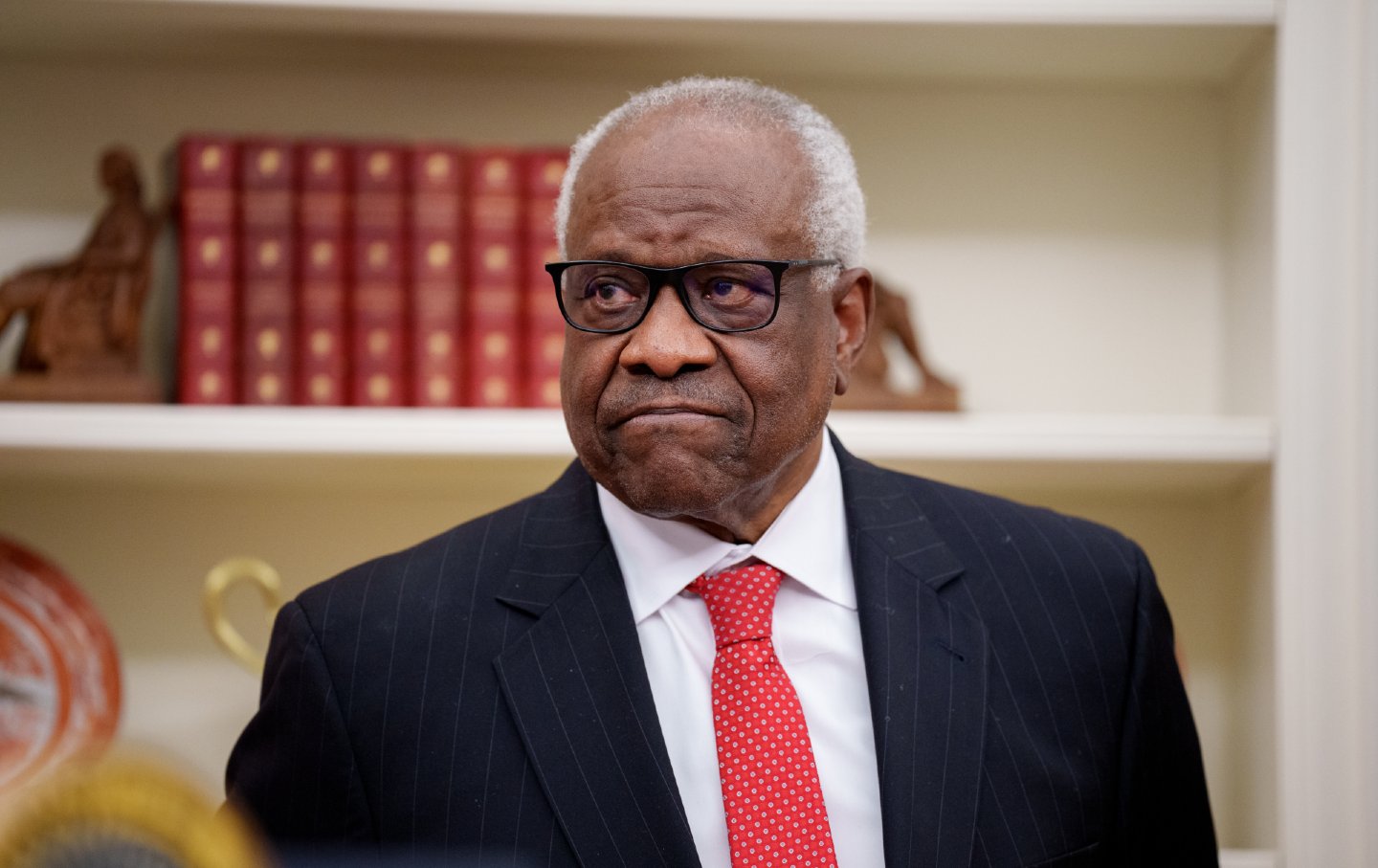
Supreme Court Associate Justice Clarence Thomas.
(Andrew Harnik / Getty Images)
In an interview at Catholic University last week, Supreme Court Justice Clarence Thomas said what he’s clearly been thinking for the past 30 years: Supreme Court precedents don’t matter, and he’s making things up as he goes along to fulfill his own political agenda.
He didn’t say it in that way, of course. People would have noticed that. Instead, he couched his self-serving philosophy in legal jargon that will fly under the radar of most people, including journalists. Here’s what he said: “At some point we need to think about what we’re doing with stare decisis.… [I]t’s not some sort of talismanic deal where you can just say ‘stare decisis’ and not think, turn off the brain, right?”
To translate: “Stare decisis” is a foundational legal principle in this country and all countries that follow a “common law” system. What it means, in simple terms, is that prior judicial rulings govern future judicial rulings. If a court rules, for instance, that “gay people have the same basic rights as everyone else in this country, including the right to marry other people,” then that ruling is supposed to govern all future cases concerning the rights of gay people.
Thomas, apparently, doesn’t agree. Instead of respecting stare decisis and precedent, he is saying that older cases shouldn’t have the power to control newer ones. For Thomas, just because courts ruled that LGBTQ people should have rights in the past, including the right to marry, doesn’t mean he feels compelled to rule that they should keep them.
Obviously, courts change the rules and take things away all of the time. Sometimes, old cases are just, well, old, and their rulings should not be carried forward perpetually into the future. There are legitimate ways to overcome stare decisis—specifically, three ways—but that’s not what Thomas is proposing. Still, it’s helpful to understand what they are.
The first is legislation or amendments. Congress could pass a new law saying “gay people don’t have the same rights as other Americans” or amend the constitution to do the same thing. The most famous time this happened in American history was when the Reconstruction Amendments (the 13th, 14th, and 15th amendments) overruled the Dred Scott decision. But new legislation or amendments happen rarely.
Usually, Congress doesn’t break stare decisis; judges do. The most common way for them to do that is to “distinguish” the case before them from cases in the past. This, my friends, is where most legal appellate work is done. Show a lawyer a rule governing “trees,” and get prepared for a botanist’s dissertation distinguishing “bushes” from the noble tree. A famous example of distinguishing was when John Roberts redefined Obamacare as a “tax” (it wasn’t) to avoid making another precedent allowing the government to use the commerce clause to regulate health care.
The third way to ignore precedent and break stare decisis is to claim that things have materially changed since the old ruling. It’s the judicial equivalent of saying, “At one time we thought the earth was flat but now we know it is round, so our prior rulings demanding the destruction of telescopes are overturned.” The most famous historical example of this is Brown v. Board of Ed overturning Plessy v. Ferguson. In Brown, the court said that segregation hurt Black people in ways that white people couldn’t have possibly known when they decided Plessy (note: They freaking knew).
The astute reader will note that at no point are judges supposed to say that prior precedent was wrong. They’re not supposed to come out and say, “We are overturning this old case, because we don’t like it anymore and desire different political and legal outcomes. Thank you for coming to my TED talk.” Congress is allowed to do that, but not the courts.
Clarence Thomas is saying: To hell with all that. He knows that the normal way of dealing with stare decisis is not to “turn your brain off.” His problem is that the legitimate ways of overturning prior opinions doesn’t get him to where he wants to go. He can’t say anything has materially changed since, for instance, Obergefell v. Hodges, which recognized same-sex marriage. He can’t distinguish new marriage equality cases from the old one, and Stephen Miller hasn’t furnished him with a new constitutional amendment to outlaw the practice. But he certainly doesn’t want gay couples to get married. Stare decisis blocks him from stopping them, so he’s telling people to ignore stare decisis. Thomas thinks that some prior decisions were just wrong and he gets to decide what is wrong and what is right, even though nobody elected him to do that work.
Here’s another quote from his Catholic University talk: “We never go to the front [to] see who’s driving the train, where is it going. And you could go up there in the engine room, find it’s an orangutan driving the train, but you want to follow that just because it’s a train.”
First of all, I swear Thomas is the only Black public intellectual I am familiar with who uses simian analogies when describing something he thinks is stupid. They need to add him to the DSM as a new form of “self-loathing.”
Anyway… Thomas is saying that if he doesn’t like where the “train” of stare decisis is leading him, he can just get off and go in a different direction. Remember, Thomas’s war against the 20th century can’t achieve victory if old Supreme Court opinions have weight.
In place of stare decisis, Thomas offers this invented framework: that “the precedent should be respectful of our legal tradition, and our country, and our laws, and be based on something, not just something somebody dreamt up and others went along with.”
The problem is: The question of which precedents are “respectful of our legal tradition, our country, and our laws” can quickly devolve into what Clarence Thomas thinks is “respectful” of those traditions or laws. It’s completely ungrounded from anything real or provable. It’s not even textual. “Respect” means whatever the hell Thomas wants it to mean, at any given time.
We’ve seen this in Thomas’s opinions in recent years. In 2022, he declared, in a separate but supporting opinion in the Dobbs case, that Roe v. Wade was not respectful of our legal traditions, but Loving v. Virginia is. Why? Well because Roe gave women rights, while Loving gave Thomas the right to marry his white wife, and if you have a better legal difference between those cases other than Thomas’s own personal preferences, I’d love to hear you explain it. Thomas has also decided (in this case, writing for the majority) that simple gun registration laws are not respectful of our traditions in this country, but he signed on to an opinion giving the president the powers of the very king we revolted against. You simply cannot chart a course through what passes for logic in Thomas’s head without understanding his preferred policy outcomes.
If Thomas were the only justice who thought like this, it would be a containable problem. But the entire Republican cabal on the Supreme Court rules exactly in the way Thomas is talking about, with no respect for precedent or stare decisis. This coming term, the Republicans on the court are likely to overturn a voting rights precedent they set for themselves only a couple of years ago. The Republicans literally cannot be trusted to respect their own rulings.
Popular
“swipe left below to view more authors”Swipe →The entire Trump administration has been a “mask off” moment for the Supreme Court’s conservatives. It turns out, they don’t actually care about precedent (no matter how many times they lied and claimed to care during their Senate confirmation hearings). They don’t actually care about the text. They don’t actually care about judicial restraint. They want the political outcomes they want and they have the votes to do it.
Thomas’s speech is a declaration that there is no judicial precedent that is safe from the current Republicans on the court. Stare decisis will not stand in their way of getting what they want. You could read the entire speech as a shot across the bow of Obergefell v. Hodges, and it is, but it’s also a rare moment where Thomas told the truth about what he and his friends are actually doing. They do not care about traditions, norms, or the very foundation of judicial decision making in a common law system. They only care about winning.
That’s all going to be very bad for those of us who do not happen to be white cis-hetero men in the near term, but there is a silver lining. Thomas’s speech at Catholic University literally lays down the playbook for how to defeat him and all the evil and cruelty he has wrought during his time on the bench. According to Thomas, future Supreme Court justices do not have to wrestle with the precedents laid down by Thomas and his Roberts-court brethren. They do not have to distinguish future cases from the ones that are being decided today. They do not have to wait for Congress to pass new laws, or for the Constitution to be amended. They don’t have to stay on the train Clarence Thomas is driving.
And I am here for that. By Thomas’s own admission, the power of the Roberts court dies the moment there are more liberals on the bench than Republicans. That could happen as soon as the next presidential election, if Democrats get their act together to take control of the Supreme Court. If stare decisis is dead, then it’s dead forever. What can’t happen is for future Democratic justices to try to resurrect it, to preserve the power of the people who killed it.
Clarence Thomas will soon be the longest-serving justice in American history. It’s good to know that he thinks his opinions will not matter after he’s dead. On that, he and I agree.
Become a Sustaining Donor This September
Between the reemergence of right-wing red-baiting and Donald Trump’s use of the chilling National Security Presidential Memorandum–7 to criminalize left political organizing, we’re seeing McCarthyism reborn before our eyes.
This assault on democracy cannot be ignored or wished away. Resisting it requires bravery in the face of threats and repression, a steadfast commitment to the truth, and the unwavering belief that we can—and will—overcome this darkness.
We must have an independent media that sets the record straight, unearths corruption and abuses of power, and advances a politics of justice and dignity for all if we’re to win this fight.
That’s why I’m writing to you today. This September, The Nation needs to add 100 monthly donors to sustain our progressive journalism. Your contribution makes the next investigative report, the next truth-speaking column, and the next pathbreaking essay all possible.
I hope you’ll support our work with a recurring donation today. If you donate $10 or more a month, we’ll send you a brand new “Hands Off the Free Press!” sticker to recognise your commitment to our cause. Please, donate today.
Onward,
Katrina vanden Heuvel
Editor and Publisher, The Nation