Are We Distracting Ourselves Into Climate Catastrophe?
When shocking news about how soon civilization might collapse is overshadowed by Taylor Swift’s engagement, we might have a problem.
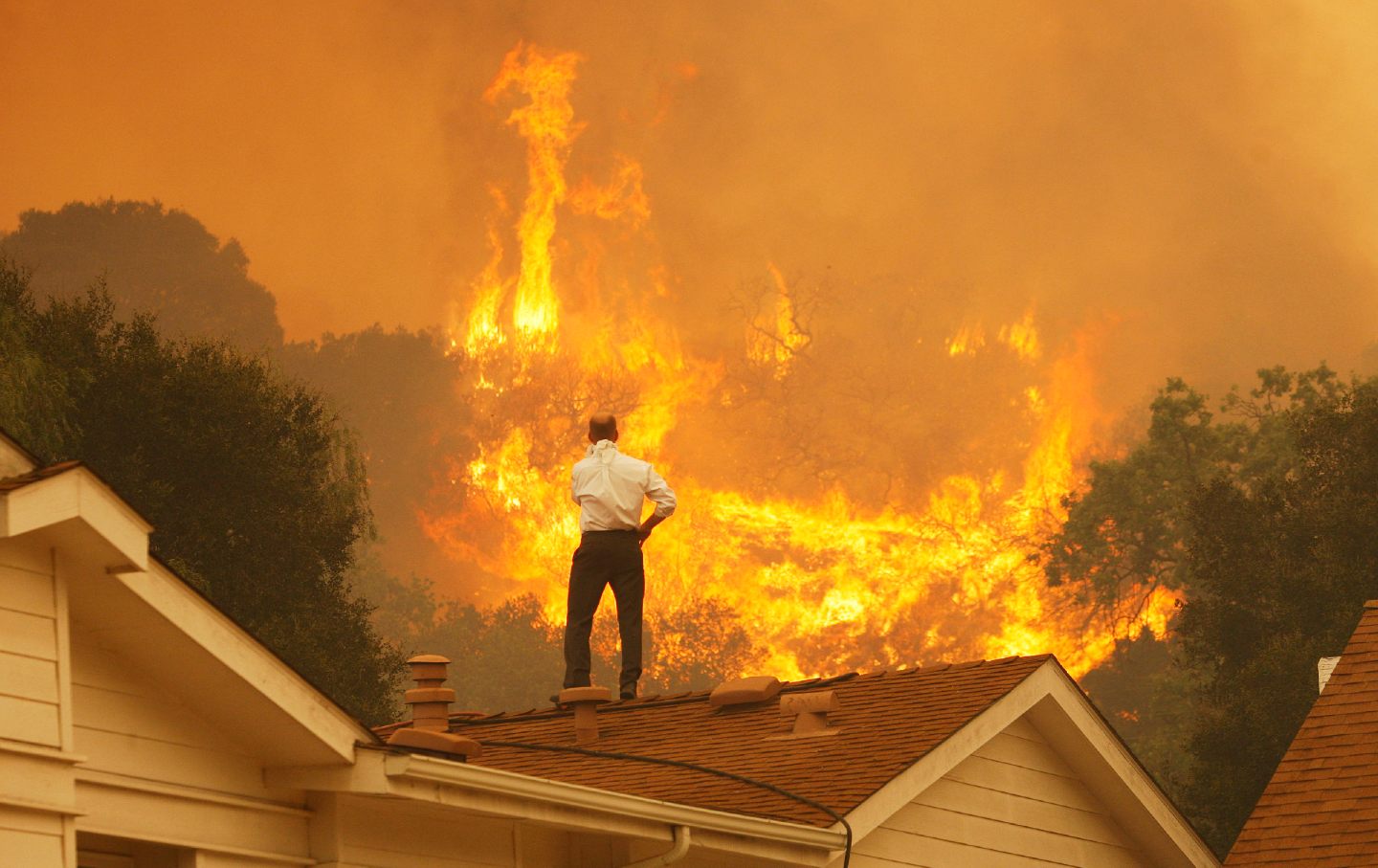
A man on a rooftop looks at approaching flames as the Springs fire continues to grow on May 3, 2013 near Camarillo, California.
(David McNew / Getty Images)
Chances are you’ve heard that Taylor Swift is getting married. When she and Travis Kelce announced their engagement last month, it was all over the news, all over the world.
Chances are equally good that you did not hear some other, literally Earth-shaping news that broke two days later. On August 28, some of the world’s foremost climate scientists dramatically revised their estimate of how soon one of the foundations of Earth’s climate system could collapse.
Media’s obsession with one story—and its ignoring of the other—highlights the gaps that remain in treating the climate crisis like the cataclysm it has become. While progress has been made in many newsrooms, old journalism habits linger, including sidelining important climate news out of misguided fears that it’s depressing or too complicated. As CCNow’s 89 Percent Project has shown, that’s not how most readers or viewers see it.
The collapse of what is commonly called the Gulf Stream—the vast Atlantic ocean current that scientists refer to as the Atlantic Meridional Overturning Circulation, AMOC—would deal a crushing blow to civilization as we know it. Sometimes known as Europe’s “central heating unit,” the AMOC is why Britain, France, The Netherlands, and their northern neighbors enjoy relatively mild winters, even though they sit as far north as Canada and Russia.
AMOC originates in the Caribbean, where sun-warmed sea water flows northeast across the Atlantic toward Greenland. The amount of heat AMOC transports is staggering: 50 times more heat than the entire world uses in a year. Without AMOC, the history and present day of Europe would look very different. Winters would be much colder and longer. Food production would be much less, as would the human population and infrastructure the region could support.
The scientific study released on August 28 concluded that AMOC’s collapse “can no longer be considered a low-likelihood event,” to quote The Guardian, one of the very few outlets to report the news. Indeed, such a collapse is more likely than not if humanity’s greenhouse gas emissions remain on their current trajectory. If emissions continue to rise, there is a seven out of 10 chance that AMOC will collapse, the scientists calculated. If emissions fall to a moderate level, the odds are 37 percent—roughly one in three. Even if emissions decline in line with the Paris Agreement goal of limiting temperature rise to 1.5 to 2 degrees Celsius, there is a one in four chance of collapse.
Although the collapse might not occur in this century, the scientists warned that the system could pass a “tipping point” in the next decade or two that makes its eventual collapse inevitable. As 44 scientists explained in an open letter to the Nordic Council of Ministers, AMOC might well collapse in this century, but there is an “even greater likelihood a collapse is triggered this century but only fully plays out in the next.”
The only hope, the scientists added, is a “global effort to reduce emissions as quickly as possible, in order to stay close to the 1.5 [degrees C] target set by the Paris Agreement.”
By no means is northern Europe the only region in peril. A collapse, or even significant slowdown, of AMOC would devastate agriculture in Africa and other parts of the Global South by massively disrupting rainfall patterns.
All of which helps explain why Stefan Rahmstorf of the Potsdam Institute for Climate Impact Research, who co-authored the new study, was frustrated by how little attention he and his colleagues’ warnings got. “What more can we do to get heard?” he asked. “It’s like the saying that every disaster movie starts with scientists warning and being ignored.”
Become a Sustaining Donor This September
Between the reemergence of right-wing red-baiting and Donald Trump’s use of the chilling National Security Presidential Memorandum–7 to criminalize left political organizing, we’re seeing McCarthyism reborn before our eyes.
This assault on democracy cannot be ignored or wished away. Resisting it requires bravery in the face of threats and repression, a steadfast commitment to the truth, and the unwavering belief that we can—and will—overcome this darkness.
We must have an independent media that sets the record straight, unearths corruption and abuses of power, and advances a politics of justice and dignity for all if we’re to win this fight.
That’s why I’m writing to you today. This September, The Nation needs to add 100 monthly donors to sustain our progressive journalism. Your contribution makes the next investigative report, the next truth-speaking column, and the next pathbreaking essay all possible.
I hope you’ll support our work with a recurring donation today. If you donate $10 or more a month, we’ll send you a brand new “Hands Off the Free Press!” sticker to recognise your commitment to our cause. Please, donate today.
Onward,
Katrina vanden Heuvel
Editor and Publisher, The Nation