DC Statehood: Now, More Than Ever
The best counter to Trump’s authoritarianism is a renewed commitment to secure full representative democracy in Washington.
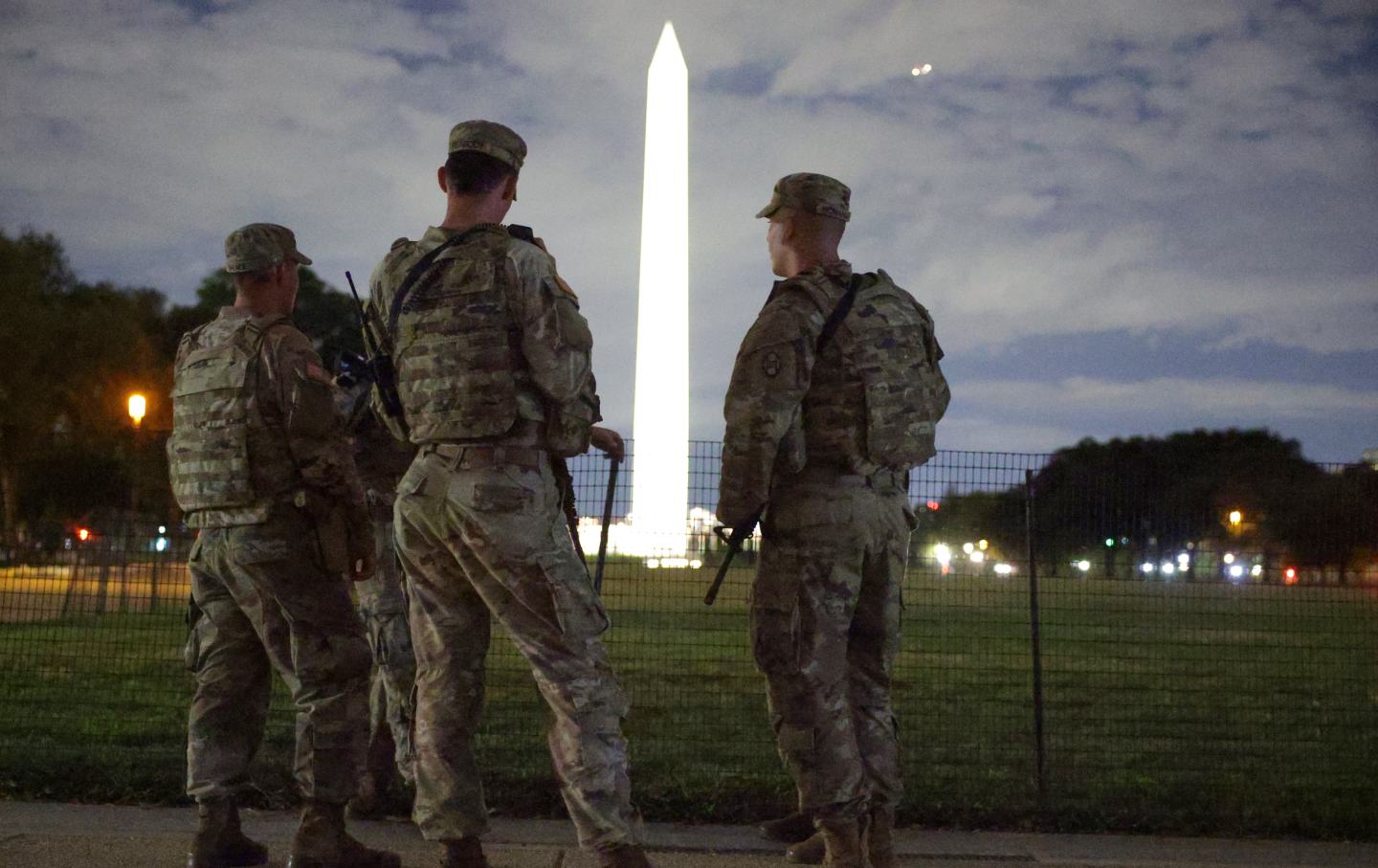
Members of the National Guard patrol at the National Mall on August 26, 2025 in Washington, DC.
(Alex Wong / Getty Images)The District of Columbia is not a state. It’s the legally enigmatic, underrepresented, and officially disempowered creation of a federal government that has a history of neglecting the needs and the potential of the nation’s capital city. Now Donald Trump has taken full advantage of this circumstance to flood Washington with heavily armed soldiers and masked federal agents.
Trump acknowledges that his move to militarize law enforcement in DC has unsettled Americans. “Already they’re saying, ‘He’s a dictator,’” Trump said last week, after the military surge began. The president claimed that he was just trying to fight an out-of-control crime wave. “The place is going to hell and we’ve got to stop it,” he announced. “So instead of saying ‘He’s a dictator,’ they should say, ‘We’re going to join him and make Washington safe.’”
But Trump’s crime claim is wrong. “There is not a crime crisis in DC,” Rosa Brooks, a former DC Metropolitan reserve police officer who now teaches at Georgetown Law School, told NPR. Brooks decried the president’s authoritarian overreach, saying, “This is police state territory, banana republic police state territory.”
Unfortunately, there is a considerable history of federal administrations and Republican congresses entering “banana republic police state territory” when it comes to DC.
Frederick Douglass recognized that there was a crisis of democracy in the nation’s capital 135 years ago. The great abolitionist and social reformer, who taught that “power concedes nothing without a demand. It never did and it never will,” was as ahead of his time when it came to DC as he was in so many other areas. He spent the last years of his life working with a pioneering voting rights group, the District Suffrage Petition Association, to bring the promise and the protection of democracy to DC.
Douglass attended the group’s meetings and rallies, and asked, “What have the people of the district done that they should be excluded from the privileges of the ballot box?”
Several of the democratic reforms that Douglass advocated for during the course of his remarkable lifetime were achieved in the century after his death. Washington today has an elected mayor and city council, as well as the ability to cast ballots (and choose electors) in presidential elections.
Yet, 130 years after Douglass died, the citizens of the District of Columbia are still blocked from electing voting members of Congress.
The denial of the full franchise to citizens of the nation’s capital city is just one example of the patchwork approach to suffrage in the United States, where Americans who live in commonwealths, territories, and possessions lack full representation rights in Congress and, in most instances, the right to vote for president. Even in the states, voting rights are ill-defined, and the Voting Rights Act, already so weakened by the Supreme Court, is under further legal assault—as the current gerrymandering push by Trump-aligned Texas Republicans so amply illustrates.
Yet the District of Columbia has perhaps the most complex relationship with voting rights of any US jurisdiction. While district residents can vote in presidential elections, they do not have the right to elect voting representatives to the House or Senate. DC Delegate Eleanor Holmes Norton, the veteran civil rights activist who campaigned for many years for the placement of the seven-foot-tall Douglass statue that now stands in the US Capitol, recalled when it was dedicated a dozen years ago, “There has been too little recognition that as a District of Columbia resident, three Republican presidents appointed Douglass to three local posts: to what was then the upper chamber of the DC Council, part of the home-rule government given the district by the Republican Congress and president during Reconstruction, as DC recorder of deeds and as US marshal for the local and federal courts. Who knew that Douglass lost the Republican nomination for delegate to the US House of Representatives?”
Norton and others know that today, though DC has an elected local government, the power of that government—and, thus, of Washington residents to determine their own affairs—has often been constrained by Republican Congresses. And it is now being overridden by an authoritarian Republican president.
Citizens of the district—which has a population larger than Vermont’s and Wyoming’s—have organized, campaigned, and petitioned for statehood for decades.
Popular
“swipe left below to view more authors”Swipe →But the cause of statehood—and basic democratic respect—has been thwarted since the days when members of Congress refused the request of the great radical senator from South Dakota, Richard F. Pettigrew, who urged after the death of Douglass in 1895 “that out of respect to his memory his remains be permitted to lie in state in the rotunda of the National Capitol between the hours of 10 a.m. and 4 p.m. on tomorrow.”
Today, congressional Republicans form the primary barrier to DC statehood. They like to note that Douglass was a Republican. But that was in the day when Douglass saw the GOP as a progressive force that demanded the expansion of the franchise.
In recent decades, the Democratic Party has made the demand a standard part of its platform. But, too frequently, Democrats have done so in an unfocused and halfhearted manner. What’s been missing is a sense of urgency.
Trump’s militarization of policing in the city establishes that urgency, now and into the future. While a Trump-aligned Republican Congress is not going to do the right thing, Democrats must make it clear that—as part of the broader voting rights renaissance that must follow the Trump years—DC statehood will top their agenda.
The dream of voting rights has been deferred since the days when Douglass wrote of the district as “the one spot where there is no government for the people, of the people and by the people. Its citizens submit to rulers whom they have no choice in selecting. They obey laws which they had no voice in making.”
If the long arc of the moral universe bends toward justice, as the Rev. Martin Luther King Jr. preached in his lifetime, then surely the legacy of this awful moment for American democracy must be DC statehood.
Disobey authoritarians, support The Nation
Over the past year you’ve read Nation writers like Elie Mystal, Kaveh Akbar, John Nichols, Joan Walsh, Bryce Covert, Dave Zirin, Jeet Heer, Michael T. Klare, Katha Pollitt, Amy Littlefield, Gregg Gonsalves, and Sasha Abramsky take on the Trump family’s corruption, set the record straight about Robert F. Kennedy Jr.’s catastrophic Make America Healthy Again movement, survey the fallout and human cost of the DOGE wrecking ball, anticipate the Supreme Court’s dangerous antidemocratic rulings, and amplify successful tactics of resistance on the streets and in Congress.
We publish these stories because when members of our communities are being abducted, household debt is climbing, and AI data centers are causing water and electricity shortages, we have a duty as journalists to do all we can to inform the public.
In 2026, our aim is to do more than ever before—but we need your support to make that happen.
Through December 31, a generous donor will match all donations up to $75,000. That means that your contribution will be doubled, dollar for dollar. If we hit the full match, we’ll be starting 2026 with $150,000 to invest in the stories that impact real people’s lives—the kinds of stories that billionaire-owned, corporate-backed outlets aren’t covering.
With your support, our team will publish major stories that the president and his allies won’t want you to read. We’ll cover the emerging military-tech industrial complex and matters of war, peace, and surveillance, as well as the affordability crisis, hunger, housing, healthcare, the environment, attacks on reproductive rights, and much more. At the same time, we’ll imagine alternatives to Trumpian rule and uplift efforts to create a better world, here and now.
While your gift has twice the impact, I’m asking you to support The Nation with a donation today. You’ll empower the journalists, editors, and fact-checkers best equipped to hold this authoritarian administration to account.
I hope you won’t miss this moment—donate to The Nation today.
Onward,
Katrina vanden Heuvel
Editor and publisher, The Nation
More from The Nation
Islamophobic Elites Lied to Destroy the Life of a Palestinian Brown Student Islamophobic Elites Lied to Destroy the Life of a Palestinian Brown Student
Plutocrats, pundits, and government officials joined together in a racist smear campaign against a queer Palestinian student at Brown University.
Recent Democratic Victories Have Republicans Running Scared Recent Democratic Victories Have Republicans Running Scared
Elise Stefanik is just the latest top Republican deciding against running in the 2026 midterms.

Pirate Trump Pirate Trump
Donald Trump escalates Caribbean tensions with vessel attacks near Venezuela.
Trump’s “Warrior Dividend” Might Be His Scariest Idea Yet Trump’s “Warrior Dividend” Might Be His Scariest Idea Yet
This week’s “Elie v. US” explores the authoritarian threat beneath Trump’s bonuses for military families. Plus, a case for getting rid of the Second Amendment.


