The Invisible Snakes of Climate Change
Tony Bartelme’s new book shows how great storytelling can wake people up.
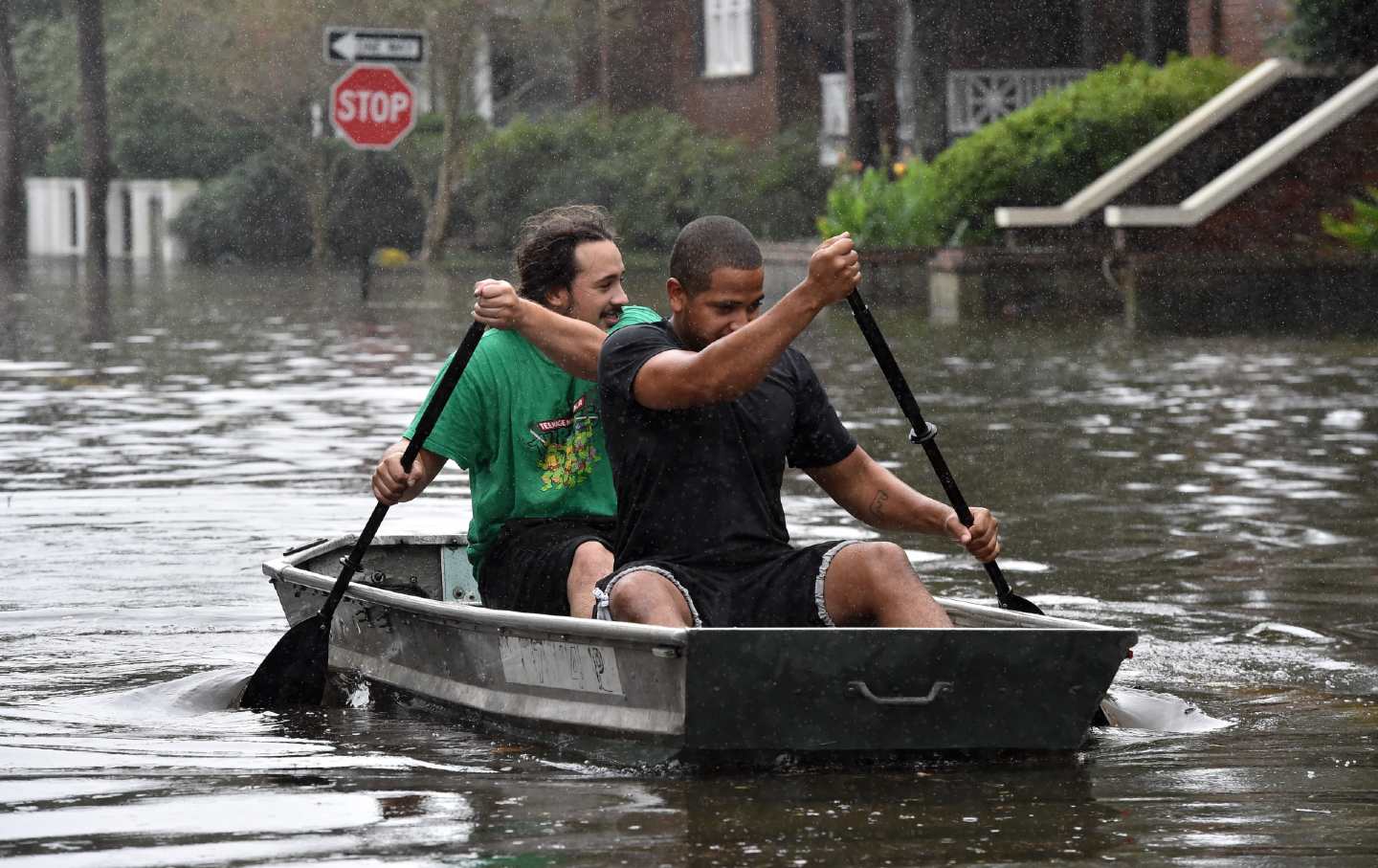
Two men row a boat on a flooded street in downtown Charleston, South Carolina, on October 4, 2015.
(Mladen Antonov / AFP via Getty Images)Every journalist covering the climate story can learn a thing or two from Post and Courier journalist Tony Bartelme. His new book, Rising Waters, entertainingly explores the title theme from his hometown, Charleston, South Carolina, whose low-lying coastal landscape makes it one of the most climate-threatened cities in the United States. But his work is equally valuable to someone reporting in land-locked Arkansas or mountainous Mongolia.
That’s because Bartelme knows how to tell a story. That’s a helpful skill, especially these days when editors besieged by shrinking budgets often have to be convinced that a planet on fire is a story worth covering. Good storytelling has attracted audiences since humans’ earliest days around evening campfires, and bigger audiences please newsroom managers.
A four-time Pulitzer Prize finalist, Bartelme has a light touch that lets him write about heavy stuff—every inch of sea-level rise, he notes, means that 6 million additional people around the world get flooded—without sounding heavy. Favoring short, declarative sentences, he addresses the reader in a voice like a favorite uncle’s: friendly, informed but never arch, with dashes of dry humor.
“Imagine you’re walking down a path” on a beautiful day, the book begins, when suddenly, by your feet, you spot a poisonous snake. “In that moment, what are you not going to do? Deny its existence? Check your Instagram? No, I guarantee you that your frontal cortex will light up…and tell you to get the bleep away from that snake.”
The problem, he continues, is that climate change is “an invisible snake.” Carbon dioxide can’t be seen by the naked eye, and many climate impacts—melting glaciers, rising seas, dying corals—happen far away. So our brains “remain on standby.”
Bartelme’s goal is to make the invisible snakes of climate change visible and “wake up…our noggins” before we get bitten. To convey why overheating the ocean is so dangerous, he writes that half of the oxygen in Earth’s atmosphere “comes from ocean plankton—every other breath” that humans take. To explain why king tides now flood downtown Charleston 70 or more times a year, rather than once or twice as they did 40 years ago, he travels to Greenland, where his reporting won a 2022 Covering Climate Now Journalism Award. Greenland’s fast-melting ice, he writes, “cracks like ice cubes dropped in a warm drink, except these cracks sound like thunderclaps and shake your ribs.”
Warning that “apathy and cynicism are [climate] denial’s twin cousins,” he concludes the book with good news: “The solutions aren’t invisible snakes…. No more coal and gas. More electric cars and trucks…” To readers asking what they can do, he says “replace your oil-burning furnace with a heat pump; eat less meat; vote for leaders who have the courage and honesty to collectively make these things happen.” And, not least, remember the beauty of this still-magnificent planet: “Beauty is a reminder that action is worth the effort.”
Time is running out to have your gift matched
In this time of unrelenting, often unprecedented cruelty and lawlessness, I’m grateful for Nation readers like you.
So many of you have taken to the streets, organized in your neighborhood and with your union, and showed up at the ballot box to vote for progressive candidates. You’re proving that it is possible—to paraphrase the legendary Patti Smith—to redeem the work of the fools running our government.
And as we head into 2026, I promise that The Nation will fight like never before for justice, humanity, and dignity in these United States.
At a time when most news organizations are either cutting budgets or cozying up to Trump by bringing in right-wing propagandists, The Nation’s writers, editors, copy editors, fact-checkers, and illustrators confront head-on the administration’s deadly abuses of power, blatant corruption, and deconstruction of both government and civil society.
We couldn’t do this crucial work without you.
Through the end of the year, a generous donor is matching all donations to The Nation’s independent journalism up to $75,000. But the end of the year is now only days away.
Time is running out to have your gift doubled. Don’t wait—donate now to ensure that our newsroom has the full $150,000 to start the new year.
Another world really is possible. Together, we can and will win it!
Love and Solidarity,
John Nichols
Executive Editor, The Nation