The UK’s Climate National Emergency Briefing Should Be a Wake-Up Call to Everyone
The briefing was a rare coordinated effort to make sure the media reflects the science: Humanity’s planetary house is on fire, but we have the tools to put that fire out.
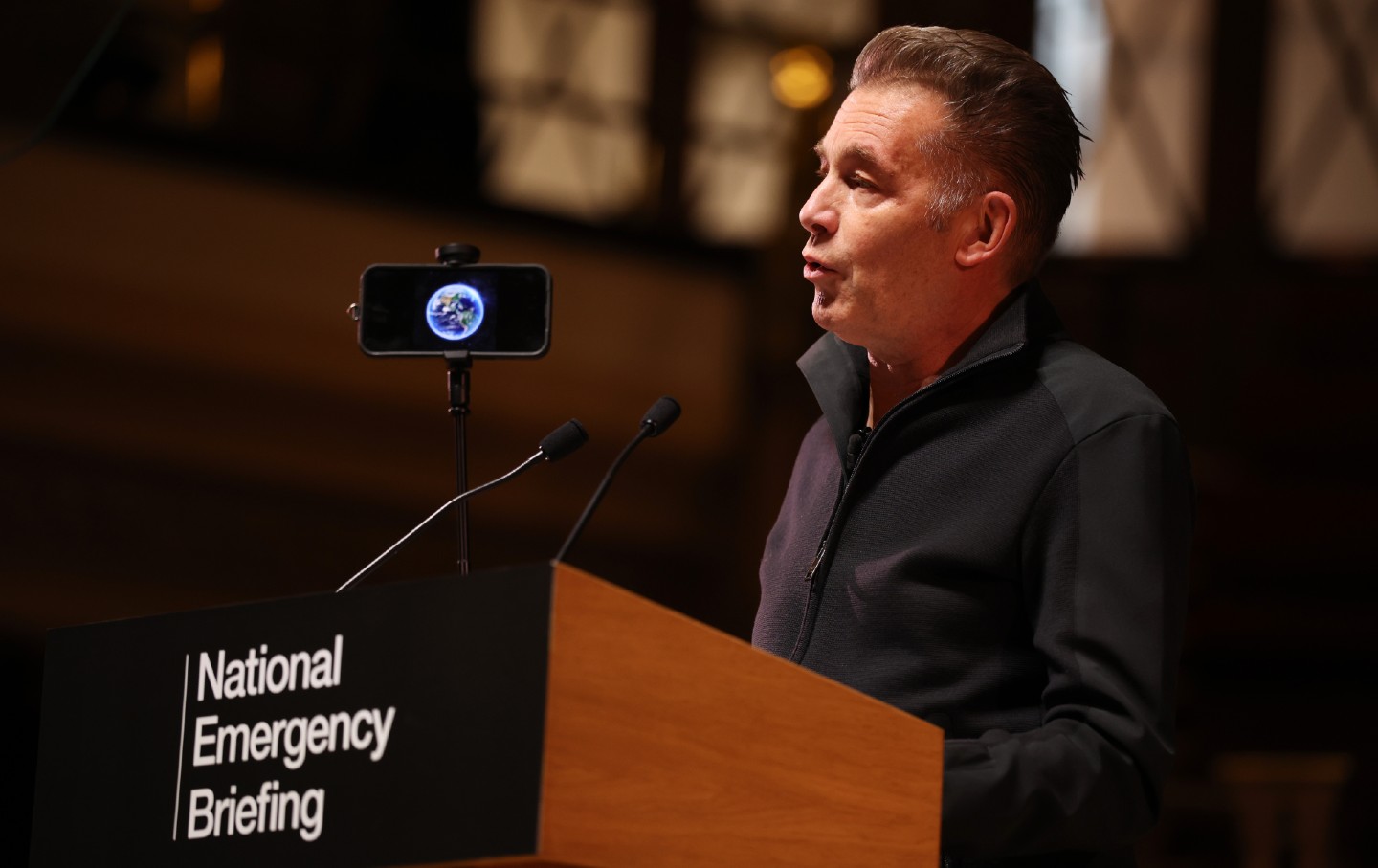
Chris Packham addresses the audience at a National Emergency Briefing on the climate and nature crisis, at Central Hall Westminster on November 27, 2025, in London, England.
(Dan Kitwood / Getty Images)
“You must listen to the science.” Chris Packham, the veteran presenter of BBC nature shows, was imploring an audience at London’s Westminster, a stone’s throw from the Houses of Parliament, to face facts. An invitation-only crowd of about a thousand people, including more than 100 members of Parliament, news executives, celebrities, and civil society leaders sat before him, joined by a live-streaming audience. Held November 27, the gathering was billed as a National Emergency Briefing.
“You must listen to the science,” Packham repeated. “Because if you don’t, then things go wrong, and lives are lost.” Quoting from a recent investigation of the UK government’s handling of the Covid pandemic, Packham noted that an additional 23,000 people died during a single week because scientific advice was ignored as social distancing orders were lifted prematurely. “Tragically,” he continued, the threat posed by climate change is “far, far greater…. It’s not thousands, it’s not hundreds of thousands, or millions of lives that are at risk. It’s billions of lives that are at risk.”
“Billions” was no TV star’s rhetorical flourish, a panel of top scientists then explained. A series of 10-minute presentations summarizing the latest research on how rising global temperatures affect food production, public health, economic well-being, and military security offered a fresh take on what thousands of scientists have long warned. Humanity “is hurtling toward climate chaos,” in the words of “The 2025 State of the Climate Report,” “an unfolding emergency…where only bold, coordinated action can prevent catastrophic outcomes.”
Irreversible tipping points, such as the shutdown of the massive ocean current known as the Atlantic Meridional Overturning Circulation (AMOC), absolutely must be avoided, said Tim Lenton of the University of Exeter. An AMOC shutdown would spread Arctic Ocean ice far southward, give London temperatures of -20 degrees Celsius (-4 degrees Fahrenheit) for a full three months of the year, and cut in half the world’s growing regions for wheat and maize, Lenton said, sparking “a global food security crisis.”
Packham also called out his news industry colleagues. The BBC presenter said the public was not “getting access to…the reality of what is happening to our one and only home.” Disinformation spread by the fossil fuel industry and its allies is partly to blame, he said. But beyond that, he added, much of the media “is either far from independent, outwardly biased, or simply failing in its duty to explain to everyone the gravity of our predicament.”
The briefing concluded with the release of a public letter demanding that government and media leaders do better. Addressed to Prime Minister Keir Starmer and the heads of five of Britain’s national broadcasters and their independent regulatory body, the letter was read aloud by Olivia Williams, an actor in the television series The Crown. Declaring that the people of Britain “are not safe,” the letter urged “the Government and all public service broadcasters to hold an urgent televised national emergency briefing for the public, and to run a comprehensive public engagement campaign so that everyone understands the profound risks this crisis poses to themselves and their families.”
Although this particular national emergency briefing was focused on Great Britain, it’s a wake-up call that needs to be heard in countries—and newsrooms—around the world. Despite an abundance of strong individual stories and a scattering of news outlets providing high-profile coverage of the climate emergency, the media as a whole is still not reflecting what science is saying: Humanity’s planetary house is on fire, but we have the tools to put that fire out. “Now is the time,” the letter concluded, “to put trust in the public,” which, if properly informed, can take “the action needed.”