
What We Can Learn About Immigration From an Unlikely Source: Ronald Reagan
Rather than deporting millions of migrants, this Republican president opted for the opposite strategy—legalizing them.
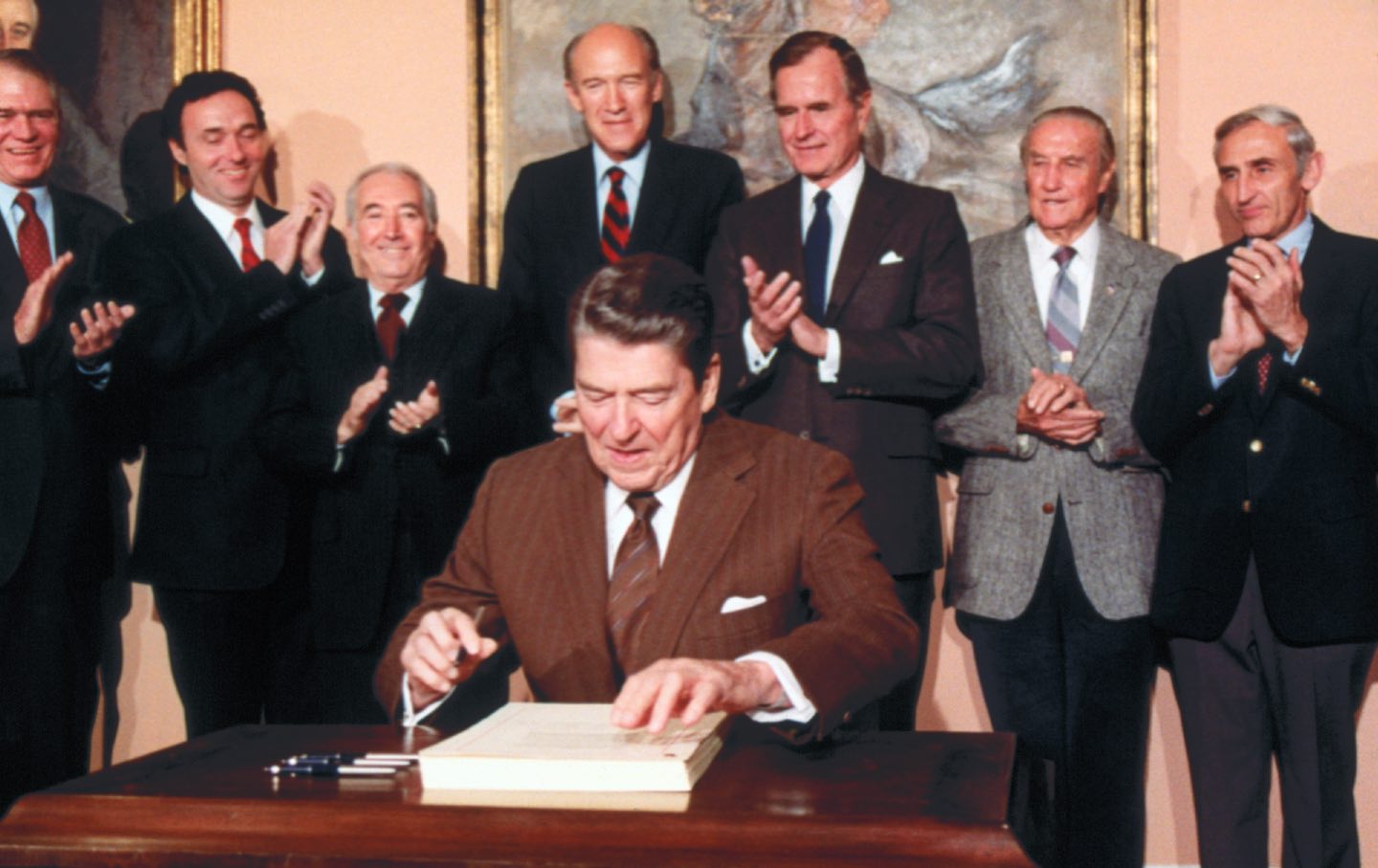
The number of illegal aliens in America had risen to an alarming level, and the Republican president in the White House was determined to take strong action. But rather than deporting millions of migrants, this Republican president opted for the opposite strategy: legalizing them.
Ronald Reagan is not known for his compassion toward the less fortunate. This is the president who struck 400,000 families off the aid rolls and made a million people ineligible for food stamps. Overall, Reagan cut federal spending for lower-income programs other than housing by almost one-third.
But even Reagan rejected the pointless cruelty and economic disruption of a campaign to deport 5 million people who lacked legal status but were simply trying to support themselves and their families. “I believe in the idea of amnesty for those who have put down roots and lived here, even though sometime back they may have entered illegally,” he said in 1984.
With Reagan’s support, Congress passed a bipartisan bill in 1986— the Immigration Reform and Control Act—that created the largest immigration legalization program in American history: permanent residency, with a path to citizenship, for 2.7 million undocumented aliens.
Today we face another crossroads in immigration policy. But this time it is Democrats who have an opening to do the right thing—morally, economically, and politically.
First, however, we have to understand how we got here.
Besides amnesty, the 1986 law had a second, equally important, objective: drying up the flow of illegal crossings that had made amnesty a necessity. For this, the legislation strengthened enforcement at the southern border.
But that goal was not met. After initially declining by half, apprehensions of unauthorized immigrants at the border surged to their pre-reform level of 1.6 million by 1996, only a decade after passage of the act. The newly founded NAFTA was driving the influx, as unrestrained competition from its more developed partners devastated the Mexican economy.
While an expanded Border Patrol caught millions, other millions slipped through. The number of illegal aliens in the USA—mostly Mexicans—climbed steeply from 3.5 million in 1990 to 8.7 million in 2000.
Failure to secure the border gave amnesty a taint. A New York Times editorial summarized the prevailing view in 2000:
The primary problem with amnesties is that they beget more illegal immigration…. Amnesties signal foreign workers that American citizenship can be had by sneaking across the border, or staying beyond the term of one’s visa, and hiding out until Congress passes the next amnesty.
Fast-forward to the even bigger border crisis from which we have just emerged.
Border apprehensions skyrocketed in 2021, from 400,000 the previous year to more than 1.6 million. The following year, they shot up again, to 2.4 million, before reaching the previously unimaginable peak of 2.5 million in 2023.
This time, Mexicans were outnumbered by other Latin Americans, mainly from Guatemala, Honduras, Nicaragua, Venezuela, Colombia, and Cuba. The common thread was post-pandemic economic hardship accompanied by rising violence—either political, criminal, or both.
But the “push” of socioeconomic and political travails at home was accelerated by the “pull” of America’s lenient asylum policy.
Migrants could ask for asylum at the border with an 80 percent probability of being allowed to enter and live freely while their cases were pending. After a six-month waiting period, work permits are routinely granted. The backlogged system takes an average of 3.5 years to come to a conclusion—much longer in some immigration courts.
Asylum applications exploded from 152,000 in 2021 to 945,000 in 2023.
While many asylum seekers were legitimately seeking refuge from danger, many others were gaming the system, as knowledge of the asylum gambit spread.
A former top immigration official in Joe Biden’s administration recently conceded that “the border crisis is, to a large extent, an asylum crisis. Our broken immigration laws have increasingly incentivized economic migrants to claim that they fear persecution in order to start a lengthy administrative process that allowed them to remain in the United States and work.”
Like Reagan before him, Biden sought a unifying solution. But Donald Trump saw that a chaotic border benefited his campaign for president more than a calm one would. Under his direction, Republican senators changed course and sank a bipartisan bill that would have raised the bar for asylum seekers and reinforced border controls.
Once back in office, Trump wasted no time in securing the border, using some of the tools that had been prefigured in the doomed bill, but going much further. Two days after his inauguration, he declared a national emergency to fight an “invasion” at the border, barring all asylum claims and calling in the military to support the Border Patrol.
The results were striking. In June, the Border Patrol apprehended only 9,306 undocumented migrants at the southern border. That is the lowest annualized rate—a little over 100,000—since the 1960s.
Popular
“swipe left below to view more authors”Swipe →The flip side of Trump’s immigration coin is making good on his pledge to deport all 11.7 million illegal aliens. Here, as well, the administration has started out dramatically. ICE arrested twice as many presumed unauthorized immigrants during the first half of this year as they did last year under Biden—95,000 vs. 46,000.
The challenge for Democrats is to unite behind a strong border in order to convince Americans to reject wholesale deportation.
Trump’s border security policies are broadly popular. A large majority, 85 percent, agree that “We need to restore order at the border” with more law enforcement, immigration judges, and technology. Sixty percent support Trump’s closure of the border, including a majority, 55 percent, of independents.
Democrats need to narrow the gap, now a startling 41 percent, in voter trust on border security.
With solid support for a hard border easing fears of uncontrolled immigration, Democrats can credibly push for legislation to enact Americans’ strong preference—75 percent in favor—for providing a path to citizenship for unauthorized immigrants without criminal records.
The argument is as much economic as moral and political. Unauthorized immigrants are estimated to fill 24 percent of jobs in farming, 15 percent in construction, and 8 percent in production industries like food processing and manufacturing. The surge in immigration in the early 2020s increased GDP by an estimated 2 percent. Deporting these workers and consumers would have the opposite effect.
Democrats can succeed where Reagan failed by supporting not only amnesty but also a tighter asylum system and a daunting presence at the border.
This is how we can give the next Democratic president the opportunity to proclaim again, as his Republican predecessor did a generation ago:
The legalization provisions in this act will go far to improve the lives of a class of individuals who now must hide in the shadows, without access to many of the benefits of a free and open society. Very soon many of these men and women will be able to step into the sunlight and, ultimately, if they choose, they may become Americans.
Time is running out to have your gift matched
In this time of unrelenting, often unprecedented cruelty and lawlessness, I’m grateful for Nation readers like you.
So many of you have taken to the streets, organized in your neighborhood and with your union, and showed up at the ballot box to vote for progressive candidates. You’re proving that it is possible—to paraphrase the legendary Patti Smith—to redeem the work of the fools running our government.
And as we head into 2026, I promise that The Nation will fight like never before for justice, humanity, and dignity in these United States.
At a time when most news organizations are either cutting budgets or cozying up to Trump by bringing in right-wing propagandists, The Nation’s writers, editors, copy editors, fact-checkers, and illustrators confront head-on the administration’s deadly abuses of power, blatant corruption, and deconstruction of both government and civil society.
We couldn’t do this crucial work without you.
Through the end of the year, a generous donor is matching all donations to The Nation’s independent journalism up to $75,000. But the end of the year is now only days away.
Time is running out to have your gift doubled. Don’t wait—donate now to ensure that our newsroom has the full $150,000 to start the new year.
Another world really is possible. Together, we can and will win it!
Love and Solidarity,
John Nichols
Executive Editor, The Nation
More from The Nation

Read the CBS Report Bari Weiss Doesn’t Want You to See Read the CBS Report Bari Weiss Doesn’t Want You to See
A transcript of the 60 Minutes segment on CECOT, the notorious prison in El Salvador.

The Christmas Narrative Is About Charity and Love, Not Greed and Self-Dealing The Christmas Narrative Is About Charity and Love, Not Greed and Self-Dealing
John Fugelsang and Pope Leo XIV remind us that Christian nationalism and capitalism get in the way of the message of the season.

In Memoriam: Beautiful Writers, Influential Editors, Committed Activists In Memoriam: Beautiful Writers, Influential Editors, Committed Activists
A tribute to Nation family we lost this year—from Jules Feiffer to Joshua Clover, Elizabeth Pochoda, Bill Moyers, and Peter and Cora Weiss

Trump’s Anti-DEI Crusade Is Going to Hit White Men, Too Trump’s Anti-DEI Crusade Is Going to Hit White Men, Too
Under the Trump administration’s anti-DEI directives, colleges would be forced to abandon gender balancing, disadvantaging men.

Why We Need Kin: A Conversation With Sophie Lucido Johnson Why We Need Kin: A Conversation With Sophie Lucido Johnson
The author and cartoonist explains why we should dismantle the nuclear family and build something bigger.

Bari Weiss’s Counter-Journalistic Crusade Targets “60 Minutes” Bari Weiss’s Counter-Journalistic Crusade Targets “60 Minutes”
The new editor in chief at CBS News has shown she’s not merely stupendously unqualified—she’s ideologically opposed to the practice of good journalism.

