A New Wave of Protests Confronts Zelensky’s Move to Rein in Anti‑Corruption Agencies
These are the largest since the Russian invasion of 2022—and seem poised to continue.
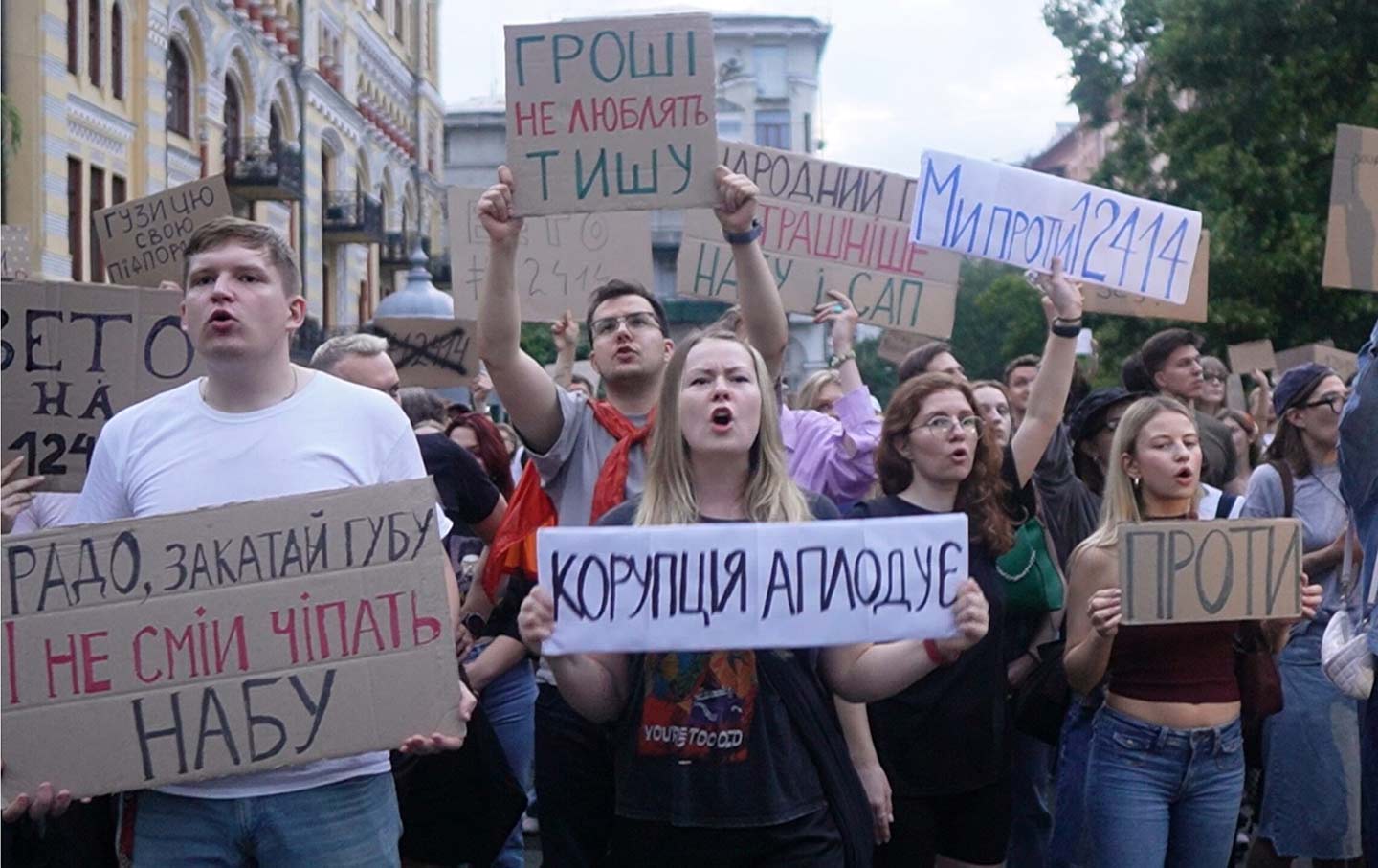
Kyiv, Ukraine—A new protest movement may have taken shape in Ukraine on Tuesday night, when thousands of mostly twentysomething demonstrators packed the square outside Kyiv’s Ivan Franko National Drama Theater—within sight of the Presidential Office on Bankova Street—to condemn President Volodymyr Zelenskyy’s signature on a law that strips the National Anti‑Corruption Bureau (NABU) and the Special Anti‑Corruption Prosecutor’s Office (SAP) of their independence by placing both under the prosecutor general, a post he appoints.
The protests, held simultaneously in other large cities—Lviv, Dnipro, Odesa, and even Sumy, which lies close to the front line and faces daily strikes—were the largest since Russia’s full‑scale invasion in 2022 and appear poised to continue. For supporters, what’s at stake is clear: Whether a nation fighting for survival can also defend the hard‑won democratic reforms achieved after the 2014 Revolution of Dignity—and with them, the country’s hopes for European Union membership. Equally at issue is the public’s trust that wartime sacrifices are underwriting a freer, more accountable state rather than, as critics warn, an emergent authoritarian system serving the president’s inner circle and a powerful elite.
The legislation passed Parliament in a lightning vote earlier that day and was then signed by the president before sundown—a pace critics, including at least one prominent opposition MP, called unprecedented and possibly in violation of parliamentary rules. Crowds began assembling at 8 pm, chanting “Ukraine is not Russia,” “Hands off NABU,” and “Why the fuck do I need a system that works against me? (“Нахуя мені система що працює проти мене”) beneath the theater’s colonnade.
“After the Maidan Revolution—Ukraine’s Revolution of Dignity—there were 11 years of reforms aimed at fighting corruption,” said Yana Prots, a 22‑year‑old media worker. “Now, in just a few hours…our government wants to roll those changes back. That’s why I’m here: to defend the anti‑corruption agencies and to protest this outrageous move.” Prots still holds out hope that Zelenskyy will reverse his decision. “We want a democratic society and independent anti‑corruption agencies,” she added.
There are signs the pressure is already working. At a meeting with top law‑enforcement officials on Wednesday, following the protests, Zelenskyy said, “We all hear what society is saying,” and promised to announce a new anti‑corruption plan within two weeks, according to the Kyiv Independent.
Earlier, he defended the bill in his nightly address, arguing that recent security‑service raids exposed “Russian influence” inside the National Anti‑Corruption Bureau. NABU and SAPO will keep investigating cases, he said, but placing them under the prosecutor general will ensure “real accountability” and unblock high‑value probes that have “lain dormant for years.” The overhaul, Zelenskyy added, is meant to deliver “more justice” in wartime, not to hobble reform. He did not address criticism that the prosecutor general now has sole authority to end investigations against high‑ranking officials.
The vote came amid growing concerns about authoritarian tendencies in the Zelenskyy administration and what some saw as a crackdown on critics. On July 11, the State Bureau of Investigation searched the Kyiv apartment of one of Ukraine’s most prominent anti-corruption activists, Vitaliy Shabunin, head of the Anti-Corruption Action Center, and charged him with draft evasion and fraud—allegations denounced by civil society groups as political payback for his scrutiny of presidential allies.
Days later, the SBU carried out searches at NABU’s headquarters and detained two detectives it alleged were collaborating with Russian operatives, prompting Transparency International to warn that the sweep threatened the independence of Ukraine’s anti‑graft system, according to Reuters.
The call for the Kyiv protest came from viral Twitter and Facebook posts by Dmytro Koziatynskyi, a veteran and combat medic. He urged residents to defend the anti‑corruption system built since Maidan and “not let the country slip back to Yanukovych times.” At the square, telltale signs of Ukrainian’s experience with protest were visible: a water station was set up to keep people hydrated on a humid summer night. One man brought a guitar to occupancy the chants, and a woman kept time with a tambourine.
Soldiers dotted the crowd, many wearing masks and shying away from interviews.
For Roman, a soldier who, in his youth, marched in both the 2004 Orange Revolution and the 2013–14 Maidan uprising, the scene carried bitter echoes. “When we won the 2004 Maidan, we ended up in a long, bogged‑down political mess that wiped out the chance we had,” he said, adding that he feared people would forget the lessons of Ukraine’s recent past.
Younger voices insisted they had not. Varvara, 22, an IT specialist, drew a direct line to the 2014 protests: “Every new administration risks sliding back into old ways—trying to shut us up. They must know that won’t work anymore.”
Popular
“swipe left below to view more authors”Swipe →Nearby, Valentin, 24, a charitable‑foundation worker, held a handwritten sign reading “EU Means Independent NABU.” “Everyone here knows NABU isn’t perfect,” he said, “yet gutting its powers would stall, even reverse, our progress toward the European Union. Nobody wants that.”
Above the crowd waved a lone “Don’t Tread on Me” flag, hoisted by Bogdan, 23. “We’re told we’re moving toward freedom and the EU,” he said, “but power is being concentrated in an unelected presidential office.… Zelenskyy promised liberty and delivered the opposite—pushing us toward a Belarus‑ or Russia‑style regime.”
As curfew approached, voices rose in another chorus of the national anthem. Stefaniya, 21, a Kyiv barista attending her first demonstration, summed up the mood: “Leaders act as though they can do anything they want and nothing will stop them. We came to show them people do care—we won’t just sit with our arms folded.”
And so far, she seems right. The following night, Wednesday, the protest more than doubled in size, as thousands more young Ukrainians joined their compatriots in front of the President’s Office, with the crowd spelling into side streets, and the atmosphere growing festive, yet remaining defiant. “Corruption is destroying!” they chanted.
Disobey authoritarians, support The Nation
Over the past year you’ve read Nation writers like Elie Mystal, Kaveh Akbar, John Nichols, Joan Walsh, Bryce Covert, Dave Zirin, Jeet Heer, Michael T. Klare, Katha Pollitt, Amy Littlefield, Gregg Gonsalves, and Sasha Abramsky take on the Trump family’s corruption, set the record straight about Robert F. Kennedy Jr.’s catastrophic Make America Healthy Again movement, survey the fallout and human cost of the DOGE wrecking ball, anticipate the Supreme Court’s dangerous antidemocratic rulings, and amplify successful tactics of resistance on the streets and in Congress.
We publish these stories because when members of our communities are being abducted, household debt is climbing, and AI data centers are causing water and electricity shortages, we have a duty as journalists to do all we can to inform the public.
In 2026, our aim is to do more than ever before—but we need your support to make that happen.
Through December 31, a generous donor will match all donations up to $75,000. That means that your contribution will be doubled, dollar for dollar. If we hit the full match, we’ll be starting 2026 with $150,000 to invest in the stories that impact real people’s lives—the kinds of stories that billionaire-owned, corporate-backed outlets aren’t covering.
With your support, our team will publish major stories that the president and his allies won’t want you to read. We’ll cover the emerging military-tech industrial complex and matters of war, peace, and surveillance, as well as the affordability crisis, hunger, housing, healthcare, the environment, attacks on reproductive rights, and much more. At the same time, we’ll imagine alternatives to Trumpian rule and uplift efforts to create a better world, here and now.
While your gift has twice the impact, I’m asking you to support The Nation with a donation today. You’ll empower the journalists, editors, and fact-checkers best equipped to hold this authoritarian administration to account.
I hope you won’t miss this moment—donate to The Nation today.
Onward,
Katrina vanden Heuvel
Editor and publisher, The Nation
More from The Nation

The US Is Looking More Like Putin’s Russia Every Day The US Is Looking More Like Putin’s Russia Every Day
We may already be on a superhighway to the sort of class- and race-stratified autocracy that it took Russia so many years to become after the Soviet Union collapsed.
Israel Wants to Destroy My Family's Way of Life. We'll Never Give In. Israel Wants to Destroy My Family's Way of Life. We'll Never Give In.
My family's olive trees have stood in Gaza for decades. Despite genocide, drought, pollution, toxic mines, uprooting, bulldozing, and burning, they're still here—and so are we.

Trump’s National Security Strategy and the Big Con Trump’s National Security Strategy and the Big Con
Sense, nonsense, and lunacy.
Does Russian Feminism Have a Future? Does Russian Feminism Have a Future?
A Russian feminist reflects on Julia Ioffe’s history of modern Russia.
Ukraine’s War on Its Unions Ukraine’s War on Its Unions
Since the start of the war, the Ukrainian government has been cracking down harder on unions and workers’ rights. But slowly, the public mood is shifting.
I’m a Teacher in Gaza. My Students Are Barely Hanging On. I’m a Teacher in Gaza. My Students Are Barely Hanging On.
Between grief, trauma, and years spent away from school, the children I teach are facing enormous challenges.

