
Indiana’s Gerrymander Victory Won’t Save Us
The Hoosier State’s Senate showed rare backbone in resisting the Trump White House’s demand for a mid-cycle gerrymander. But the Roberts court gets the final say.
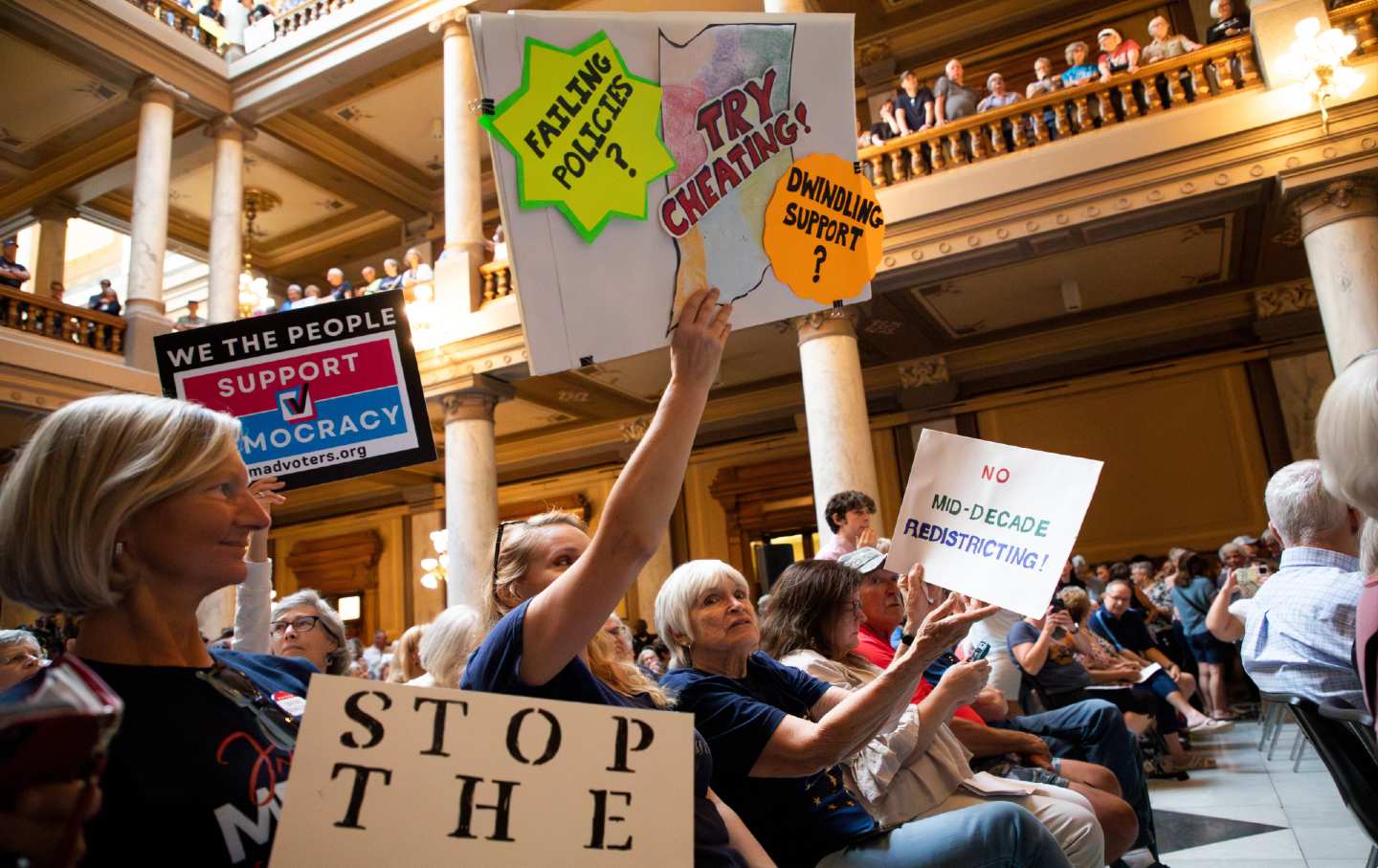
Demonstrators at the Indiana Statehouse denounce the proposed mid-decade gerrymander promoted by the Trump administration.
(Kaiti Sullivan / Bloomberg via Getty Images)It’s a big deal that Republicans in Indiana’s state Senate last week squashed President Trump’s demands for a gerrymandered US House map that would have awarded the GOP a 9–0 congressional delegation in the state.
Yes, the remaining map is still a GOP gerrymander. It ensures Republicans seven safe seats, which they won in 2024 by an average of 30 percentage points, despite netting just 58 percent of the statewide vote. A more balanced map would include as many as four districts within plausible reach of Democratic candidates.
And yes, throughout the rest of the country, Republicans maintain the upper hand during this unprecedented mid-decade redistricting war. Perhaps most consequentially, the GOP supermajority on the US Supreme Court will have the deciding vote when it rules on a voting rights case from Louisiana, perhaps as soon as next month.
No one should feel reassured at the likelihood that John Roberts can award the GOP a near-unbreakable grip on the House simply by doing two of his favorite things: rendering the Voting Rights Act unworkable and declaring that the way to end racial discrimination is to stop discrimination against white people.
Nevertheless, let’s be allowed a brief Mr. Smith moment. Authoritarianism thrives amid cowardice and fear. It relies on the bended knee from those who know better, whether members of Congress, the boards of Ivy League universities, partners at Paul, Weiss and Kirkland & Ellis, or the trembling overlords of CBS and ABC.
The stiffened spine from Indiana’s Senate Republicans should be celebrated as that rare moment in which Trump’s own party said no. They defied a forceful and unrelenting campaign of MAGA intimidation.
Vice President JD Vance arm-twisted Hoosier state legislators twice in person. The Club for Growth invested part of its seven-figure budget to continue churning out GOP gerrymanders in a digital pressure campaign. At least 11 lawmakers were subjected to bomb threats or swatting incidents at their homes. US Senator Jim Banks offered the unassailable logic that the 9–0 map was “the least that we can do” because “they killed Charlie Kirk.” Then as Thursday’s vote drew near, the Heritage Foundation revealed that Trump threatened to cut off all federal funding to Indiana—“Roads will not be paved. Guard bases will close. Major projects will stop”—if lawmakers did not rubber-stamp the gerrymander.
Indiana Republicans still said no. A majority of the GOP caucus joined every Senate Democrat in shutting down this egregious partisan power play.
This is an unexpected development in the gerrymandering armageddon that will likely determine which party controls the House after the 2026 midterms—a no-holds-barred power grab in state legislatures that so far, has largely gone the Republicans way.
The scoreboard will continue to fluctuate as additional state legislatures and the courts weigh in. But here’s a sense of where things stand.
At this moment, presuming that new maps in California and Texas counteract each other, Republicans have picked up two seats in Ohio, one in Missouri and one in North Carolina.
The big prize on the table remains Florida, where Governor Ron DeSantis has suggested he could flip as many as three to five Democratic seats with a new map.
There is renewed chatter in Kansas about a January special session to erase the Kansas City–area seat currently held by Democrat Sharice Davids. Some lawmakers in New Hampshire continue to push for a mid-decade redraw as well. The Club for Growth and Turning Point Action have put millions on the table to pressure lawmakers there and elsewhere.
The GOP has likely lost one seat in Utah. Voters there amended the state Constitution in 2018 to establish a nonpartisan redistricting advisory commission. Republicans repealed it, then drew a 4–0 gerrymander. When a state court found the legislature’s actions unconstitutional, the GOP tried to stonewall with another 4–0 map. The court—in a moment of all-too-rare independence in a red state—said no, and imposed a map of its own. On this map, blue Salt Lake City would be favored to elect a Democrat. The Republican legislature continues to battle and pursue appeals.
It also remains possible that the Missouri gerrymander could come off the board. Missouri activists qualified a veto initiative by turning in an astounding 305,000 signatures this month. They needed to collect only 110,000. Ordinarily, that would suspend the legislature’s action until voters have their say in a statewide initiative. Missouri’s secretary of state and attorney general, however, have departed from precedent and allowed the map to remain in place. State courts will need to resolve this dispute—though there may be further end-runs ahead from the state’s deep-red legal administrators..
Democrats continue to lack many viable options for gerrymanders of their own. Virginia looks most likely to try. Some lawmakers have talked tough about a 10–1 map. That’s probably MSNBC fan fiction. It would require a statewide vote, and the state’s new redistricting commission passed easily with 65 percent of the vote in 2020. Would a majority in this purple state really approve handing Democrats 90 percent of the House delegation? In any wave year, the current map would produce two more Democratic seats, regardless.
New York’s state Constitution makes a new map extraordinarily unlikely before 2028. Illinois lawmakers seem to understand that the current 14–3 Democratic gerrymander probably maximizes the party’s gains. The Democratic state Senate leader in Maryland has refused to consider an 8–0 map that adds one more blue seat. Oregon’s governor has also declined to consider an all-blue delegation. No action seems likely from New Jersey. Some lawmakers and gubernatorial hopefuls in Colorado favor an effort to work around their state’s new commission, but that’s not viable before 2028.
And yet: Because Republicans did not take the two seats in Indiana, and, for the moment, have not moved on Kansas, Kentucky, Nebraska, or New Hampshire, the state of play for Democrats is not as dire as it appeared it might be just several weeks ago. Let’s say Florida finds three seats, and also that Kansas reconsiders and targets the Davids seat in January. Too many GOP lawmakers would like to be governor in 2026, and this would be an easy way to curry favor with the White House. That’s a net of seven seats. Voters in those districts, as well as in the affected Texas and California seats, would have their choices curtailed, but it wouldn’t put the House beyond reach of the right sort of blue wave.
Only one group of Republicans could ensure an airtight set of GOP gerrymanders at this point: the conservative supermajority on the US Supreme Court. The Roberts court will have the ultimate say over the 2026 midterms, as it has in so many other White House initiatives in Ttrump’s authoritarian second term. Back in October, the court heard Louisiana v Callais. This is a challenge to the constitutionality of Section 2 of the Voting Rights Act (VRA), and the use of race to draw majority-minority districts in covered localities to protect minority communities that might otherwise have no representation at all.
The stakes are extraordinarily high. Stacey Abrams’s Fair Fight and Black Voters Matter Fund suggests that as many as 19 seats currently held largely by Black Democrats—in South Carolina, Georgia, Tennessee, Florida, Alabama, Louisiana, Mississippi and Missouri, among others—could be in the crosshairs. These VRA protections explain, for example, why Missouri Republicans targeted the Kansas City district last fall rather than St. Louis, which is covered under the Act. It explains why North Carolina Republicans acted to redraw their map, but Alabama and Tennessee did not.
Popular
“swipe left below to view more authors”Swipe →If the court suspends Section 2 in these states, some of these districts could be wiped off the map early next year. This would devastate minority representation across the South and likely return the number of Black members from the affected states to Jim Crow–era levels. And an anti–voting rights decision would in all likelihood hand most, if not all, of those seats to white conservatives.
The court’s conservatives teed this case up. Chief Justice John Roberts has worked toward this goal since he arrived in Washington as a young warrior in Ronald Reagan’s Department of Justice. Justice Brett Kavanaugh laid out the winning argument in a ruling on an earlier test case. And when the court needed to offer even more assistance, it ordered the case reargued along specific constitutional lines.
Which is to say: We all know what Roberts wants to do. The decision here appears to be a foregone conclusion: The court will likely leave the VRA intact in name only, while making it all but impossible to use. The real mystery is when it will be announced, and exactly how far it will go. By scheduling arguments for early October, the court opened the doors to a decision as soon as January. (Citizens United, another case the court ordered reordered early in its 2009–10 term, came down in late January.) That could be soon enough for some states to enact new maps ahead of 2026. (The court’s entirely made-up Purcell principle that allegedly governs changes to election laws ahead of an election is not a legal standard but a political one, firmly nested in Roberts’s zone for calling balls and strikes, depending on who is hitting and who is pitching.)
That Roberts is a partisan par excellence is a settled question at this point. But he is also a patient partisan. He has waited 40 years for this victory. He might well hold out until March or April, making new maps more likely for 2028 than 2026 (and probably winning praise from hollow-eyed op-ed boards for his wisdom and restraint). How partisan does he want to be before the midterms? Is this his top priority? Or would he slow-walk this decision for the sake of upholding a different expansion of executive power?
The midterms may depend upon which John Roberts shapes the Callais opinion. Will it be the steady incrementalist who bulldozes slowly on behalf of his team? Or will it be the John Roberts happy to allow his court to do the unpopular dirty work on voting rights that many Republicans, such as those in Indiana, still recoil from? Remember that the same GOP Congress that confirmed Roberts also reauthorized the Voting Rights Act nearly unanimously in 2006, secure in the knowledge that the Republicans appointed for life would take care of it for them.
Much has been lost. Voters across Texas, California, Ohio, Missouri, and North Carolina will cast ballots in districts that are dramatically less fair, in elections where the results have largely been predetermined. Minority representation could be endangered. The reform cause has been set back and endangered as the parties have raced toward the bottom. And most of this is Roberts’s dirty legacy.
Democrats could be in a tougher position. The path to winning back the House, the most likely route to slowing Trump’s march to Hungarian-style competitive autocracy, would be marginally tougher if Indiana, Kansas, and Nebraska pushed additional seats into the GOP pile.
Still, this is no moment for celebration. The midterms, the future of minority representation, and perhaps even an enduring House majority that could last for cycles on end is in the hands of a chief justice who has been his party’s most effective strategist and tactician of the 21st century. It’s long been clear that John Roberts will not save us. The uncomfortable question before us is simply how far, and how fast, he wishes to turn back the clock.
More from The Nation

What Are Democrats Prepared to Do if Trump Rigs the Election? What Are Democrats Prepared to Do if Trump Rigs the Election?
In this week’s Elie v. U.S, our justice correspondent challenges Democrats' lack of a plan if Trump steals the midterms. Plus: the most racist, and honest, AI add ever.
Ramaswamy’s Guide to a Better Vocabulary Ramaswamy’s Guide to a Better Vocabulary
Quotes of the Week.
Why Trump Is Embracing Vivek Ramaswamy’s Vile Ad Why Trump Is Embracing Vivek Ramaswamy’s Vile Ad
The president is leaning into the politics of toxic parenting.

The Shadow Knows The Shadow Knows
High-tech weapons, low-tech intelligence.
Tom Hayden’s Legacy and the New American Left Tom Hayden’s Legacy and the New American Left
It’s been 10 years since he passed away.
The Decades-Long Battle Within the Democratic Party Establishment Between the Heirs of Dean Acheson and Franklin Roosevelt The Decades-Long Battle Within the Democratic Party Establishment Between the Heirs of Dean Acheson and Franklin Roosevelt
The calamitous history of America’s wars of choice.

