How Jeffrey Goldberg and The Atlantic Blew “the Biggest Story of the Year”
How Jeffrey Goldberg and “The Atlantic” Blew “the Biggest Story of the Year”
Given advance warning of an impending war crime, the former cheerleader for the Iraq war decided his priority was to protect his scoop.

Staff protests fleck the history of this magazine. I recall one especially, a small, unstoried objection in Reagantime that raised a big though unintended question. Two women from the business side, who monitored expenses and regarded editors requesting more than one pencil as profligate, had a complaint. They were tired: of pages dominated by proxy armies, allied tyrants, US-backed atrocities from Sabra and Shatila to the killing fields of Central America and southern Africa, etc. This is The Nation, they said; it should cover the nation.
Their wordplay remains provocative. In an imperial state, with force projection everywhere on the earth, what is “the nation”?
Surely it’s not merely the people or the country, the land-of-liberty aspirations, or even illusion that inspired the magazine’s name in 1865. One can love the mongrel, damaged country; the nation is something else: full-blooded, a war machine in the imperial order and imagination—the material reality everyone in power agrees on. If it were not, life expectancy would be a “national security” crisis: lowest among rich countries (worse than the Northern Marianas); lower for Black people (comparable to Guatemala); lower still for Native people (comparable to Eritrea). As is, the nation ignores human insecurity, or heightens it. For journalists, empire presents a choice: You are an agent of the war machine, or a witness for humanity.
The “biggest story of the year” illustrates the problem. Sitting in a supermarket parking lot on March 15, Jeffrey Goldberg of The Atlantic had made his choice long before. He’d been an advance man for one war crime, pushing the Iraq weapons-of-mass-destruction lie after 9/11; now he had advance warning of another on his phone. In two hours, the US would begin bombing Yemen. No one on the Signal group chat claimed imminent threat, or even debated a delay. This was preboarding for an act of aggression—the supreme crime under international law, lest we forget.
Yet Goldberg’s concern was national security. Civilians would die—the “Target Terrorist” of the first strike was attacked as he entered his girlfriend’s building; it collapsed with all inside—and would keep dying. Goldberg left the chat, still fretting about national secrets, but he had his story. Neither he nor his media admirers described the Signal bombardiers and their cheering section as lawless psychopaths. (Tulsi Gabbard: “Great work and effects!”) In an Atlantic Zoom session, subscribers asked where Goldberg had shopped on the 15th. In the TV appearances I saw, no one related the attacks to the Houthis’ aim to thwart the US/Israeli genocide in Gaza. No one asked, “Did you ever think you had a duty to disrupt this nation’s death plans?”
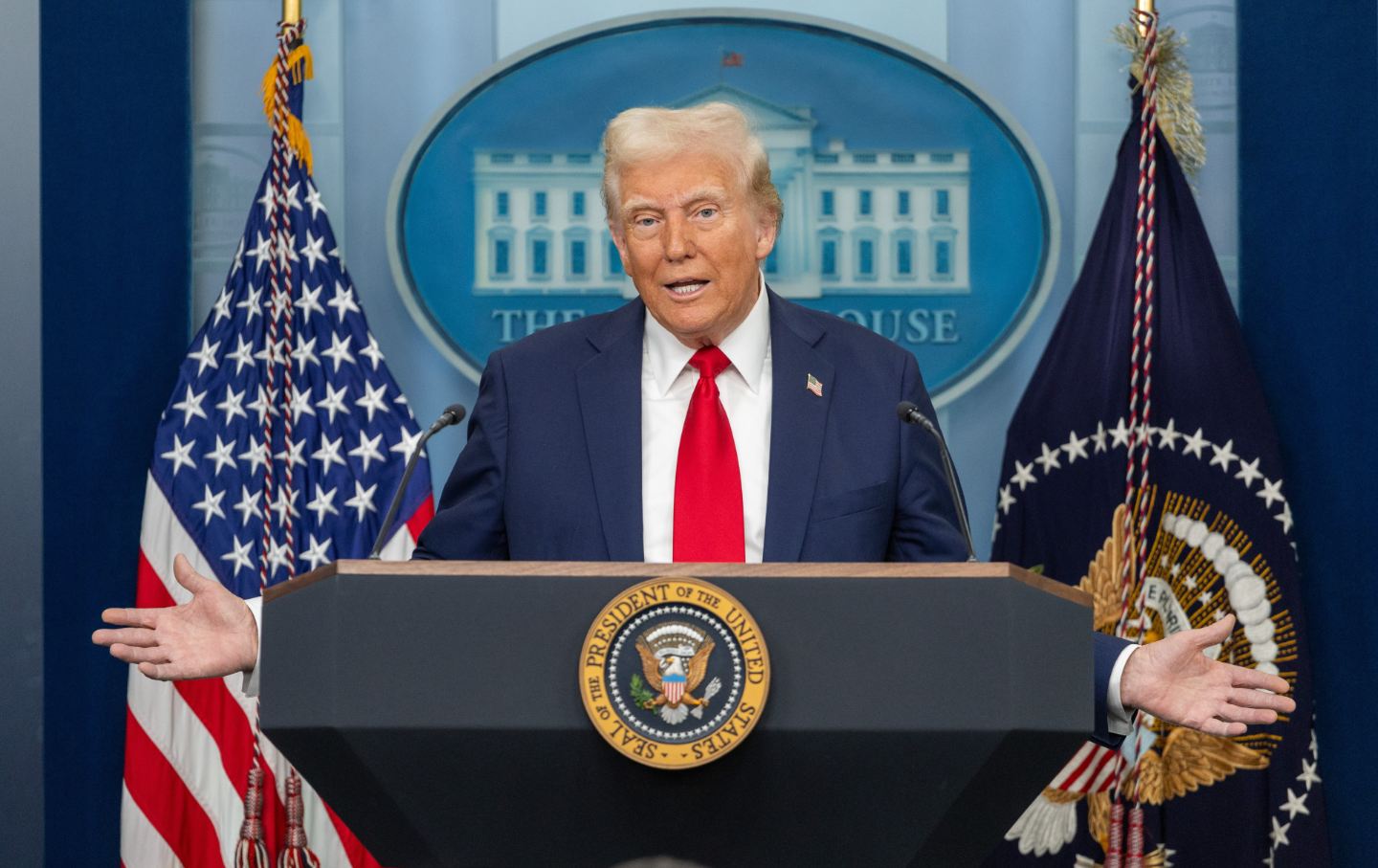
The question would have been rhetorical. Worse, it appears to be unthinkable. An editor with an audience at high levels of state had two hours to sound an alarm about an imminent war crime. His stated fear for the safety of US troops—thin gruel given the 36,000-plus dead or injured soldiers he had waved into the meat grinder of Iraq—assumes that the US military has no intelligence and no contingency plans. Maybe an outcry wouldn’t have grounded the planes. We’ll never know. A month later, an Atlantic crew was at the White House. The president congratulated Goldberg: “You were successful, and it became a big story…. You got it out very much to the public.” Next, Trump will be leaking to him.
The Nation has long believed that publishing is a tool for showing the nation plain. If we invoked international law a lot, it wasn’t because people win their liberation through it but because, as Craig Mokhiber, an international human rights lawyer, says about the duty to confront genocide, “This is a struggle, and any tools we can use are necessary.” History is a tool. These days, when so much peace talk is corrupt, I remember Alexander Cockburn eviscerating some US deal for Central America and quoting Calgacus on the Romans: “They make a desolation and they call it peace.”
Our “peace” for Central America eventually crossed the border, and now the nation is at war against the beloved mongrel country.
In 1960, six months before the Bay of Pigs invasion, The Nation reported that the CIA was training counterrevolutionaries “for an eventual landing in Cuba.” Editor Carey McWilliams called on the bigger-foot press to investigate and for public pressure to force “the administration to abandon this dangerous and hare-brained project.” Some newspapers followed up; some spiked their stories; The New York Times trimmed its sails on the CIA’s role. After Cuba smacked the US proxies down, President John F. Kennedy confided to a Times man that more reporting might “have saved us from a colossal mistake.” McWilliams was wiser: The press does its job so public pressure might too.
Empire disfigures every American—the privilege of knowing that we are unlikely to be bombed here while the nation that takes our name visits that terror freely on others across the world. Fifty years ago, the Vietnamese people taught the empire what it meant to lose, and taught the country, through the peace movement—and especially the anti-war GIs—what might be gained from resistance rather than accommodation. It is some coincidence of anniversaries.
Time is running out to have your gift matched
In this time of unrelenting, often unprecedented cruelty and lawlessness, I’m grateful for Nation readers like you.
So many of you have taken to the streets, organized in your neighborhood and with your union, and showed up at the ballot box to vote for progressive candidates. You’re proving that it is possible—to paraphrase the legendary Patti Smith—to redeem the work of the fools running our government.
And as we head into 2026, I promise that The Nation will fight like never before for justice, humanity, and dignity in these United States.
At a time when most news organizations are either cutting budgets or cozying up to Trump by bringing in right-wing propagandists, The Nation’s writers, editors, copy editors, fact-checkers, and illustrators confront head-on the administration’s deadly abuses of power, blatant corruption, and deconstruction of both government and civil society.
We couldn’t do this crucial work without you.
Through the end of the year, a generous donor is matching all donations to The Nation’s independent journalism up to $75,000. But the end of the year is now only days away.
Time is running out to have your gift doubled. Don’t wait—donate now to ensure that our newsroom has the full $150,000 to start the new year.
Another world really is possible. Together, we can and will win it!
Love and Solidarity,
John Nichols
Executive Editor, The Nation