We Don’t Have to Hand It to Harvard
The university’s lawsuit against the Trump administration was widely celebrated, but our school has been quietly complying with federal demands around Palestine for weeks.
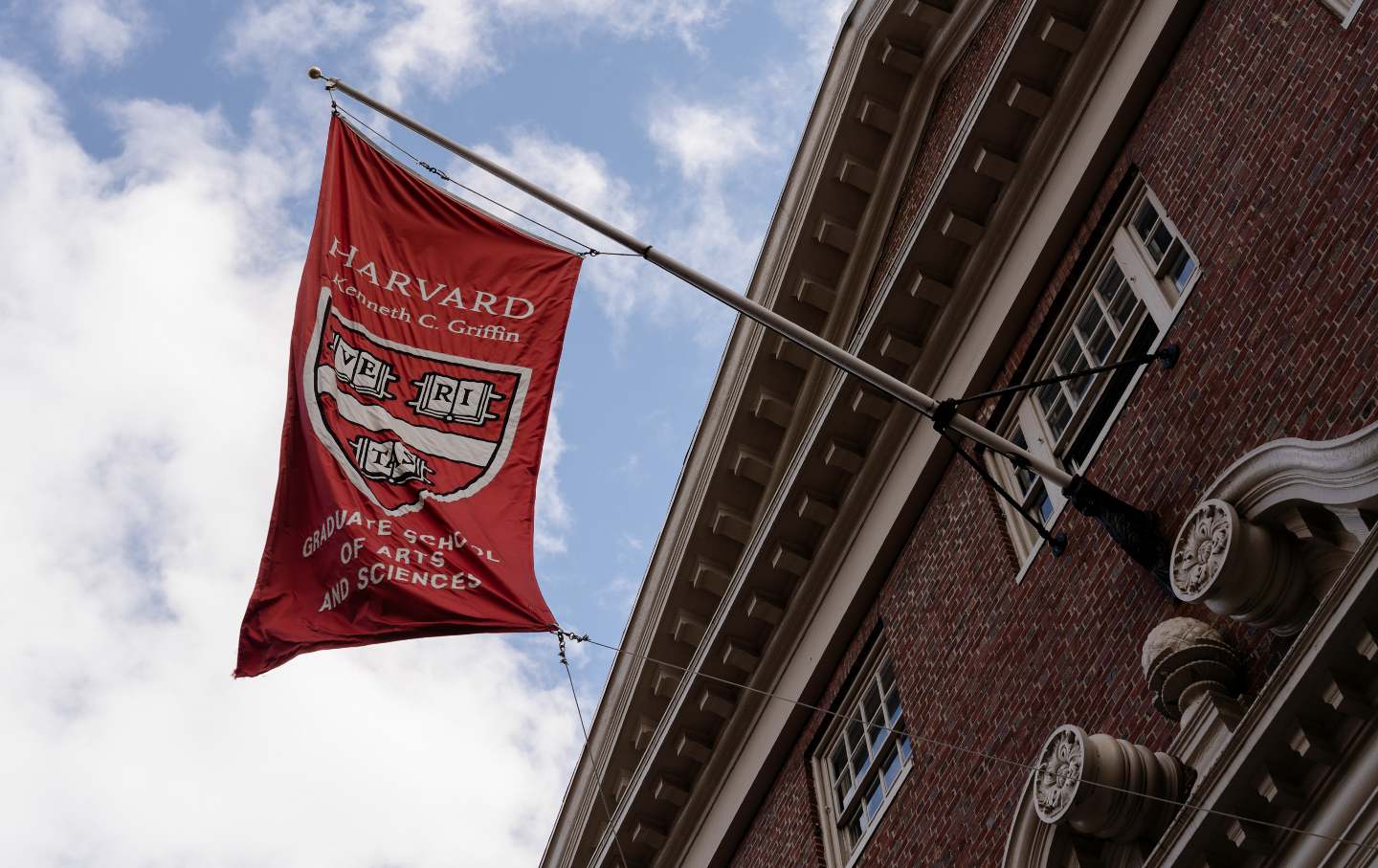
A Graduate School of Arts and Sciences flag on the Harvard University campus in Cambridge, Massachusetts.
(Sophie Park / Getty)These dark times for higher education must be seen as a threat to the rigorous independence of US universities. Over the past few months, under pressure from the Trump administration, right-wing conspiracists, and conservative elements within their bureaucracies, universities have repressed free expression and critical scholarship—most notably on Israel’s ongoing genocide in Gaza.
But in a widely publicized letter sent earlier this month, the Trump administration appeared to have gone one step too far. The Department of Education issued a slew of extreme demands to Harvard University—including the elimination of all diversity, equity, and inclusion programs, overhaul of its disciplinary procedures, and submission to audit by federal regulators, all in order to “maintain [its] financial relationship with the federal government.”
Harvard President Alan Garber’s response, in which he decried these most recent government efforts to regulate so-called “intellectual conditions,” won instant acclaim, with many relieved to see a university stand up to the Trump administration. The university’s move, taken together with an ambitious fundraising campaign and a lawsuit announced on April 21 against the federal government’s funding freeze, has been lauded as a new, combative stance that other universities ought to emulate.
What this celebration has missed, however, is that Harvard has been quietly complying with Trump’s agenda for weeks.
On March 26, two of our professors, Cemal Kafadar and Rosie Bsheer, were dismissed from their positions as director and associate director of Harvard’s Center for Middle Eastern Studies (CMES). They are both scholars with exceptional reputations in their fields, and dedicated mentors to hundreds of students. The proximate cause for their firing: lectures sponsored by the CMES that included experts on Palestine and demonstrated an alleged lack of balance. In particular, the center hosted a speaker series that brought scholars to campus to share their expertise on contemporary politics in the region, including in Israel/Palestine, Sudan, Syria, and Lebanon, as part of hundreds of events that make up the center’s programming.
Their dismissal has been widely condemned as a flagrant act of censorship. It enacts the Trump administration’s goals for higher education: undermine intellectual autonomy and punish students and scholars for speaking out on Palestine. One student, who asked to remain anonymous out of fear of reprisal, said they “don’t trust [Harvard’s] promises to resist Trump’s demands when it has already enacted much of the same agenda as Trump on its own, by implementing overly restrictive protest policies last summer, adopting the widely criticized IHRA definition of antisemitism this winter, and, just recently, gutting programs that explore anti-racist and Palestinian perspectives.”
The same week that the CMES leadership was dismissed, Harvard cut ties between its School of Public Health and Birzeit University and paused the Harvard Divinity School’s Religion, Conflict, and Peace Initiative (RCPI), a program that had focused on Palestine. Over the past 18 months, all three programs—the Center for Middle East Studies, Birzeit partnership, and RCPI—have become favored targets of the House Republicans, Harvard alumni, and student lawsuits that have claimed nearly any engagement with Palestine at Harvard as evidence of antisemitism.
If Harvard is now willing to stand up to President Trump in defense of “open inquiry and freedom of speech” why is its leadership systematically repressing critical scholarship and teaching related to Palestine on its campus? In part, these acts represent an attempt to appease the Trump administration set in motion before Harvard’s change to a more confrontational tack. More fundamentally, Harvard has demonstrated that it actually agrees with the government’s view that speech and activism critical of Zionism must be suppressed on campus. As President Garber said on the Harvard Corporation call that decided the new strategy of resistance, “We agree with a lot of what is in the government’s letter.”
What is crystal clear is that the “Palestine exception” to free speech and academic freedom that has long existed in American higher education and public life is being deeply institutionalized at Harvard. Combined with the growing influence of wealthy donors, alumni, and trustees, there is a slide underway from “academic” to “managerial control” at elite universities in the United States. Tellingly, on Thursday President Garber announced a shift in disciplinary power from school-based committees to a special presidential disciplinary committee in cases involving multiple Harvard schools. A central Trump demand of universities has been that discipline of protesters be controlled by the president’s office, which is seen as more willing to administer harsh punishments to students.
Students with whom we spoke who were involved in last year’s protests were largely unpersuaded that the university’s newly combative attitude would meaningfully impact the ability to freely and openly study and speak on the Middle East. “No one should be surprised the Trump administration demanded so much from Harvard. In consistently cracking down on pro-Palestine speech in every corner of campus, Harvard signaled it was open for business—that it would barter away free academic inquiry and the right of its students to speak to preserve its wealth and prestige,” said one law student. “The repression didn’t start in the Trump administration—it started here in the name of Veritas.”
Right-wing pundits and their allies in Washington are advancing the patently false accusation that the CMES’s programming was “antisemitic” because it included speakers who were critical of Israel’s wars on Gaza and Lebanon. They disingenuously conflate criticism of Israeli policies with antisemitism, a long-standing strategy that has accelerated in recent months. In January, Harvard added support to these baseless charges by adopting the controversial International Holocaust Remembrance Alliance (IHRA) definition of antisemitism, which includes criticism of Zionism and Israel. Violet Barron, a Jewish junior at the College, explained that “the IHRA definition does not make Jewish students safer, nor will it eliminate antisemitism on campus. Instead, it will only police the righteous outrage of Palestinian and pro-Palestinian students and is a manifestation of anti-Palestinian racism in and of itself.”
When pressed at a faculty meeting on the dismissal of professors Kafadar and Bsheer, Harvard Faculty of Arts and Sciences Dean Hopi Hoekstra asserted that “academic freedom is a red line.” But an attack on Middle East Studies and Palestine programming is the canary in the coalmine. Undermining critical scholarship on the Middle East is just the first step in eliminating diversity, equity, and inclusion programming, increasing disciplinary capacities for punishment of constitutionally protected speech, and the full cooperation of the university with the Department of Homeland Security. Even as Harvard is praised for upholding freedom of speech, they have yet to publicly commit to any meaningful protections for students facing detention and threats of deportation by ICE.
Popular
“swipe left below to view more authors”Swipe →The campaign to orient the American university toward conformity with right-wing demands on diversity and inclusion, limiting what can be said, thought, and taught on important topics has begun in earnest. This includes attacks on our ability to organize and write about other issues like trans rights, the climate emergency, racism, disability, and more.
Come what may, students and scholars will continue to find ways of studying and speaking out against the war on Palestine. But those concerned with the future of higher education, with freedom of speech, and with academic integrity in the United States should condemn Harvard’s silencing of speech in the strongest possible terms.
Disobey authoritarians, support The Nation
Over the past year you’ve read Nation writers like Elie Mystal, Kaveh Akbar, John Nichols, Joan Walsh, Bryce Covert, Dave Zirin, Jeet Heer, Michael T. Klare, Katha Pollitt, Amy Littlefield, Gregg Gonsalves, and Sasha Abramsky take on the Trump family’s corruption, set the record straight about Robert F. Kennedy Jr.’s catastrophic Make America Healthy Again movement, survey the fallout and human cost of the DOGE wrecking ball, anticipate the Supreme Court’s dangerous antidemocratic rulings, and amplify successful tactics of resistance on the streets and in Congress.
We publish these stories because when members of our communities are being abducted, household debt is climbing, and AI data centers are causing water and electricity shortages, we have a duty as journalists to do all we can to inform the public.
In 2026, our aim is to do more than ever before—but we need your support to make that happen.
Through December 31, a generous donor will match all donations up to $75,000. That means that your contribution will be doubled, dollar for dollar. If we hit the full match, we’ll be starting 2026 with $150,000 to invest in the stories that impact real people’s lives—the kinds of stories that billionaire-owned, corporate-backed outlets aren’t covering.
With your support, our team will publish major stories that the president and his allies won’t want you to read. We’ll cover the emerging military-tech industrial complex and matters of war, peace, and surveillance, as well as the affordability crisis, hunger, housing, healthcare, the environment, attacks on reproductive rights, and much more. At the same time, we’ll imagine alternatives to Trumpian rule and uplift efforts to create a better world, here and now.
While your gift has twice the impact, I’m asking you to support The Nation with a donation today. You’ll empower the journalists, editors, and fact-checkers best equipped to hold this authoritarian administration to account.
I hope you won’t miss this moment—donate to The Nation today.
Onward,
Katrina vanden Heuvel
Editor and publisher, The Nation
More from The Nation
The Supreme Court v. My Mother The Supreme Court v. My Mother
After my mother escaped the Holocaust, she broke the law to save her family. Her immigration story is more pertinent today than ever before.
The Slop of Things to Come The Slop of Things to Come
This past week boasted many overhyped AI breakthroughs, but the healthiest one was the fierce repudiation of a contemptuous McDonald’s ad.

Keeping the Police Out of Pregnancy Care Keeping the Police Out of Pregnancy Care
We must be vigilant in keeping law enforcement out of exam rooms.

White Farmers Are Getting a Taste of Their Own Medicine White Farmers Are Getting a Taste of Their Own Medicine
Trump’s tariffs and immigration raids are driving the latest farm crisis. White farmers have stood by him year after year—and still do.

The Stagecraft Behind the New Orleans Immigration Raids The Stagecraft Behind the New Orleans Immigration Raids
In a text exchange, Border Patrol Commander Gregory Bovino calls his operation a “massive disturbance” in the making.
“This Is Historic”: FIFA and UEFA Presidents Are Accused of Aiding Israel’s War Crimes “This Is Historic”: FIFA and UEFA Presidents Are Accused of Aiding Israel’s War Crimes
A coming filing with the ICC accuses FIFA’s Gianni Infantino and UEFA’s Aleksander Čeferin of crimes against humanity for their financial support of settlement clubs.

