Trump Has Created a Legal Nightmare
The president is using obscure statutes in shocking ways as part of his anti-immigrant witch hunt.
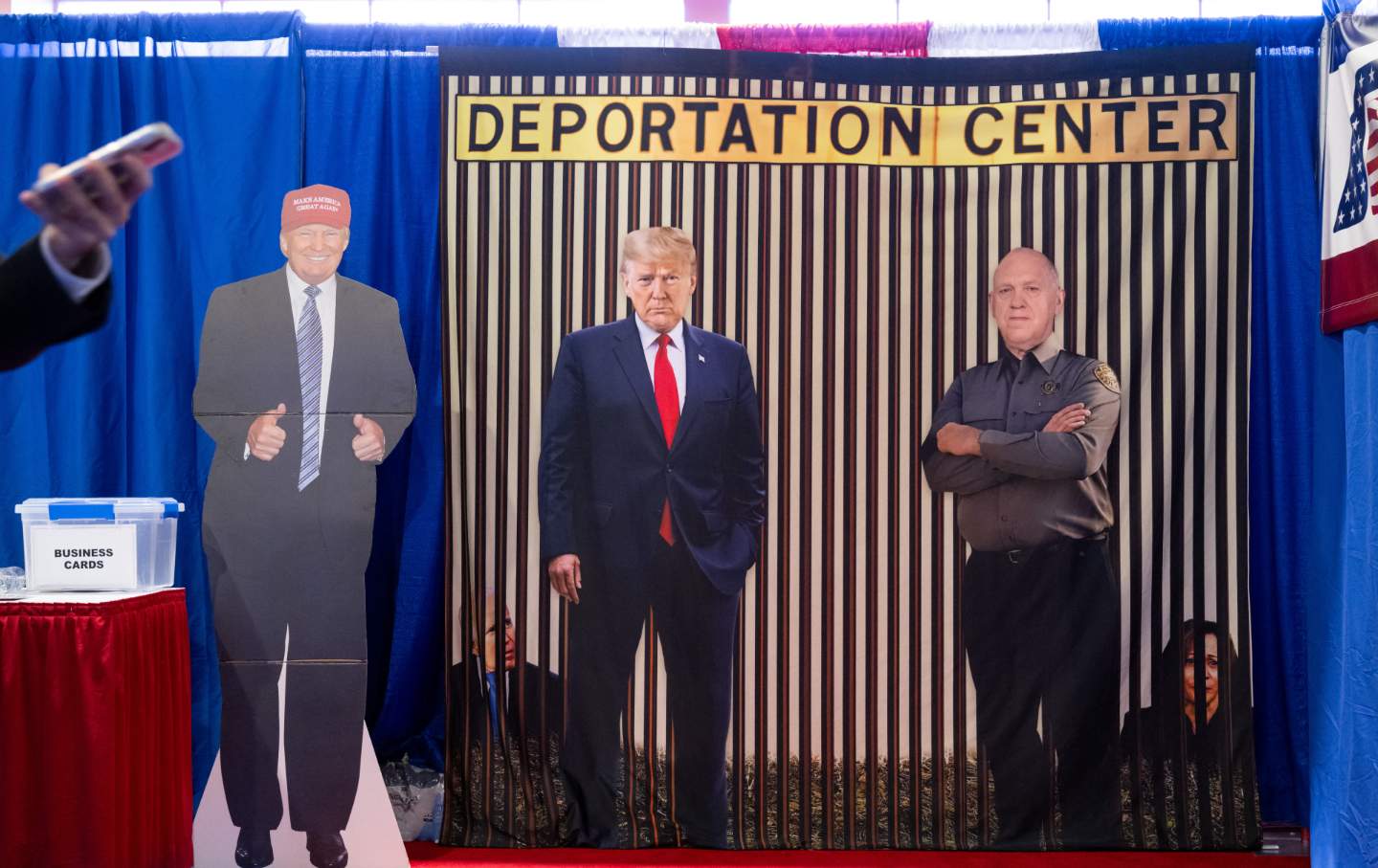
University students snatched off the streets and spirited away by plainclothes agents of the state. So-called “enemy aliens” shipped to a Central American prison with no semblance of due process. AI-fueled witch hunts against dissidents. This is life under Donald Trump’s immigration regime. The sterile language of the federal immigration bureaucracy fails to meet the urgency of the moment. Instead, the words that come to mind are evocative of authoritarian governments: kidnappings, abductions, disappearances.
Trump’s justifications for these depredations are no less alarming. The students abducted by Immigration and Customs Enforcement, we’re told, are supporters of terrorism whose presence in the country threatens US foreign policy interests. The Venezuelan migrants flown to a brutal Salvadoran prison in blatant defiance of a judicial order, Trump assures us, are vicious gang members who don’t need due process. The evidence provided for these bombastic allegations is—to put it mildly—scant. Attending a protest or writing an op-ed critical of Israel is all it takes to brand someone a foreign policy threat. Tattoos of any kind function as proof of gang membership.
Heinous as they are, these actions aren’t entirely unprecedented. ICE has been accused of targeting activists in the past, though not necessarily ones with legal status; for over a decade, the agency has used overly broad gang databases to indiscriminately round up immigrants. Even the mechanics of the recent arrests—plainclothes officers following someone to their home or on their commute, refusing to identify themselves—are a standard part of immigration enforcement.
Trump isn’t starting from scratch on the legal front, either. At every turn, his administration has cited laws that have been on the books for decades or even centuries. It’s likely that the courts will disagree with some of these interpretations, but there was a legal architecture in place waiting for Trump to exploit it.
Students who have criticized their universities’ complicity in Israel’s war on Gaza—or protested Israel’s actions at all—are being rounded up under the auspices of the Immigration Act of 1952, passed at the height of the McCarthy era. That law, also known as the McCarran-Walter Act, allows the secretary of state to declare someone “deportable” if their presence in the country is deemed to have “potentially serious adverse foreign policy consequences.” The “foreign policy bar,” as it’s called, has rarely been invoked. One of the most recent examples dates back to the 1990s. In that instance, a federal judge—Trump’s sister, Maryanne Trump Barry—declared it unconstitutional, though her decision was later reversed by an appeals court.
The Alien Enemies Act, which Trump has invoked to send Venezuelans, including asylum seekers, to El Salvador, dates back all the way to the 18th century. It has been used against far more people than the foreign policy bar, most recently to justify the internment of more than 100,000 Japanese Americans during World War II. But until now, the law has been invoked only in times of war. Despite Trump’s claim that Venezuelan migrants’ presence in the country amounts to “an invasion and predatory incursion into the United States,” we are not currently at war with Tren de Aragua, the Venezuelan gang that the administration claims is wreaking havoc on the country.
While the laws Trump is using aren’t new, his administration’s manipulation of these statutes to punish dissidents and asylum seekers is largely unprecedented. (That said, other provisions of the McCarran-Walter Act have previously been used against academics and journalists who have criticized the US, as well as against pro-Palestinian activists.) But it’s instructive that laws written with enemies of the state in mind—alleged foreign spies who threatened the early Republic, communist sympathizers during the Cold War—are being used against the new enemies of the state. Nor is it shocking that Trump, whose political career began with promises to build a wall and deport “illegals,” is now targeting legal immigrants, including permanent residents and visa holders. In a hypothetical universe in which Trump managed to deport every single undocumented immigrant, ICE’s work still wouldn’t be done. The list of targets would simply expand further, as it already has.
None of this was inevitable, and liberals bear some responsibility too. The moment Trump left office in 2021, Republicans resumed their hysterics over supposed lawlessness at the border. Rather than countering them, Democrats tried to appease them. By Trump’s second term, some Democrats were eager to aid in his deportation efforts. Many of the same Democrats who bought into the “migrant crime wave” narrative also smeared student protesters as antisemites for opposing Israel’s relentless war on Gaza. The villainization of migrants and student protesters was a bipartisan affair. The results speak for themselves, and they show that the solution can’t simply be to change presidents. If we want to avoid an even deeper slide into authoritarianism, we have to change the laws and the system that enforces them.
Time is running out to have your gift matched
In this time of unrelenting, often unprecedented cruelty and lawlessness, I’m grateful for Nation readers like you.
So many of you have taken to the streets, organized in your neighborhood and with your union, and showed up at the ballot box to vote for progressive candidates. You’re proving that it is possible—to paraphrase the legendary Patti Smith—to redeem the work of the fools running our government.
And as we head into 2026, I promise that The Nation will fight like never before for justice, humanity, and dignity in these United States.
At a time when most news organizations are either cutting budgets or cozying up to Trump by bringing in right-wing propagandists, The Nation’s writers, editors, copy editors, fact-checkers, and illustrators confront head-on the administration’s deadly abuses of power, blatant corruption, and deconstruction of both government and civil society.
We couldn’t do this crucial work without you.
Through the end of the year, a generous donor is matching all donations to The Nation’s independent journalism up to $75,000. But the end of the year is now only days away.
Time is running out to have your gift doubled. Don’t wait—donate now to ensure that our newsroom has the full $150,000 to start the new year.
Another world really is possible. Together, we can and will win it!
Love and Solidarity,
John Nichols
Executive Editor, The Nation