Democrats Are Helping Trump Carry Out His Nativist Agenda
Trump and his white-nationalist allies are pursuing a shock-and-awe strategy against immigrants—and many Democrats seem all too eager to join him.
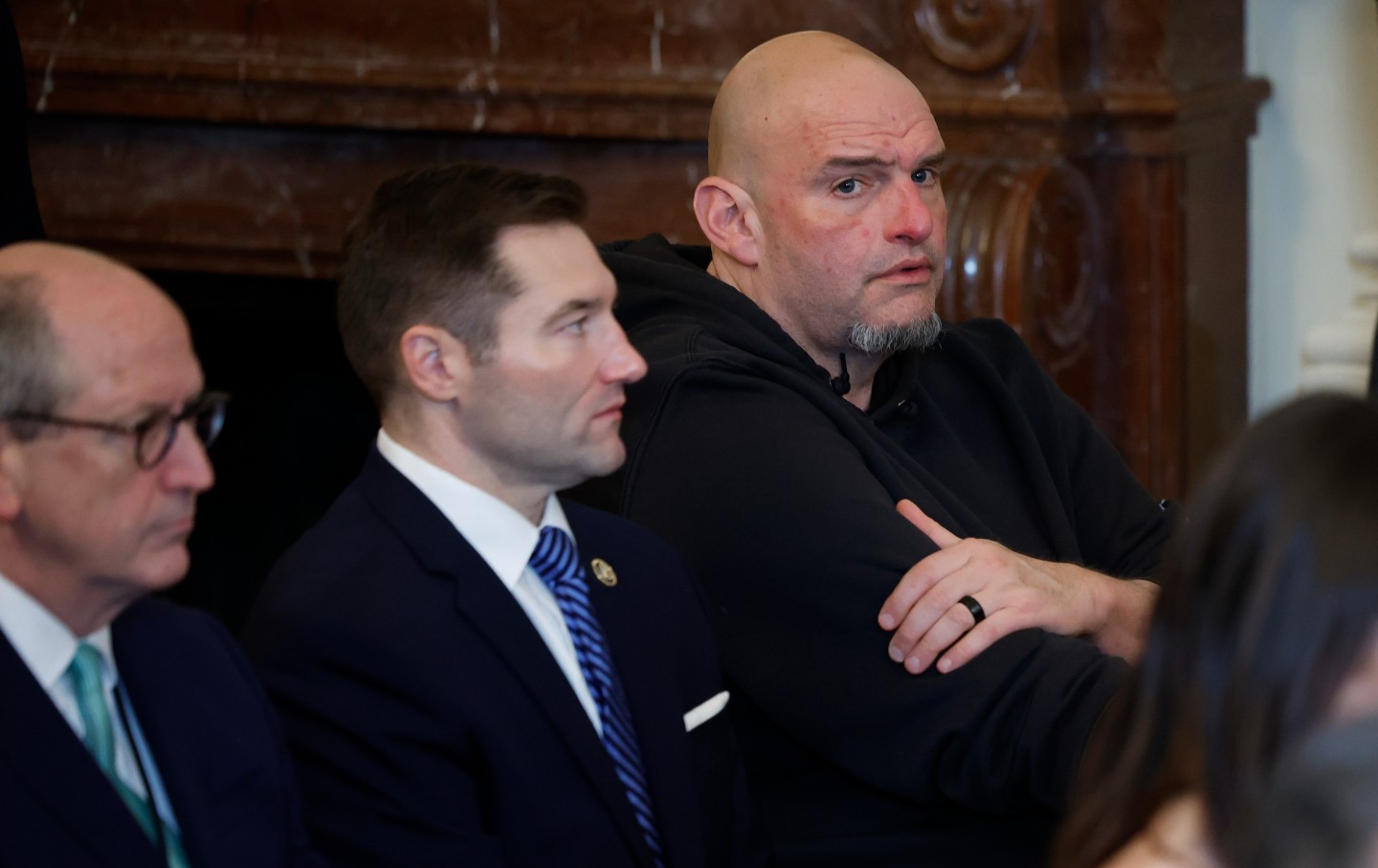
Senator John Fetterman joins other lawmakers for the signing ceremony for the Laken Riley Act on January 29, 2025.
(Chip Somodevilla / Getty Images)President Donald Trump’s second term began much like his first: with a succession of shock-and-awe immigration tactics intended to herald the beginning of a new, more punitive era.
In his first week alone, Trump laid the foundation for a new Muslim ban, ordered the military to help carry out deportations, suspended refugee admissions, and attempted to end birthright citizenship, a blatantly unconstitutional act. Immigration and Customs Enforcement raids ramped up almost immediately after Trump returned to the White House, with the agency arresting nearly 1,200 people across the country in a single day. The administration reportedly plans to conduct major raids in three cities each week. It has also begun flying migrants to the prison on the Guantánamo Bay Navy base.
The Trump administration is already being sued in multiple jurisdictions and by various actors over its immigration policies. These legal challenges could prevent the most egregious abuses, like the attempted abolition of birthright citizenship, from going into effect—though the current makeup of both the federal judiciary and the Supreme Court makes it hard to be optimistic about even that. Still, no amount of pushback will stop Trump’s army of nativists, led by White House adviser Stephen Miller, from trying to enact their white nationalist agenda.
And this time around, the administration can rely on help from some members of the Democratic Party, who appear to have decided they have no choice but to collaborate with Trump’s immigration policies.
After Homeland Security Secretary Kristi Noem descended on New York City in a bulletproof vest, bragging about ICE “getting the dirt bags off the streets,” Mayor Eric Adams said he had “directed the NYPD to coordinate” with ICE to carry out an arrest—a reminder of the limitations of New York’s “sanctuary” law. (The city has also advised migrant shelters that they were allowed to let ICE agents enter their premises without a warrant in certain circumstances.)
At a press conference, New York Governor Kathy Hochul said ICE was only going after “people who committed crimes, serious offenders, and those are exactly the people we want removed from the state of New York.” ICE boasted of the arrests of alleged members of the Venezuelan Tren de Aragua gang, including a man wanted on kidnapping and burglary charges, but the agency has only released the name and charges of one of these so-called “criminal aliens.” And while Democratic politicians say their cooperation is about getting criminals off the streets, the White House has made it clear they consider anyone in the country without authorization a target.
Congressional Democrats, too, appear eager to do their part to help Trump. Just two days into Trump’s term, Congress passed the Laken Riley Act, a bill requiring mandatory immigration detention for all noncitizens charged with theft, drunk driving, and certain violent crimes. The bill’s passage was helped along by dozens of Democrats in the House and 12 in the Senate, including Pennsylvania’s John Fetterman, who attended the signing ceremony for the bill, and newly elected Arizona senator Ruben Gallego, who told Politico he was channeling the “perspective of working class Latinos from Arizona.” Never mind that less than a year ago, Republicans tanked the Democrats’ much-touted “bipartisan border bill” at Trump’s behest because they didn’t want to give Biden a win during an election year.
Rather than picking up on the art of stonewalling from their colleagues across the aisle, Democrats seem to think that this time, bipartisanship will yield political victories. “If we agree to detain ‘criminal aliens,’” the logic goes, “perhaps they’ll grant us concessions elsewhere.” This strategy has not worked a single time in the Trump era, but nevertheless, the Democrats persist.
If the fragmented Democratic coalition had competent leadership, the Trumpian model could have been instructive.
Biden did try to carve out a more humane immigration policy than his predecessor, at least at the beginning of his term. He implemented a 100-day deportation moratorium, ended Trump’s disastrous “Remain in Mexico” policy, and urged Congress to pass a bill creating a path to citizenship for millions of undocumented immigrants. Conservatives predictably sued over the moratorium and refused to consider an “amnesty” bill. The Biden administration took the legal challenges, combined with the right’s immediate accusations that Biden was presiding over a “border crisis,” as a sign to negotiate with Republicans on immigration instead of fighting them. Biden spent the remainder of his term in a defensive posture, fending off accusations of having “opened” the border while simultaneously alienating the immigrant rights groups that helped elect him by embracing the Title 42 expulsion order implemented by Trump at the onset of the Covid-19 pandemic.
When arrivals did surge, Biden had already been backed into a corner by his own attempts to reason with his political opponents. And when Title 42 was finally lifted in 2023, Biden’s DHS began requiring migrants to book appointments to seek asylum via a glitchy app called CBP One.
Biden and his allies described this as a creation of “lawful pathways” for asylum seekers, obfuscating the fact that seeking asylum is already legal and that the app, with its limited appointments, curtailed migrants’ ability to do so while keeping them trapped in border cities where they became easy prey for cartels. Trump then shut down CBP One on his first day back in office, without establishing a replacement program. This move was decried, correctly, as an attack on migrants—but it’s an attack that wouldn’t have been possible without Biden’s endless capitulations to nativists. (Biden did create temporary pathways for migrants from certain countries, including Venezuela and Haiti, to legally live and work in the US for two years; Trump is now reportedly preparing to reverse these measures.)
The combination of Republican zealotry and Democratic collaborationism bodes badly for the future. In the coming weeks and months, we can expect to see more ICE raids, both in the form of targeted arrests and large-scale operations. Asylum seekers and refugees—including those who were approved for resettlement after a years-long process—will be denied entry. Deportations will continue, as they always have, but many of the people arrested in the coming weeks won’t be deported immediately. Instead, they’ll languish in detention centers, and when those inevitably fill up, DHS will no doubt turn to tracking people in deportation proceedings with ankle monitors, smartwatches, and other electronic surveillance mechanisms—the same “alternatives to detention” Republicans claimed were unacceptable nearly every day in the four years leading up to Trump’s second inauguration. The expansion of this vast surveillance apparatus, which at its peak tracked more than 180,000 people, is among Biden’s biggest gifts to Trump.
It is no longer useful to see Democrats’ willingness to cooperate with Republicans on immigration as a betrayal of the anti-Trump “resistance.” Instead, we should see it as a return to form for a party that has always made distinctions between “good” and “bad” immigrants.
In 1996, Bill Clinton signed the Illegal Immigration Reform and Immigration Responsibility Act, a bill passed with overwhelming bipartisan support that expanded the list of crimes that could trigger deportation, thus making far more people—including permanent residents—deportable. The bill’s supporters justified its punitive policies by saying they only applied to criminals; law-abiding immigrants would be fine. A little less than two decades later, Barack Obama was describing his approach to deportation as targeting “felons, not families.” These distinctions didn’t help stem anti-immigrant politics then. Now, the lines Democrats have insisted on drawing between good and bad immigrants have been blurred and are at risk of being erased altogether. They have no one to blame but themselves.
Become a Sustaining Donor This September
Between the reemergence of right-wing red-baiting and Donald Trump’s use of the chilling National Security Presidential Memorandum–7 to criminalize left political organizing, we’re seeing McCarthyism reborn before our eyes.
This assault on democracy cannot be ignored or wished away. Resisting it requires bravery in the face of threats and repression, a steadfast commitment to the truth, and the unwavering belief that we can—and will—overcome this darkness.
We must have an independent media that sets the record straight, unearths corruption and abuses of power, and advances a politics of justice and dignity for all if we’re to win this fight.
That’s why I’m writing to you today. This September, The Nation needs to add 100 monthly donors to sustain our progressive journalism. Your contribution makes the next investigative report, the next truth-speaking column, and the next pathbreaking essay all possible.
I hope you’ll support our work with a recurring donation today. If you donate $10 or more a month, we’ll send you a brand new “Hands Off the Free Press!” sticker to recognise your commitment to our cause. Please, donate today.
Onward,
Katrina vanden Heuvel
Editor and Publisher, The Nation