
Columbia Is Betraying Its Students. We Must Change Course.
The administration is choosing complicity over courage in the case of Mahmoud Khalil. It’s time for the faculty to demand a new path.
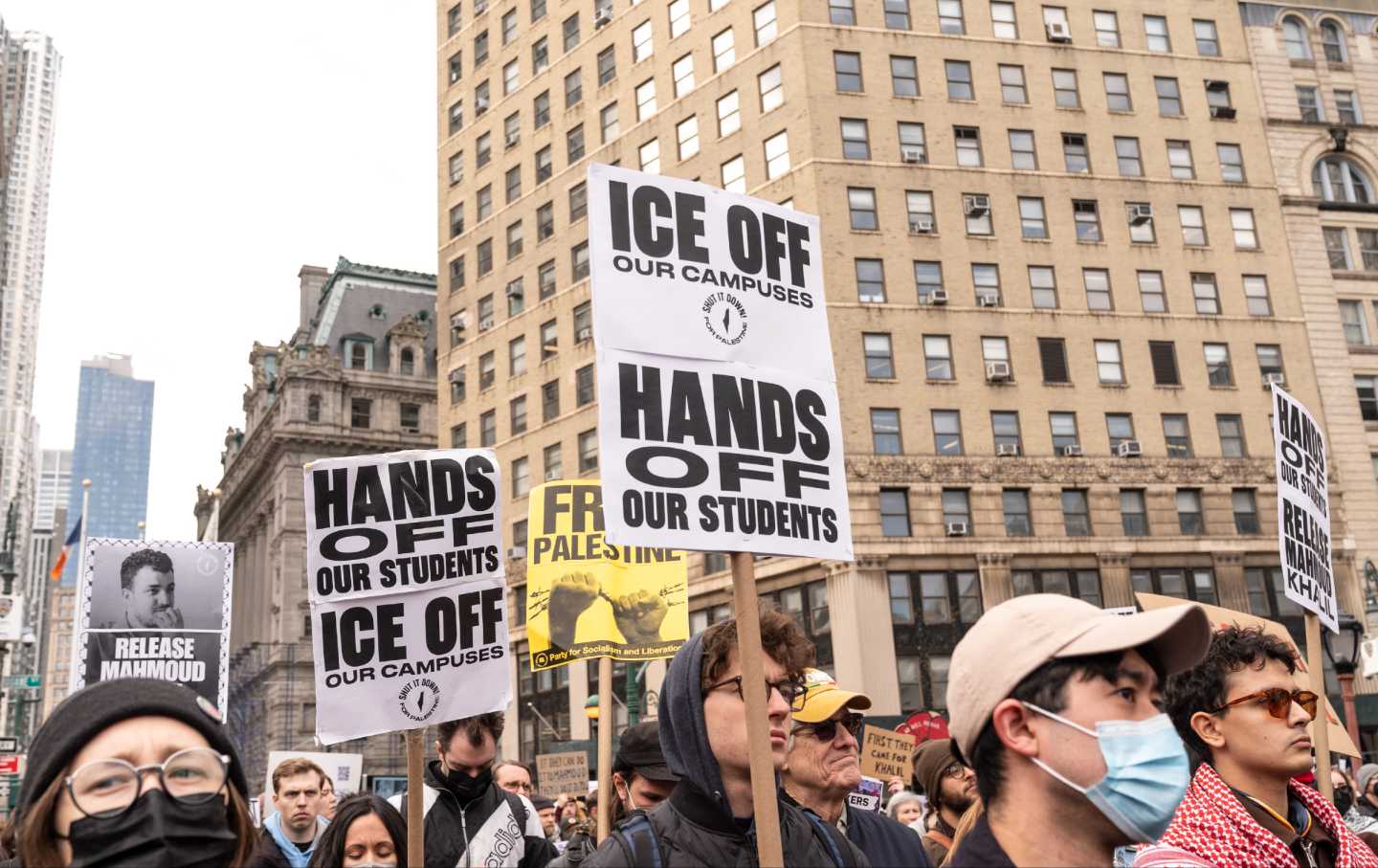
Supporters of Mahmoud Khalil rally at Foley Square in Manhattan on March 12, 2025.
(Lev Radin / Pacific Press / LightRocket via Getty Images)On Friday, March 7, the Trump administration announced it was freezing $400 million in funding that had been awarded to Columbia University over what it claimed was a failure to combat antisemitism on campus. The next day, agents of Immigration and Customs Enforcement (ICE) came to the university-owned apartment of Mahmoud Khalil, a recent graduate and a legal resident of the United States who was a leader in Columbia’s pro-Palestine protests in 2024. The agents arrested Khalil in front of his pregnant wife and spirited him off to Louisiana, where he remains behind bars despite the White House openly admitting that he has broken no laws.
This two-pronged assault—first the funding freeze and then Khalil’s abduction—seems to have left Columbia’s administration petrified and speechless. An e-mail to faculty by its interim president, Katrina Armstrong, vowed to work with the federal government to deal with antisemitism on campus— the ostensible excuse for Trump’s campaign—but made no mention of how the university would respond if ICE comes back, as Trump has said it will. Armstrong didn’t even mention Khalil’s name, or anything to do with his arrest. Instead, she leaned on vague platitudes:
We will support our community. I understand the distress that many of you are feeling about the presence of U.S. Immigration and Customs Enforcement (ICE) agents in the streets around campus. I feel it too and am working with our team to manage the response. Resources for students are listed below.
Related
To judge from the loud and prolonged campus demonstration organized by progressive Jewish students on Tuesday, March 11, students may have been expecting something more from their president than a rote assurance that she feels their pain. Alternating their chants with prayers and songs in Hebrew, they made it clear that they reject the narrative that the campus is rife with antisemitism. They denounced deportation and ICE and they demanded the protection the university owes them. They were not happy with interim president Armstrong’s frozen silence.
There is no evidence that Khalil committed any illegal act. Armstrong might have mentioned that. There is no evidence that he was arrested for anything other than expressing his political views. There is no evidence that the claims by the Trump administration and the pro-Israel lobby that Khalil ever supported Hamas are true—and would that have been an illegal act if he had?
There is evidence, on the other hand, that Khalil has denounced antisemitism in the past. There is evidence that members of the pro-Israel lobby went out of their way to ask the government to arrest and deport Khalil, describing him in degraded language which should set off alarms in all Jews. And there is evidence that the day before his arrest, Khalil wrote to the Columbia administration requesting its protection.
McCarthyism has returned, with the all-encompassing charge of “Communist traitor” now replaced by “supporter of Hamas” and “supporter of terrorism.” McCarthy famously waved a nonexistent list about. Now, once again, theatrical gestures seem to be enough to destroy someone’s life; no evidence of actual support for Hamas or terrorism need be produced. And institutions like Columbia are caving in advance. The American Association of University Professors has distinguished itself by not caving; its Columbia press conference and faculty demonstration on behalf of Khalil and freedom of speech on March 9 included two rabbis and one child of Holocaust survivors, among many other speakers. I counted about 25 television cameras.
Far from trying to protect its students, Columbia has helped bolster the White House’s war against them. The charge of “persistent” or “relentless” antisemitism on campus, which is the official government justification for the targeting of Columbia, has never been disputed by the Columbia administration. Antisemitism is real, of course, and some of it is to be found anywhere in the country you care to look. But “relentless” antisemitism at Columbia? It is hard to fathom what must be going on in the minds of those who equate Palestinian slogans that mean “uprising” (like “intifada”) and the discomfort some Jewish students feel when they hear them with what the Germans were doing to the Jews in the streets in the 1930s and what Jews then had good reason to feel.
Yet Columbia has gone along with this smear campaign for over a year, including by forming a “task force” on antisemitism whose objectivity has always appeared to Jewish faculty members like myself as a joke. Here’s how Len Gutkin of The Chronicle of Higher Education, as impartial an observer as I can think of, describes the task force’s second report:
It recounts a handful of instances of abusive language on a Columbia-only social-media site, which provide evidence, however limited, of genuinely hateful attitudes among some of its students. But most of the other incidents the report includes are uncorroborated, and there’s no reason to think that the most alarming—necklaces ripped off of Jewish students while they walk back to campus, for instance—were perpetrated by Columbia students. As a piece of investigatory reportage, the document is a mess. It strains to make the most of very little; it was going to conclude that antisemitism was rife on campus no matter what it uncovered.
The obvious reason the Trump administration is making an example of Columbia is the Gaza protests of last spring, which began on Morningside Heights and spread at warp speed around the nation. But the government is also using its anti-Palestinian crackdown as an excuse to fulfill another one of its cherished goals: to crush the influence of prestigious universities. That helps explain the alacrity with which it slashed funds from Columbia, while threatening more potential cuts down the line.
This should be a moment when the Columbia leadership reflects on how much damage it has caused to an institution it purports to love. But there are signs that it will continue its pattern of complicity instead. Columbia’s interim president Katrina Armstrong is also CEO of the Irving Medical Center and dean of the medical school. Large numbers of faculty from the medical school signed on to an open letter accepting the Trump administration’s account of antisemitism on the Columbia campus and demanding that more be done about it. The 2–1 no-confidence vote that helped unseat former president Minouche Shafiq took place in the faculty of Arts and Sciences, not the medical school, or the law school, or the business school. Meanwhile, the dead of Gaza are already falling out of the conversation, even as so many of them remain in the ruins, unburied. The Columbia administration has never wanted to talk about the slaughter in Gaza.
Administrators presumably think, as administrators tend to think, that they represent a perpetually endangered rationality—that they are doing their best to maintain order and civility as they field angry e-mails from two sets of irreconcilable and unreasonable extremists. They tend to look away from historical precedents like the movements against segregation, apartheid, and the Vietnam War—where, in retrospect, the kind of cautious, complicit neutrality they are now demanding was thoroughly discredited.
The mood of Columbia faculty is mixed. More instructors are probably outraged at the Trump administration’s disregard for free speech than by the Columbia administration’s refusal to stand up to Trump. Corridor chat is muted. Faculty listservs are buzzing with admonitions to keep it down: This is not the time to air our disagreements (read this is not the time to speak about Israel/Palestine—but it never was) or to be critical of the Columbia administration. We have to stand together to defend our institution. As Monty Python put it, let’s not quibble about who killed whom. It’s not as clear as it might be that the faculty wants to do more than get rid of private security on campus and open the gates. That would be a start, though a small one.
Immanuel Wallerstein, who taught in Columbia’s department of sociology during the student uprising of 1968 and published a book on the subject the next year, warned his readers that they should never expect those employed by a prestigious university at the apex of global power to espouse revolutionary views. The best the students could hope for, he said, was to shift the solid center of the faculty a bit to the left, probably on issues of violence (Vietnam) and property management (Harlem).
Even by those limited standards, the Columbia of 2025 is failing. As of this writing, the administration has not yet stood up in defense of Mahmoud Khalil’s freedom of speech. It has not proposed noncooperation with ICE or the protection of foreign student activists from deportation. It has not threatened to sue the federal government over a withdrawal of funds that is very likely unconstitutional.
The faculty may not have the power to force it to do any of these things. But if we don’t at least try, we will be equally complicit in failing to stand up for our students, and for the basic civil liberties that allow institutions like Columbia to exist in the first place. The stakes could not be higher. It’s time we made it clear which side we’re on.
Become a Sustaining Donor This September
Between the reemergence of right-wing red-baiting and Donald Trump’s use of the chilling National Security Presidential Memorandum–7 to criminalize left political organizing, we’re seeing McCarthyism reborn before our eyes.
This assault on democracy cannot be ignored or wished away. Resisting it requires bravery in the face of threats and repression, a steadfast commitment to the truth, and the unwavering belief that we can—and will—overcome this darkness.
We must have an independent media that sets the record straight, unearths corruption and abuses of power, and advances a politics of justice and dignity for all if we’re to win this fight.
That’s why I’m writing to you today. This September, The Nation needs to add 100 monthly donors to sustain our progressive journalism. Your contribution makes the next investigative report, the next truth-speaking column, and the next pathbreaking essay all possible.
I hope you’ll support our work with a recurring donation today. If you donate $10 or more a month, we’ll send you a brand new “Hands Off the Free Press!” sticker to recognise your commitment to our cause. Please, donate today.
Onward,
Katrina vanden Heuvel
Editor and Publisher, The Nation
More from The Nation
Is Platonic Co-Parenting the Future of the Family? Is Platonic Co-Parenting the Future of the Family?
Disillusioned with the nuclear family and apprehensive of tethering their reproductive futures to the bleak hellscape of modern love, young people are seeking a different way.
How Trump’s Crackdown on Speech Has Damaged the Student Press How Trump’s Crackdown on Speech Has Damaged the Student Press
I serve as editor in chief and president of The Stanford Daily. Our newsroom has keenly felt the effects of Trump’s campus crackdown, which is why we sued the federal government.
Treat Spotify Like a Public Utility Treat Spotify Like a Public Utility
Music streaming platforms have way too much control over musicians and music lovers. It’s time to rein them in.
What’s the Matter With Effective Altruism? What’s the Matter With Effective Altruism?
President Trump has decried the techbro creed for indulging in AI doomerism, but its excesses are far worse than that.
As Morale Sags, More Military Service Members Are Having a Crisis of Conscience As Morale Sags, More Military Service Members Are Having a Crisis of Conscience
According to multiple GI rights organizations, service members are inquiring in unprecedented numbers about seeking conscientious objector status.

