Gatsby at 100
The classic as past and prologue.
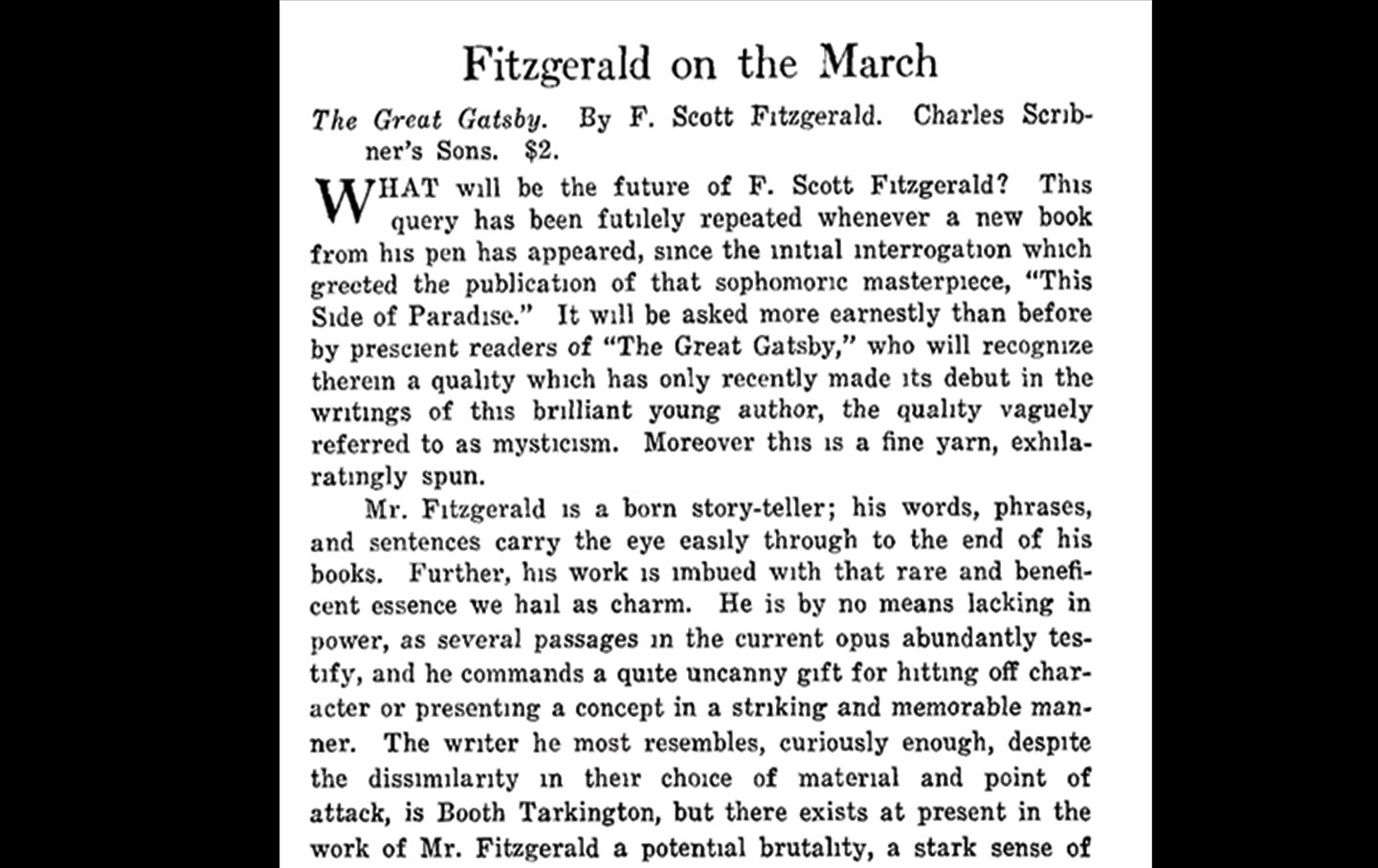
A century ago, on April 10, 1925, The Great Gatsby was published by Scribner. One month later, Carl Van Vechten, a novelist, photographer, and Zelig-like impresario, reviewed the novel for The Nation.
Van Vechten was a friend of Gatsby’s author, F. Scott Fitzgerald, whom he’d met several years earlier at a party that ended in a scene that could have been taken from the novel: As Van Vechten played the piano, the publisher Horace Liveright drunkenly yanked him from his seat, fracturing the writer’s shoulder.
In his review, Van Vechten called Gatsby “a fine yarn, exhilaratingly spun,” and Fitzgerald “a born story-teller” whose “work is imbued with that rare and beneficent essence we hail as charm.”
In Gatsby, he wrote, Fitzgerald had moved beyond his earlier fascination with “the flapper” to a new preoccupation: “the theme of a soiled or rather cheap personality transfigured and rendered pathetically appealing through the possession of a passionate idealism.” He noted that Fitzgerald’s own potential “depends to an embarrassing extent on the nature of his own ambitions.”
Tragically, the novelist fell prey to the very vices he lampooned in his work. In 1937, Van Vechten ran into Fitzgerald at lunch; aged by drink, he was barely recognizable. They went outside and Van Vechten took some of the last known pictures of Fitzgerald.
A century on, The Great Gatsby has lost none of its bite as an indictment of the “vast carelessness” of the rich, who live “safe and proud above the hot struggles of the poor.” One cannot help but see in its pages a preview of today’s MAGA moment. Racist ex–football player Tom Buchanan now seems a truer embodiment of contemporary America than Jay Gatsby. Unlike Gatsby’s longing for a vanished past, which was born of an “extraordinary gift for hope,” Tom’s nostalgia had curdled into something darker—an obsession with the superiority of the “white race.”
“Something was making him nibble at the edge of stale ideas,” Fitzgerald wrote. One can easily imagine Tom these days hosting a popular manosphere podcast: “Flushed with his impassioned gibberish, he saw himself standing alone on the last barrier of civilization.”
Ruled by our own posse of Internet-addled Toms, we live at the dawn of another age of “vast carelessness”—only now it’s not just “things and creatures” being “smashed up,” as Fitzgerald wrote at the end of Gatsby, but a country.