The Olympics Aren’t the Way to Rebuild Los Angeles
The right opposes the LA Olympics on reactionary grounds, but the left must not embrace their arguments. There are better ways to help LA recover than LA28.
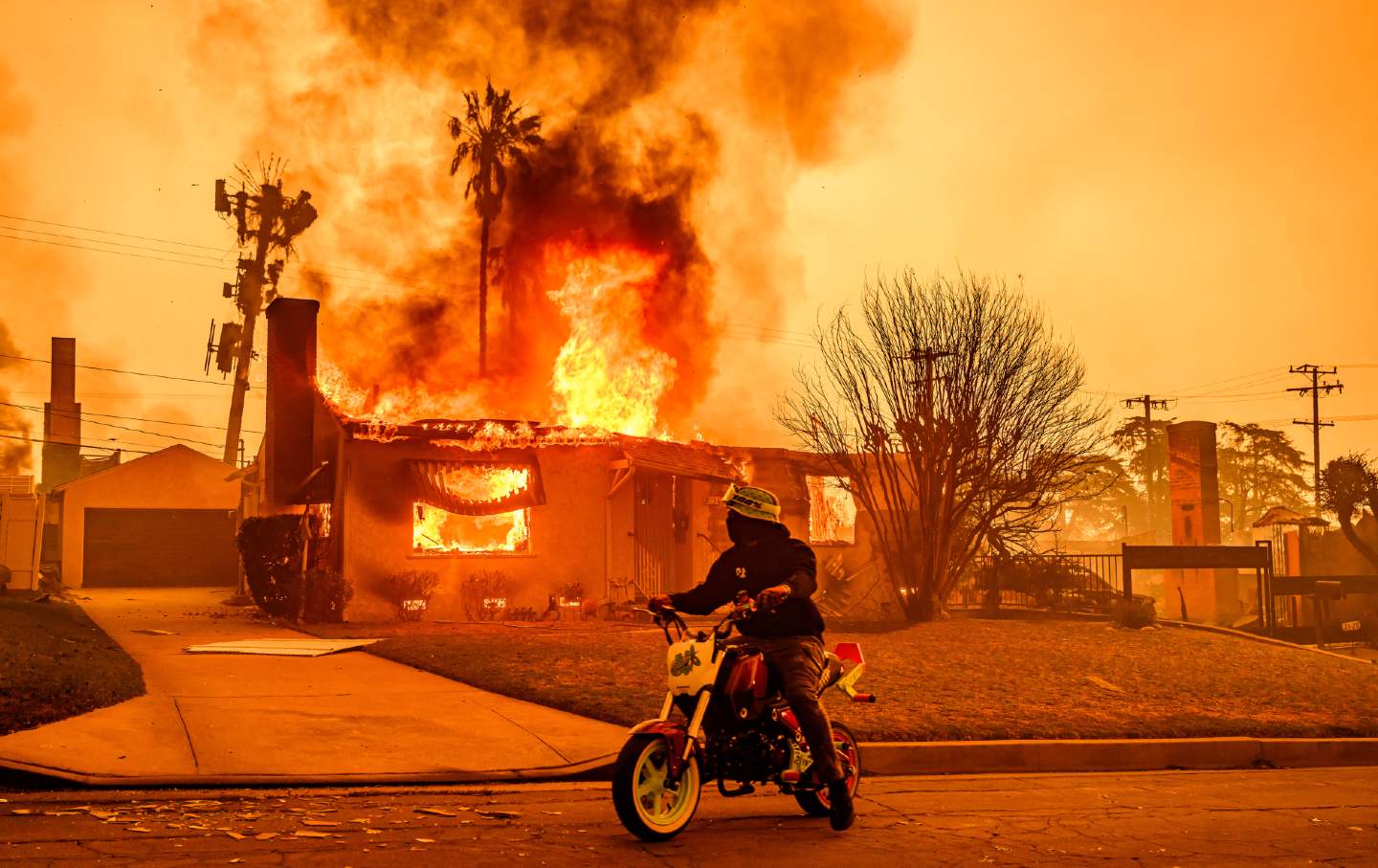
A motorcyclist stops to look at a burning home during the Eaton fire in the Altadena area of Los Angeles County, California, on January 8, 2025.
(Josh Edelson / AFP via Getty Images)
Los Angeles is on fire. While celebrity heartache has garnered significant media coverage, the broader damage and widespread human suffering should be at the center of our minds. The scale of the destruction has been crushing: the loss of life, the untold billions it will cost to repair, the damage to the environment, and the knowledge that not enough will be done to help before the next climate disaster.
Amid the carnage and countless horror stories, California Governor Gavin Newsom is rightly calling for a 21st-century Marshall Plan, a massive fiscal intervention modeled after the US-led reconstruction of Europe after World War II. Yet Newsom plans to rebuild Los Angeles through not only what he hopes will be an enormous federal expenditure but also the economic development and architectural overhaul he is promising will come as a result of hosting the 2028 Summer Olympic Games and other mega-events.
In an interview with NBC, Newsom pointed to “all that opportunity and that pride and spirit” that comes from hosting the Olympics, the Super Bowl, and the 2026 men’s World Cup, “but also the opportunity I think to rebuild at the same time. And that’s why we’re already organizing a Marshall Plan. We already have a team [that’s]… reimagining LA 2.0, and we are making sure everyone’s included.”
This is the wishful, even fantastical political space where disaster capitalism meets “celebration capitalism,” a place where the Olympics are somehow part of the solution for rebuilding Los Angeles instead of a big part of the problem (not the least of which is the massive environmental cost and carbon footprint of the Games).
Newsom has rebranded the 2028 Olympics the “Recovery Games” or the “Comeback Games,” and this could recast the way the controversial Olympic planning is viewed by residents of a devastated city. In a country where mega-events and sports funding often feels like a substitute for anything resembling urban investment, Newsom’s words hold a vision of hope, joy, and, most of all, a concrete plan to bring the city back. Amid the burnt ruins, this kind of Olympic-inspired development could feel like manna from heaven.
Turning LA28 into the Recovery Olympics should also sound familiar. In 2020, Tokyo Olympic organizers tried the same gambit in the wake of the earthquake, tsunami, and nuclear disaster that hit Japan in 2011. When we visited Fukushima in 2019, locals were embittered by the chasm separating Olympic rhetoric and reality. Covid, of course, scrapped the pageantry that was planned for Tokyo’s Recovery Games, so now the branding is being dusted off and spit-shined for Los Angeles.
In this political atmosphere, the left will need to strategize how to oppose the displacement, gentrification, greenwashing, militarization, and corruption that attach themselves to the Games.
Figuring out how to organize against the Olympics is especially urgent, because, as the fires still burn, the right has suddenly taken up the anti-LA28 banner. Trump’s number-one youth leader, Charlie Kirk (they keep calling him “youth” even though he is in his 30s) has already called for the Olympics to relocate to “punish” Los Angeles. “The Los Angeles Olympics should be cancelled,” Kirk posted to social media. “If you can’t fill a fire hydrant, you aren’t qualified to host the Olympics. Move them to Dallas or Miami, so the world’s athletes can compete in a place capable of actually safely building and running something.”
Let’s be clear: Climate change is fueling these wildfires, and moving them to a scorching Dallas summer or—my God—Miami is no solution. But it’s not just conservatives who seem eager to curry Trump’s favor. The view that the Olympics can be SoCal’s savior has Newsom—being derided daily as “Newscum” by the incoming president—sliding into sycophancy mode. He said recently, “Donald Trump, to his credit, was helpful in getting the Olympics to the United States of America, to get it down here in LA. We thank him for that. This is an opportunity for him to shine.”
This is revisionist history. Trump played only a tiny role in securing the Games: He duly promised security funding. But the arrival of the Games tees up a massive sportswashing opportunity for Trump. It could allow him, like autocrats in the past, to leverage sports to legitimize himself on the world stage, stoke nationalism, and divert attention from chronic social problems at home. It also will give Trump’s federal government unprecedented military control over Southern California, allowing for ICE raids and all manner of repression of the immigrant communities that make up the heart of Los Angeles.
In such an upside-down atmosphere, where the liberals want the Olympics to act as a post-wildfire recovery program and the right is banging drums about taking it away or using it as carte blanche to invade Los Angeles’s immigrant community, the space to organize against the worst effects of the 2028 Games will be distorted going forward. This is why it’s important to stake out with utter clarity what the issues actually are and why they matter. The right does not, should not, and must not set the terms of the debate. The right opposes the LA Games on the most backward, reactionary grounds, but the left must still oppose them on the basis of fighting police repression, stopping the attacks on the unhoused, and other social-justice issues—not out of the desire to immiserate our perceived political enemies. Even if our voices are fainter than we would like, we need to speak out about what we oppose about the Olympics and why. Yes, we must rebuild LA. Yes, we need a Marshall Plan for the 21st century to do it. And yes, LA can be reborn again, but the Olympics are not how we’ll get there.