
South Korea’s Autumn of the Patriarchy
President Yoon Suk-yeol is the first of his country’s leaders eager to be a stooge of both Washington and Tokyo. His impeachment is testimony to the strength of Korean democracy.
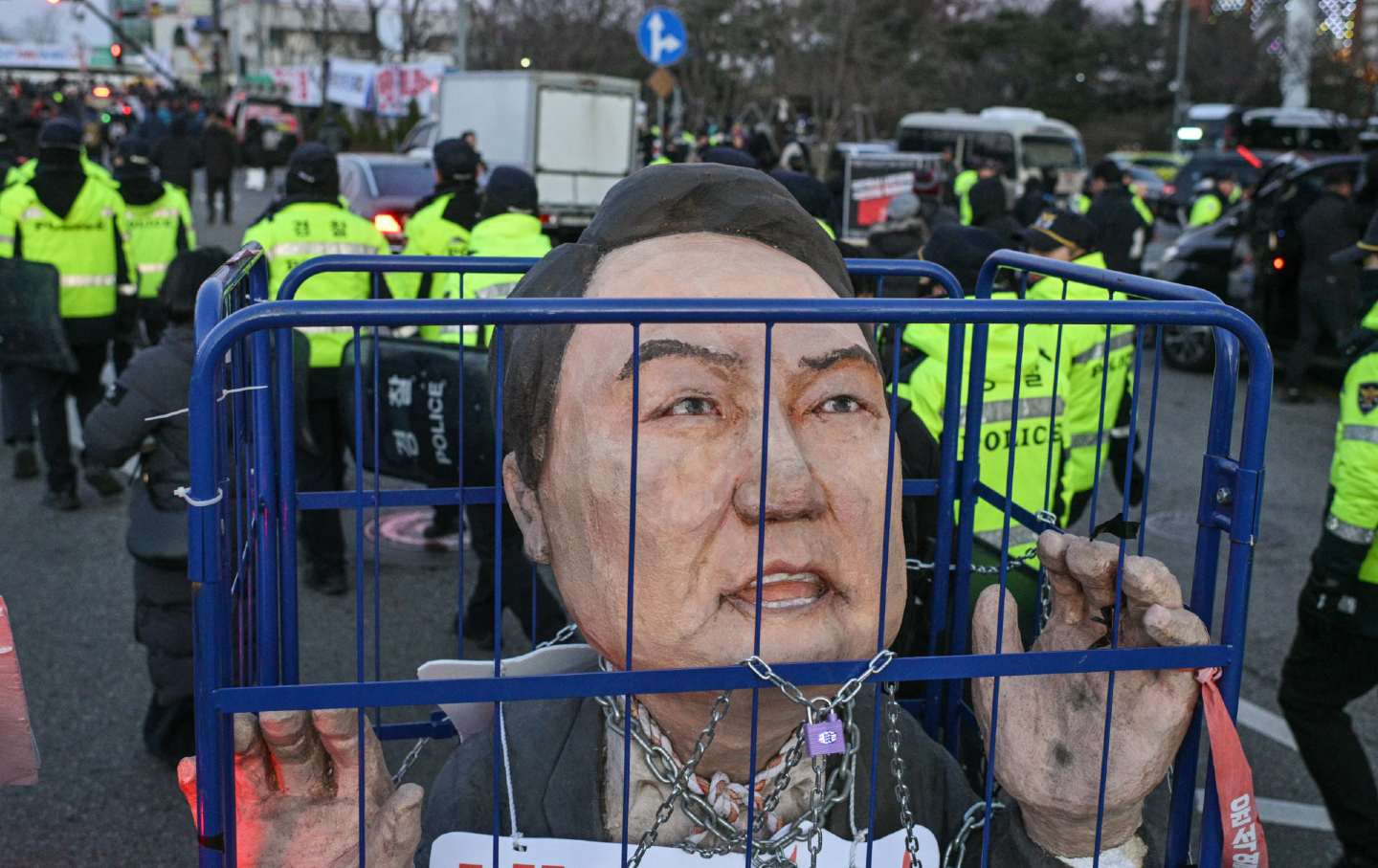
On December 3 at 11 pm, South Korean President Yoon Suk-yeol declared martial law, stating that the opposition party, which had a large majority in the National Assembly, is rife with criminals and sympathizers with North Korea. He ordered Lt. Gen. Kwak Jong-keun to have his troops storm the Assembly and arrest opposition lawmakers: “Break the door down right now and get in there and drag out the people inside,” Yoon demanded, lest they produce a quorum that could vote martial law down.
Yoon chose his time carefully, when wives are sleeping, or pretending to, and their inebriated husbands are being driven home by one of Korea’s major enterprises, the roughly 100,000 people employed to shepherd drunks home every night. His Army chief of staff, Park An-su, however, was sitting at home, sober, when he learned via his TV that he was now the martial law commander.
Another general ordered 300 paratroopers to garrison the National Assembly, but they arrived too late; the opposition legislators voted down the martial law decree, which was in force a mere six hours. “We didn’t know much about martial law,” General Park later said, “What should we do?” Grizzled Marine veterans knew what to do: two days later they marched near the presidential office chanting, “Let’s decapitate Yoon Suk Yeol!”
Yoon seemed to confuse Seoul with Tegucigalpa, and the Republic of Korea (12th largest economy) with the Republic of Honduras (which produced 560 tons of bananas in 2022.)
He also seemed to inhabit a bizarre time warp—as if 45 years had not passed since the last declaration of martial law in the country. It was as anachronistic as if Vladimir Putin announced that he was bringing back the dictatorship of the proletariat.
Yoon is a well turned-out representative of the Confucian patriarchy, standing ramrod-straight with a stilted delivery, stone-faced, home-dyed jet-black hair. He is known for his top-down approach to governance, expecting his underlings to leap at his every command. But his real time warp is the contemporary crisis of six centuries of Confucian practice. Beginning in 1392 the new Choson Dynasty took a fundamentally Buddhist country and slowly implemented a self-conscious ideological project lasting centuries, to implant Neo-Confucian doctrine. The scholar Martina Deuchler has shown that women were the particular victims of this program, losing property rights and becoming the homebound “inside person,” with the husbands free to roam the outside. Eventually, elite Korean women would only leave the house clothed in a chador-like shroud.
By the 19th century many foreigners commented that Korea seemed more Confucian than China. In many ways this was true because ideologues and formalists and censors had developed elaborate systems to show that they had formed a more perfect union around this foreign doctrine than had China. You see the same syndrome in North Korea, when in 1965 Kim Il Sung tongue-lashed Premier Alexei Kosygin and KGB head Yuri Andropov for being revisionists, and declared before his incredulous interlocutors, “We are building perfect Marxism here!”
The same impulse animated pro-Japanese Koreans during the colonial period (1910–1945); for decades, South Korean institutions often seemed to be replicas of Japanese models. That was particularly true of the military officers who ran the country and declared martial law twice, in 1972 and 1980. The typical pattern was for pro-Japanese toadies to go into the closet in August 1945, waiting to see if Kim Il Sung showed up in Seoul; when, on September 8, 25,000 American combat soldiers showed up instead, out came the pro-American toadies. Two examples were Park Chung Hee and Kim Jae-gyu, former officers in the Japanese military who graduated from the second class of the American military academy in 1946. Readers may remember that when Kim was head of the Korean Central Intelligence Agency, he assassinated President Park one night in October 1979.
The US Army Military Government, which lasted three years until August 1948, hired just about every Korean who had served the Japanese that it could lay its hands on—especially in the forces of order, the army and the police. This gave anti-Japanese sentiment a big boost, and it has been one of the strongest undercurrents in Korean life ever since, helped along by the Japanese never finding a way honestly and sincerely to make amends for their colonial rule. Never have they atoned for the thousands of Korean sex slaves who served the Japanese military, or the forced Korean laborers who fueled Japanese industry during World War II.
As a matter of high policy, Americans have never understood or cared about the depth of Korean hatred of the Japanese reign of terror. The makers of American foreign policy have always wanted South Korea to cozy up to Japan. I first heard this in 1967 when, as part of our Peace Corps orientation in Seoul, a US Embassy official urged us to understand that Koreans should let bygones be bygones, and unite with those friendly people off to the east.
Along comes President Yoon, the first Korean president pleased to be a stooge of both Washington and Tokyo, helping the Biden administration to cobble together a quasi-alliance to contain China. This tripartite gambit heavily contributed to Yoon’s unpopularity, which already had an abysmal 20 percent approval rating even before his Keystone Kops martial law edict. Among other things, Koreans have noted that in any war over Taiwan, the 28,500 American troops still based in Korea would likely be one of China’s targets—as might Korea itself.
Yoon may be a model of Confucian rectitude, but he was hiding under the bed when the brains were passed out. In spite of graduating from a prestigious law school, he failed the bar exam eight times. And the only foreign model he seemed to be trying to perfect was the proverbial Chinese Fire Drill—without letting the fire chief know. Biden’s vaunted triangular arrangement is likely to fall apart when the opposition party takes power. Several members of Yoon’s party voted to impeach him on December 14, and even though the Constitutional Court has six months to rule on the case, it seems inevitable that both Yoon and his “People’s Party” will be consigned to the dustbin of history for the foreseeable future.
If Yoon himself reached back to an absurdly unusable past, to young people in Korea, and particularly women, his presidency looks like a blast from the past that they thought, or hoped, was disappearing. Observers noted how many young women were in the vanguard of the tens of thousands of protesters marching to support impeachment. The generation gap in Korea is a yawning chasm; if Yoon ever dared to show up at a K-Pop event, it would be like Calvin Coolidge taking in a Taylor Swift concert.
A deeper problem is that millions of young Korean women have expressed themselves in opposition to the age-old Confucian patriarchy with their bodies, like Lysistrata, viewing a husband and a baby as their unwanted entry ticket to an “inside person” Confucian totality. Therefore, many of them don’t get married or have babies, leaving South Korea with the lowest birth rate in the developed world.
Demographers worry that in 100 years there won’t be any Koreans. But for now the only thing we can be sure of is that there won’t be any more of President Yoon in public life (although it is likely there will be a Yoon in jail; that’s what happened to the other president who was successfully impeached, Park Chung Hee’s daughter, Park Geun-hye).
Popular
“swipe left below to view more authors”Swipe →I was in Seoul in 2002 when Roh Moo-hyun—the closest thing to a leftist that South Korea has ever elected—won the presidency by a narrow margin. From my hotel window, I watched a huge crowd of demonstrators supporting Roh. The opposition party immediately accepted this outcome. I marched with thousands of people in 2016, holding candles against the wind and demanding the impeachment of President Park. The crowds were full of young couples pushing strollers, grandparents, retired soldiers, office workers. In both cases, there was not a hint of violence. Nor did any violence mar the recent mass protests over the martial law decree.
The steadfastness and resilience of Korean democracy is only to be admired. I think it is the most successful example of evolution from decades of military dictatorship to genuine democracy. Taiwan is a close runner-up—but it has not had to withstand impeachment and martial law. Less noticed perhaps is the role of the Korean military—98 percent of which refused to go along with Yoon’s decree. Ever since the last general left the presidency in 1993, the military has remained in the barracks and sought to retrieve its self-respect and regain the support of the people. I say “well done” in both cases.
More from The Nation
The Saudi Phase of the Iran War Signals More Chaos to Come The Saudi Phase of the Iran War Signals More Chaos to Come
The conflict that Donald Trump has repeatedly proclaimed an unequivocal American victory keeps spiraling out of control.
Andy Burnham’s Speech to the Labour Party Conference Could Be the Start of a Positive Social-Democratic Politics Andy Burnham’s Speech to the Labour Party Conference Could Be the Start of a Positive Social-Democratic Politics
But the autumn budget to be released at the end of October will offer needed details.
Why Navi Pillay’s Receiving the Nobel Peace Prize Is So Important Why Navi Pillay’s Receiving the Nobel Peace Prize Is So Important
She believes that human rights and international law are universal principles that must be enforced regardless of violator’s ideology, ethnicity, or geostrategic alignment.
Writing About War as Bombs Fall Writing About War as Bombs Fall
While the Israeli government launched a well-orchestrated offensive of disinformation and hyperbole that would make the illegal permissible in the war on Gaza.
Turkey Is Brutally Oppressing Queer People. Here’s What You Need to Know. Turkey Is Brutally Oppressing Queer People. Here’s What You Need to Know.
The government’s sweeping crackdown on the LGBTQ community is an escalation of a decades-long pattern.

