Our Back Pages / November 28, 2024

A 150-Year Critique of the Electoral College

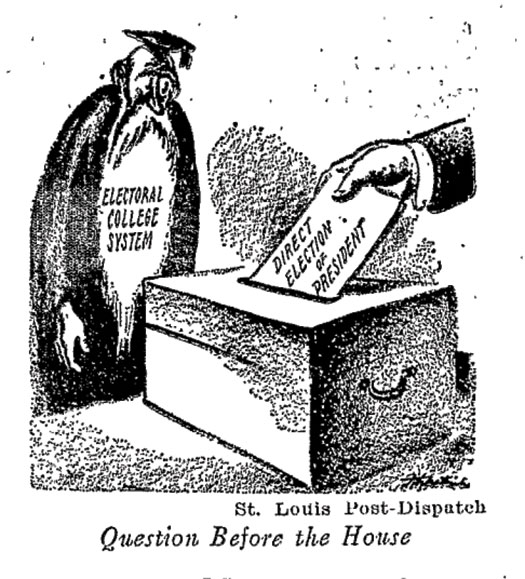
As far back as the 1870s, The Nation opposed the existence of the Electoral College as “so grotesque as to be almost ludicrous.”
Richard Kreitner

One of the many mysteries that future historians will have to try to explain as they mull what exactly befell the American Republic in the first quarter of this century is our failure to dismantle the decrepit piece of constitutional machinery known, bizarrely, as the Electoral College. Twice already, in 2000 and in 2016, a president was elected despite losing the popular vote—in the latter case, by nearly 3 million ballots. In 2020, the incredibly slow, needlessly complicated tallying of Electoral College votes left an opening for the defeated incumbent to launch an attempted coup d’état. The fact that this year’s gruesome election results spared us such a fiasco is a mighty slim silver lining.

As befuddled as future historians will be, Americans of the past would likewise be horrified to learn we let things go on this long. The Nation has opposed the Electoral College since at least 1876, when competing voter-fraud claims after the heated presidential contest between Rutherford B. Hayes and Samuel Tilden stalled the Electoral College count—and almost led to a second civil war. (Eventually, the crisis ended with a compromise that handed the victory to Hayes, a Republican, in exchange for his agreeing to sacrifice what remained of Reconstruction in the South.)

As the crisis unfolded, The Nation took aim, in an editorial, at the Electoral College. Its continued existence was “so grotesque as to be almost ludicrous,” the magazine said. While Alexander Hamilton had argued in The Federalist Papers that the system was designed to “afford as little opportunity as possible to tumult and disorder,” the Electoral College had never worked as intended. Instead, it had become a national embarrassment: Anyone looking for “a clear case of political sham and humbug,” The Nation argued, could “scarcely find a better instance in any country than the Electoral College of to-day.”

Fast-forward some 85 years, and The Nation was still singing the same song. After John F. Kennedy’s historically narrow 1960 victory, the veteran journalist Ted Lewis noted that a change of a few thousand votes could have swung the election to Richard Nixon. Observing that the close call had produced an “unprecedented public revulsion against the complicated electoral-college procedure,” Lewis warned that the institution would eventually have to be scrapped “when the nation, in some future Presidential election, finds its will has been thwarted to the point where it revolts against the results.” The national will has been thwarted twice since Lewis made that prediction—and still we wait for the revolt.
Disobey authoritarians, support The Nation

Over the past year you’ve read Nation writers like Elie Mystal, Kaveh Akbar, John Nichols, Joan Walsh, Bryce Covert, Dave Zirin, Jeet Heer, Michael T. Klare, Katha Pollitt, Amy Littlefield, Gregg Gonsalves, and Sasha Abramsky take on the Trump family’s corruption, set the record straight about Robert F. Kennedy Jr.’s catastrophic Make America Healthy Again movement, survey the fallout and human cost of the DOGE wrecking ball, anticipate the Supreme Court’s dangerous antidemocratic rulings, and amplify successful tactics of resistance on the streets and in Congress.

We publish these stories because when members of our communities are being abducted, household debt is climbing, and AI data centers are causing water and electricity shortages, we have a duty as journalists to do all we can to inform the public.

In 2026, our aim is to do more than ever before—but we need your support to make that happen. 

Through December 31, a generous donor will match all donations up to $75,000. That means that your contribution will be doubled, dollar for dollar. If we hit the full match, we’ll be starting 2026 with $150,000 to invest in the stories that impact real people’s lives—the kinds of stories that billionaire-owned, corporate-backed outlets aren’t covering. 

With your support, our team will publish major stories that the president and his allies won’t want you to read. We’ll cover the emerging military-tech industrial complex and matters of war, peace, and surveillance, as well as the affordability crisis, hunger, housing, healthcare, the environment, attacks on reproductive rights, and much more. At the same time, we’ll imagine alternatives to Trumpian rule and uplift efforts to create a better world, here and now. 

While your gift has twice the impact, I’m asking you to support The Nation with a donation today. You’ll empower the journalists, editors, and fact-checkers best equipped to hold this authoritarian administration to account. 

I hope you won’t miss this moment—donate to The Nation today.

Onward,

Katrina vanden Heuvel 

Editor and publisher, The Nation

Richard Kreitner

Richard Kreitner is a contributing writer and the author of Break It Up: Secession, Division, and the Secret History of America's Imperfect Union. His writings are at richardkreitner.com.

More from The Nation

Trump’s “Warrior Dividend”  Might Be His Scariest Idea Yet

Trump’s “Warrior Dividend” Might Be His Scariest Idea Yet Trump’s “Warrior Dividend” Might Be His Scariest Idea Yet

This week’s “Elie v. US” explores the authoritarian threat beneath Trump’s bonuses for military families. Plus, a case for getting rid of the Second Amendment.

Elie Mystal

How Do We See Hegseth?

How Do We See Hegseth? How Do We See Hegseth?

Surf's up!

Steve Brodner

HUD Is Refusing to Enforce Anti-Discrimination Law—and Won’t Let Anyone Else Do It, Either

HUD Is Refusing to Enforce Anti-Discrimination Law—and Won’t Let Anyone Else Do It, Either HUD Is Refusing to Enforce Anti-Discrimination Law—and Won’t Let Anyone Else Do It, Either

The initial chaos of layoffs has been followed by a concerted effort by the Trump administration to halt the enforcement of the Fair Housing Act.

Bryce Covert

Unleashing AI

Unleashing AI Unleashing AI

Ignoring the dangers, tech companies race forward.

OppArt / Peter Kuper

Representative Ilhan Omar (D-MN) walks toward the Capitol on December 10, 2025.

Why Ilhan Omar Makes the Right Lose Its Mind Why Ilhan Omar Makes the Right Lose Its Mind

Trump and his MAGA allies want people like Omar to vanish from this country—and they hate her for refusing to do so.

Isi Baehr-Breen

Brad Lander on What It Takes to Win as a Progressive

Brad Lander on What It Takes to Win as a Progressive Brad Lander on What It Takes to Win as a Progressive

The outgoing New York City comptroller discusses governing on the left, his run for Congress, and why housing and affordability should define the next Democratic fight.

Q&A / Bhaskar Sunkara