
Donald Trump’s Foreign Policy Will Be Chaos First, Not America First
His team of cronies includes establishment hawks and cranky outsiders who are more likely to deliver global anarchy than world peace.
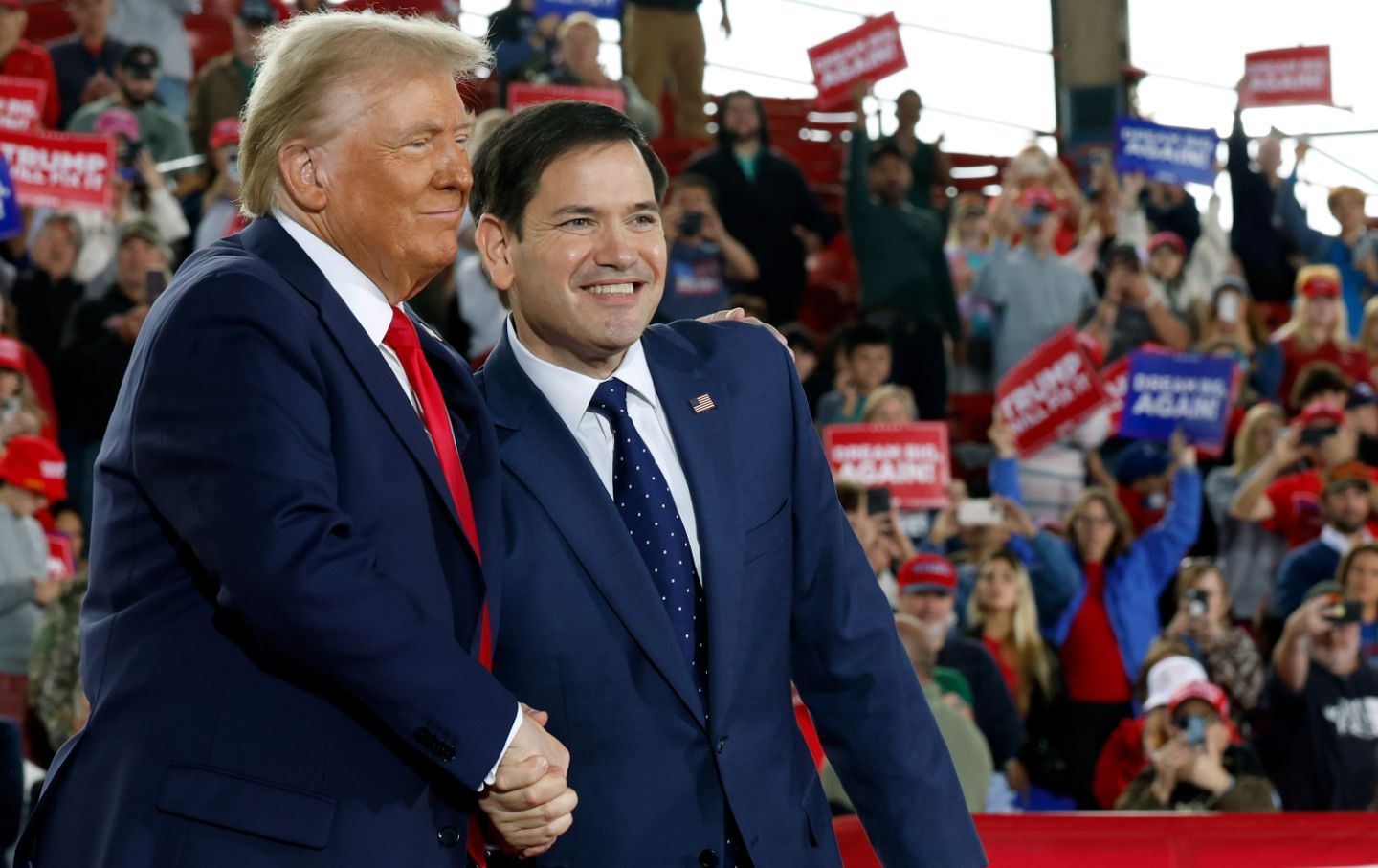
Donald Trump won the presidency in both 2016 and 2024 in no small part because he ran as an outsider, with anti-war proclivities that stood in contrast to a bipartisan political establishment discredited by the forever wars. But Trump’s first term in office showed how shallow his anti-war commitments actually were, as he repeatedly gave powerful posts to establishment hawks such as John Bolton, John Kelly, H.R. McMaster, and Nikki Haley while rolling back Barack Obama’s legacy of diplomatic engagement with Iran and Cuba. Trump’s actual foreign policy consisted largely of continuing the forever wars, engaging in nuclear brinkmanship with North Korea, applying maximum pressure on Iran (and scuttling Obama’s nuclear deal), and withdrawing from long-standing arms control deals with Russia.
While Trump didn’t start any new wars, he was quicker than even Obama to engage in long-distance bombing. Far from being an “isolationist” (a nonsensical accusation levied by establishment figures wedded to the outdated framework of World War II and the Cold War), Trump’s actual philosophy was “more rubble, less trouble.” That is to say, Trump was willing to project violence abroad (including, in the case of North Korea, threats of preemptive nuclear war) but wary of putting boots on the ground.
Given his record, Trump shouldn’t have been able to sell himself in 2024 as a peace candidate. The fact that he did so is part based on his amazing chutzpah—but also on the dubious foreign policy record of Joe Biden. A dyed-in-the-wool establishment internationalist, Biden elevated maintaining American global hegemony to a guiding principle, which meant he was unwilling to negotiate an end to the Russia/Ukraine conflict or to restrain Israel in any meaningful way in its savage and nihilistic pummelling of the Palestinian people and neighboring countries. Given spiralling conflicts in both Europe and the Middle East, combined with Biden’s continued confrontationist stance towards China, the war-weary public again looked for an anti-establishment alternative.
Cynical and cagey, Trump answered the call by arguing that his America First foreign policy is the anti-war war alternative. He claimed, “During my Administration, we had peace in the Middle East, and we will have peace again very soon!” In his victory speech, Trump said, “I’m not going to start wars, I’m going to stop wars.”
The left should demand that Trump live up to this promise. But we should also be skeptical that Trump’s second term will be any more anti-war than his first. There’s little reason to think that either Trump or his foreign policy team have the skill or the desire for a true anti-interventionist foreign policy, one that would draw down the American empire, use diplomacy to engage with rivals, and shift resources from the bloated military budget toward domestic repair and international climate action.
One reason to wary of Trump’s foreign policy is that his team of advisers are a mixed bag of establishment hawks and cranky America First outsiders. The foreign policy establishment (including Democratic Party hawks) is reportedly thrilled by the naming of Senator Marco Rubio to be secretary of state and Representative Mike Waltz to be national security adviser. Conversely the establishment has been unhinged by some of Trump’s wild-card nominations—notably those of Fox News host Pete Hegseth to be secretary of defense and former representative Tulsi Gabbard to be director of national intelligence. Hegseth isn’t so much a hawk as a militaristic nihilist, who in 2017 advocated pre-emptively nuking North Korea.
Gabbard is a more heterodox and intriguing figure. Although an ultra-hawk in the Middle East, she is also an advocate of diplomatic engagement with Russia to end the conflict in Ukraine. This has earned her abuse from establishment figures (including Democrats such as Hillary Clinton), who have smeared Gabbard as a Russian asset. Trump’s patron-turned-consigliere Elon Musk has been tasked with gutting the federal bureaucracy, but he also has some unorthodox foreign policy ideas: The New York Times reports that Musk met with Iranian diplomats to ease tensions between the United States and the Islamic Republic (a claim that Iran vehemently denies).
We should welcome any overtures Gabbard and Musk might make in the direction of diplomacy. There are some very intelligent Trump supporters who argue that Trump will in fact override his more hawkish advisers and implement an American First foreign policy that will decisively turn away from Joe Biden’s reckless interventionism and sponsorship of multiple wars. This was an argument very ably made recently in Foreign Affairs by Dan Caldwell, public policy adviser at Defense Priorities and Reid Smith, vice president of Foreign Policy at Stand Together.
Caldwell and Smith argue, “The Republican Party should embrace Trump’s ‘art of the deal’ foreign policy approach. Trump has articulated a desire to negotiate with U.S. adversaries such as China, Iran, North Korea, and Russia to de-escalate tensions and avoid fresh conflicts.”
Alas, these idealistic sentiments deserve the ironic response Jake Barnes delivered in Ernest Hemingway’s The Sun Also Rises: “Isn’t it pretty to think so?” We should be grateful that conservatives such as Caldwell and Smith are embracing foreign policy restraint. This presages well for a future where the left and right can work toward a bipartisan drawdown of the American empire. But that will have to take place in another presidency. Nothing in Trump’s record should make us confident that his spasmodic anti-war tendencies will result in genuine restraint.
Instead, we should be troubled by the incoherence of Trump’s cabinet picks. The governing principle of his nominations is neither hawkishness nor restraint but rather cravenness. Trump is putting together not a team of rivals but a team of cronies, united by obsequiousness to his whims. As Trump’s former national security adviser John Bolton notes, “Their connection is fealty to Trump, not loyalty. Loyalty is a good thing, but fealty, that’s a medieval idea of being subservient. He just wants yes-men and yes-women.”
A foreign policy team blowing in whatever direction Trump’s passing fancies points to will by definition be unstable. Trump may be reluctant to send American soldiers to die in wars, but he is otherwise quite happy to use American power—including the threat of nuclear annihilation—to bully foreign adversaries. Nor does Trump have a good record of negotiating with rivals. Even if the war in Ukraine ends with a negotiated settlement, the hawks in Trump’s administration will likely use the freed-up resources to turn the screws on Cuba, Venezuela, China, and Mexico. This is not a genuine anti-war leader but rather the American empire in a new guise. The most plausible path for the second Trump administration is not America First but Chaos First.
More from The Nation

Mamdani Can No Longer Avoid the Issue of the NYPD Mamdani Can No Longer Avoid the Issue of the NYPD
The mayor has been able to put difficult questions about policing on the back burner—until now.

Why Democratic Leaders Keep Waging War on the Young Why Democratic Leaders Keep Waging War on the Young
The party's silver-haired establishment is caught up in an existential culture war.
The White Man Can Always Take What You Have The White Man Can Always Take What You Have
In this week's Elie v. US, our justice correspondent breaks down the real message of the attacks on Ilhan Omar. Plus: the anti-trans case that will come for us all.

Where Is the Outrage Over Trump’s Racist Targeting of Ilhan Omar? Where Is the Outrage Over Trump’s Racist Targeting of Ilhan Omar?
The establishment press and some Democrats are strangely mute over the president’s flagrant abuse of the legal system.

