For Israeli Protesters, Palestine Might as Well Not Exist
There is a gaping, Gaza-shaped void at the heart of the hostage deal demonstrations.
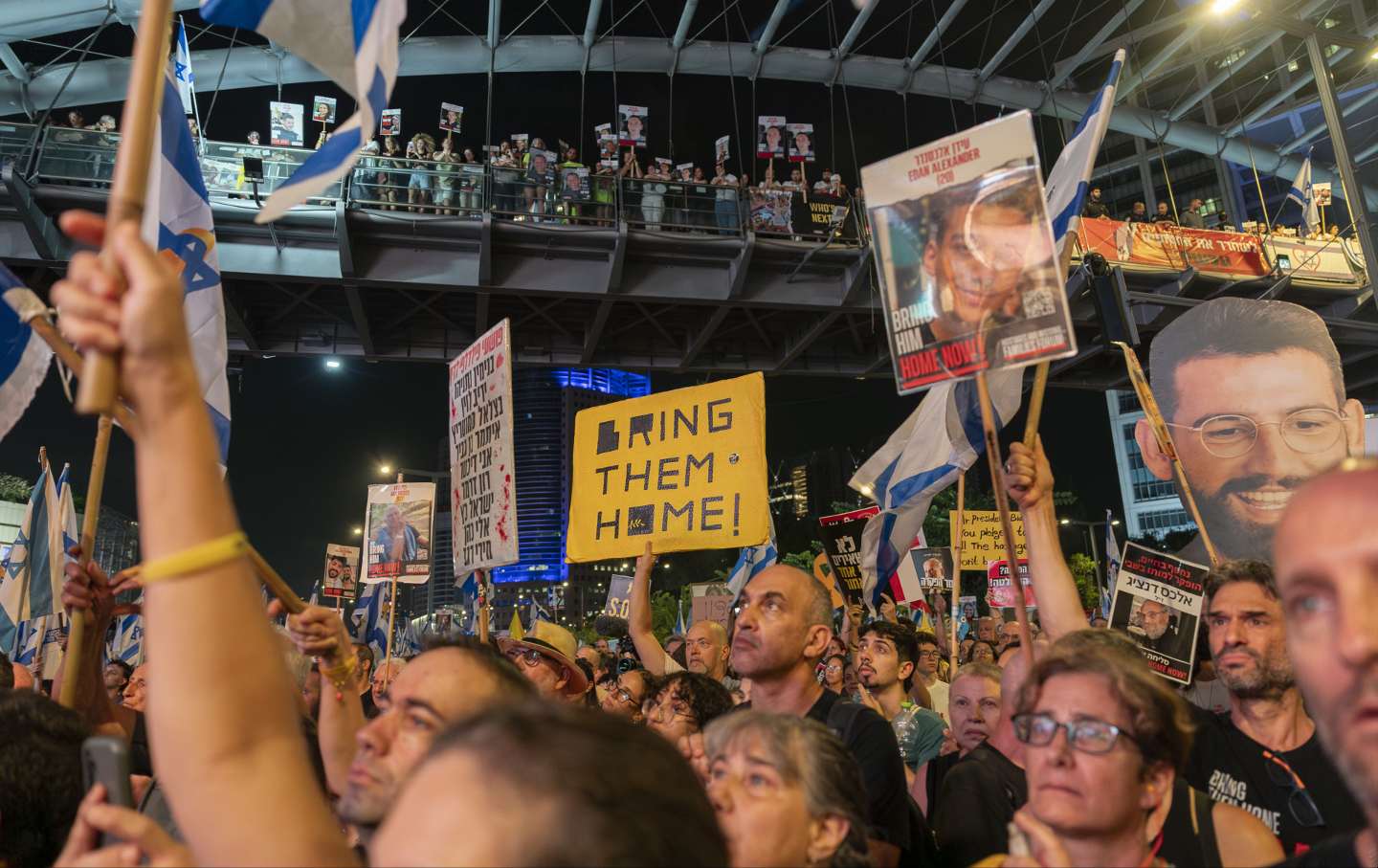
Israelis protest during a demonstration against the government and the hostage situation in Gaza, in Tel Aviv, Israel, on Saturday, September 7, 2024.
(David Lombeida / Bloomberg via Getty Images)The political balance in Israel is subtly shifting. For 11 months, most people here have accepted the argument that Israel’s two goals for its genocidal campaign in Gaza are not just commensurate but also complementary. These goals were “destroying Hamas” (all sorts of qualifiers were later added to this phrase; none stuck) and “returning the hostages.” Our government insisted that the ever-expanding Gaza assault was hastening the return of the hostages. Hamas would learn our might and fear our anger. Once that happened, they would surrender, return the hostages and everything would be over in 10 minutes. That is something you still hear very frequently from Israelis of all political persuasions—that all Hamas has to do to make the pain go away is return the hostages. After all, Israelis want peace.
The death of six Israeli hostages at the end of August allowed the penny to drop for many Israelis. The plight of the hostages had been spun as a “human interest” story by the Netanyahu government, their protesting relatives depicted as motivated by personal commitment at best. Previous hostage deaths seemed to take place in a mythical place and time, either on “October 7” or in “the tunnels,” and were all “on Hamas.”
But these six hostages had obviously been shot because IDF troops had approached them and their keepers. It’s unclear whether the soldiers knew the hostages were there, but the tragedy made it plain that “military pressure” from Israel was getting the hostages killed, not getting them back. Their deaths were entirely preventable, wholly disturbing, and frustrating. Many Israelis suddenly realized that the languishing of the hostages was a strategic failure, a resounding defeat. So, over the last two weeks, they have taken to the streets, including this past weekend.
Still, one thing has not shifted. Among hundreds of thousands of demonstrating Israelis, one would be hard-pressed to find more than several hundred calling for an actual end to the Gaza campaign.
The protesters implore Netanyahu to “make a deal.” They say nothing about the Palestinians or about Israel’s genocidal actions. A deal, it is implied, does not negate Israel’s commitment to the “destruction of Hamas.” The ongoing daily killing of dozens of Palestinians in Gaza and the expansion of the Israeli attacks in the West Bank are not mentioned. There is no vision of a future beyond “bringing them home now.” Israel must sign a deal to bring the hostages home. If it finds that it must continue to carry out a genocide even after the hostages return, it will continue to do so, seemingly with the acquiescence of most of the people in the streets.
It might seem strange that hundreds of thousands of Israelis who have committed to changing the reality of the genocide ignore the tens of thousands of Palestinian civilians that Israel has killed, but that is where we are. Some examples of indifference are downright surreal.
Eden Yerushalmi was one of the six hostages killed in August. When her body was returned, Israeli media revealed that she weighed 36 kilograms (just under 80 pounds). This was spun as proof that Hamas had intentionally starved her, demonstrating yet again that Israel was facing “animals.” No one made a connection between Israel’s intentional starvation of Gaza and Yerushalmi’s emaciated condition. No one thought that her death might be connected to the consequences of Israeli policy toward the Palestinians. The protests against the government decried its incompetence and cruelty, but these were directed towards Israelis. The Palestinians simply did not exist.
What is behind this total repression of Palestinian lives and deaths? It is very easy to find an explanation in the never-ending stream of genocidal incitement gushing from Israeli social and mainstream media, as well as from Israeli politicians and pundits. When retired Israeli generals suggest that 300,000 Palestinians be “allowed” to “evacuate” from Gaza City (where will they go?) and that a “hermetic” siege will then be laid on the city, forcing the 5,000 “terrorists” remaining in it (says who? How many hostages are still in Gaza?) to surrender or die, what is that if not a genocidal plan?
It joins many other “plans” floated by Israeli authorities over the past year, from obeying the religious commandment to wipe the memory of “Amalek” from beneath the heavens to the “consensual” transfer of 2 million Gazans into the northern Sinai. These, of course, come from officials. The vileness of the filth spewed by soldiers in Gaza and by ordinary Israeli citizens is often much worse. When this is all you are exposed to for a year and for your entire life, how else will you respond?
But I think this explanation misses the true horror of Israel’s genocide. This horror does not reside in some recent turn toward extremism. It has been there all along.
Israel was built on the principle of Jewish supremacy. Defending Jews (even Jewish terrorists) regardless of the circumstances is Israel’s reason for being. We defended and enhanced our supremacy by working hard to make it transparent. We segregated and discriminated and occupied not with a desire to kill all the Palestinians but with a commitment to having “them” know their place and keep out of “our” sight as much as possible. We wanted to establish a hierarchy so clear that we would never need to refer to it overtly—so clear that it would become transparent. We thought we were succeeding.
That delusion died brutally on October 7. The Hamas massacre made it impossible for us to repress or unsee the Palestinians. We could not sustain our supremacy, even if only because our supposedly glorious military had been trounced. The blow was so harsh that we immediately regressed from supremacy to solipsism.
We knew that we were real and the Palestinians were not. Nobody else was real, in fact. We were the only real people in the world. Such a position can be defended only destroying any challenge to its integrity.
The very existence of Hamas threatened our deepest sense of self. We could not allow “them” to live. Could we clearly identify “them”? Obviously not, because they “hid” among civilians. It wasn’t our fault that those civilians died. Was it our fault, as the days and weeks and months of killing passed, that we discovered more and more civilians actually supported the “terrorists” or were “terrorists” themselves? It wasn’t our fault.
The fact that after 11 months of destruction even the greatest opponents of Hamas might now support it does not enter our calculations. They are not real. In their pretension of realness, they threaten ours. We don’t want to destroy them all. But we have no other option.