
An Interfaith Dispatch From the West Bank
Rabbis for Ceasefire and Hindus for Human Rights make a peace pilgrimage.
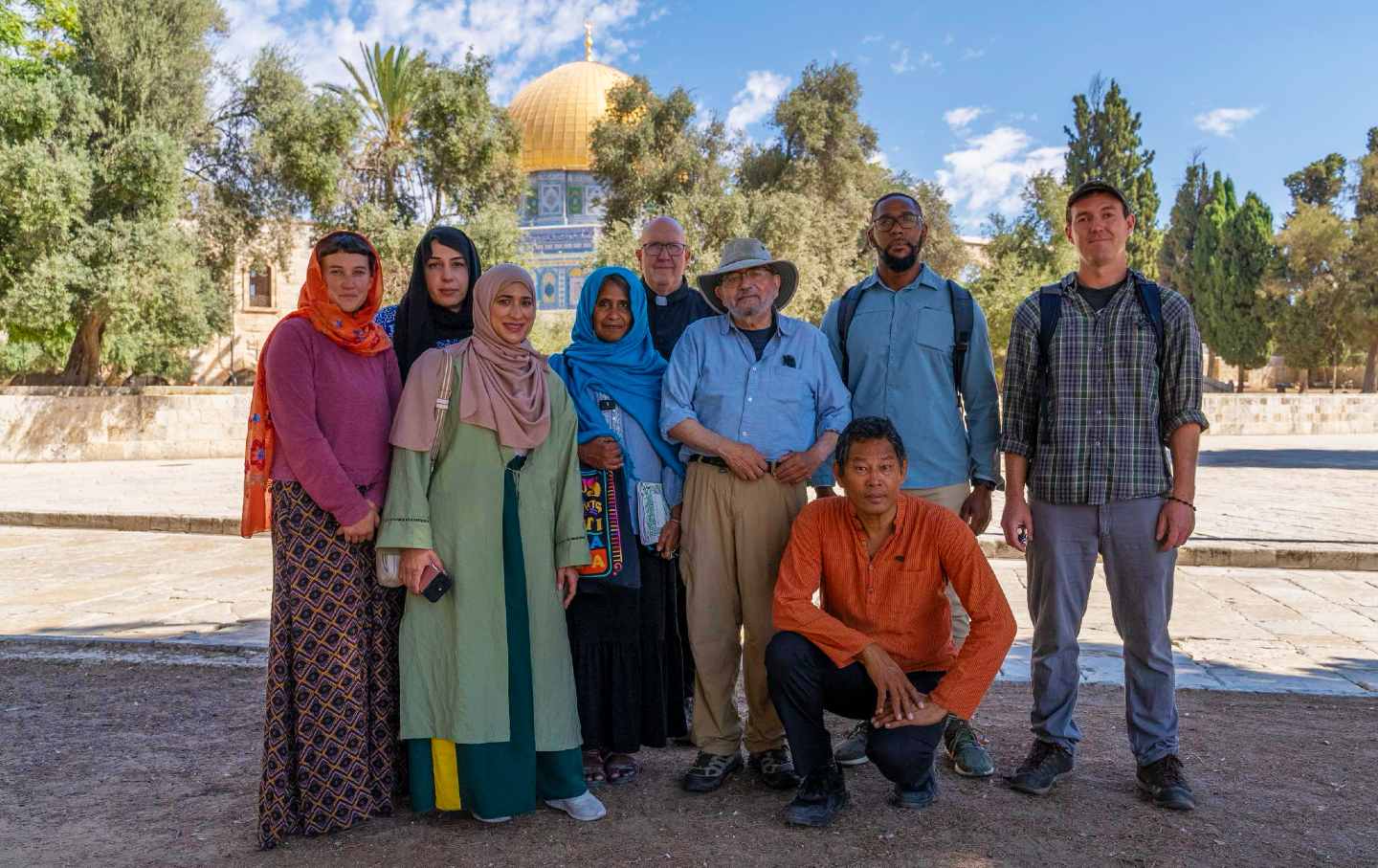
An interfaith peace delegation in the West Bank.
(Photo supplied by the author)
I am writing this from Palestine, where I am part of an interfaith delegation that has come to bear witness, listen deeply, and physically stand with the people of this troubled land. Our group is diverse—Muslims, Christians, Jews, Hindus, Buddhists—and we are here because we understand that this is not just a conflict between Jews and Muslims. The suffering here touches all communities living here. Angela Kassieh, a Christian Palestinian woman in Makhrur, near Bethlehem, whose family is fighting to protect their ancestral land from being seized by Israeli settlers, told our delegation: “This is not a religious conflict between Jews and Muslims. This is settler colonialism. Tell the world about us: We are the last Christians in the land where Jesus was born.”
Israel has begun a large “Gaza-style” invasion of the Northern West Bank. This genocide is clearly the latest chapter of the Nakba that began in 1948, and ugly chapters still lie ahead. The escalation of tensions in the immediate region and the increasing sense that a regional war is imminent, the financial support and political complicity of powerful Western nations, including the United States and the United Kingdom, and the mass protest movements in so many countries show us that the conflict touches the entire world. Indeed, renowned Palestinian scientist and environmentalist Mazin Qumsiyeh told our delegation that he believes there is a high likelihood that these tensions will result in nuclear war.
My grief and horror compelled me to seize the opportunity to join Rabbis for Ceasefire and Christians for Ceasefire on their peace pilgrimage. I also came because I am Indian and Hindu.
I bring with me to Palestine the story of India, and it is one of deep complicity in the oppression I am witnessing here. As I move through the checkpoints, see the demolished homes, and speak with families separated by walls and policies, I am painfully aware that the hands stained by this violence are not just those of the Israeli state and the United States where I live. India, where I was born, is an enabler and active participant in this cycle of violence.
India is now one of the largest buyers of Israeli weapons, technology that is often “battle-tested” on Palestinians before being sold to other countries. This exchange is not just financial; it is ideological. The tools of oppression, whether drones or bulldozers, move seamlessly between Tel Aviv and New Delhi. What’s more, India has sent weapons and drones for Israel’s arsenal; it is directly complicit in the genocide in Gaza.
The alliance between Hindu supremacist ideology and Zionism is not an accidental one. Both ideologies are rooted in a vision of ethno-religious purity that marginalizes and oppresses others. In recent years, we have seen increasing collaboration between these two movements—from joint military exercises to the exchange of sophisticated surveillance technologies.
Meeting Angela and her family brought to mind the bulldozers used to terrorize Indian Muslims. The same settler colonialism we see in the West Bank, where Jewish settlers encroach on Palestinian lands and homes, can be seen in Kashmir, where the Indian government has stripped the region of its special status, effectively opening it up for demographic engineering. The bulldozers that raze Palestinian homes look strikingly similar to those used to demolish Muslim homes in India, often without any evidence or due process.
Then there are the arbitrary arrests—people detained without trial, held without evidence. We traveled to Birzeit, north of Ramallah, to meet Lulu and Tania Nasir, mother and godmother of 23-year-old Layan Nasir. Layan was forcibly taken from her home during a nighttime raid on April 7, and has been in jail since then, without charges or trial. Journalist Khurram Parvez is one of thousands of people under such arbitrary arrest in Kashmir. Kashmiris and Palestinians are two peoples who know too well what it means to live under occupation, their daily lives governed by forces they cannot control.
Afreen Fatima is an Indian Muslim human rights activist whose family home was bulldozed two years ago. This was punishment by the Indian government for the human rights advocacy of Afreen and her father. When I told Afreen about my trip to Palestine and the bulldozing of homes here, she said what she went through bears no comparison to what is happening in Palestine, but she noted, “The way the fascist occupiers work, their modus operandi, draws from the same playbook. The world leaders know exactly what is happening, and can stop it if they want to, but don’t because they are beneficiaries of the oppressive systems. If what is happening in Palestine happens in India, it will be hell on earth. However, the resistance of the Palestinians gives me hope.”
Tamara Taha, a Palestinian American member of my delegation, and my roommate, was thrilled that we were being allowed to visit the Al-Aqsa Mosque, also known as Haram al-Sharif, because she is afraid it will not survive long. The 1000-year-old mosque, from which the prophet Mohammed is believed to have ascended to heaven, is one of the most important mosques in the world for Muslims and a focal point of conflict. The mosque, with its central shrine, the Dome of the Rock, stands on a large, raised compound called the Temple Mount, sacred to Jews and Muslims alike. The Temple of Jerusalem that once stood here was destroyed by the Romans in 70 AD. Israeli Minister Itamar Ben Gvir has been building momentum behind a “temple movement” of ultra-Zionist Jews who are planning to ritually slaughter five red heifers that were flown in from Texas, as a prelude to destroying the Al-Aqsa Mosque and building a synagogue in its place.
All of this recalls the Babri Masjid demolition in Ayodhya, where a 500-year-old mosque was destroyed in 1992 by Hindu extremists to make way for a Hindu temple to Lord Rama. Many Hindus believe that a Rama temple was destroyed by Mughal emperor Babur, and the Babri Masjid built in its place. Both the Archeological Survey of India and the Indian Supreme Court have stated that there is no evidence that a Hindu temple stood beneath the mosque, but there is often no room for facts in religious conflict.
When we reached the Al-Aqsa Mosque, we were led past many armed guards and into the holy mosque itself by Mahdi Dissi, a member of the Waqf (mosque board) for 12 years. Mahdi was warm, welcoming, and funny but also visibly nervous. He was very happy to show us around because “this is a holy place and a historic site, and people from the world must see it.” However, he said, “it is a holy place and a dangerous place, so you must follow the rules.” We women were to cover our heads, take no videos, and to stay in a group. He told us about the religious significance of the mosque and about the many attacks on it. In 1969, an Australian Christian Zionist set fire to it. There were quite a few attacks by Israeli forces on the mosque over the years, and Mahdi showed us shattered windows that hadn’t yet been fixed, and entrances that had been blasted and were no longer in use.
The Hindu tradition teaches that God is in every person and every aspect of the universe. Listening to our guide, it was hard to accept that God was in the soldiers that unleashed rubber bullets at worshippers at the Al-Aqsa Mosque or the Hindu mob in Ayodhya that turned the Babri Masjid into rubble. I sat for a while in the cave, touching the massive rock under the golden dome, the iconic feature of the Jerusalem skyline. I could not summon up the feeling of peace I enjoy in houses of worship. My mind wandered to Ayodhya, and I wondered how anyone can have enough hate in their heart to use their bare hands and implements to destroy a place of religious significance to so many, a historic place of such beauty.
I had traveled to Ayodhya two years ago, while the Ram Temple was still being constructed. I walked through the winding mesh corridor leading to the inner shrine, feeling nauseated and devastated. The corridor was lined on side with military guards holding rifles and huge billboards for banks on the other. I felt certain that Lord Rama would not want a temple built here. I vowed that I would never return to the temple, which was not a place of worship but a citadel to Hindu supremacy and material greed.
Mahdi told us that one of the gates to the Al-Aqsa Mosque compound has a sign that says Jews cannot enter, and that it was Jews, not Muslims, who had made the sign. There are many Jews who believe that they should not ascend the Temple Mount until the coming of the Messiah. Rabbi David Cooper, a member of our delegation, said, “I do not want the Haram al-Sharif to ever be turned into a Jewish Temple. I am going in acknowledgement of this place as currently a holy Muslim site that once was the Temple, but is no longer and, God-willing, never will be.”
Cooper had visited the Al-Aqsa Mosque once before in 1984, along with a group of human rights lawyers. A contractor had shown him around, highlighting the damage from the 1969 attack on the mosque. Cooper had asked the contractor if repairing the mosque was a deeply religious experience. The contractor first said yes, but then said more quietly, “But you know, I am a communist. For me it’s not about God but art.”
Popular
“swipe left below to view more authors”Swipe →There was a lot of art to be seen at the Shu’afat refugee camp in East Jerusalem, another place our delegation visited. The wall of apartheid that jailed in the refugee camp, separating it from the Israeli land of settler privilege, was stark and gray on the outside, but painted on the inside with colorful flower-drenched countryside murals. The UNRWA school in the refugee camp was pockmarked with bullet holes. A small boy told us that Israeli soldiers come unannounced almost daily and fire tear gas and sometimes bullets. There is a menacing watchtower at the entrance to the refugee camp from which a soldier once shot 54 children dead. The watchtower is covered in splotches of paint—children throw paint and other objects at it when no one is looking.
While I am here in the West Bank, I hope to visit the Indian Hospice, an 800-year-old shrine in honor of Baba Farid, the 12th-century Sufi saint from Punjab whose poetry is included in the Guru Granth Sahib, the holy book of Sikhs, and still sung at the Golden Temple in Amritsar. Baba Farid traveled to Jerusalem and lived here for some time. Legend has it that he spent his days sweeping the Al-Aqsa Mosque compound. Baba Farid’s teachings were of love, humility, and justice. He was Muslim but is revered by Sikhs and Hindus too. This holy man, who hailed from India, made such a deep connection with Jerusalem that his shrine still exists 800 years later. There is a profound irony in the fact that there is a little Indian corner of Jerusalem that is about love and unity; and that Jews found refuge in India for over two millennia, their grand synagogues still standing in places like Kolkota, Kochi, and Bombay. India was once a sanctuary for those fleeing oppression. And yet, today, the Hindu supremacist government of India is complicit in the very kind of religious and ethnic oppression that it once resisted.
The history of humanity is replete with examples where mass movements—in South Africa, in the US civil rights movement, and in India’s own freedom struggle—required people to rise, to make many sacrifices to stand against power, to speak truth to it.
All these mass movements were diverse, bringing people together to fight for a world that respects the dignity and humanity of all. The democracies we seek, we yearn for, are diverse and guarantee equal rights to all. Religious extremists thrive on hatred and seek to divide us. The only weapon we have against them is our refusal to be divided.
The Rev. William Barber, who is continuing the legacy of Dr. Martin Luther King Jr. through the Poor People’s Campaign, calls for movements of moral fusion: “If the enemies of justice are cynical enough to stand together, we ought to be smart enough to come together and build a movement to reconstruct democracy.”
Godmother of the imprisoned Layan Nasir, Tanya Nasir, is an 83-year-old trained opera singer. She believes that international solidarity is the only source of hope for Palestinians. But Tanya sees a mutuality of hope that echoes Reverend Barber’s call for moral fusion, “The world is finding itself through Palestine. In fact, I see this war as a gift we are giving the world, to wake up their conscience.”
This is why I am here in Palestine, to take my place in the worldwide moral fusion movement that is calling for an immediate ceasefire, an arms embargo, and the path to peace and true justice for all the people who call this place home. And bound up in a free Palestine is a free India, a free America, a free Sudan, a free Myanmar—the liberation of us all.
Become a Sustaining Donor This September
Between the reemergence of right-wing red-baiting and Donald Trump’s use of the chilling National Security Presidential Memorandum–7 to criminalize left political organizing, we’re seeing McCarthyism reborn before our eyes.
This assault on democracy cannot be ignored or wished away. Resisting it requires bravery in the face of threats and repression, a steadfast commitment to the truth, and the unwavering belief that we can—and will—overcome this darkness.
We must have an independent media that sets the record straight, unearths corruption and abuses of power, and advances a politics of justice and dignity for all if we’re to win this fight.
That’s why I’m writing to you today. This September, The Nation needs to add 100 monthly donors to sustain our progressive journalism. Your contribution makes the next investigative report, the next truth-speaking column, and the next pathbreaking essay all possible.
I hope you’ll support our work with a recurring donation today. If you donate $10 or more a month, we’ll send you a brand new “Hands Off the Free Press!” sticker to recognise your commitment to our cause. Please, donate today.
Onward,
Katrina vanden Heuvel
Editor and Publisher, The Nation
More from The Nation
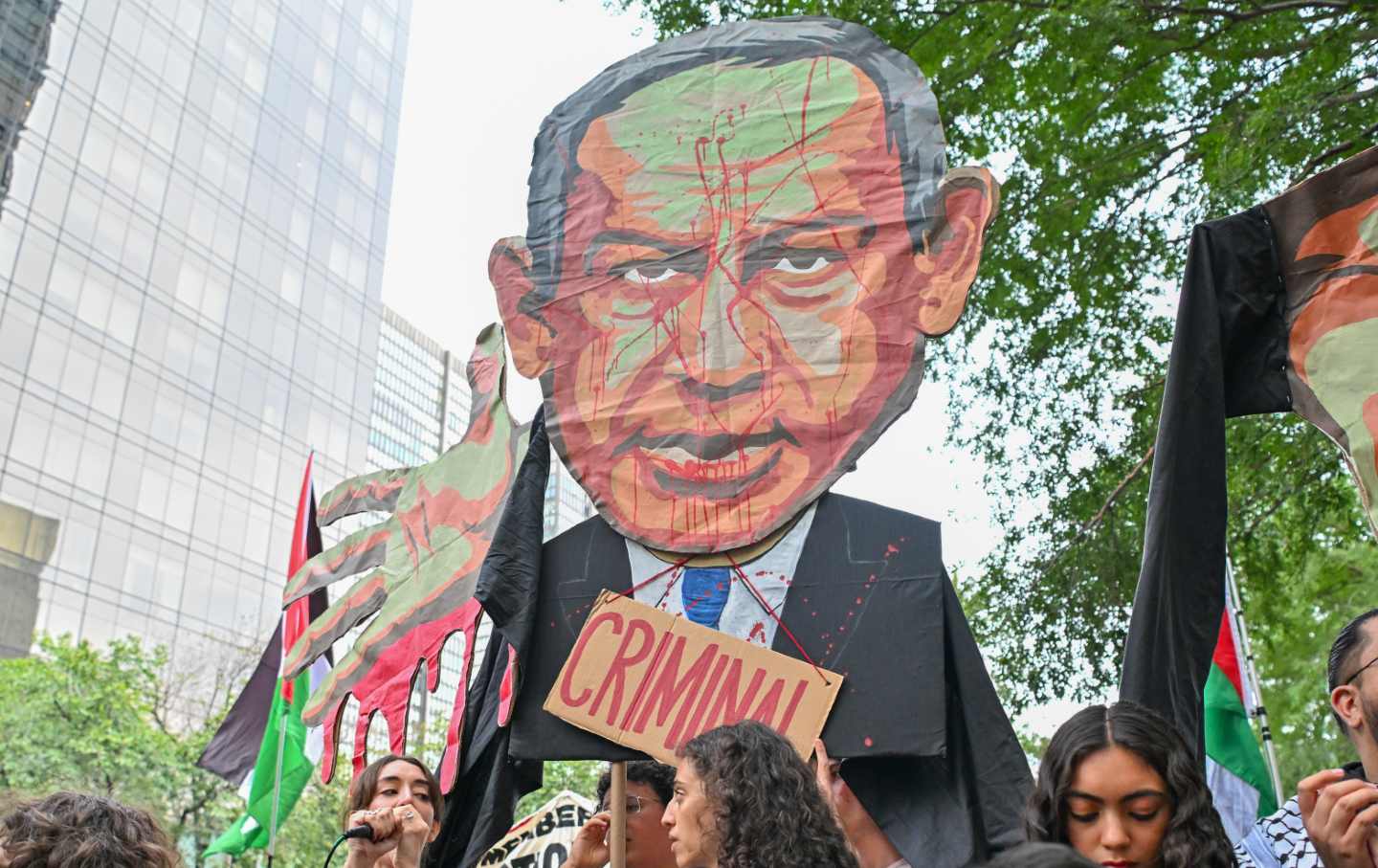
Netanyahu Came to New York. New Yorkers Were Ready for Him. Netanyahu Came to New York. New Yorkers Were Ready for Him.
Scenes from the defiant protest against the genocidal leader’s UN speech.
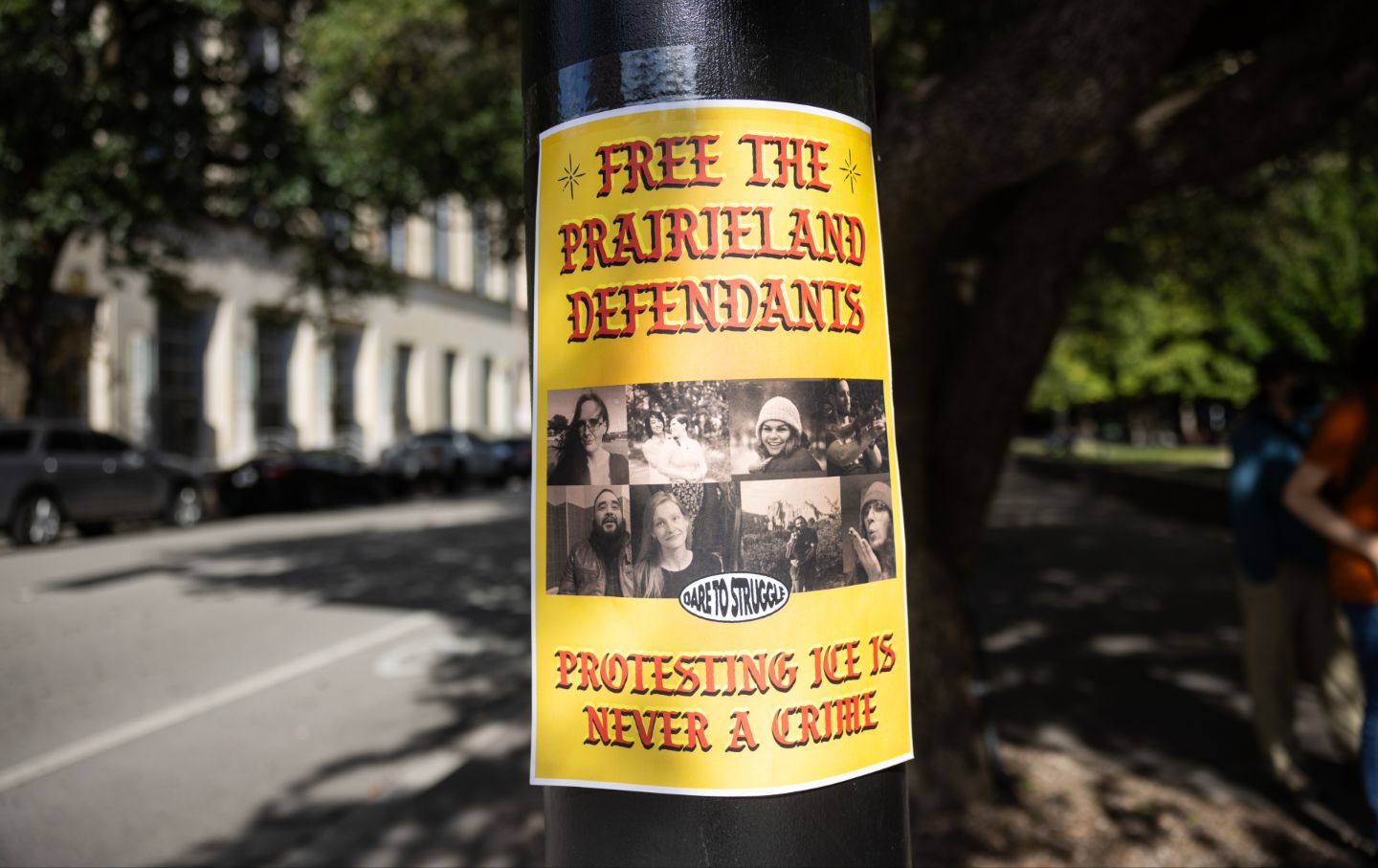
A Message From Prairieland Prisoner Autumn Hill: “Don’t Be Afraid” A Message From Prairieland Prisoner Autumn Hill: “Don’t Be Afraid”
I talked to the political prisoner about the politics of love, her case, surviving as a trans woman in a men’s prison, and how she makes it through the day.
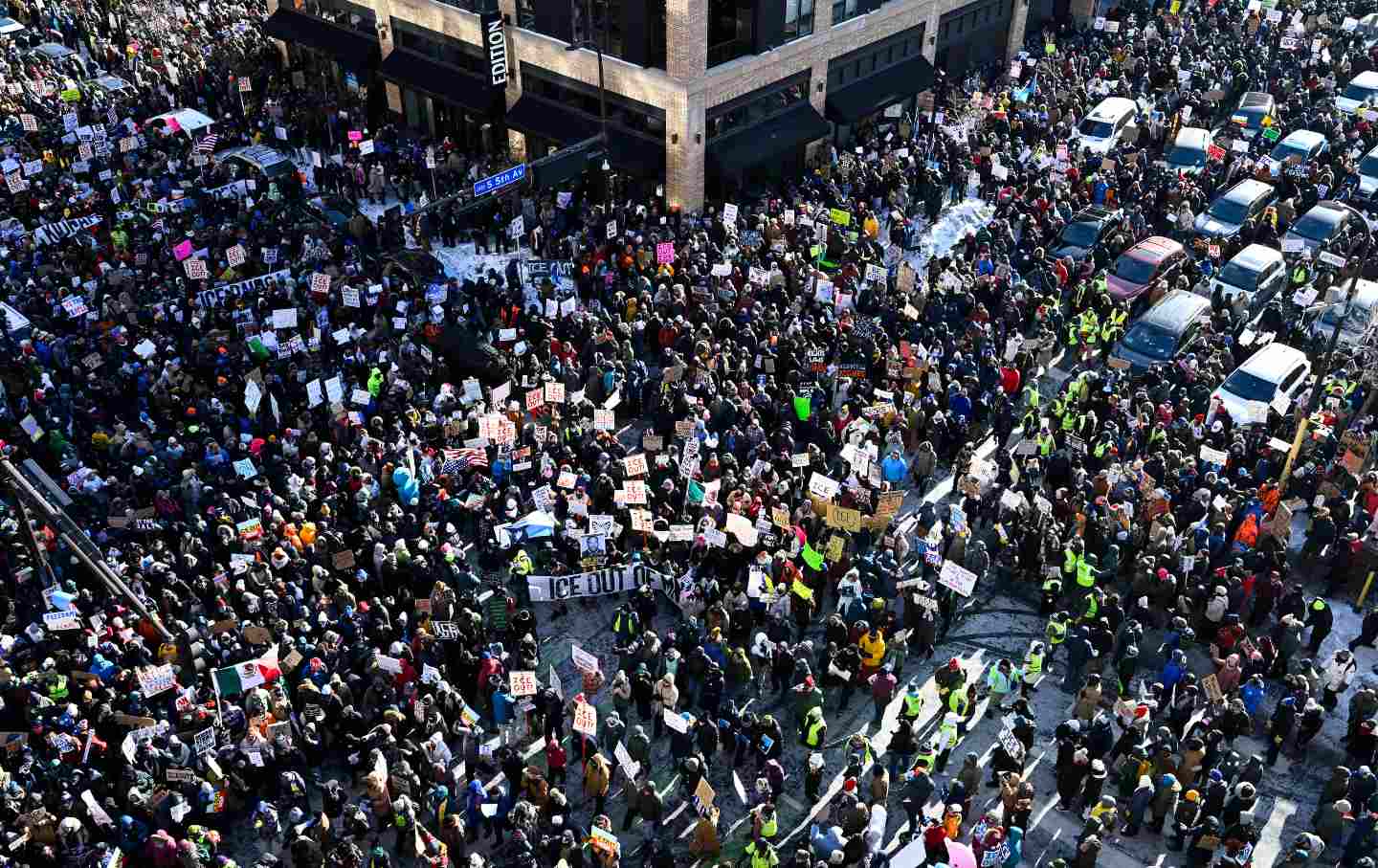
The Impossible Will Take a Little While: The Power of Persistence The Impossible Will Take a Little While: The Power of Persistence
In troubled times, history offers a lesson: Seemingly impossible change can begin with ordinary people who refuse to give up.
Gloria Steinem’s Many-Splendored Feminist Life Gloria Steinem’s Many-Splendored Feminist Life
The feminist icon lived the struggle for gender equality and always found time to lend support and solidarity to other women leaders, even in her final days.

No, Woke 1 Was Not Crazy No, Woke 1 Was Not Crazy
AOC and others are laughing off 2020 as a wild, isolated moment. None of that is true.
How Occupy Wall Street Still Explains Politics Today How Occupy Wall Street Still Explains Politics Today
It sowed the seeds for a new era of social movements—but its politics of powerlessness should act as a cautionary tale.

