
Everything You’ve Heard About the Keffiyeh Is Wrong
The iconic Palestinian scarf has been demonized as a symbol of Nazi-like hatred. This bigoted nonsense couldn’t be further from the truth.
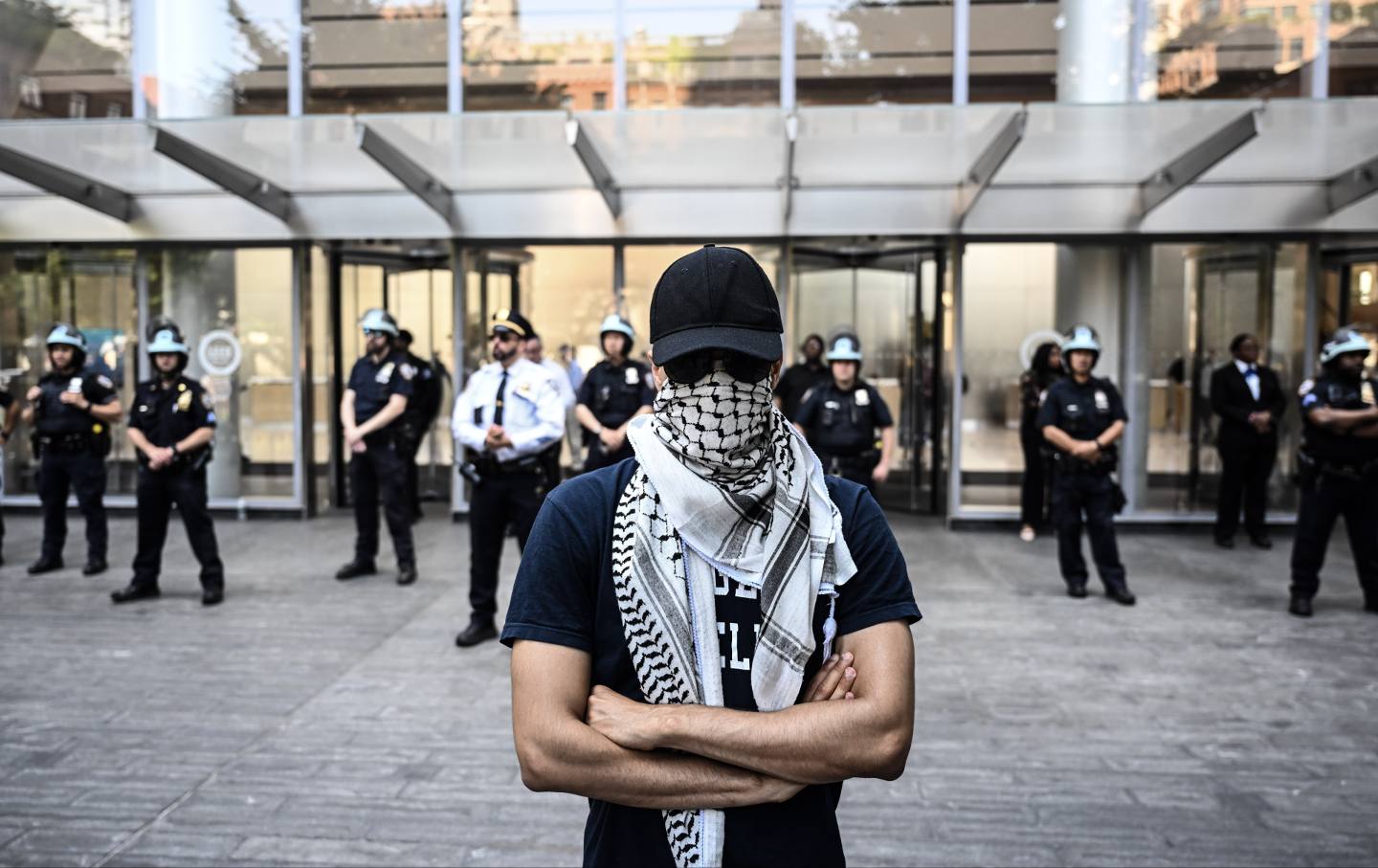
A pro-Palestinian protester wearing a keffiyeh in New York on June 13. 2024.
(Fatih Aktas / Anadolu via Getty Images)On June 27, the “Unmask Hate” coalition, made up of a group of lawmakers who are trying to criminalize masks at New York City protests, stood outside Columbia University to explain why they thought covered faces were such a threat to public safety. One of their key targets? The iconic Palestinian scarf known as the keffiyeh.
Assembly Member Jeffrey Dinowitz claimed that “there is no difference” between a protester wearing a keffiyeh around their head, and a Ku Klux Klan member with a hood. He urged lawmakers to return to a special session to pass his legislation reinstating the protest mask ban.
Dinowitz subsequently walked his statement back, though he simultaneously doubled down on the smearing of pro-Palestinian protesters. “To be clear—the issue here is intent and masked intimidation. I should have been clearer and spoken more artfully,” he said. “No offense was intended. I absolutely do not equate the two in and of themselves. Full stop.”
Dinowitz is not alone. An increasingly long line of prominent people have demonized the keffiyeh in recent months by comparing the scarf to hate symbols donned by white nationalist groups.
Back in March, Anti-Defamation League CEO Jonathan Greenblatt, who appeared alongside Dinowitz at the June press conference, compared the keffiyeh to a swastika on MSNBC’s Morning Joe.
In December, Eve Gerber, wife of Jason Furman—a professor at Harvard’s Kennedy School of Government and a former senior economic aide to Barack Obama—harassed a Harvard graduate student while she was walking on campus with a keffiyeh. “Thank you for walking through neighborhoods with your terrorist scarf,” Gerber yelled.
And in June, CNN senior political commentator Van Jones added to the vitriol by comparing keffiyehs to Confederate flags. “If you show up there wearing a keffiyeh…you show up chanting from the river to the sea, that would be just like a white person running up with a Confederate flag in Harlem,” he said.
Clearly, these comments are deluded and bizarre. But what they highlight above all is the depth of anti-Palestinian racism that exists in this society. Attacks against Palestinians and their allies have become so normalized at this point that it’s now open season on banning the simplest acts of solidarity. The vilification of this cultural garment has led to violent attacks all over the country. From college students getting shot while walking around their neighborhood to park-goers getting hot coffee thrown at them to people getting pushed towards subway platforms, it’s clear that the patterned scarf has made people targets of hate crimes, not the perpetrators of them.
There is, in fact, a difference between a scarf that has been worn by oppressed populations for decades to protect against state violence, and a mask that white nationalists wore to hide their identities while carrying out lynchings. These divisive statements are not only rooted in Islamophobia and anti-Palestinian racism. They are also a betrayal of the real victims of Klan, Nazi, and Confederate hatred, who do not deserve to have their suffering weaponized for such cynical political ends. And they do an injustice to Jewish people fighting antisemitism in America, as the institutions that are supposed to protect them are completely losing all credibility.
This campaign of hatred also shows the need to highlight the rich, proud history of the keffiyeh—to educate people about where it comes from and what it truly represents.
The keffiyeh—كوفية in Arabic—translates to “related to Kufa,” the city in Iraq where it is believed people first started wearing it. It is a black or red and white scarf that was originally plain white, and worn as a practical headdress by farmers and bedouins for centuries in the Levant. It was rooted in the working class: In the early 20th century, its original purpose was to protect farmers against sunburns and the dust and sand of the desert atmosphere.
There is no clear definition amongst historians about what the design of the keffiyeh means, but some Palestinians say each pattern has come to represent a different part of Palestinian life. The bold black lines on the edge of the scarf are said to symbolize historic trade routes; the fishnet pattern reflects Palestinian ties to the Mediterranean Sea; and the curved lines represent olive trees, one of the agricultural staples of historic Palestine.
The rise of the keffiyeh as a symbol of solidarity, however, mirrors issues of state surveillance that we still see today. During British colonial rule in Palestine in the 1930s, rural freedom fighters—known as fedayeen—began resisting occupation and were easily identifiable by their head scarves. As a result, Palestinian men in urban areas, who had previously donned the Ottoman-style fez, answered calls to stand in solidarity with the fedayeen and remove class identifiers by wearing the keffiyeh.
In 1936, during the Arab Revolt, Palestinian nationalists also began to use the keffiyeh to conceal their identity and avoid arrest by British colonial forces. Much like today’s lawmakers in the United States, the British unsuccessfully attempted to ban the headscarf, because they could no longer identify who was an urban Palestinian and who was a revolutionary. (Their solution to this challenge was to indiscriminately kill everyone.) As Jane Tynan, an assistant professor in design history and theory at Vrije Universiteit Amsterdam, told Middle East Eye: “From its function in the revolt as a tool to disguise the identity of the wearer from British authorities, the keffiyeh became shorthand for the Palestinian struggle”.
Popular
“swipe left below to view more authors”Swipe →The keffiyeh spread around the world as Palestinian liberation became a central cause of the global left. In 1990, just one month after he was released from prison, Nelson Mandela donned the keffiyeh at a summit in Algiers in a now-famous picture. Three years after apartheid officially ended in South Africa, he declared, “We know too well that our freedom is incomplete without the freedom of the Palestinians.” When South African leaders brought their genocide case against Israel to the International Court of Justice in January, many of their delegates wore their keffiyehs to court while giving public statements.
Protesters in the United States who wear the keffiyeh at protests are not doing it because they are hoping to engage in hate crimes without being identified. Rather, they know that if they do not protect themselves, in the same way Palestinian revolutionaries did during the British mandate, they will expose themselves to the dangers of state surveillance and doxxing.
But the scarf has practical purposes too. In 2018, Palestinians in Gaza used keffiyehs to muffle the fumes from Israeli tear-gas canisters; their innovation taught protesters in the United States that the keffiyeh can be used to combat methods of police brutality such as tear gas and water cannons.
It is also an important part of disability justice within the movement. In 2021, Palestinian artist Mohammed Musallam created a medical-grade keffiyeh face mask during the height of both the pandemic and the Israeli bombardment of Gaza to highlight the Israeli-manufactured healthcare crisis in the besieged strip. The keffiyeh is still seen on top of masks at protests today in order to protect the community against spreadable diseases.
Much like the art of tatreez—Palestinian cross-stitched clothing that often represents specific tribes and villages—the keffiyeh speaks to Palestinian Indigenous identity, solidarity, and resistance against colonial forces. That is one of the reasons it has been so hated for so long.
It’s not enough for our identities to be erased and vilified—our cultural items are also stolen, appropriated, or desecrated in the public view.
In May, Israeli worshippers cheered as a doll wearing a keffiyeh hung from the ceiling of a synagogue in Jaffa during a Purim service. In the video, the noose was wrapped around the neck of the doll as the keffiyeh sways back and forth in a clear mockery of the mass killings of Palestinians. The scene is reminiscent of “mock-lynchings” of Black people which have happened in the United States for decades.
So when people go on the air and compare the keffiyeh to the hoods of Klan members, we should not take anything they say seriously; it no longer is worthy of a response. Leaders in the United States have actively funded and cheered on a genocide for the past nine months—why should we look to them to guide our moral compass?
Their indignation is not rooted in any real concern for marginalized groups, but rather in frustration over their being unable to quash solidarity with the Palestinian cause. The keffiyeh is a simple act of resistance against the colonial system that seeks to erase us.
Earlier this month, Hazem Suleiman, a journalist in Gaza who had to get his leg amputated, posted a video on Instagram reminding the world of the importance of the keffiyeh in the struggle for liberation, especially in this moment. “Our keffiyeh is our pride. Our keffiyeh is our heritage. From among the rubble and the destroyed tower blocks, we convey to you this message.”
“This,” he said pointing to his keffiyeh, “is Gaza.”
If they attempt to ban it, like they tried with our flag and our fruits, we will find a new way to rise up and represent our collective struggle. That checkered pattern draped over someone’s shoulders on every train, every classroom, and every protest is a reminder that we are still here, in all places at all times.
Become a Sustaining Donor This September
Between the reemergence of right-wing red-baiting and Donald Trump’s use of the chilling National Security Presidential Memorandum–7 to criminalize left political organizing, we’re seeing McCarthyism reborn before our eyes.
This assault on democracy cannot be ignored or wished away. Resisting it requires bravery in the face of threats and repression, a steadfast commitment to the truth, and the unwavering belief that we can—and will—overcome this darkness.
We must have an independent media that sets the record straight, unearths corruption and abuses of power, and advances a politics of justice and dignity for all if we’re to win this fight.
That’s why I’m writing to you today. This September, The Nation needs to add 100 monthly donors to sustain our progressive journalism. Your contribution makes the next investigative report, the next truth-speaking column, and the next pathbreaking essay all possible.
I hope you’ll support our work with a recurring donation today. If you donate $10 or more a month, we’ll send you a brand new “Hands Off the Free Press!” sticker to recognise your commitment to our cause. Please, donate today.
Onward,
Katrina vanden Heuvel
Editor and Publisher, The Nation
More from The Nation
The Impossible Will Take a Little While: The Power of Persistence The Impossible Will Take a Little While: The Power of Persistence
In troubled times, history offers a lesson: Seemingly impossible change can begin with ordinary people who refuse to give up.
Gloria Steinem’s Many-Splendored Feminist Life Gloria Steinem’s Many-Splendored Feminist Life
The feminist icon lived the struggle for gender equality and always found time to lend support and solidarity to other women leaders, even in her final days.
No, Woke 1 Was Not Crazy No, Woke 1 Was Not Crazy
AOC and others are laughing off 2020 as a wild, isolated moment. None of that is true.
How Occupy Wall Street Still Explains Politics Today How Occupy Wall Street Still Explains Politics Today
It sowed the seeds for a new era of social movements—but its politics of powerlessness should act as a cautionary tale.
Abdul El-Sayed’s Win Is a Landmark. But the Fight Is Far From Over. Abdul El-Sayed’s Win Is a Landmark. But the Fight Is Far From Over.
Even though the Palestine movement is on the march, we can’t afford any complacency.
Mamdani’s Team Redefined Political Video. Now They’re Betting on Short Films. Mamdani’s Team Redefined Political Video. Now They’re Betting on Short Films.
Premiering exclusively in The Nation, a new short film produced by City Hall and narrated by Morgan Spector highlights the efforts of the biggest tenant-led union in New York City...

