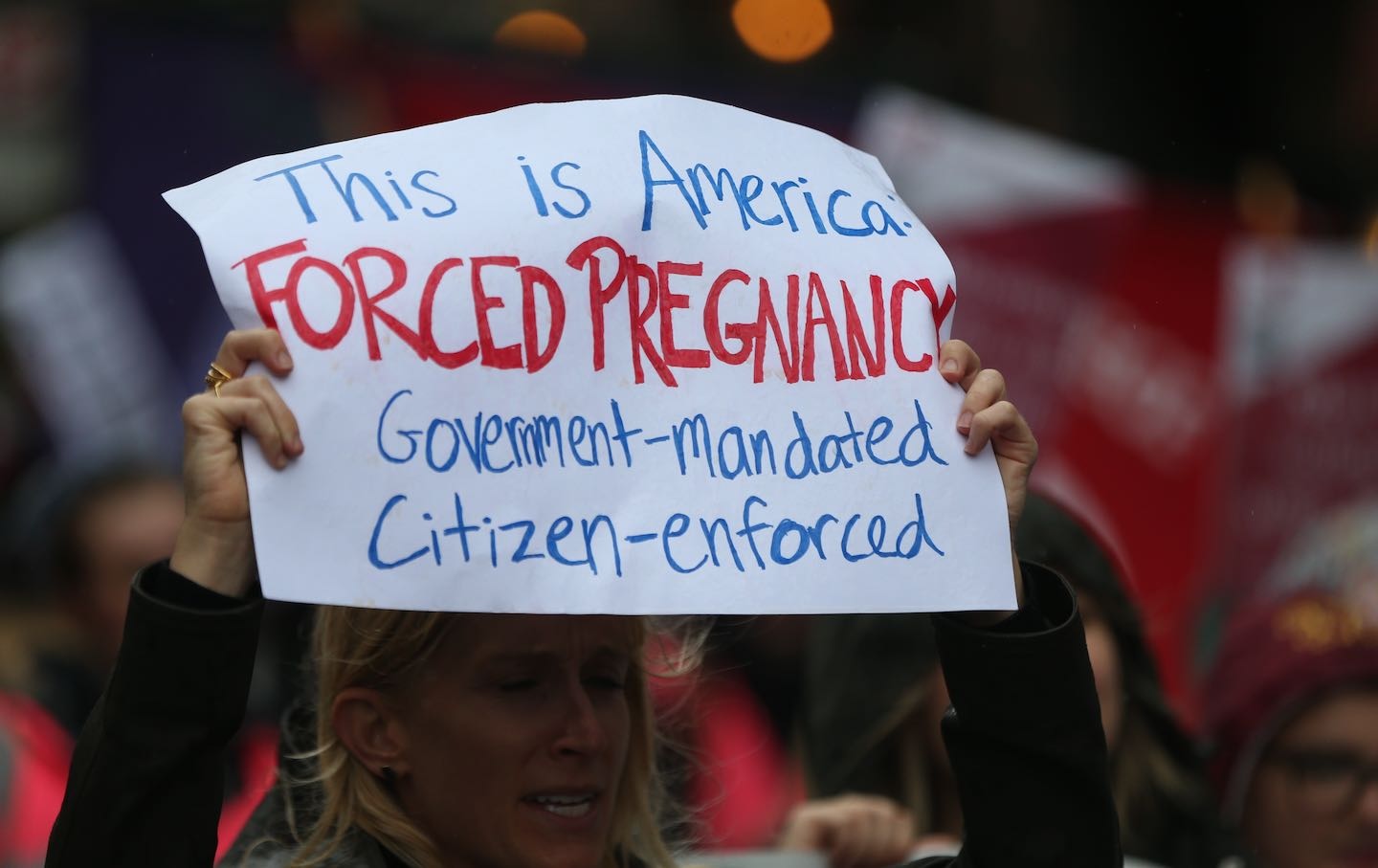
A protester at Trafalgar Square following the abortion ban in Texas, on October 2, 2021, in London, United Kingdom.
(Photo by Hasan Esen / Anadolu Agency via Getty Images)
Before thousands of anti-abortion protesters at the Texas Capitol in 2023, Republican Governor Greg Abbott brazenly touted his party’s passage of draconian abortion laws as “life-saving.” “We promised we would protect the life of every child with a heartbeat, and we did. I signed a law doing exactly that,” Abbott told the crowd at the annual Texas Rally For Life event. “All of you are life savers, and thousands of newborn babies are the result of your heroic efforts.”
Abbott’s words now ring particularly hollow in light of a new study in the Journal of the American Medical Association Pediatrics that reveals a stark increase in infant deaths in Texas following SB 8, which barred care at the first sign of embryonic cardiac activity, typically around six weeks of pregnancy, and carried a private enforcement provision that deterred the vast majority of care in the state. The 2021 law stood as the most restrictive abortion ban at the time.
Researchers with Johns Hopkins Bloomberg School of Public Health found that infant deaths rose by nearly 13 percent in 2022. Comparatively, these deaths, defined in the study as occurring under 12 months old, increased less than 2 percent in the rest of the United States.
“We found that infant mortality increased pretty substantially in Texas, but not in the rest of the country,” Alison Gemmill, assistant professor in the Bloomberg School’s Department of Population, Family and Reproductive Health and one of the study’s lead authors, tells The Nation. “It speaks to how these restrictive laws can have horrific and devastating effects on infant health, pregnant people, and on families overall—unintended or not.”
While many reproductive health studies (including ones that show a link among infant mortality and abortion bans) can only prove a correlation between factors, this one notably claims a direct causation, providing important evidence of the law’s dire impacts. “This study shows that the state policy is responsible for these deaths—there is a very, very strong causal link here,” says Gemmill.
The research is said to be one of the first large-scale studies to highlight the spillover effects of anti-abortion laws in the United States on maternal and infant health. By analyzing monthly death certificate data, researchers were able to isolate and examine outcomes of what would happen with and without the law.
Congenital anomalies—birth defects that can include fatal conditions of the heart, spine, and brain—lead the cause of death among infants, researchers found. These deaths spiked nearly 23 percent in Texas between 2021 and 2022, compared to a decrease of 3.1 percent in the rest of the United States during the same period. Glaringly, the Texas abortion law holds no exception for fatal fetal anomaly, which are typically diagnosed later than six weeks.
Those unable to access abortion care were forced to “experience the physical risks of continuing the pregnancy and the emotional and psychological hardships of losing a pregnancy in this way,” Dr. Gracia Sierra, a Texas-based data scientist who focuses infant mortality and reproductive health at Resound Research for Reproductive Health (unaffiliated with the study) tells The Nation. “The process can be difficult and painful, and it ultimately takes away their freedom to make their own decisions about their reproductive life.”
In response to the study, Abbott’s office doubled down on its ostensible “pro-life” agenda, despite the findings. It applauded a different study from Johns Hopkins researchers that found SB 8 may have resulted in nearly 10,000 additional births.“Texas is a pro-life state, and Governor Abbott will always fight for the most vulnerable among us,” Andrew Mahaleris, spokesperson for Abbott, told The Nation. “Texas passed a critical law to save the innocent unborn, and now thousands of children have been given a chance at life.”
While Abbott and anti-abortion advocates continue to laud the measure as life-saving, in reality this means perpetuating forced births—no matter the outcome of that birth.
“It’s never been clearer that the term ‘pro-life’ is a farce,” says Nicolas Kabat, staff attorney at the Center for Reproductive Rights. “Politicians are forcing women to carry doomed pregnancies and give birth to babies who will live only a few painful minutes or hours. This suffering is man-made—it’s being inflicted by Texas lawmakers.”
Women who recently fought the State of Texas in court after being denied abortion care despite severe pregnancy complications are all too familiar with the state’s forced birth policy. Zurawski v. Texas, a legal challenge filed by 22 women, sought to provide much-needed clarity to the abortion laws’ vague medical exceptions.
Samantha Casiano, one of nearly a dozen women in the lawsuit who faced a nonviable pregnancy, was forced to watch her baby slowly die. Diagnosed with the lethal condition anencephaly, her child would be born missing parts of its brain and skull. The mother of four lacked the resources to travel for abortion care, and had no choice but to carry her fatal pregnancy to term. In court, Casiano tearfully recounted how she watched her baby gasp for air for four hours before ultimately dying. “I told her, I am so sorry I couldn’t release you to heaven sooner. There was no mercy for her,” she said. The trauma will haunt her and her family forever, explained Casiano.
Last month, the all-Republican Texas Supreme Court failed to provide clarity on the laws or grant any relief for those who might suffer the same fate as Casiano, issuing a ruling confirming that pregnant people cannot have abortions for fetal diagnoses of any kind, even lethal ones. The Center for Reproductive Rights’ Kabat, who represented the plaintiffs in Zurawski, says the lawsuit is a stark reminder that the state is uninterested in taking responsibility for deaths like the one Casiano and others were forced to endure.
Gemmill says this is the first of many studies to come. Researchers are now working to assess the impact of abortion restrictions on the live births of different races, ethnicities, and socioeconomic backgrounds. They’re also examining infant mortality in Texas from 2022 forward and taking a look at those rates across the country.
They predict that what they’ve found in Texas foreshadows what is happening in more than a dozen states that have also barred abortion care, since Texas enacted its law—10 months before Roe was overturned. At least 13 states similarly carry no exception for fatal fetal anomalies, which impact roughly 120,000 pregnancies a year.
“This will likely be a harbinger of what’s to come for other banned states, since Texas is nearly a year ahead of everyone else,” says Gemmill.
“Unless we get a flood of resources for patients to seek care across state lines, I really don’t see this increase in infant deaths changing. I don’t have any reason to think this wouldn’t persist into the future.”
Become a Sustaining Donor This September
Between the reemergence of right-wing red-baiting and Donald Trump’s use of the chilling National Security Presidential Memorandum–7 to criminalize left political organizing, we’re seeing McCarthyism reborn before our eyes.
This assault on democracy cannot be ignored or wished away. Resisting it requires bravery in the face of threats and repression, a steadfast commitment to the truth, and the unwavering belief that we can—and will—overcome this darkness.
We must have an independent media that sets the record straight, unearths corruption and abuses of power, and advances a politics of justice and dignity for all if we’re to win this fight.
That’s why I’m writing to you today. This September, The Nation needs to add 100 monthly donors to sustain our progressive journalism. Your contribution makes the next investigative report, the next truth-speaking column, and the next pathbreaking essay all possible.
I hope you’ll support our work with a recurring donation today. If you donate $10 or more a month, we’ll send you a brand new “Hands Off the Free Press!” sticker to recognise your commitment to our cause. Please, donate today.
Onward,
Katrina vanden Heuvel
Editor and Publisher, The Nation