
President Biden Has His New Asylum Ban. Does He Have the Stomach for What Comes Next?
Many people say they want tougher border enforcement. They don’t always like what that looks like.
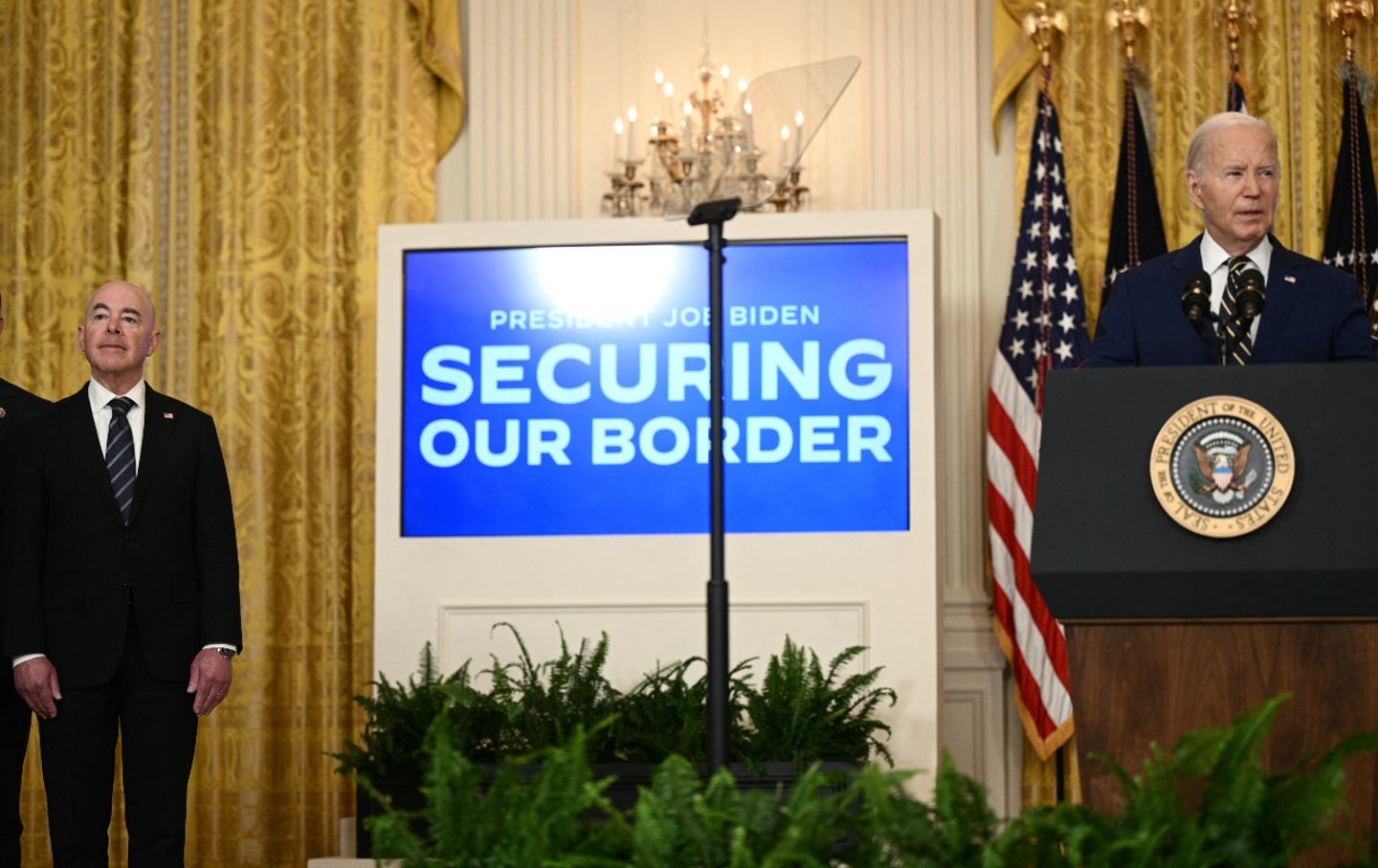
Joe Biden sounded tired as he announced his new asylum ban at the White House on Tuesday. “I’ve come here to take the necessary steps to secure our border,” he said from a podium flanked by border city mayors, explaining that he had signed a new executive order that will block anyone who crosses the border between official ports of entry from gaining asylum. About halfway through his short speech, Biden went on the defensive. “I will never demonize immigrants; I will never refer to immigrants as ‘poisoning the blood’ of a country,” he said. Biden could perhaps anticipate the criticism his ban was about to get because he had once dished it out himself: In 2019, when the courts blocked a similar asylum ban from the Trump administration, Biden had tweeted:
Trump is fighting tooth & nail to deny those fleeing dangerous situations their right to seek asylum in our nation. We should uphold our moral responsibility & enforce our immigration laws with dignity—not turn away those fleeing violence, war, & poverty.
Biden’s critics on the left were quick to call him a hypocrite. “This is disgraceful,” Laura St. John, the legal director at the Arizona-based Florence Immigrant & Refugee Rights Project, said in a statement after the ban was announced. “President Biden promised on the campaign trail to restore humanity to our immigration system, and instead he is choosing to slam shut the door to safety to those who need protection most.” Biden did make promises on the campaign trail; but it’s worth considering that it’s his own voters, not Biden, who have changed.
It’s hard to overstate how strange a moment the 2020 presidential race was when it came to the border. Since the 1960s, Gallup polls have found a broad hostility towards immigrants among the American public: year after year, decade after decade, the number of Americans who believe that immigration should decrease has far outpaced the number of Americans who believe it should increase. Something changed in 2020. After four years of family separation, after ICE raids, after the deaths of children in immigration detention, and after Remain in Mexico, Americans attitudes toward immigrants shifted. For the first time in history, polls found that there were more American who said they wanted immigration to increase than there were those who wanted it to decrease. Sympathy towards immigrants became a potent political force.
That moment was short-lived. Since the winter of 2020, the number of people Border Patrol agents encounter on the southern frontier has climbed, breaking all-time records, with almost 2.5 million encounters in 2023. And as rates of migration have increased, support for migrants has cratered. By 2022, an NPR poll found that a majority of Americans believed there was an “invasion” on the southern border. This year, an Axios poll found that 51 percent of all Americans surveyed—and 42 percent of Democrats—said they’d support the mass deportation of undocumented immigrants. Biden may be breaking promises, but he’s also following the will of the voters.
However, the president took pains to say he won’t go as far as Trump. “I will never separate children from their families,” Biden said in his speech on Tuesday. “I will not send the US military to go into neighborhoods all across the country to pull millions of people away from their homes and away from their families to put [them] in deportation camps to await deportation as my predecessor says he will do if he occupies his office again.”
The president—and Democrat voters who support him—seems to believe that there’s a sort of middle path for immigration enforcement: He can create a meaningful deterrent for immigrants without demonizing them; he can enforce an asylum ban without detaining refugees en masse, and without militarizing immigration enforcement. Biden is wrong. The new asylum ban puts us on a clear path to mass deportation camps. Trump is correct that internment camps are the only way to meaningfully enforce the kind of asylum ban Biden has unveiled.
Think seriously for a moment about what an asylum ban does. It doesn’t put in place some force field that suddenly prevents people from crossing the 2,000 mile US-Mexico border. Biden has said anyone crossing between ports of entry will be quickly deported; no matter how quickly those deportations happen, they will first require armed agents to arrest, detain, and transport the people caught crossing the border. The Border Patrol simply does not have the manpower or detention space to actually carry out this ban. So how will it play out in the weeks to come? We can look to recent history for the answer. Less than two years ago, the Biden administration was trying—and failing—to enforce an even more complete asylum ban.
When Biden took office, he decided to keep Title 42 in place—the most severe asylum restriction to come out of the Trump administration. In March 2020, during the early days of the Covid-19 pandemic, Trump senior adviser Stephen Miller pioneered a way to use an obscure federal public health statute as an effective asylum ban. With Title 42 in place, anyone seeking asylum—whether they crossed between ports, or presented themselves legally at an official port of entry—was subject to immediate expulsion. Title 42 was in place for the first two years of the Biden administration, but it still failed to stop border crossings from reaching record highs.
If you listened to Biden’s Republican critics, you’d think that’s because the president “opened the borders.” That’s not true. Under Title 42, Biden presided over 2.8 million expulsions—far greater than the number of people Trump deported during his four years in office. But even with such strict enforcement, the number of people entering the country skyrocketed. On some days, Custom and Border Protection officers encountered over 10,000 migrants trying to cross the border.
CBP—which includes the Border Patrol—is by far the largest federal law enforcement agency, with over 60,000 employees. But that’s not even close to the number of people the agency would require to actually detain and jail every migrant crossing the border on an average day in 2023. Instead, Border Patrol agents resorted to a strategy that they’ve used for decades, including under Trump: parole. Instead of taking migrants to holding cells and handing them over to ICE, Border Patrol agents take migrants’ IDs and biometric data; the migrants are then given a court date (and often an ankle monitor) and released under their own recognizance, with firm instructions to check-in at an ICE office by a certain day.
Biden’s new executive order will push Border Patrol and ICE to detain more people, but there’s still only so much those agencies will be able to do. While Mexico will accept some immediate expulsions, deportations on the scale envisioned by the executive order are a massive logistical undertaking. Flights have to be chartered around the world, and there are dozens of countries that won’t cooperate: Venezuela and China don’t accept deportees; Cuba has historically accepted only one flight per month. Brazil and Nicaragua require extensive notice before they’ll accept a single deportee. What do you do then, with tens of thousands of migrants, many of whom cannot be deported for months, or even years? Trump has been clear about what his solution will be if he takes office: military-run internment camps.
There’s an underappreciated psychological element to immigration policy: Many Americans say they want draconian border enforcement, but then don’t have the stomach for what it actually looks like. During his campaign for president in 2016, Trump promised to stop giving migrant families a special pass. Often, Border Patrol agents would quickly parole parents traveling with children, to avoid putting kids in jail. Trump called this practice “catch-and-release” and promised to replace it with a “zero tolerance” approach instead—all adults would be detained until they could be prosecuted and deported. When the Trump administration officials began putting this policy into practice, they quickly ran into a problem: Federal law makes it illegal to detain children for more than 21 days. Therefore, to jail parents, the administration would have to separate them from their children. By 2018, Americans had heard audio recordings of children screaming in horror after being ripped from their parents’ arms. It turned family separation into one of the most unpopular government policies in recent history, and likely helped turn American attitudes in favor of immigrants.
We can hope that, even if Americans seem to be warming to the idea of mass deportations, they still aren’t ready for the sight of families getting rounded up and placed behind the barbed wire of internment camps. Of course, it wouldn’t be the first time this country put families and children in prison camps. This new asylum ban brings us much closer to that harrowing reality.
More from The Nation

The Jewish Case Against AI The Jewish Case Against AI
Haredi rabbis and the secular left agree: This technology is a threat to the entire social fabric.
The Fight for Educational Equality Is Also a Fight for a Just Supreme Court The Fight for Educational Equality Is Also a Fight for a Just Supreme Court
The court has severely weakened our ability to make an education system that fulfills the promise of Brown.

The Fall of “Scientific American” The Fall of “Scientific American”
When the beloved science publication got too political, its corporate owners stepped in. Now its future is uncertain.

The Bookstore Revolution in Taiwan’s Conservative Heartlands The Bookstore Revolution in Taiwan’s Conservative Heartlands
After Taiwan legalized same-sex marriage, gender-themed bookstores are working to build the social acceptance that the law alone couldn’t deliver.

Jalen Hurts Deserved Better. We All Do. Jalen Hurts Deserved Better. We All Do.
In a country that treats workers as expendable parts, Hurts’s playing through a blood clot is just the highest-profile example of the price workers pay in an oligarchy.
The Terrifying Future of States’ Criminalizing Pregnant People Is Already Here The Terrifying Future of States’ Criminalizing Pregnant People Is Already Here
The idea of charging people who have abortions with murder is gaining traction on the right. But a report finds that people are already being prosecuted for their pregnancy outcom...

