
How Trump Keeps Getting Away With Blasphemy
Liberals struggle to understand why the president’s evangelical supporters never seem to mind his sacrilegious tendencies. They’re missing the point.
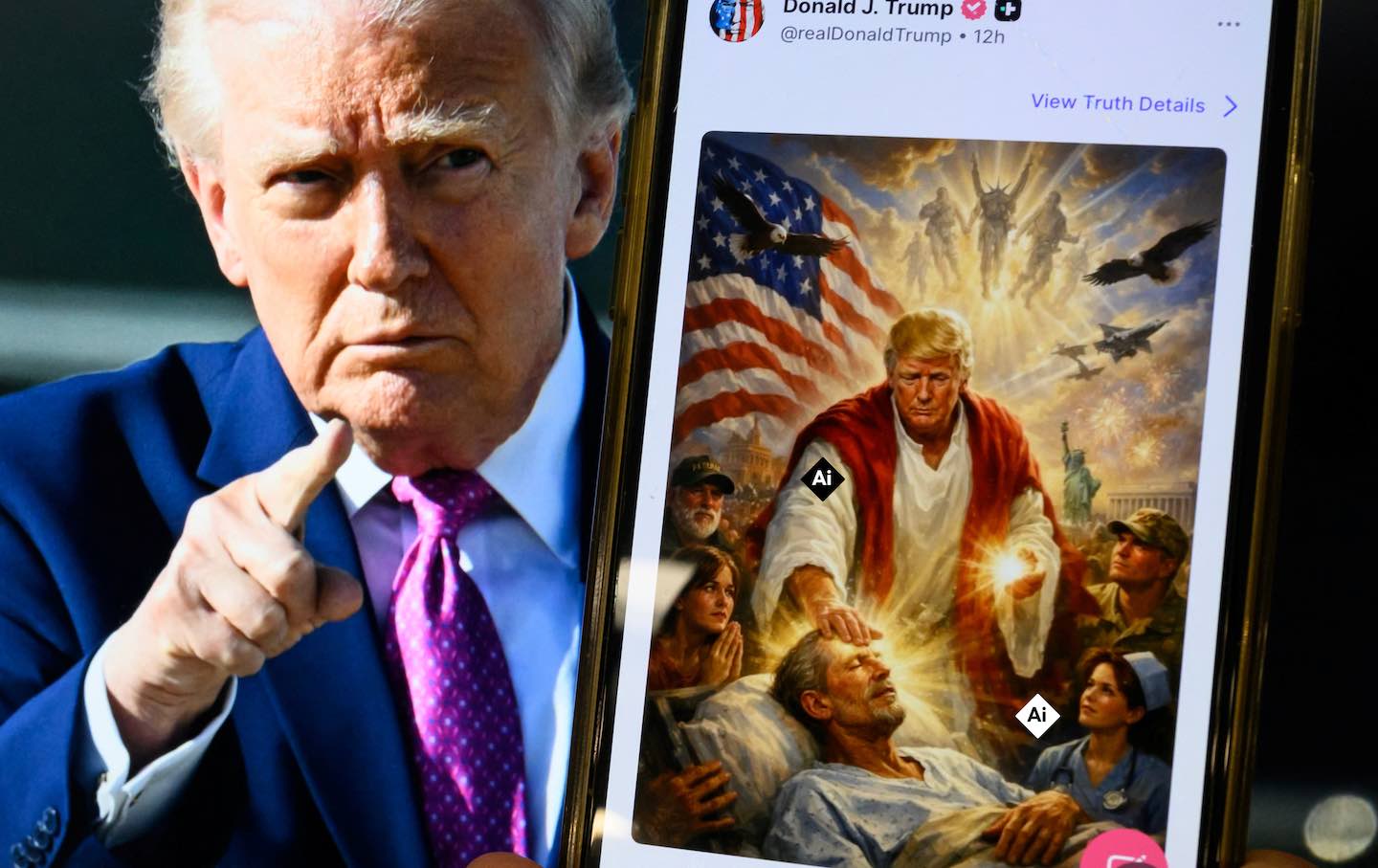
President Donald Trump with an AI-generated picture he posted on his Truth Social platform, depicting himself as Jesus Christ, after criticizing Pope Leo XIV.
(Mandel Ngan / AFP)Taking a break from convulsing the news cycle with nonsensical ultimatums about the Iran war, President Donald Trump elected to stir things up at the start of the week by posting an image of himself as Jesus on his Truth Social account. That now-infamous depiction came in the wake of a long screed Trump posted the day before assailing Pope Leo XIV for his dissension from the illegal attack on Iran (as well as for being “soft on crime,” in an apparent call to revive the Spanish Inquisition). The general run of dazed commentary about Trump’s self-deifying display grouped it together with other Trump-branded power plays; as the Son of God, Trump could clearly claim to outrank the lowly pontiff. After evangelical and Catholic detractors properly called out the post as blasphemy, Trump finally took it down, and the backlash from diehard Trump devotees on the religious right seemed poised to dissipate, in keeping with thousands of other episodes of Trump-centric transgression.
Trolling the pope was no doubt part of what might be charitably termed the president’s strategic thinking, but there’s a broader, though equally demented, logic at work here. The best way to plot out this logic, curiously enough, is to contrast Trump’s Jesus post with another Trump image that came into prominence this week: an Oval Office shot from Getty Images photographer Andrew Harnick, which won the White House Correspondents Association Award for Excellence in Presidential New Coverage by Visual Journalists. It shows the president standing at the Resolute Desk as a group of White House functionaries have rushed in the background to attend to a pharmaceutical executive who fainted during the president’s photo-op touting a White House initiative to lower prescription drug prices.
It’s a revealing foil for the Trump-as-Jesus image, being such a vivid reminder of who the actual Donald Trump is. As everyone else in the room is animated by concern for the fallen man’s well-being—they’re elevating his legs to ensure that blood is flowing to his brain—Trump is assuming the bored-to–petulant affect he normally shows when he’s not the center of attention. He’s standing with his arms dangling at his side with his prepared remarks open on the desk in front of him. He’s registering awareness of the health crisis behind him with an exasperated sidelong glance, showing his seeming impatience to resume the carney-patter presentation of a drug plan that’s achieved vanishingly little in the way of actual consumer savings.
The photo sums up what we’ve long known about Trump: He brandishes the clinical narcissist’s hatred of weakness, disease, and dependence, which all serve as rude reminders of the mortality of the self. This trait goes far back in Trump’s biography, starting with his repudiation of his alcoholic brother, Fred, and his bid to secure the disinheritance of Fred’s disabled grandson with the reported comment that the boy’s father, Fred Trump III, should “just let him die.” On the stump during his first presidential campaign, Trump cruelly mimicked the movements of the disabled New York Times reporter Serge Kovaleski, and then denied having done so—much as he ludicrously sought to dismiss his blasphemous Truth Social post as merely a depiction of him as a doctor, with no religious meaning whatsoever. (Baldfaced lying and gaslighting are of course two other central components of the narcissist’s psychic tool kit.)
But Trump’s half-assed evasions aren’t enough to shore up his central role in MAGA mythology as a righteous force of deliverance, vengeance, and redemption. That’s where MAGA’s evangelical wing—far and away the most ardent partner in the Trump coalition—comes in. Faced, during Trump’s first campaign, with a presidential standard-bearer who was a sociopathic bully and a confessed serial sexual assaulter, evangelical apologists for Trump jury-rigged a crude, but still notionally biblical, basis for supporting him. Following the lead of New Apostolic Reformation preacher Lance Walnau, they embraced the image of Trump as a Cyrus figure—someone who, like the ancient Persain king, could help bring about the reconstruction of the faith while falling outside the strictures of formal worship. This interpretation allowed for evangelicals to hold the cognitive dissonance of Trump’s true bottom-feeding character in place while fantasizing that he was, in the grander scheme of things, a powerful instrument of God’s will.
Yet that ultimately proved thin gruel for a political movement craving a savior. So after Trump’s first term—and most especially after the evangelical-fueled bid to overthrow the government on January 6—MAGA true believers entered what religion writer Jeff Sharlet calls the movement’s “martyrdom period.” This involved the depiction of the forces of liberal pluralism as literal demons, seeking to eradicate Christianity outright and establish Satan’s dominion over Earth. The evangelical mobilization for January 6 thus sought not merely the intervention of lickspittle GOP congresspeople, but the Lord himself. Figures such as Ashli Babbit, the demonstrator shot to death in the Capitol, were sanctified as martyrs for the holy cause.
Trump also underwent a profound spiritual makeover in the wake of January 6. No longer an ascriptive outsider to the true faith, he was its full-blown redeemer. A widely screened video during Trump’s 2024 campaign was called “And God Made Trump.” It was modeled on radio personality Paul Harvey’s encomium to the yeoman figure of Middle American mythology, “And God Made a Farmer”—but went into a far deeper and more disturbing spiritual register than Harvey’s oration. While depicting members of the political opposition such as Alexandra Ocasio-Cortez as wolves and pleading for a savior figure to “wrestle the deep state,” the video assures anxious viewers that, in the person of Trump, the moment of deliverance has arrived: “God had to have somebody willing to go into the den of vipers, call out the fake news for their tongues as sharp as a serpent’s. The poison of vipers is on their lips, and yet stopped. So God made Trump.”
Against this blatantly messianic backdrop, you can readily understand how Trump—whose grasp of theology is negligent to nonexistent—would have thought it was no big deal to post an image of himself as MAGA Jesus. In his mind, it was another instance of turning the pandering dial up to 11—a difference in degree, not in kind.
After all, the image Trump used in the post was a modified version of a worshipful piece of AI slop circulated by MAGA influencer Nick Adams, which caused no stir among Trump’s followers when it first appeared. The image shows the president plainly attired in the manner of Jesus, apparently healing a bedridden hospital patient with the aid of a mysteriously glowing orb in his hand, as a corps of grateful citizens—a nurse, a soldier, a woman in the attitude of Christian prayer, and a gray-bearded generic patriot—all look on in wonderment. Overhead, an angel and a group of spiritually transfigured soldiers look down on the scene as an Air Force plane and a bald eagle fly by.
The cumulative impact of all this crass spiritual self-aggrandizing may now shock the evangelical conscience after surfacing with a presidential imprimatur, but all of its components were firmly entrenched in MAGA circles long before the president decided it was a good idea to flame the pope. As Sharlet explained in 2024, when I interviewed him about Trump’s post-January 6 spiritual persona, “When you think of the Christian iconography of Trump, he is the Jesus figure on a tank. Or maybe there’s a Jesus figure hovering somewhere behind him, but Trump is always the focus. It’s an incarnation.”
And as Trump’s own governing agenda careens into quasi-apocalyptic global confrontations and fruitless bids to reclaim momentum in his fracturing coalition, Trump needs to recur to the dominant image of himself as national savior—though at this point it’s likely a maneuver that reassures him more than an increasingly restive and disaffected evangelical following. And even a raging narcissist like Trump has to know by now that he can’t afford to aggrandize himself at the expense of the evangelical army now amassed behind him; just two days after he was forced to remove his Trump-as-Jesus post, he launched a new Truth Social salvo depicting him enclosed in Jesus’ embrace. Liberal commentators greeted this as another detour into unhinged blasphemy, but in terms of MAGA-evangelical iconography, it announced a return to the fold; the post Trump was recirculating asked “doesn’t it seem, with all these satanic, demonic, child-sacrificing monsters being exposed…God might be playing the Trump card?” Trump’s own commentary was also clearly meant to signal that he was back in harness with the pandering culture-war rhetoric his followers demanded: “The Radical Left Lunatics might not like this, but I think it is quite nice!!!” Franklin Graham, the MAGAfied son of the 20th-century pastor to power Billy Graham, promptly picked up on the cue, declaring that the follow-up image simply conveyed that “we all need to be listening to Jesus”—while also, for good measure, dismissing the original furor over the Jesus post as “a lot to do about nothing.”
What secular liberals who read all of Trump’s religious pronouncements as unhinged hubris don’t understand is that such overtures, nakedly desperate and craven though they are, actually work. They reinscribe the image of Trump, the longtime sex-pest crony of Jeffrey Epstein, as the heroic scourge of “satanic, demonic, child-sacrificing monsters.” They reassure grievance-addicted believers that Trump is not only one of them but the foreordained agent of their deliverance—a righteous warrior who is poised to stage the ultimate act of divine retribution by waging an end-time holy war in Iran. Most of all, they posit Trump’s movement as the vanguard force that will visit richly earned eternal suffering on the far-flung defilers of just scriptural rule; that is the point at which the casually cruel Trump we recognize in Andrew Harnick’s photo achieves a kind of postmodern transubstantiation, and merges indistinguishably with the evangelically sanctioned image of Trump as Jesus on a tank. After all, as the Gospel of Matthew said, Jesus preached faith in a God for whom all things are possible.
Become a Sustaining Donor This September
Between the reemergence of right-wing red-baiting and Donald Trump’s use of the chilling National Security Presidential Memorandum–7 to criminalize left political organizing, we’re seeing McCarthyism reborn before our eyes.
This assault on democracy cannot be ignored or wished away. Resisting it requires bravery in the face of threats and repression, a steadfast commitment to the truth, and the unwavering belief that we can—and will—overcome this darkness.
We must have an independent media that sets the record straight, unearths corruption and abuses of power, and advances a politics of justice and dignity for all if we’re to win this fight.
That’s why I’m writing to you today. This September, The Nation needs to add 100 monthly donors to sustain our progressive journalism. Your contribution makes the next investigative report, the next truth-speaking column, and the next pathbreaking essay all possible.
I hope you’ll support our work with a recurring donation today. If you donate $10 or more a month, we’ll send you a brand new “Hands Off the Free Press!” sticker to recognise your commitment to our cause. Please, donate today.
Onward,
Katrina vanden Heuvel
Editor and Publisher, The Nation
More from The Nation

Irish Goalkeeper Gavin Bazunu’s Refusal to Play Against Israel Puts Him on the Right Side of History Irish Goalkeeper Gavin Bazunu’s Refusal to Play Against Israel Puts Him on the Right Side of History
Bazunu’s decision raises the perennial question: Why is a country that is currently committing a genocide allowed to compete in the first place?

The Promises and Compromises of the University of California The Promises and Compromises of the University of California
I grew up in a neighborhood manufactured by the University of California, Irvine. It felt like a utopia for academics—until the university forsook its mission of serving the publi...

Is Platonic Co-Parenting the Future of the Family? Is Platonic Co-Parenting the Future of the Family?
Disillusioned with the nuclear family and apprehensive of tethering their reproductive futures to the bleak hellscape of modern love, young people are seeking a different way.

How Trump’s Crackdown on Speech Has Damaged the Student Press How Trump’s Crackdown on Speech Has Damaged the Student Press
I serve as editor in chief and president of The Stanford Daily. Our newsroom has keenly felt the effects of Trump’s campus crackdown, which is why we sued the federal government.
Treat Spotify Like a Public Utility Treat Spotify Like a Public Utility
Music streaming platforms have way too much control over musicians and music lovers. It’s time to rein them in.

